The Fall of Jerusalem in 586 BC represents the darkest, most catastrophic turning point in Old Testament history. For over three centuries, the majestic Temple of Solomon had crowned Mount Moriah, glowing as the earthly dwelling place of Yahweh's Shekinah glory. But centuries of unfaithfulness, idolatry, social injustice, and obstinate rejection of God’s prophets culminated in divine judgment. In the smoke and ashes of burning Jerusalem, Israel learned that no religious heritage, sacred building, or historic covenant can shield an unrepentant people from the holy righteousness of God.
1. The 18-Month Siege of Famine and Despair
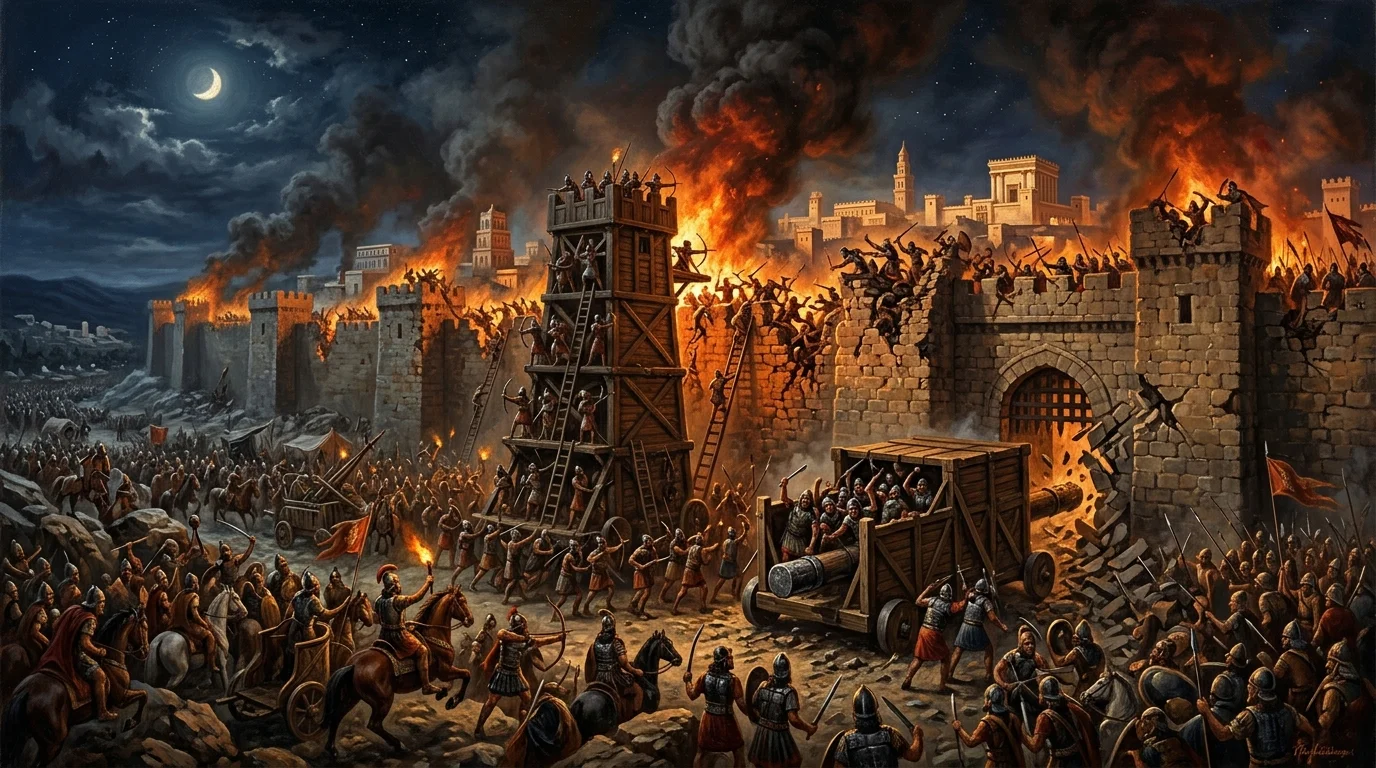
In the ninth year of King Zedekiah’s reign, on the tenth day of the tenth month (January 588 BC), Nebuchadnezzar king of Babylon marched his massive imperial army to Jerusalem and laid siege to it. Huge earthen siege ramps, battering towers, and iron weaponry encircled the holy city, completely cutting off all food, water, and supply lines.
For eighteen grueling months, the inhabitants of Jerusalem endured unimaginable horrors. The book of Lamentations describes the agony: mothers weeping over starving infants, noble youths black as soot begging for bread, and elders sitting in dust covered with sackcloth. By the summer of 586 BC, famine crushed the city so severely that there was no bread left for the soldiers or citizens. The defenders grew so weak from hunger that they could barely lift their spears on the battlements.
2. The Breach of the Wall and the Tragic Fate of King Zedekiah
On the ninth day of the fourth month (Tammuz), the Babylonian siege engines finally smashed through the northern wall of Jerusalem. Babylonian generals entered and sat triumphantly at the Middle Gate.
Seeing the breach, King Zedekiah and his royal bodyguard fled the city under cover of darkness through the gate between the two walls near the king's garden, escaping toward the Jordan Valley. But the Babylonian cavalry pursued and overtook Zedekiah in the plains of Jericho. His scattered army abandoned him, and the captured king was dragged north to Riblah in Syria before King Nebuchadnezzar.
At Riblah, Nebuchadnezzar pronounced a brutal judgment. He forced Zedekiah to watch his royal sons executed one by one before his very eyes. Immediately afterward, Babylonian executioners gouged out Zedekiah’s eyes, bound him in heavy bronze shackles, and dragged the blinded, childless king in chains to Babylon, where he died in prison—fulfilling Ezekiel 12:13: "I will bring him to Babylon... yet he shall not see it, though he shall die there."
3. The Destruction of Solomon's Temple and City
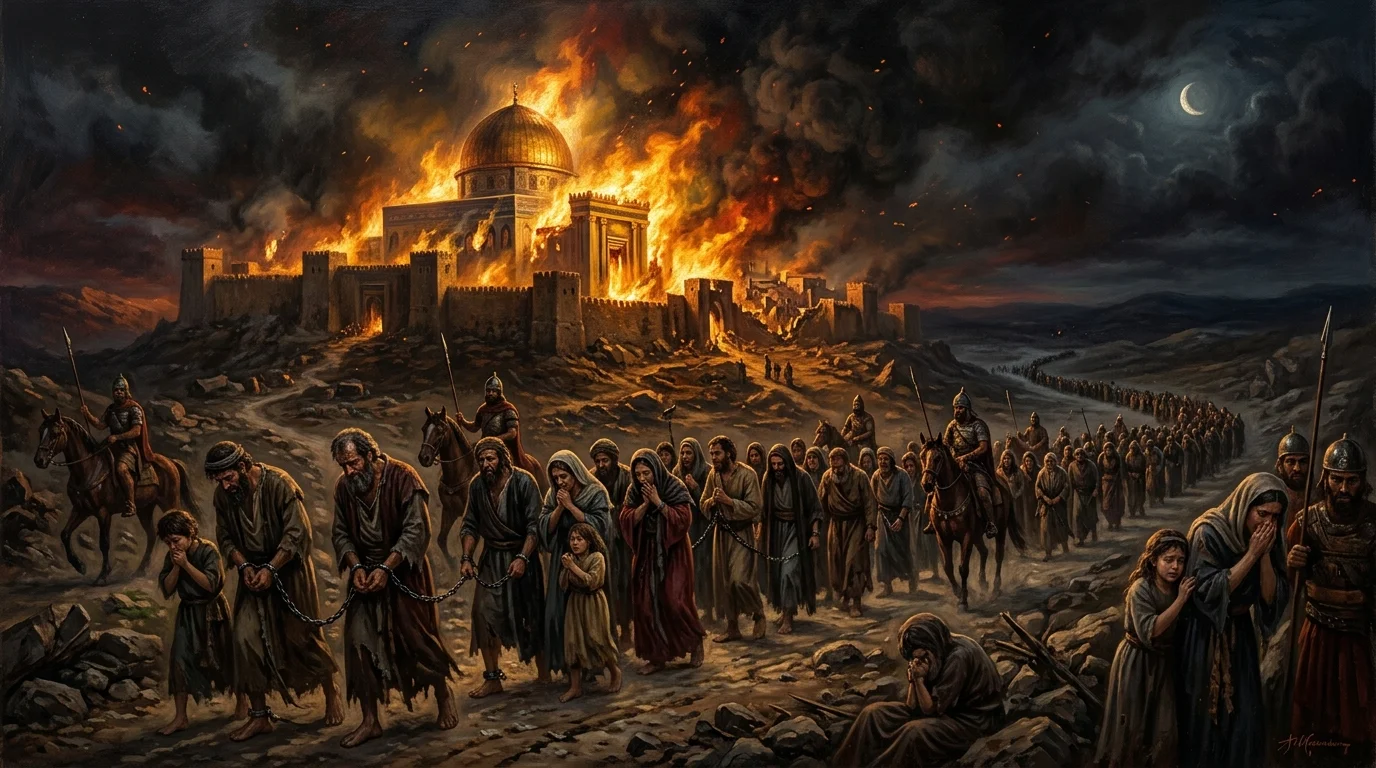 On the 9th of Av, Nebuzaradan burned the magnificent Temple of Solomon, broke down the walls of Jerusalem, and marched the captives into exile.
A month later, on the seventh day of the fifth month (Ab), Nebuzaradan, commander of Nebuchadnezzar's imperial guard, entered Jerusalem with orders of total destruction.
Nebuzaradan set fire to the sacred House of the Lord—Solomon’s Temple, which had stood in golden splendour for nearly four hundred years. The cedar-paneled holy rooms, the veil, and the altars were consumed by roaring flames. The royal palace and all the grand residences of Jerusalem were burned with fire. The Babylonian army tore down the fortified stone walls around Jerusalem until the city was an open, smoking ruin.
The Babylonians dismantled the two colossal bronze pillars (Jachin and Boaz), the giant bronze Sea, and all the sacred golden and silver basins, carrying tons of precious metal back to Babylon. Seraiah the Chief Priest, Zephaniah the second priest, and royal counselors were captured and executed.
4. The 70-Year Babylonian Exile and the Seed of Hope
Nebuzaradan marched the remaining citizens, craftsmen, nobles, and soldiers in long chained columns away from their ancestral homeland toward Babylon, leaving only the poorest of the poor to work the vineyards and plow the fields under the governor Gedaliah.
Yet, in the midst of this catastrophic judgment, God did not abandon His covenant. The 70-year exile was a severe mercy—a divine pruning to purge idolatry forever from the hearts of the Jewish people. As Jeremiah wrote to the exiles: "For I know the thoughts that I think toward you, says the Lord, thoughts of peace and not of evil, to give you a future and a hope." (Jeremiah 29:11). From the ashes of Babylon, a purified remnant would return to rebuild the Temple and prepare the lineage for the Messiah.
5. Archaeological Confirmations of the Fall of Jerusalem
Archaeological excavations in Jerusalem over the past fifty years have revealed dramatic, tangible proof of the Babylonian destruction in 586 BC. In the City of David and the Jewish Quarter of the Old City, archaeologists discovered the famous **"Burnt Room"** and the **"House of Ahiel,"** filled with a thick layer of ash, charred wooden ceiling beams, and scorched reddish limestone walls caused by intense fire.
Among the ash layers, excavators uncovered numerous Babylonian and Judean bronze and iron arrowheads (*Scytho-Iranian trilobate arrowheads*), testifying to the fierce final battle at the northern city fortifications. Furthermore, the discovery of the **Lachish Letters**—ancient ostraca (inscribed pottery shards) written in carbon ink by Judean military commanders shortly before the fall of Jerusalem—records military lookouts watching the signal fires of Lachish and Azekah go dark, precisely as described in Jeremiah 34:7.
6. The 70 Years and the Promise of the New Temple
The tragedy of the Babylonian exile was not the end of God's redemptive timeline. God had specifically designated the duration of the exile as seventy years (Jeremiah 25:11, 29:10) to allow the land of Israel to enjoy the Sabbath rests that the people had neglected for 490 years (2 Chronicles 36:21, Leviticus 26:34-35).
In 538 BC, King Cyrus the Great of Persia captured Babylon and issued his famous royal decree permitting the Jewish exiles to return to Jerusalem under Zerubbabel and Joshua the High Priest to rebuild the Temple of God. This restoration set the stage for the coming of Jesus Christ, who declared Himself to be the ultimate Temple—destroyed on the Cross and raised to life in three days (John 2:19-21).
Spiritual Reflections & Practical Life Application:
- God's Holiness is Uncompromising: Spiritual lineage, church attendance, or external religion cannot replace heartfelt repentance and genuine obedience. God judges sin even among His own people.
- Prophetic Truth Always Comes to Pass: For 40 years Jeremiah was mocked as a doomsday fanatic. But every word he prophesied was fulfilled to the letter. God's Word never fails.
- Discipline is Not Destruction: The Babylonian exile was painful chastening, but it permanently cured Israel of polytheistic idol worship. When God disciplines you, it is for your eternal sanctification (Hebrews 12:6).
- Hope Beyond the Ashes: Even in the darkest national tragedy, God preserves a remnant and guarantees His ultimate redemptive plan through Jesus Christ.
⚡ Fast Facts
- The siege lasted 18 months from 588 to 586 BC under King Nebuchadnezzar
- Solomon's Temple, which stood for nearly 400 years, was completely razed on the 9th of Av (Tisha B'Av)
- King Zedekiah saw his sons slaughtered before his eyes were gouged out at Riblah
- The 70-year exile fulfilled Jeremiah's prophecy to give the land its Sabbath rests
❓ Frequently Asked Questions (FAQs)
2 Chronicles 36:14-16 explains that the leaders, priests, and people polluted the Lord's house with horrific abominations, mocked God's messengers, and despised His words until the wrath of the Lord arose against His people till there was no remedy.
The Ark of the Covenant is never mentioned in the Babylonian plunder lists (Jeremiah 52). Scripture records the bronze pillars and golden vessels being looted, while Jewish tradition holds that Jeremiah or the priests hid the Ark in Mount Nebo or secret subterranean vaults beneath Mount Moriah.
The exile lasted exactly 70 years (from the first deportation in 605 BC to the return decree of Cyrus of Persia in 538/536 BC), fulfilling Jeremiah 25:11-12 and 29:10.