In the entire canon of Scripture, few visions possess the breathtaking power, poetic grandeur, and supernatural hope of Ezekiel’s Valley of Dry Bones. Preaching to a demoralized generation of Jewish exiles sitting weeping by the irrigation canals of Babylon—their temple destroyed, their holy city burned, their Davidic king blinded—God transported His prophet into an expansive cemetery of scattered human skeletons. In that desolate canyon of bleached bones, God demonstrated that no situation is too dead, no hope is too far gone, and no valley is too dry for the resurrecting breath of the Holy Spirit.
1. Transported to the Desolate Valley
The hand of the Lord came upon Ezekiel, and the Spirit of Yahweh carried him out and set him down in the middle of a vast desert valley. As Ezekiel looked around in stunned awe, he realized that the entire canyon floor was carpeted with countless human bones—the grim aftermath of a colossal ancient battle where soldiers had fallen, were left unburied, and were picked clean by vultures and bleached white by the scorching sun.
God led Ezekiel back and forth among the skeletal remains. Scripture emphasizes two profound details: "there were very many on the surface of the valley, and behold, they were very dry." (Ezekiel 37:2). There was not a shred of moisture, marrow, or life remaining. They were completely, irrevocably dead.
Then God asked a question that probed the very limits of human faith: "Son of man, can these bones live?"
From a human, medical, and scientific perspective, the answer was impossible. But Ezekiel possessed deep theological wisdom. Instead of doubting or presuming, the prophet replied with reverent humility: "O Lord God, You know." (Ezekiel 37:3). Ezekiel placed the impossible in the hands of the God who created the universe out of nothing.
2. Prophesying to the Dry Bones: The Rattling Earthquake
God then commanded Ezekiel to do something that seemed completely foolish to human logic: "Prophesy to these bones, and say to them, 'O dry bones, hear the word of the Lord! Thus says the Lord God to these bones: Behold, I will cause breath to enter you, and you shall live. I will put sinews on you, bring flesh upon you, cover you with skin, and put breath in you, and you shall live; then you shall know that I am the Lord.'" (Ezekiel 37:4-6).
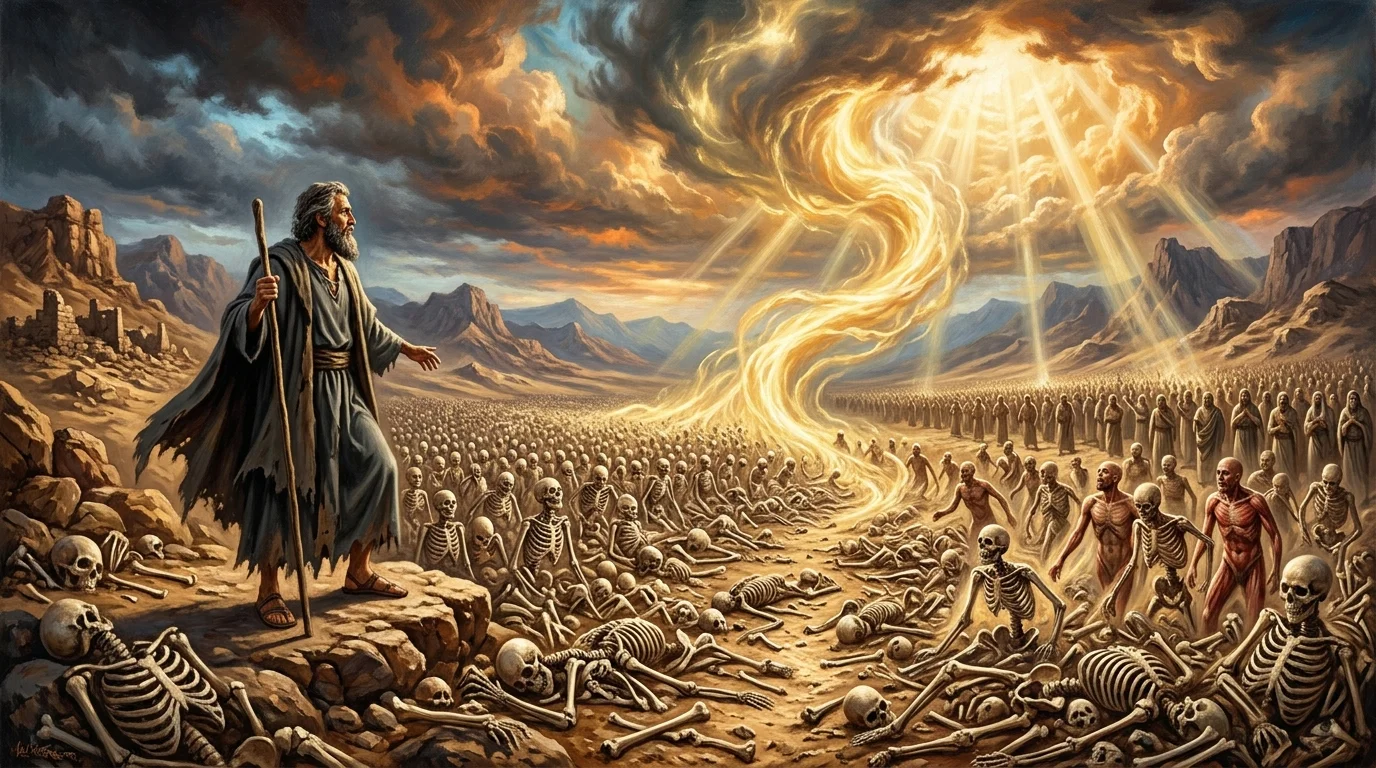
Ezekiel opened his mouth and began to preach to the lifeless skeletons. As the prophetic words echoed off the canyon walls, a sudden, thunderous rattling sound shook the valley! The ground trembled as supernatural power moved across the field.
Before Ezekiel’s astonished eyes, scattered fragments began sliding across the dust, bone seeking out its matching bone. Ankle bones locked into shin bones; femurs snapped into hip sockets; vertebrae aligned into spinal columns; ribcages curved into place; skulls attached to neck joints. Then, glistening white sinews bound the joints together, thick red muscle tissue formed over the skeletons, and smooth skin covered them completely. Thousands of fully formed human bodies lay across the valley floor. Yet, as Ezekiel looked closely, "there was no breath in them."
3. Calling the Four Winds: The Breath of Life
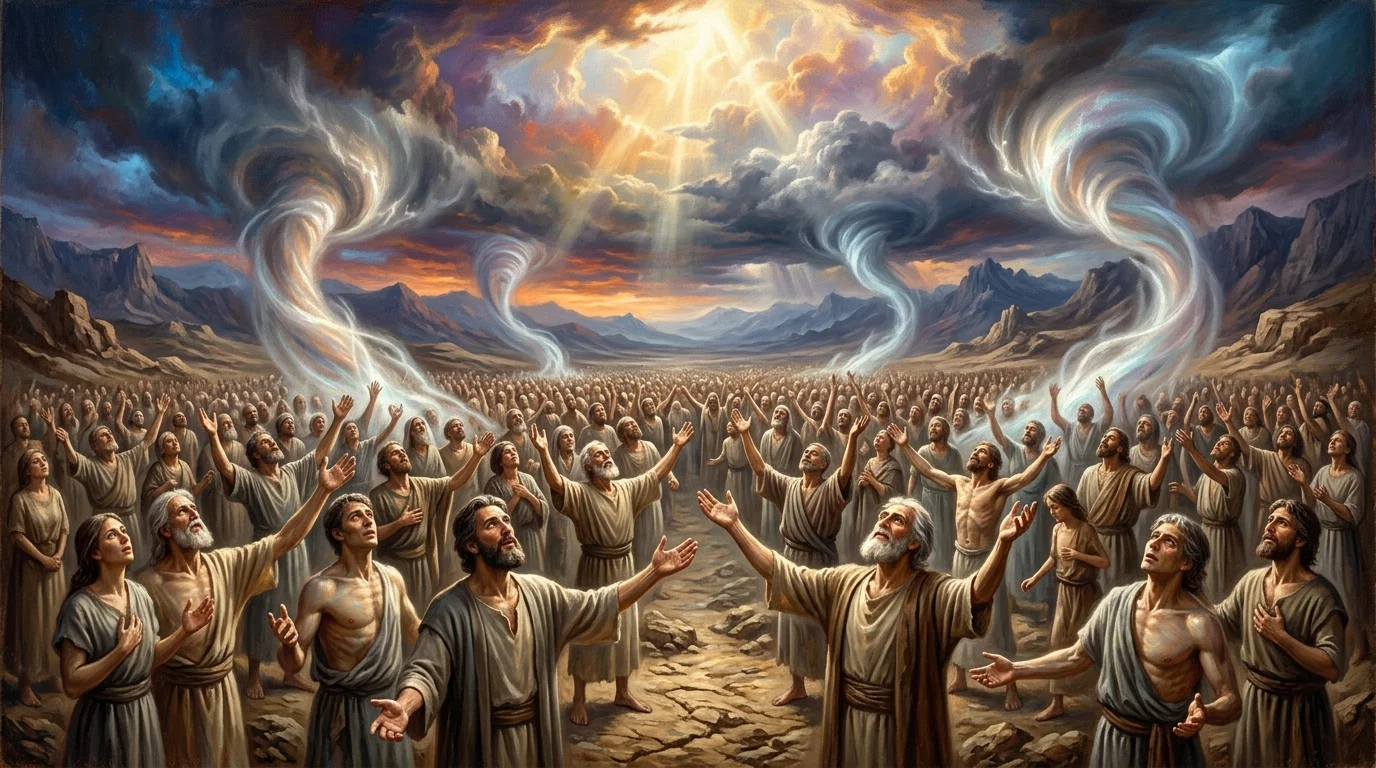 As the four winds of the Holy Spirit breathed into the slain, they came alive and stood on their feet—an exceedingly great army.
Physical form without the Spirit of God is only a corpse. God gave Ezekiel a second, higher command: "Prophesy to the breath; prophesy, son of man, and say to the breath, 'Thus says the Lord God: Come from the four winds, O breath, and breathe on these slain, that they may live!'" (Ezekiel 37:9).
In Hebrew, the word used here is Ruach—a rich, multifaceted term that means wind, breath, and Holy Spirit. Ezekiel prophesied as he was commanded.
Suddenly, a mighty divine gale swept through the valley from the north, south, east, and west. The heavenly Ruach rushed into the nostrils of the corpses. Chests began to rise and fall. Eyes opened wide, blinking in the radiant sunlight. Blood pulsed through restored veins. The multitude stood up upon their feet—"an exceedingly great army!" (Ezekiel 37:10). Where a field of decaying death had laid minutes earlier, now stood a living, breathing, organized army of praise to the Almighty.
4. The Meaning of the Vision: Israel Restored & Resurrection Hope
God immediately interpreted the vision for Ezekiel and for every believer across time:
"Son of man, these bones are the whole house of Israel. They indeed say, 'Our bones are dry, our hope is lost, and we ourselves are cut off!' Therefore prophesy and say to them, 'Thus says the Lord God: Behold, O My people, I will open your graves and cause you to come up from your graves, and bring you into the land of Israel... I will put My Spirit in you, and you shall live.'" (Ezekiel 37:11-12, 14).
The dry bones represented Israel in Babylonian exile, viewing themselves as dead with no future. God proved that His covenant promises cannot be buried in an exile's grave. Historically, this prophesied the return of the Jewish remnant under Zerubbabel, Ezra, and Nehemiah. Prophetically and spiritually, it points to the New Covenant where the Holy Spirit regenerates dead sinners (Ephesians 2:1-5) and guarantees the physical resurrection of all believers at the return of Jesus Christ.
5. The Two-Stage Miracle: Structure Precedes Life
A careful theological reading of Ezekiel 37 reveals a profound two-stage miraculous progression. In the first phase (Ezekiel 37:7-8), God caused the physical anatomy to assemble—bone connected to bone, sinews bound the skeleton, muscle tissue formed, and skin covered the corpses. Yet Scripture explicitly notes: *"but there was no breath in them."*
Only in the second phase (Ezekiel 37:9-10), when Ezekiel prophesied to the *Ruach* (the Holy Spirit), did divine life enter the slain and cause them to stand. This teaches a vital spiritual principle: physical organization, doctrinal structure, church buildings, and religious programs are essential frameworks, but without the supernatural power and breath of the Holy Spirit, they remain only organized corpses. We need both the Word (truth/structure) and the Spirit (breath/power) to experience true spiritual awakening.
6. The Prophetic Timeline: Israel’s Rebirth and the Valley Today
The vision of the dry bones possesses layered prophetic fulfillments. Historically, it began with the return of the Jewish exiles under Cyrus. In modern history, following the unspeakable horrors of the Holocaust where six million Jewish lives were reduced to ashes and bones, the miraculous rebirth of the nation of Israel in 1948 stood as a breathtaking fulfillment of dry bones returning to their land.
Yet the ultimate fulfillment awaits the spiritual regeneration of Israel when they look upon Him whom they pierced (Zechariah 12:10, Romans 11:26), and the final glorious resurrection when Christ returns and calls all saints from their graves to reign with Him in the New Jerusalem.
Spiritual Reflections & Practical Life Application:
- No Situation is Beyond God's Resurrection Power: When your marriage, finances, health, or spiritual passion feels completely dry and lifeless, remember the valley. God specializes in resurrecting dead things.
- The Power of Proclaiming God's Word: When Ezekiel spoke God's Word, bones came together. We must speak Scripture, not human despair, into the dead areas of our lives.
- We Need the Holy Spirit (Ruach): Religious structure, good intentions, and external forms are powerless without the breath of the Holy Spirit. Pray daily for the Spirit to breathe life into your soul and church.
- Resurrection Hope in Christ: Jesus declared: "I am the resurrection and the life. He who believes in Me, though he may die, he shall live." (John 11:25). Our ultimate victory is guaranteed through the risen King.
⚡ Fast Facts
- Ezekiel was a priest-prophet ministering to the Jewish exiles by the River Chebar in Babylon
- The dry bones represented the spiritually dead and hopeless 'whole house of Israel'
- Two-stage miracle: first physical structure (bones, sinews, skin), then spiritual life (Ruach/Breath)
- Prophetic picture of Israel's national restoration and the ultimate resurrection in Christ
❓ Frequently Asked Questions (FAQs)
Ezekiel 37:11 explains: 'These bones are the whole house of Israel. They say, "Our bones are dried up, our hope is lost; we are completely cut off!"' It symbolized a nation crushed by exile, with no human hope of revival.
The Hebrew word 'Ruach' means wind, breath, and Spirit. Just as God breathed the breath of life into Adam at creation (Genesis 2:7), the Holy Spirit (Ruach) breathes supernatural resurrection life into dead souls.
This vision foreshadows the New Covenant promise of Ezekiel 36 (a new heart and a new Spirit) and Jesus Christ's power as the Resurrection and the Life, raising spiritually dead sinners and promising the final physical resurrection of all believers.