The massive stone gates of Jericho were barred, bolted, and reinforced with heavy bands of bronze. Within the towering ramparts, an eerie, suffocating silence gripped the pagan stronghold. For forty years, the terrifying reports of Yahweh's wonders had echoed through the desert caravans—tales of the Red Sea split in two, the miraculous defeat of the Amorite kings Sihon and Og, and now, the supernatural drying up of the flooded Jordan River right before their eyes. The Canaanite inhabitants were paralyzed with dread. Scripture records with solemn brevity: "Now Jericho was securely shut up because of the children of Israel; none went out, and none came in" (Joshua 6:1). The double-rampart fortress—an imposing cyclopean stone retaining wall surmounted by thick red mudbrick parapets—seemed entirely impregnable to human assault.
A short distance from the Hebrew encampment at Gilgal, Joshua walked alone across the dusty plain, surveying the intimidating fortifications of the city. As he lifted his eyes, the commander of Israel was startled by a breathtaking vision: a towering warrior stood directly in his path, His unsheathed sword gleaming in the Mediterranean sun. Undaunted, Joshua strode forward and challenged the stranger: "Are you for us or for our adversaries?" (Joshua 5:13). The warrior's reply dismantled all human presumption with a single word: "No! But as Commander of the army of Yahweh (Sar-Tzeva Yahweh) I have now come" (Joshua 5:14).
In that electrifying moment, Joshua realized he was not addressing a mortal mercenary or an ordinary angel. This was the pre-incarnate Son of God—a Christophany of the Almighty Sovereign of heaven's armies! Instantly, Joshua fell on his face to the earth in trembling worship, crying, "What does my Lord say to His servant?" The divine Commander replied with the exact words Yahweh had spoken to Moses from the burning bush at Horeb: "Take your sandal off your foot, for the place where you stand is holy" (Joshua 5:15). God did not come to take sides in human conflicts; He came to take over. The conquest of Canaan was not Israel's political war; it was Yahweh's holy campaign against cosmic darkness.
Then, the Commander revealed a battle plan that defied every established doctrine of ancient siegecraft. Instead of constructing earthen assault ramps, assembling timber siege towers, or battering the bronze-plated gates, Israel was ordered to execute a sacred liturgical march. For six consecutive days, the armed men of Israel were to march around the circumference of Jericho once per day. In their midst, seven priests bearing seven ram's horn trumpets (*shofar ha-yovelim*) were to precede the golden Ark of the Covenant, the physical footstool of Yahweh's presence. Most astonishing of all was the command of absolute vocal silence: "You shall not shout or cause your voice to be heard, neither shall a word proceed out of your mouth, until the day I say to you, 'Shout!' Then you shall shout" (Joshua 6:10).
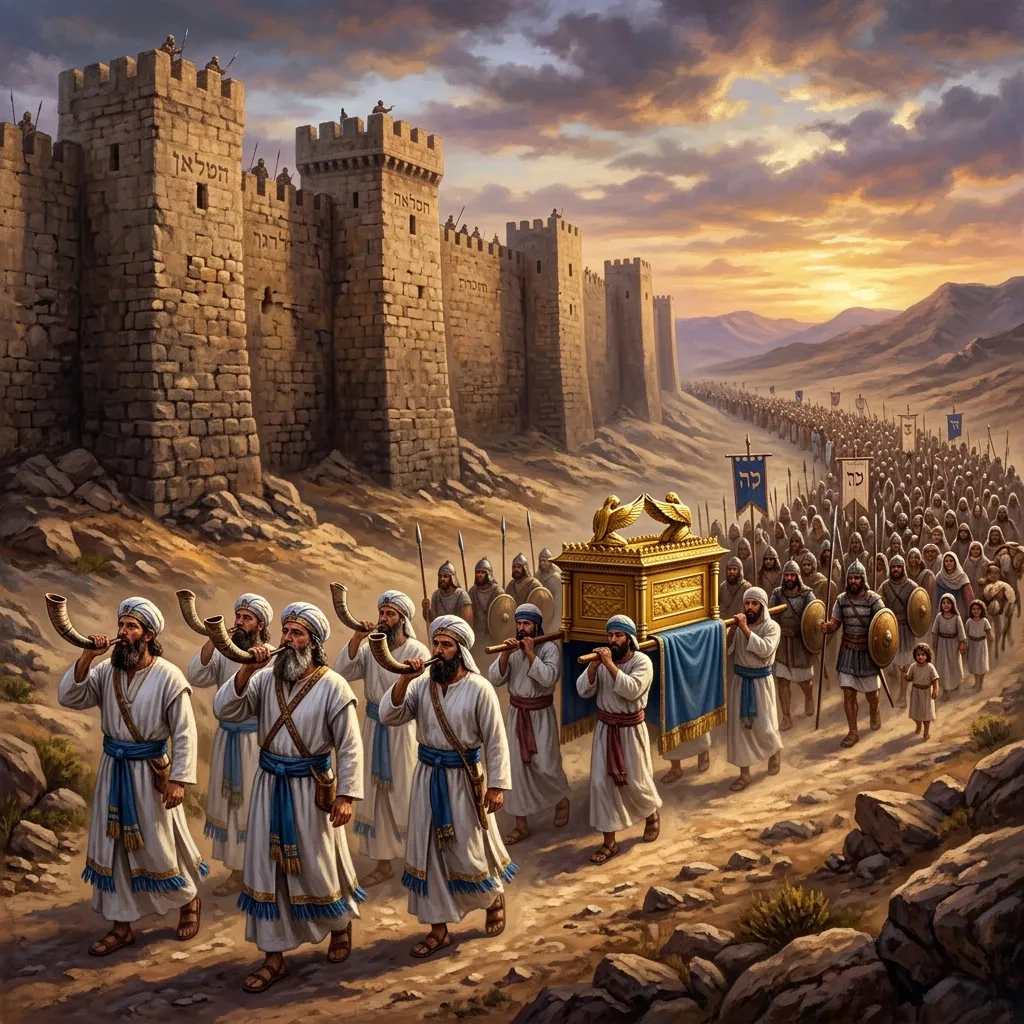
For six agonizing days, the bizarre procession unfolded before the bewildered eyes of Jericho's garrison. Each morning, the armed vanguard marched past the walls, followed by the seven white-robed priests blowing their curved ram's horns in persistent, wailing blasts. Behind them came the golden Ark carried on the shoulders of the Levites, followed by the rearguard of all Israel. Not a sword was swung; not an arrow was notched; not a single battle cry was uttered. The only sound echoing off the limestone cliffs was the rhythmic crunch of sandals on gravel and the piercing, supernatural drone of the rams' horns. To the proud sentries watching from the parapets, it appeared as the height of military folly. Yet in the spiritual realm, each silent circuit was binding the demonic powers of Canaan and tightening the divine noose of judgment around the doomed city.
On the seventh day, the camp of Israel stirred before the first rays of dawn. Rising at daybreak, the holy army began its march with intensified urgency. On this sacred Sabbath of judgment, they did not circle the fortress once, but seven consecutive times. As the scorching midday sun beat down upon the seventh circuit, the entire nation reached the climax of faith. Joshua raised his staff and commanded the two million Hebrews with a thunderous roar: "Shout, for Yahweh has given you the city!" (Joshua 6:16).
Joshua issued the inviolable decree of the firstfruits: "Now the city shall be devoted to destruction (cherem), it and all that is in it, to Yahweh. Only Rahab the harlot shall live, she and all who are with her in the house, because she hid the messengers that we sent. And you, by all means keep yourselves from the accursed things, lest you become accursed when you take of the accursed things, and make the camp of Israel a curse, and trouble it. But all the silver and gold, and vessels of bronze and iron, are consecrated to Yahweh; they shall come into the treasury of Yahweh" (Joshua 6:17–19).
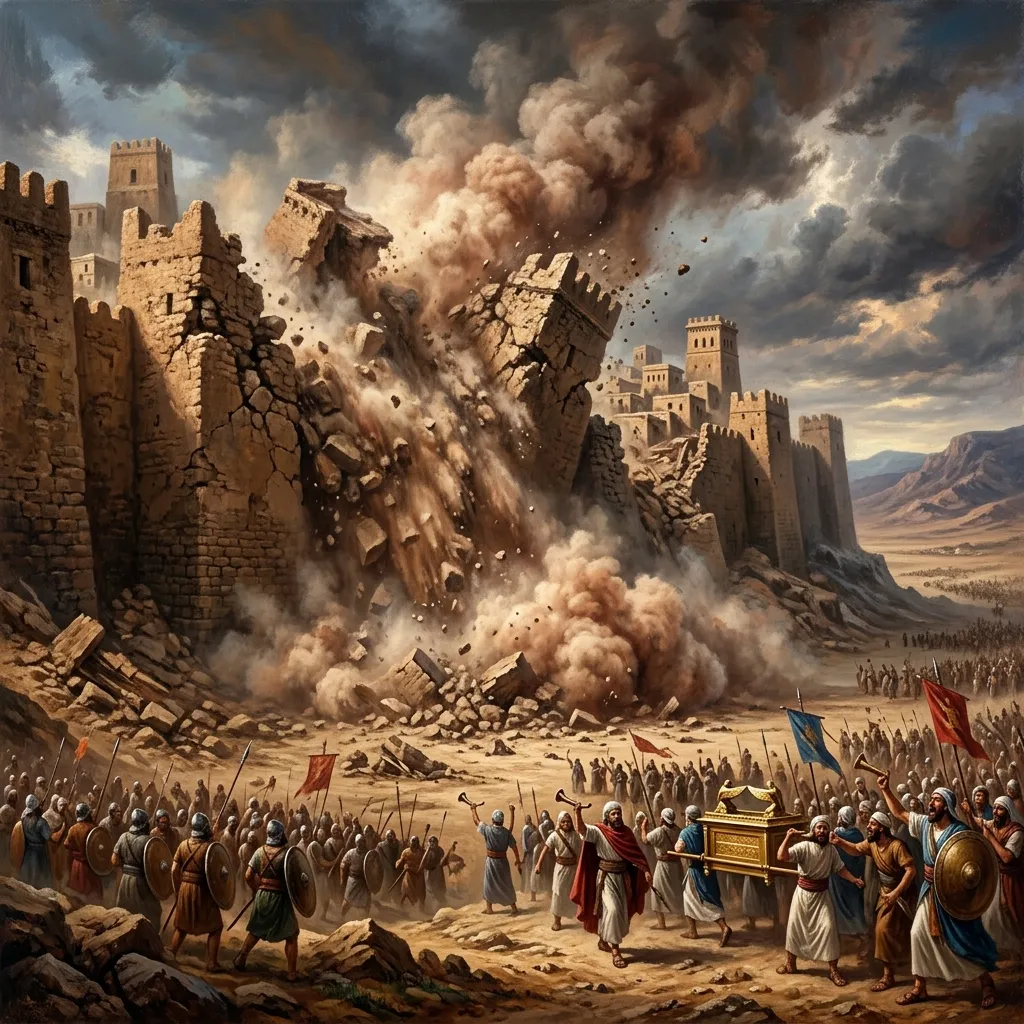
Then came the cosmic eruption. The seven priests filled their lungs and blew a prolonged, deafening blast upon the jubilee trumpets. At the sound of the horn, the gathered millions of Israel unleashed a unified, earth-shaking shout (*teruah*)! The ground trembled beneath an invisible seismic shockwave. Scripture records the miracle with anatomical precision: "The wall fell down flat (naflah tahteyha—collapsed beneath itself), then the people went up into the city, every man straight before him, and they took the city" (Joshua 6:20).
Modern archaeological excavations at Tell es-Sultan confirm that the towering red mudbrick ramparts collapsed outward, tumbling down the face of the stone retaining wall to form a continuous ramp of broken masonry, allowing the Hebrew warriors to charge directly upward into the citadel without siege ladders. Every section of the colossal perimeter crashed into ruin—except for one solitary, miraculous segment of the northern wall where the house of Rahab stood with the scarlet cord fluttering from her window!
Joshua immediately honored the sacred oath sworn by the two spies. The young scouts sprinted into the dust-choked ruins, found Rahab's house completely intact, and brought out Rahab, her father, her mother, her brothers, and all her family, leading them safely outside the camp of Israel. Then, the army of Yahweh put the entire city to the torch. Jars filled with spring harvest grain, wooden beams, and pagan palaces were reduced to a one-meter layer of glowing ash, rising as a burnt offering of firstfruits unto the Lord. The silver, gold, bronze, and iron were gathered into the sacred sanctuary treasury, consecrating the foundation of Canaan's conquest to the God of heaven.
Joshua then pronounced a prophetic curse upon the ruins: "Cursed be the man before Yahweh who rises up and builds this city Jericho; he shall lay its foundation with his firstborn, and with his youngest he shall set up its gates" (Joshua 6:26)—a curse fulfilled five centuries later when Hiel of Bethel rebuilt Jericho during the apostate reign of Ahab, losing his eldest son Abiram and his youngest son Segub (1 Kings 16:34).
The fall of Jericho stands forever as an eternal monument of redemptive history: human fortresses crumble not by human might or military genius, but by absolute obedience and expectant faith in the Word of God. Through seven days of patient, silent walking with the Ark, God demonstrated that when His people consecrate themselves and lift the shout of faith, every demonic wall in their path must violently collapse before the King of Kings!
Biblical Keywords & Theological Roots
Commander / Captain of the Host of Yahweh; the pre-incarnate appearance of the Son of God (Christophany) standing as supreme general of heaven's armies.
Trumpets of rams' horns / jubilee trumpets; ritual instruments blown by priests to declare divine presence, sacred jubilation, and holy warfare.
Devoted thing, sacred ban, utterly consecrated to destruction; placing the firstfruits of Canaan irrevocably into Yahweh's treasury and altar.
A shout, clamor, blast of joy, war-cry of victory; the unified vocal eruption of faith that preceded and triggered the supernatural collapse of the walls.
To fall down, be cast down, collapse flat; used with *tahteyha* in Joshua 6:5 to describe the miraculous downward failure of the stone and brick ramparts.
Ancient Near Eastern & Archaeological Context
Ancient Jericho (Tell es-Sultan) was an imposing Late Bronze Age citadel commanding the spring of Ain es-Sultan and guarding the main approach into the central Judean hill country. Archaeological excavations directed by John Garstang (1930–1936), Dame Kathleen Kenyon (1952–1958), and re-analyzed by Dr. Bryant Wood provide striking physical corroboration of the biblical narrative. The city was fortified with a formidable double-rampart system: a lower cyclopean stone retaining wall (12–15 feet high) surmounted by an exterior red mudbrick wall (6–8 feet thick and approximately 20 feet high), followed by an inner retaining scarp rising to an upper mudbrick defensive wall. Kenyon's trench excavations revealed that when the fortification collapsed, the red mudbricks of the upper and lower walls did not fall inward into the city, but tumbled outward and downward to the base of the stone retaining wall, piling up into a continuous debris ramp that enabled attackers to charge straight up into the fortress ('every man straight before him,' Joshua 6:20). Stratigraphically above the collapsed bricks lies a dense, one-meter-thick burn layer composed of ash, reddened debris, and charred roof beams, alongside dozens of large ceramic storage jars filled to the brim with carbonized, uneaten grain. This archaeological profile confirms three crucial biblical facts: the siege took place in the springtime shortly after the barley harvest (when grain jars were full), the siege was exceptionally brief (lasting only seven days, leaving the food supplies intact), and the invading army did not plunder the grain or domestic goods, fulfilling the strict covenant command that the city was *cherem*—devoted entirely to destruction by fire unto Yahweh (Joshua 6:24).
Practical Discipleship & Spiritual Application
- God Does Not Take Sides; He Takes Over: When Joshua confronted the armed warrior outside Jericho and asked, 'Are you for us or for our adversaries?' the Commander replied with an emphatic 'No! But as Commander of Yahweh's army I have now come.' We must never treat God as a cosmic mascot recruited to endorse our personal ambitions or political agendas. The only appropriate response before Jesus Christ is to fall face down, surrender our plans, and align ourselves unconditionally with His sovereign kingdom.
- God's Battle Plans Defy Worldly Logic to Exalt Faith: To march around a fortified stone citadel in dead silence for six days, blowing rams' horns rather than swinging battering rams, appeared militarily absurd. Yet Hebrews 11:30 testifies: 'By faith the walls of Jericho fell down after they were encircled for seven days.' God intentionally chooses methods that confound worldly wisdom (1 Corinthians 1:27) so that the glory for our breakthroughs belongs entirely to Him.
- The Principle of the Firstfruits Belongs Solely to Yahweh: Jericho was the very first fortified stronghold conquered in Canaan. God placed it under *cherem*—all silver, gold, bronze, and iron went into the treasury of the Lord, while the city was burned. When God gives us breakthrough, the 'firstfruits' of our increase, time, and talent belong exclusively to Him. Honoring God with our firstfruits unlocks divine blessing upon all subsequent endeavors.
- An Island of Mercy Amidst the Sea of Judgment: When the colossal walls of Jericho violently collapsed into dust, one solitary section of the outer rampart remained standing: the house of Rahab marked by the scarlet cord. Even in the midst of overwhelming divine wrath against wickedness, God preserves an impregnable sanctuary of mercy for any sinner who seeks refuge under the covenant blood of Jesus Christ.
⚡ Fast Facts
- Seven priests bearing seven trumpets of rams' horns (*shofrot hayovelim*) marched continuously before the Ark of the Covenant throughout the seven-day encirclement (Joshua 6:4).
- For six consecutive days, Israel encircled the perimeter of Jericho once per day in absolute vocal silence, with only the piercing blasts of the rams' horns echoing against the walls (Joshua 6:3, 10).
- On the seventh day, the army rose at the dawning of the day and encircled the city seven times; at the seventh circuit, the priests blew a prolonged blast and the people shouted with a great shout (Joshua 6:15–16).
- Joshua placed a prophetic curse upon anyone who would rebuild the fortified city of Jericho, which was fulfilled 500 years later during Ahab's reign when Hiel of Bethel rebuilt it at the cost of his sons' lives (Joshua 6:26; 1 Kings 16:34).
❓ Frequently Asked Questions (FAQs)
The figure who appeared to Joshua in Joshua 5:13–15 was not an ordinary created angel, but a pre-incarnate appearance of the Son of God, known theologically as a Christophany or Theophany. Several decisive textual proofs demonstrate His absolute deity. First, when Joshua fell on his face to the earth and worshiped, the Commander received his adoration without rebuke. In contrast, whenever humans attempt to worship created angels in Scripture, the angels immediately forbid it with horror, saying, 'See that you do not do that! For I am your fellow servant... Worship God!' (Revelation 19:10; 22:8–9). Second, the Commander issues the exact same divine decree that Yahweh spoke to Moses out of the burning bush: 'Take your sandal off your foot, for the place where you stand is holy' (Joshua 5:15; Exodus 3:5). No mere angel makes ground holy; holiness is generated solely by the presence of the self-existent God. Third, in Joshua 6:2, the narrative seamlessly transitions to identify this speaker as 'Yahweh' Himself: 'And Yahweh said to Joshua: "See! I have given Jericho into your hand..."' Christ appeared to Joshua with His sword unsheathed, not as a heavenly subordinate, but as the supreme Commander of the armies of heaven, demonstrating that the conquest of Canaan was not an ethnic land-grab by Israel, but a holy war executed by God Himself.
The excavations at Tell es-Sultan (ancient Jericho) provide an astonishing series of physical synchronisms with Joshua chapter 6. Excavations by John Garstang in the 1930s and Dame Kathleen Kenyon in the 1950s—re-evaluated in the 1990s by Near Eastern archaeologist Dr. Bryant Wood—revealed that Jericho was fortified by a lower retaining wall of cyclopean stones, above which stood an exterior mudbrick wall six feet thick, backed by an inner upper wall. Kenyon found that when the city fell, the red mudbricks of the walls collapsed outward, falling down to the base of the retaining wall and forming a continuous sloped pile of rubble. This matches Joshua 6:20 perfectly, which states that 'the wall fell down flat [literally 'under itself'], then the people went up into the city, every man straight before him.' Furthermore, excavators uncovered a comprehensive destruction layer approximately one meter deep, characterized by heavy ash, collapsed roof timbers, and reddened debris, proving the city was intentionally put to the torch (Joshua 6:24). Most remarkably, German and British excavations discovered dozens of large earthenware jars full of charred grain in the domestic rooms. Under normal Ancient Near Eastern siege conditions, a besieged city would consume all stored grain during a prolonged blockade lasting months or years; or if the city was sacked, the invading army would eagerly plunder the precious grain. The presence of uneaten, burnt grain proves that the siege took place in springtime just after the barley harvest (corroborating Joshua 3:15; 5:10), that the siege was exceptionally brief (lasting only seven days), and that the Israelites refused to touch the food supplies because the entire city was under the sacred ban (*cherem*).
The divine decree placing Jericho under *cherem* (the sacred ban or total devotion to destruction, Joshua 6:17–19) was grounded in two profound spiritual and theological principles: the law of firstfruits and the execution of divine judgment. First, Jericho was the very first fortified city conquered by Israel in the Promised Land. Under the Mosaic covenant, the firstfruits of every harvest, the firstborn of flocks, and the primary increase of the land belonged exclusively to Yahweh (Exodus 23:19; Proverbs 3:9). By completely devoting Jericho to the Lord—burning the city and placing all precious metals (gold, silver, bronze, iron) into the sacred sanctuary treasury—Israel acknowledged that the entire land of Canaan belonged to God, and that victory was entirely His gift. Second, the destruction of Jericho was the execution of holy judicial sentencing against Canaanite society. In Genesis 15:16, God had told Abraham that his descendants would wait four hundred years in Egypt because 'the iniquity of the Amorites is not yet complete.' For over four centuries, Canaan had practiced institutionalized sexual depravity, temple prostitution, incest, bestiality, and systemic child sacrifice (burning infants alive to Molech, Leviticus 18:24–30; Deuteronomy 12:31). God used Israel as His judicial instrument to purge this demonic cancer from the earth. By forbidding personal looting, God ensured that Israel was not fighting as mercenary plunderers seeking gold, but as a consecrated priestly army executing divine justice.