The prophetic ministry that had shaken kings, silenced pagan storm-gods on Mount Carmel, and survived the lonely wilderness of Horeb was drawing to its triumphant culmination. The appointed hour had arrived in the eternal counsel of God when Yahweh would take Elijah the Tishbite up to heaven in a whirlwind. Yet the great prophet did not slip away in private seclusion; he embarked upon a deliberate, symbolic farewell circuit through the ancient covenant sanctuaries of Israel, accompanied by his devoted disciple and successor, Elisha the son of Shaphat.
Their journey began at Gilgal—the ancient gathering place near Shiloh where the prophetic guild was trained. Looking at his faithful apprentice, Elijah issued a quiet test of spiritual endurance: "Stay here, please, for Yahweh has sent me as far as Bethel."
Elisha looked his spiritual father in the eyes. He knew what was coming. The atmosphere was pregnant with eternity. Elisha bound himself to the aging prophet with a solemn, double-sealed oath: חַי־יְהוָה וְחֵי־נַפְשְׁךָ אִם־אֶעֶזְבֶךָּ—"As Yahweh lives, and as you yourself live, I will not leave you!"
The Sacred Farewell Circuit: Bethel, Jericho, and the Jordan
They descended southward to Bethel, the sacred site where Jacob had seen the ladder extending into heaven. There, the sons of the prophets—the young disciples training in the prophetic school—rushed out to meet them. Pulling Elisha aside into the shadows, they whispered with trembling urgency: "Do you know that today Yahweh will take away your master from over your head?"
Elisha silenced their speculative chatter with firm, holy composure: "Yes, I know it; keep quiet!" He did not need their theoretical theology; his eyes were fixed upon his master.
At Bethel, Elijah tested him a second time: "Elisha, stay here, please, for Yahweh has sent me to Jericho." Again, Elisha repeated his unwavering covenant vow: "As Yahweh lives, and as you yourself live, I will not leave you!"
They descended the steep, winding canyon from the Judean hills down to the oasis of Jericho, nestled in the deep Jordan rift valley. Once more, the resident company of the sons of the prophets confronted Elisha with the same piercing question: "Do you know that today Yahweh will take away your master from over your head?" Once more Elisha answered: "Yes, I know it; keep quiet!"
For the third time, Elijah said to him: "Stay here, please, for Yahweh has sent me to the Jordan." And for the third time, with unbroken resolve, Elisha answered: "As Yahweh lives, and as you yourself live, I will not leave you!"
The Parting of the Jordan
The two men walked together toward the roaring waters of the Jordan River. Behind them, fifty sturdy young men from the prophetic guild followed at a respectful distance and stood on the bluffs of Jericho, watching across the floodplains to see how the ministry of Elijah would conclude.
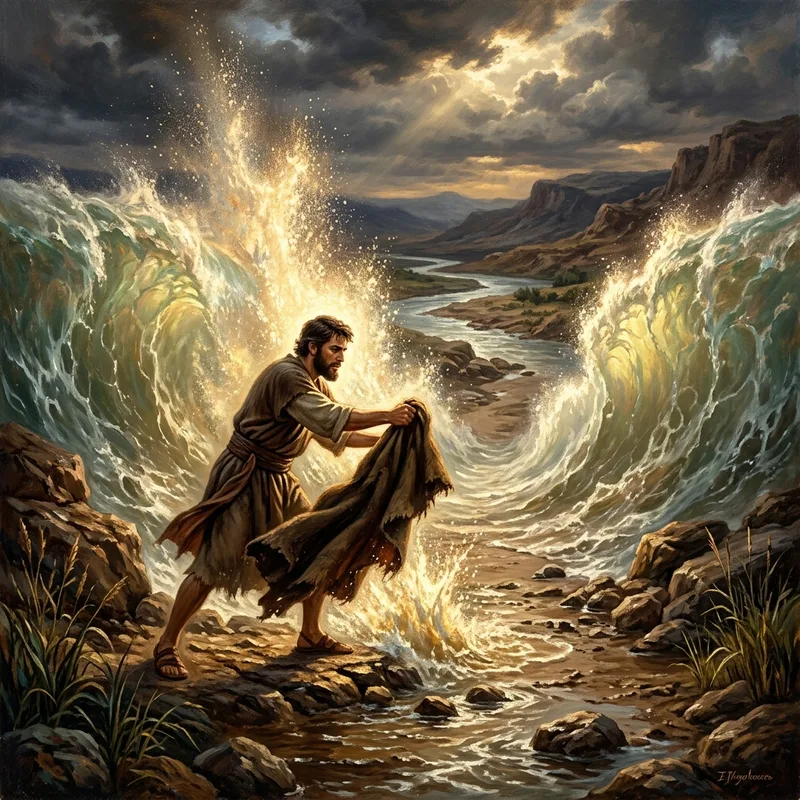
The Jordan in the spring season was swollen and impassable. Elijah stopped at the water's edge. Reaching to his shoulders, he took off his iconic mantle (אַדֶּרֶת - Adderet)—the hairy cloak of rough animal skin that had symbolized divine authority throughout his stormy career. He rolled the mantle tightly into a cylinder like a rod and struck the surface of the river.
Instantly, the surging waters divided to the right and to the left! Just as the Red Sea had parted before the staff of Moses, and the Jordan had stopped before the Ark under Joshua, the river obeyed the prophetic mantle of Yahweh. Elijah and Elisha walked across the riverbed on dry ground, stepping out onto the eastern wilderness plains of Moab—the very sacred territory where Moses had delivered his final farewell and disappeared into the hand of God on Mount Nebo.
The Request for the Firstborn Inheritance
As they walked across the arid plains of the Transjordan, the shadow of eternity fell between them. Elijah turned to his apprentice and asked with deep tenderness: "Ask what I shall do for you, before I am taken from you."
Elisha did not ask for wealth, political influence, long life, or exemption from persecution. He knew the immense, terrifying spiritual darkness that covered Israel; he knew that Jezebel still reigned, that the Baal cult still infected the northern towns, and that Ahab's sons sat upon the throne. A normal measure of grace would never suffice. Drawing upon the ancient covenant jurisprudence of Deuteronomy 21:17, Elisha made his audacious request:
"Please let a double portion (פִּי־שְׁנַיִם - Pi-Shenayim) of your spirit be upon me!"
In Israelite law, the 'double portion' was not an arrogant demand to possess twice as much spiritual power as his master. It was the technical legal phrase for the inheritance of the firstborn son. Amidst the fifty sons of the prophets watching from the cliffs, Elisha was asking to be recognized as Elijah's spiritual firstborn—to receive the headship of the prophetic movement and the spiritual capacity to finish the work Elijah had begun.
Elijah looked at him with solemn awe: "You have asked a hard thing. Yet, if you see me as I am being taken from you, it shall be so for you; but if you do not see me, it shall not be so." Spiritual succession could not be manufactured by human ceremony or committee vote; it was a sovereign gift bestowed directly by the God of heaven, sealed only if Elisha possessed the spiritual eyes to behold the veil of the unseen world torn open.
The Chariot of Fire and the Whirlwind
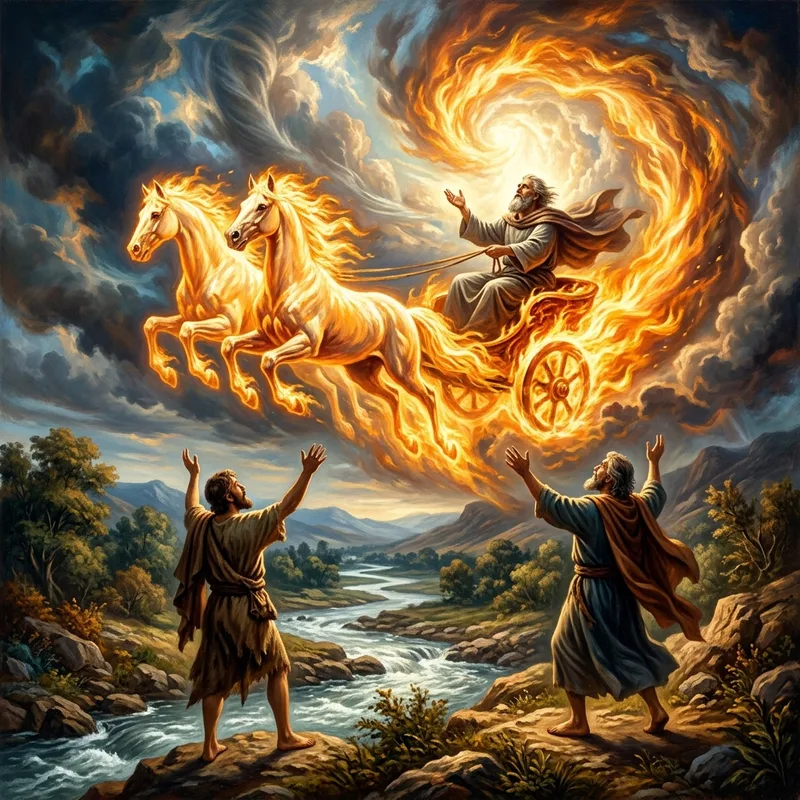
As they continued walking and talking across the wilderness, the sky above the hills of Gilead suddenly detonated with supernatural radiance. Blazing through the atmosphere descended the celestial vanguard of the Lord of Hosts: רֶכֶב אֵשׁ וְסוּסֵי אֵשׁ (Rekhev Esh ve-Susei Esh)—a chariot of fire and horses of fire!
The heavenly war-chariot blazed between them with blinding speed, physically separating the two men. In that terrifying, glorious moment, a roaring whirlwind of divine power (סְעָרָה - Se'arah) engulfed Elijah. Caught up into the fiery vortex, the great prophet was lifted bodily from the earth, carried directly into the presence of God without tasting the sting of death.
Elisha stood transfixed, his eyes wide with holy terror and awe. He saw it! Gazing into the ascending cataract of flame and wind, Elisha cried out with an agonizing, triumphant shout that echoed across the desert canyons:
אָבִי אָבִי רֶכֶב יִשְׂרָאֵל וּפָרָשָׁיו!
"My father, my father! The chariot of Israel and its horsemen!"
Elisha recognized the profound theological truth: the true security, military firepower, and defense of Israel had never resided in Ahab's iron chariots or mercenary cavalry; it resided in the solitary, praying prophet of the living God. And now, the father of Israel's prophets was gone.
The Fallen Mantle and the Jordan Re-Divided
As the fiery vortex vanished into the sapphire expanse of the heavens, Elijah was seen no more. In his overwhelming grief, Elisha seized his own clothes and tore them from top to bottom into two ragged pieces.
Then he looked down. There upon the dusty soil of Moab lay Elijah's mantle—the coarse animal-skin cloak that had fallen from the prophet as he ascended into glory. It had not burned; it was not singed. It was the tangible seal that God had granted Elisha's petition for the double portion.
Elisha bent down, picked up the fallen mantle, and draped it over his shoulders. Walking back to the western bank of the Jordan, he stood solitary before the rushing current. He held the mantle in his hands, rolled it up just as Elijah had done, and struck the water, crying out in desperate, audacious faith:
"Where is Yahweh, the God of Elijah?"
The question was not an expression of doubt, but a demand of covenant faith. When he struck the water, the Jordan parted instantly to the right and to the left! Elisha crossed over on dry ground.
From the heights of Jericho, the fifty sons of the prophets watched in stunned amazement as the river divided before the younger man. Rushing down to meet him, they threw themselves prostrate on the ground before Elisha, acknowledging the divine succession: "The spirit of Elijah rests on Elisha!" Though the mortal prophet had ascended into glory, the eternal God of Elijah remained alive, ready to unleash double power through a newly consecrated vessel.
Biblical Keywords & Theological Roots
Chariot of fire and horses of fire; the supernatural celestial cavalry of Yahweh Sabaoth, manifesting the glorious heavenly armies that minister to God's chosen servants.
Prophetic mantle / hairy cloak; the physical garment of camel skin symbolizing authorized prophetic authority, divine calling, and spiritual succession.
Literally 'a mouth of two / double portion'; the legal term under Mosaic Law (Deuteronomy 21:17) for the inheritance granted exclusively to the firstborn son.
Whirlwind / tempest; the violent vortex of wind frequently associated in Hebrew theophanies with divine judgment, sovereign power, and heavenly translation.
The chariot of Israel and its horsemen; an impassioned covenant confession acknowledging that a praying prophet of God is the true spiritual defense and security of the nation.
Ancient Near Eastern & Archaeological Context
The ascension of Elijah (circa 850 BC) took place across an intentionally symbolic geographical itinerary that traced the key spiritual and historical landmarks of Israel's conquest and covenant history in reverse. The journey began at Gilgal (the northern Gilgal near Shiloh, modern Jiljilya), proceeded south to Bethel (the sacred site of Jacob's ladder and later Jeroboam's corrupted sanctuary), descended down the steep descent to Jericho (the first city conquered under Joshua), and concluded at the Jordan River. By crossing the Jordan from west to east into the plains of Moab, Elijah returned to the exact desolate region of Mount Nebo where Moses, the founding lawgiver, had died and been buried directly by God (Deuteronomy 34:1–6). Elijah's parting of the Jordan with his mantle deliberately reenacted both Moses' parting of the Red Sea with his staff (Exodus 14:21) and Joshua's crossing of the Jordan with the Ark (Joshua 3:14–17). In ancient Near Eastern inheritance law (Deuteronomy 21:17), the 'double portion' (*pi-shenayim*) did not mean performing twice as many miracles or possessing twice as much spiritual power; rather, it was the technical legal phrase for the inheritance allotted exclusively to the firstborn son, who received two shares of the father's estate compared to single shares for younger siblings. Elisha was therefore legally asking to be recognized as Elijah's primary spiritual heir, leader, and prophetic firstborn over the guilds of the 'sons of the prophets' (*benei ha-nevi'im*). Elijah's transport directly to heaven without physical death places him in an exclusive biblical category shared only with Enoch (Genesis 5:24), foreshadowing the bodily translation of believers at the return of Christ (1 Thess 4:17).
Practical Discipleship & Spiritual Application
- Cultivate Tenacious Spiritual Hunger: Elisha refused to settle for half-hearted loyalty; he stayed with Elijah until the chariot arrived and demanded the firstborn double portion. Do not settle for superficial spirituality; pursue the fullness of the Holy Spirit with holy audacity.
- Recognize That the God of Elijah Is Still Alive: When Elijah was taken, Elisha did not build a monument to mourn; he picked up the fallen mantle, struck the river, and cried, 'Where is Yahweh, the God of Elijah?' When human heroes depart, place your faith in their unchanging God.
- Understand Your True Kingdom Value: Elisha recognized that Elijah was worth more than Israel's entire chariot army. A single believer praying in alignment with God's will wields more spiritual influence than all the secular political powers of the world.
- Prepare the Next Generation to Carry the Torch: Elijah poured his final days into teaching the sons of the prophets and mentoring Elisha. Be intentional about investing your spiritual wisdom, prayers, and life into younger believers who will pick up the mantle after you.
Support Independent Biblical Research
Did this study bless you? Help support our independent bilingual research and interactive visual Bible tools.
⚡ Fast Facts
- Elijah is one of only two men in the entire Bible recorded as having entered heaven without experiencing physical death, the other being the antediluvian patriarch Enoch (Genesis 5:24).
- The 'double portion' (pi-shenayim) requested by Elisha was literally fulfilled in scripture: the Bible records exactly 14 miracles performed by Elijah, and exactly 28 miracles performed by Elisha (including one after his death).
- Elisha cried 'My father, my father! The chariot of Israel and its horsemen!' at Elijah's departure, and decades later, King Joash of Israel wept over dying Elisha using the exact same words (2 Kings 13:14).
- Fifty strong young men from the school of the prophets searched the mountains of Gilead for three days, fearing the Spirit of Yahweh had cast Elijah upon some rugged peak, confirming his bodily translation.
❓ Frequently Asked Questions (FAQs)
What did Elisha mean by requesting a 'double portion' of Elijah's spirit?
In biblical Hebrew culture, the 'double portion' (pi-shenayim) was the precise legal formula governing inheritance under Deuteronomy 21:17. The firstborn son received a double share of the father's property compared to the other sons, symbolizing his position as the new family head and spiritual successor. Elisha was not pridefully claiming to be twice as holy or powerful as Elijah; rather, amidst hundreds of 'sons of the prophets,' Elisha was asking to be designated as Elijah's primary spiritual heir, receiving the mantle of prophetic leadership over Israel.
Why did Elijah repeatedly tell Elisha to stay behind at Gilgal, Bethel, and Jericho?
Elijah's instructions were not an effort to discard Elisha, but a deliberate covenant test designed to prove his disciple's tenacity, spiritual resolve, and unshakeable commitment to his calling. Similar to Naomi urging Ruth to return to Moab (Ruth 1:11–16) or Jesus testing the Syrophoenician woman (Matthew 15:21–28), true prophetic succession requires relentless spiritual pursuit. Elisha proved he would not settle for comfort or safety when the mantle of God was at stake.
Did Elijah ride inside the fiery chariot into heaven?
Careful textual observation of 2 Kings 2:11 reveals that the chariot of fire and horses of fire parted the two men from one another, serving as a celestial escort or divine firewall. Elijah himself ascended into heaven in a whirlwind (se'arah). The fiery chariot manifested Yahweh's heavenly host and covenant army (cf. 2 Kings 6:17), while the violent divine storm wind carried the prophet bodily into the eternal realm without tasting death.