The roaring torrents of Mount Carmel had soaked the soil of Israel, and the consuming fire of Yahweh had vindicated the living God before tens of thousands of prostrate witnesses. King Ahab drove his chariot furiously through the muddy darkness into the royal winter residence at Jezreel. Drenched, trembling with excitement, and unnerved by the terrifying demonstration of heavenly power, the king entered the palace chambers to recount the cosmic showdown to his Phoenician queen, Jezebel.
He told her how fire had fallen from an open sky, consuming not only the sacrifice but the very limestone boulders; how the entire assembly had renounced Baal; and how Elijah had personally overseen the execution of all four hundred and fifty prophets of Baal at the Brook Kishon. Ahab anticipated caution, perhaps even political retreat. But Jezebel did not bow. Her pride was demonic, her resolve venomous. Her state-sponsored religion had been shattered, and her favorite priests lay slaughtered in the muddy riverbed.
The Queen's Death Threat and the Desert Flight
Summoning a royal courier into the night, Jezebel dispatched a message to Elijah with a chilling, binding oath: "So may the gods do to me and more also, if I do not make your life as the life of one of them by this time tomorrow!"
The words struck the prophet with paralyzing force. Only hours earlier, Elijah had stood fearless before kings, false prophets, and an armed royal guard. Now, under the crushing weight of physical exhaustion, acute adrenaline depletion, and sudden spiritual isolation, the prophet cracked. Seeing that his life was targeted, Elijah rose and fled for his life. He crossed the border of the Northern Kingdom, passed entirely through the territory of Judah, and reached Beersheba—the southernmost outpost of civilization, bordering the immense, parched expanse of the Negev desert.
There in Beersheba, he left his faithful servant behind. Stripping himself of every human companionship, Elijah plunged solitary and unprotected into the scorching wilderness, traveling a full day's journey into the trackless waste. Overcome with utter despair, he sank beneath the sparse, fragile branches of a solitary desert broom bush (רֹתֶם - Rotem). The man who had commanded the clouds and outrun chariots now begged for death. Raising his tear-stained face toward the empty sky, he wept:
"It is enough; now, O Yahweh, take away my life, for I am no better than my fathers!"
The Angel Under the Broom Bush
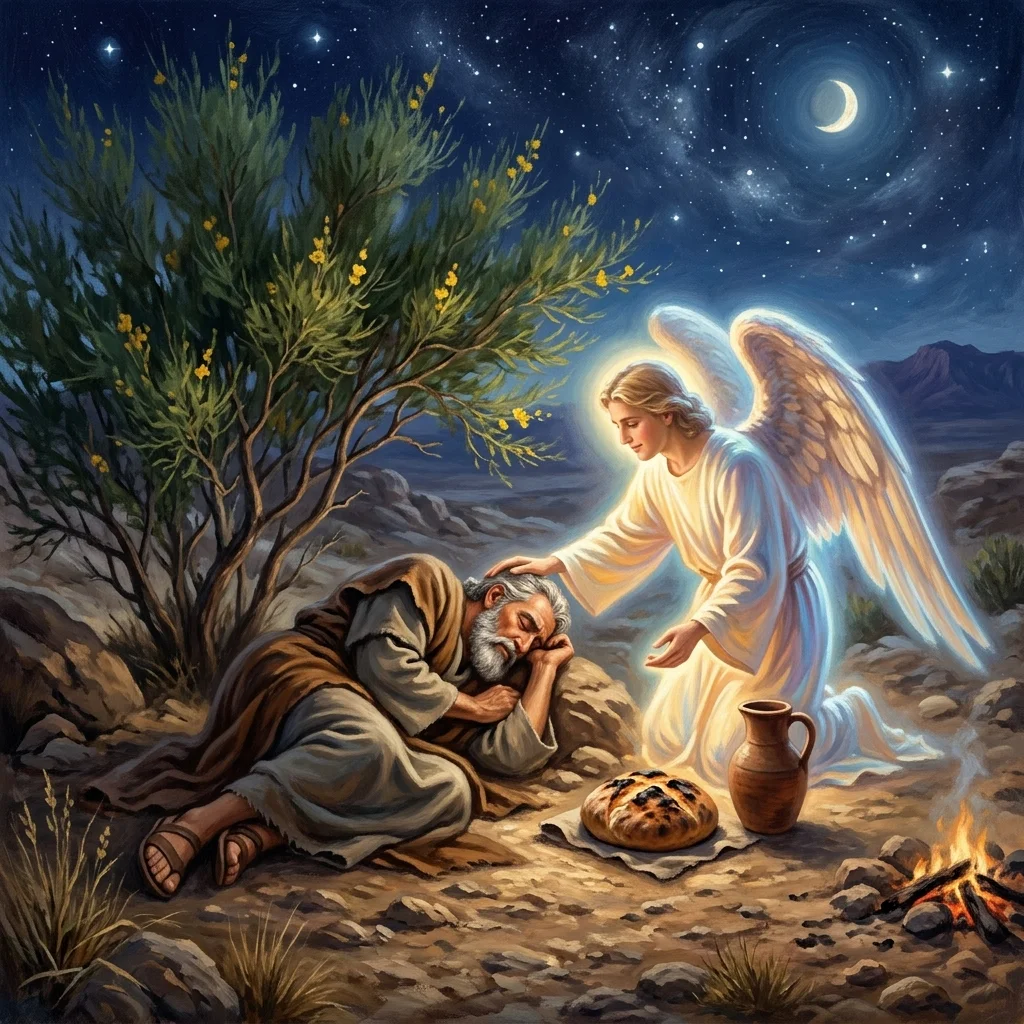
Utterly depleted in body, soul, and spirit, Elijah curled upon the stony ground beneath the broom bush and fell into an exhausted, comatose sleep. He had given up on his mission, on his nation, and on himself.
Yet God does not crush a bruised reed. While the prophet slept in self-condemning despair, the heavens opened not with judgment, but with tender supernatural compassion. An angel of Yahweh touched him on the shoulder, his voice gentle and reviving: "Arise and eat."
Elijah blinked against the harsh desert sunlight. Beside his head lay a warm, fragrant cake of bread baked fresh upon glowing coals (עֻגַת רְצָפִים - Ugat Retzafim) and an earthen jar filled with cool, sweet water. God did not lecture the prophet; He did not debate his theology; He did not condemn his fear. God fed him. Elijah ate the bread, drank deeply from the jar, and, still heavy with the exhaustion of battle, lay down and slept again.
A second time the angel of Yahweh came, knelt beside the sleeping prophet, touched him tenderly, and said: "Arise and eat, for the journey is too great for you." Once more Elijah ate of the heavenly bread and drank the water. Infused with supernatural vitality, that single meal sustained him for forty days and forty nights as he traversed the rugged limestone gorges and jagged granite peaks of the Sinai peninsula, walking the sacred path of the ancestors until he reached Mount Horeb, the sacred mount of God.
The Cave on Mount Horeb
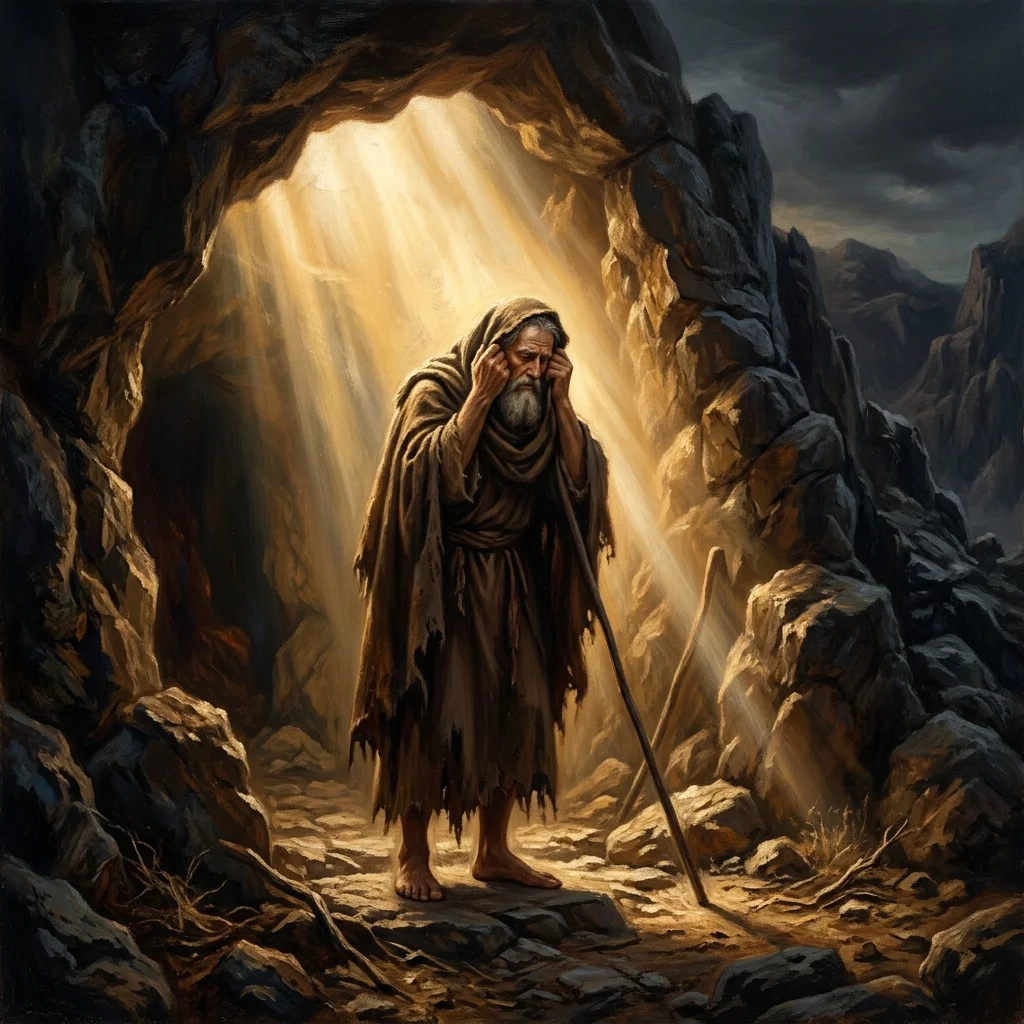
Mount Horeb—Mount Sinai—was the birthplace of Israel's covenant. Here, six centuries earlier, Moses had stood amidst billowing smoke, trumpet blasts, and trembling rock to receive the Ten Commandments. Upon reaching the mountain, Elijah found a cavern (הַמְּעָרָה - ha-me'arah), traditionally recognized as the very cleft of the rock where God had sheltered Moses while His goodness passed by (Exodus 33:22). There, in the damp, shadowy seclusion of the cave, Elijah lodged.
Suddenly, the silence was shattered by the direct, searching inquiry of the Almighty: "What are you doing here, Elijah?" The question was not an interrogation of ignorance, but a divine invitation for the wounded prophet to bare his soul. Elijah poured out the pent-up bitterness and lonely agony of his heart:
"I have been very jealous for Yahweh, the God of hosts. For the people of Israel have forsaken Your covenant, thrown down Your altars, and killed Your prophets with the sword, and I, even I only, am left, and they seek my life, to take it away!"
Elijah used the intensive Hebrew construction קַנֹּא קִנֵּאתִי (Qanna Qanneti)—'I have been fiercely zealous.' He felt betrayed. He had risked everything on Carmel, yet Jezebel still ruled, the nation was unrepentant, and he stood utterly alone, an abandoned fugitive on the brink of annihilation.
Wind, Earthquake, Fire, and the Still Small Voice
The voice of God commanded: "Go out and stand on the mount before Yahweh." As Elijah prepared to step toward the entrance of the cave, the cosmic elements were unleashed in terrifying succession.
First came a cataclysmic windstorm of hurricane fury. The gale screamed through the granite canyons, shearing massive boulders from the peaks and shattering solid cliffs into flying shrapnel before the face of Yahweh. The raw physical power was breathtaking—yet the scripture records with profound theological precision: "But Yahweh was not in the wind."
After the wind came a violent earthquake. The foundational pillars of the sacred mountain groaned and bucked beneath the prophet's feet; deep crevasses tore open the rock face, and subterranean tremors shook the Sinai wilderness. It was an awe-inspiring demonstration of planetary power—"But Yahweh was not in the earthquake."
After the earthquake, a roaring wall of fire swept across the jagged crests. Flashing lightning and sheets of flame scorched the granite ridges, reminiscent of the day when Sinai smoked like a kiln before the descending glory of God. It was magnificent and terrifying—"But Yahweh was not in the fire."
Then, as the roaring flames subsided and the echoes died away in the canyons, an absolute, unnatural stillness settled over the mountain. Out of the profound quiet arose a sound unlike anything Elijah had ever heard: קוֹל דְּמָמָה דַקָּה (Kol Demamah Dakkah)—literally, 'a voice of sheer stillness,' a sound of crushed silence, a gentle, penetrating whisper.
The moment Elijah heard that whisper, he knew that the living God was intimately present. The wind, earthquake, and fire had terrified him, but the gentle whisper melted him into holy reverence. Pulling his hairy prophet's mantle over his face to shield his eyes from the uncreated glory of God, Elijah walked slowly to the mouth of the cave and stood in trembling adoration.
The Commission and the Seven Thousand
A second time, the gentle voice asked: "What are you doing here, Elijah?" Still wrestling with his deep sense of isolated despair, Elijah repeated his heartfelt lament: "I have been very jealous for Yahweh God of hosts... I only am left, and they seek my life."
God answered not with philosophical debate, but with an assignment of sovereign geopolitical authority. The Lord said to him: "Go, return on your way to the wilderness of Damascus. And when you arrive, you shall anoint Hazael to be king over Syria. And Jehu the son of Nimshi you shall anoint to be king over Israel, and Elisha the son of Shaphat of Abel-meholah you shall anoint to be prophet in your place!"
God revealed that His righteous judgment upon the house of Ahab was already set in motion. Those who escaped the sword of Hazael would be slain by Jehu, and those who escaped Jehu would be slain by Elisha. Furthermore, God shattered Elijah's illusion of solitary isolation with a stunning revelation of covenant grace:
"Yet I will leave seven thousand in Israel, all the knees that have not bowed to Baal, and every mouth that has not kissed him!"
Elijah was not alone. In the hidden valleys, among the remote villages, and even within the capital itself, God had sovereignly preserved a faithful remnant (שְׁאָר - She'ar) of seven thousand men and women who had refused the seductive idolatry of Jezebel's court.
The Mantle Cast Upon Elisha
Refreshed, re-commissioned, and humbled by divine grace, Elijah descended from Mount Horeb and journeyed northward to Abel-meholah in the Jordan Valley. There he found Elisha the son of Shaphat plowing in the fertile alluvial fields. Elisha was leading a magnificent agricultural operation, plowing with twelve yoke of oxen before him, guiding the twelfth pair himself.
As Elijah passed by, he did not utter a word. Reaching around his shoulders, he took off his iconic mantle of animal skin and cast it squarely over the young farmer. Elisha understood the profound symbolic meaning instantly: the mantle represented the prophetic office, divine authority, and total surrender to Yahweh's calling.
Leaving the oxen, Elisha ran after Elijah and said, "Let me kiss my father and my mother, and then I will follow you." Elijah answered with solemn gravity: "Go back again, for what have I done to you?" Elisha returned to his field, took his pair of oxen, slaughtered them as a sacrifice to Yahweh, and broke up the wooden plows and yokes to build a roaring fire. Boiling the meat, he served a joyful farewell feast to the laborers and villagers. Burning his former livelihood behind him, Elisha turned his back on wealth and security, arose, followed Elijah, and became his faithful servant and apprentice.
Biblical Keywords & Theological Roots
Literally 'a voice of sheer stillness / a sound of crushed silence / a gentle whisper'; the paradoxical manifestation of Yahweh's presence in profound stillness rather than violent meteorological convulsions.
A round bread cake baked upon glowing limestone coals; a miraculous provision of warm, energizing nutrition prepared by angelic hands in the barren desert.
The desert broom shrub (Retama raetam); a tough, white-flowered desert bush providing scarce shade in the arid Negev, symbolizing the low point of physical and spiritual depletion.
The intensive Hebrew verbal repetition: 'I have been fiercely zealous / jealous'; expressing Elijah's agonizing, all-consuming passion for Yahweh's holy name amidst pervasive national rebellion.
The 'remnant'; the faithful core of God's covenant community sovereignly preserved through severe apostasy and judgment, foreshadowing the ecclesia of grace.
Ancient Near Eastern & Archaeological Context
The narrative of 1 Kings 19 highlights a profound psychological and theological juncture in the history of northern Israel. Mount Horeb (traditionally identified with Jebel Musa in the southern Sinai peninsula) was the sacred cradle of Israel's national identity, where Yahweh had inaugurated the Mosaic covenant amidst thunder, cloud, and fire (Exodus 19–20; 33–34). Elijah's forty-day pilgrimage to Horeb deliberately echoed the forty years of Israel's wilderness wanderings and Moses' two forty-day fasts on Sinai (Exodus 24:18; 34:28). Elijah returned to the exact cave (*ha-me'arah*) where Moses was sheltered in the cleft of the rock while the glory of Yahweh passed by (Exodus 33:22). Geographically, Beersheba represented the southernmost outpost of the Kingdom of Judah; by fleeing beyond Beersheba into the desolate Negev and Sinai, Elijah had completely abandoned his prophetic territory in Israel. The broom tree (*Retama raetam*), known in Arabic as *retam*, is a common desert shrub in the arid wadis of the Negev and Sinai, providing meager shade and highly flammable charcoal. Queen Jezebel's death threat invoked the traditional polytheistic formula ('So let the gods do to me and more also'), widely attested in Phoenician, Ugaritic, and Hittite royal treaties. God's subsequent commissioning of Elijah to anoint Hazael over Damascus, Jehu over Israel, and Elisha as prophet initiated the geopolitical dismantling of the Omride dynasty, later confirmed by the archaeological discovery of the Tel Dan Stele (which references the conflict between Damascus and the 'House of David' and Israel) and the Black Obelisk of Shalmaneser III (depicting Jehu bowing before the Assyrian emperor).
Practical Discipleship & Spiritual Application
- Acknowledge the Limits of Physical and Emotional Capacity: Spiritual warfare and intense labor can deplete physical and mental reserves. When feeling overwhelmed, follow the biblical pattern: rest, nourishment, and physical replenishment are often God's first medicines for burnout.
- Listen for the Still Small Voice in Daily Solitude: We frequently expect God to speak exclusively through spectacular crises or emotional climaxes. Cultivate intentional silence and daily scripture meditation to hear His gentle whisper guiding your conscience.
- Reject the Deception of Elijah's Isolation Trap: Satan tempts exhausted servants of God with the lie: 'You are the only one left who cares.' Remember that God has a silent, faithful remnant praying and serving alongside you across the globe.
- Invest in Next-Generation Leadership: When facing transitions or fatigue, do not cling to authority. Like Elijah casting his mantle upon Elisha, pour your life into discipling younger believers who will carry God's mission into future generations.
Support Independent Biblical Research
Did this study bless you? Help support our independent bilingual research and interactive visual Bible tools.
⚡ Fast Facts
- Strengthened by two angelic meals, Elijah walked approximately 200 to 250 miles (320–400 km) across the scorching Sinai desert to Mount Horeb in exactly forty days.
- The broom tree (rotem) under which Elijah slept is famous in the Negev for producing the hottest, longest-lasting charcoal coals (referenced in Psalm 120:4).
- Mount Horeb and Mount Sinai refer to the exact same mountain complex in southern Sinai, making Elijah's cave experience an intentional thematic return to Moses' holy cleft in the rock (Exodus 33:22).
- Elisha was not an idle youth when called; he was a wealthy, hard-working estate steward plowing with twelve yoke of oxen—twenty-four oxen working in synchronized procession across a vast fertile field.
❓ Frequently Asked Questions (FAQs)
Why did Elijah run in terror from Jezebel right after defeating 850 false prophets?
Elijah's flight illustrates the profound vulnerability of human psychology following massive spiritual, mental, and physical exertion. On Mount Carmel, Elijah operated under intense adrenaline and direct supernatural empowerment. Afterwards, he sprinted seventeen miles in torrential mud to Jezreel. When Jezebel reacted not with national repentance but with a cold, ruthless assassination vow, the expected national revival evaporated before his eyes. Utterly depleted physically and emotionally, his nervous system crashed into acute depression, causing him to flee into the desert.
What is the theological significance of God speaking in a 'still small voice' rather than the storm?
The wind, earthquake, and fire demonstrated that while God possesses infinite, terrifying cosmic power to shatter mountains and judge nations, His true covenant essence is characterized by gentle, intimate grace and holy righteousness. Spectacles of power may silence opponents, but only the quiet, inward word of God transforms the human heart. It taught Elijah that God's kingdom expands not merely through explosive showdowns like Mount Carmel, but through patient, quiet prophetic ministry, generational discipleship, and the hidden faithfulness of the remnant.
Why did Elisha burn his plowing equipment and boil the oxen?
By slaughtering the twelve yoke of oxen, using the wooden plowing yokes as firewood, and hosting a community feast, Elisha performed a dramatic, irreversible act of total consecration. He burned his former livelihood, eliminated any possibility of returning to his wealthy agrarian heritage, and publicly dedicated his entire future to serving Yahweh as Elijah's apprentice. It foreshadowed Jesus' disciples leaving their nets and boats immediately to follow Christ.