After three and a half years of severe drought, the land of Israel was completely parched. Streams had dried up, crops had failed, and King Ahab searched frantically for grass to save his royal horses. Yet Ahab blamed the prophet of God rather than his own idolatry. The stage was set for one of the most epic spiritual showdowns in human history on the heights of Mount Carmel.
1. Confronting Ahab: "You Are the Troubler of Israel"
 Elijah confronted Ahab, telling him: 'I have not made trouble for Israel, but you and your father's family have by abandoning the Lord's commands.'
The word of the Lord came to Elijah: "Go and present yourself to Ahab, and I will send rain on the land."
Meanwhile, Ahab had called Obadiah, his palace administrator, who was a devout believer in the Lord. When Jezebel was killing off the Lord's prophets, Obadiah had taken a hundred prophets and hidden them in two caves, supplying them with food and water. As Obadiah was walking along, Elijah met him.
When Ahab saw Elijah, he said to him, "Is that you, you troubler of Israel?"
"I have not made trouble for Israel," Elijah replied. "But you and your father's family have. You have abandoned the Lord's commands and have followed the Baals. Now summon the people from all over Israel to meet me on Mount Carmel. And bring the four hundred and fifty prophets of Baal and the four hundred prophets of Asherah, who eat at Jezebel's table."
2. The Challenge on Mount Carmel
So Ahab sent word throughout all Israel and assembled the prophets on Mount Carmel. Elijah went before the people and said:
"How long will you waver between two opinions? If the Lord is God, follow him; but if Baal is God, follow him!"
But the people said nothing.
Then Elijah said to them: "I am the only one of the Lord's prophets left, but Baal has four hundred and fifty prophets. Get two bulls for us. Let Baal's prophets choose one for themselves, cut it into pieces and put it on the wood, but not set fire to it. I will prepare the other bull and put it on the wood but not set fire to it. Then you call on the name of your god, and I will call on the name of the Lord. The God who answers by fire—he is God!"
Then all the people said, "What you say is good."
3. The Futility of Baal Worship
Elijah said to the prophets of Baal, "Choose one of the bulls and prepare it first, since there are so many of you. Call on the name of your god, but do not set fire to it."
So they took the bull given them and prepared it. They called on the name of Baal from morning till noon. "Baal, answer us!" they shouted. But there was no response; no one answered. And they danced around the altar they had made.
At noon Elijah began to taunt them: "Shout louder!" he said. "Surely he is a god! Perhaps he is deep in thought, or busy, or traveling. Maybe he is sleeping and must be awakened!"
So they shouted louder and slashed themselves with swords and spears, as was their custom, until their blood flowed. Midday passed, and they continued their frantic prophesying until the time for the evening sacrifice. But there was no response, no one answered, no one paid attention.
4. Rebuilding the Altar and Drenching the Sacrifice
Then Elijah said to all the people, "Come here to me." They all came to him, and he repaired the altar of the Lord, which had been torn down.
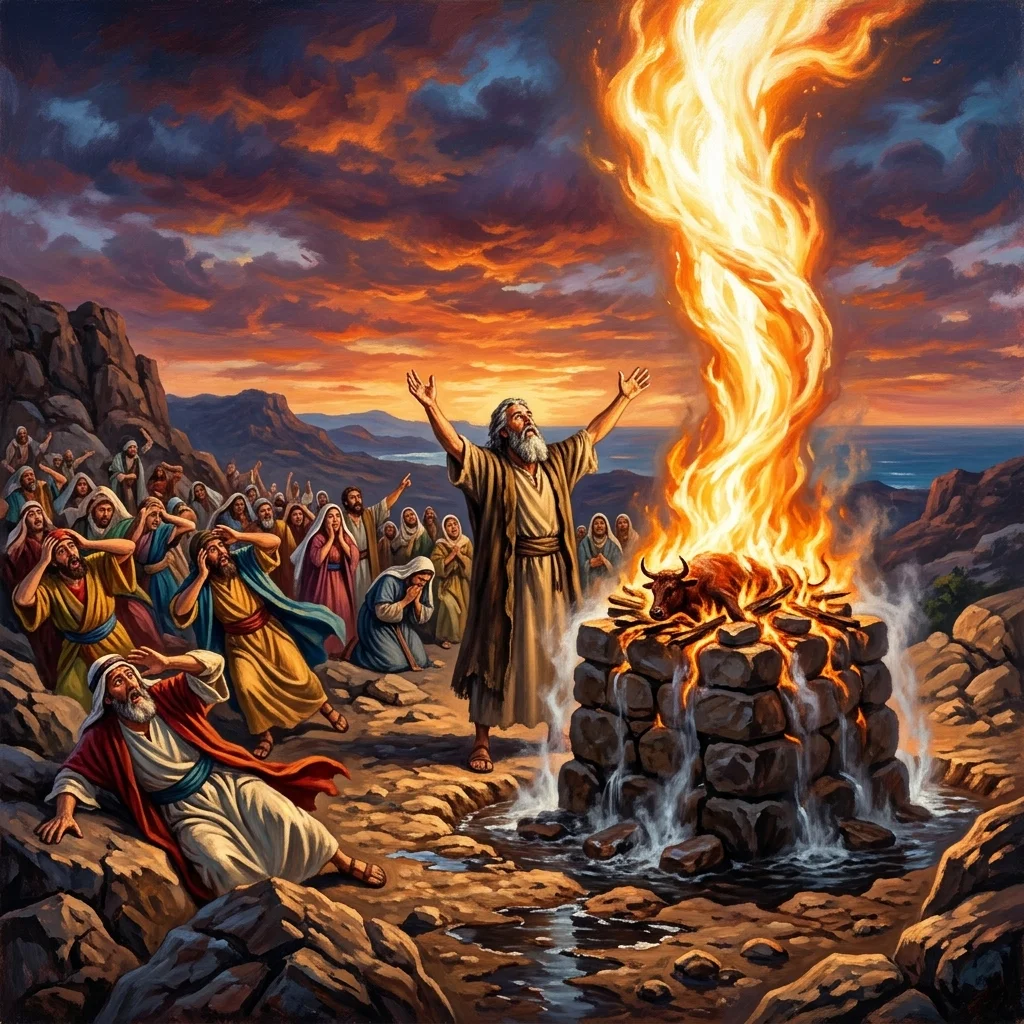
Elijah took twelve stones, one for each of the tribes descended from Jacob, to whom the word of the Lord had come, saying, "Your name shall be Israel." With the stones he built an altar in the name of the Lord, and he dug a trench around it large enough to hold two seahs of seed.
He arranged the wood, cut the bull in pieces and laid it on the wood. Then he said to them, "Fill four large jars with water and pour it on the offering and on the wood."
"Do it again," he said, and they did it again.
"Do it a third time," he ordered, and they did it a third time. The water ran down around the altar and even filled the trench.
5. Fire Falls from Heaven: "The Lord—He Is God!"
At the time of the evening sacrifice, the prophet Elijah stepped forward and prayed:
"Lord, the God of Abraham, Isaac and Israel, let it be known today that you are God in Israel and that I am your servant and have done all these things at your command. Answer me, Lord, answer me, so these people will know that you, Lord, are God, and that you are turning their hearts back again."
Then the fire of the Lord fell and consumed the sacrifice, the wood, the stones and the soil, and also licked up the water in the trench!
When all the people saw this, they fell prostrate and cried: "The Lord—he is God! The Lord—he is God!"
Then Elijah commanded them, "Seize the prophets of Baal. Don't let one escape!" They seized them, and Elijah had them brought down to the Kishon Valley and slaughtered there.
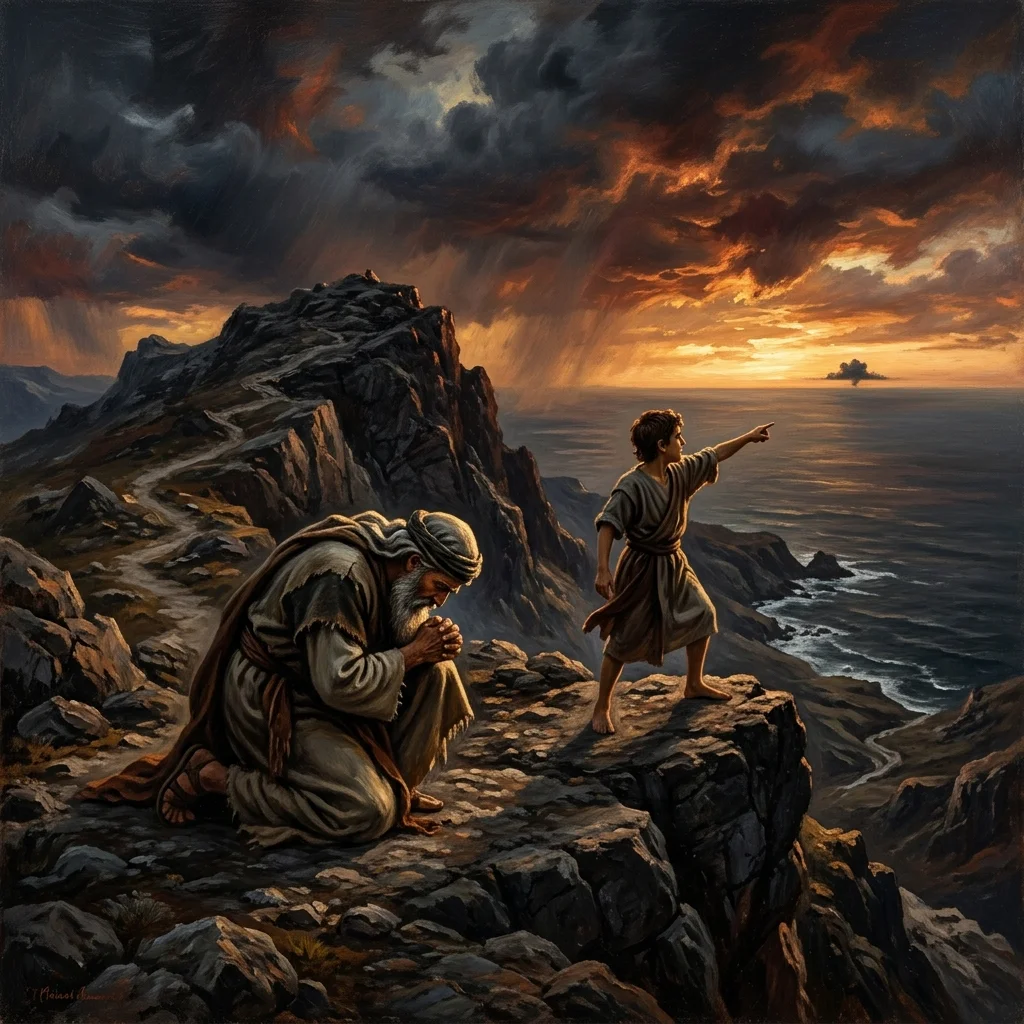
Elijah then said to Ahab, "Go, eat and drink, for there is the sound of a heavy rain." Elijah climbed to the top of Carmel, bent down to the ground and put his face between his knees. He sent his servant seven times to look toward the sea. On the seventh time, the servant reported, "A cloud as small as a man's hand is rising from the sea."
Elijah said, "Go and tell Ahab, 'Harness your chariot and go down before the rain stops you.'" Meanwhile, the sky grew black with clouds, the wind rose, a heavy rain started falling, and the power of the Lord came on Elijah so that he tucked his cloak into his belt and ran ahead of Ahab's chariot all the way to Jezreel!
Reflections on the Story:
- No Compromise: Elijah challenged Israel not to waver between two opinions. True faith requires wholehearted devotion to Yahweh alone.
- The Contrast of Prayers: Baal's 450 prophets screamed and bled all day in vain. Elijah prayed a simple 63-word prayer, and God answered instantly with fire.
- Persistent Prayer for Rain: After fire fell, Elijah prayed seven times on his knees until rain came, teaching us to persevere in prayer until God's promise manifests.
⚡ Fast Facts
- Showdown Site: Mount Carmel, pitting 1 prophet of Yahweh against 450 prophets of Baal.
- Famous Challenge: 'How long will you waver between two opinions? If Yahweh is God, follow him!'
- Water Drenching: Elijah ordered 4 large jars of water poured over the sacrifice 3 times (12 jars total).
- Consuming Fire: Fire of the Lord consumed the sacrifice, wood, stones, soil, and licked up the trench water.
❓ Frequently Asked Questions (FAQs)
To eliminate any suspicion of human trickery or hidden embers. The soaked altar made the supernatural fire from heaven unquestionable.
The 12 stones represented the original 12 tribes of Israel, reminding the divided nation of their unified covenant identity under Yahweh.
Though God promised rain, Elijah knew prayer was the instrument God ordained to fulfill His promise. Seven demonstrates complete, persistent intercession.