Dawn was breaking over the eastern pebble shore of the Sea of Galilee, painting the rugged limestone cliffs of the Decapolis in cold shades of slate gray and iron. Jesus and His twelve disciples stepped out of their wooden fishing vessel onto the stones of the Gerasene shore, their garments still damp from the midnight hurricane they had miraculously survived. But the silence of the beach was shattered in an instant. From the blackened mouths of ancient rock-cut tombs on the hillside came a sound that chilled the blood of seasoned men: a guttural, inhuman shriek, accompanied by the clanking of shattered bronze fetters. Crashing through the thorn bushes came a naked, bleeding figure—a man possessed by a legion of demons, whose superhuman fury had terrorized the entire countryside. Yet as this feral nightmare charged toward the beach, he did not tear the travelers to pieces. He skidded across the limestone gravel and threw himself prostrate upon his face before the feet of Jesus, shrieking in cosmic dread before the Lord of glory.
1. The Realm of the Dead: A Living Hell
Mark and Luke paint a clinical, horrifying portrait of demonic possession at its most catastrophic extremity. For years, this anonymous citizen of the Decapolis had been subjected to total, systematic psychological and bodily degradation:
- Dwelling among the tombs (mnēmasin): He had abandoned his home, his family, and human society to dwell in the pagan limestone necropolis. In Semitic thought, tombs were the abode of uncleanness, rotting decay, and demonic entities.
- Stripped of all human dignity: Luke notes that he "wore no clothes" (Luke 8:27). Demonic power systematically dehumanizes its victims, stripping away modesty, sanity, and the Imago Dei.
- Superhuman, frenzied strength: Pitying citizens and family members had repeatedly attempted to restrain him with iron chains and bronze shackles (pedais kai halysesin). Yet under the demonic surge, he effortlessly snapped chains like thread and smashed metal shackles against rocks. No man had the strength to tame him (damasai).
- Continuous nocturnal agony and self-mutilation: Day and night, upon the mountains and in the tombs, he screamed continuously and cut his flesh with sharp basalt stones (Mark 5:5). The demonic agenda is always suicide and self-destruction; Satan delights in torturing the body that bears God's image.
Here was the ultimate trophy of hell: a man reduced to an animalistic monster, living in a cemetery, bathing in his own blood, waiting for death to drag his soul into the pit.
2. Prostration Before the Son of the Most High
As the demoniac sprinted toward the beach with rocks clenched in his fists, the disciples must have instinctively scrambled back toward the boat, reaching for rowing oars in self-defense.
Jesus did not flinch. He did not retreat a single step. He stood immovable upon the shore, radiating the calm majesty of heaven.
Suddenly, ten yards from Christ, the demonic fury short-circuited. The man did not attack; he collapsed violently onto his knees, bowing in the dust before Jesus (Greek: prosekynēsen autō).
Then, through the vocal cords of the tortured victim, the resident unclean spirits shrieked with piercing terror:
"What have I to do with You, Jesus, Son of the Most High God? I implore You by God that You do not torment me!" (Mark 5:7; Luke 8:28).
Notice the staggering theological confession! The Pharisees in Jerusalem claimed Jesus was a blasphemer; the scribes accused Him of being in league with Beelzebub; the crowds wondered if He was merely a prophet. But the demons knew exactly who He was: Iēsou Hyie tou Theou tou Hypsistou—"Jesus, Son of the Most High God!"
Notice also the reversal of roles: the monster who had terrorized an entire province was now trembling, begging, and pleading for mercy before an unarmed Galilean rabbi! The demons knew their doom. They knew that Christ held the keys of death, hell, and the grave.
3. "My Name Is Legion": The Army of Darkness
Jesus had already begun commanding: "Come out of the man, unclean spirit!" (Mark 5:8).
Then Christ addressed the entity directly, demanding an interrogation of sovereignty:
"What is your name?" (Mark 5:9).
In ancient Near Eastern exorcism rituals, pagan sorcerers attempted to discover a demon's name in order to gain magical leverage over it. But Jesus did not ask for a name to gain power; He asked to expose the horrifying magnitude of the man's bondage to the surrounding disciples.
The voice hissed back with chilling multiplicity:
"My name is Legion, for we are many!" (Greek: Legiōn onoma moi, hoti polloi esmen) (Mark 5:9).
To any first-century hearer in the Roman Empire, the word Legion caused the skin to crawl. A Roman legion was the apex military instrument of terror, consisting of 6,000 heavily armored legionaries, divided into ten cohorts, supported by cavalry.
A vast spiritual garrison had occupied this single human soul! Six thousand unclean spirits were entrenched inside his mind, will, and emotions, turning his body into a fortress of hell.
4. The Drowning of the Two Thousand Swine
The demons knew their eviction was imminent. Terrified of being remanded to the abyssos—the bottomless subterranean holding pit where fallen angels are chained in darkness (Jude 6; Revelation 9:1)—the spirits pleaded repeatedly with Christ:
"Do not send us out of the country! Send us to the swine, that we may enter them!" (Mark 5:10–12).
On the nearby hillside, a massive commercial herd of approximately two thousand swine was feeding on acorns and scrub roots. For Jews, swine were ritually unclean animals (Leviticus 11:7); but in the Hellenistic Decapolis, pork was a lucrative commodity sold to Roman garrisons.
Jesus gave them permission: "Go!"
What followed was instantaneous pandemonium. The unclean spirits vacated the human being and invaded the beasts. The entire herd of two thousand hogs went violently insane! Squealing and trampling one another in blind panic, the massive herd stampeded across the plateau, raced over the edge of the steep limestone precipice, and plunged headlong into the deep waters of the lake, where every single animal drowned.
Why did Jesus permit this?
- To expose the murderous malice of Satan: The devil does not merely oppress; he destroys. What happened to the pigs in two minutes was what the demons intended to do to the man for twenty years!
- To grant visible assurance to the victim: The man needed unmistakable, empirical proof that his tormentors were truly gone. Watching the herd perish in the waters assured him that his tormentors had drowned in defeat.
- To establish cosmic value: In the economy of heaven, one human soul made in the image of God is worth infinitely more than two thousand pigs!
5. Clothed and in His Right Mind
The terrified swineherds fled in panic, running up through the olive groves into the city of Gerasa, broadcasting the news in every street and market.
Soon, a massive delegation of civic officials, merchants, and landowners rushed down to the shore to survey the wreckage. When they arrived at the beach, their eyes fell upon a scene that defied all human comprehension:
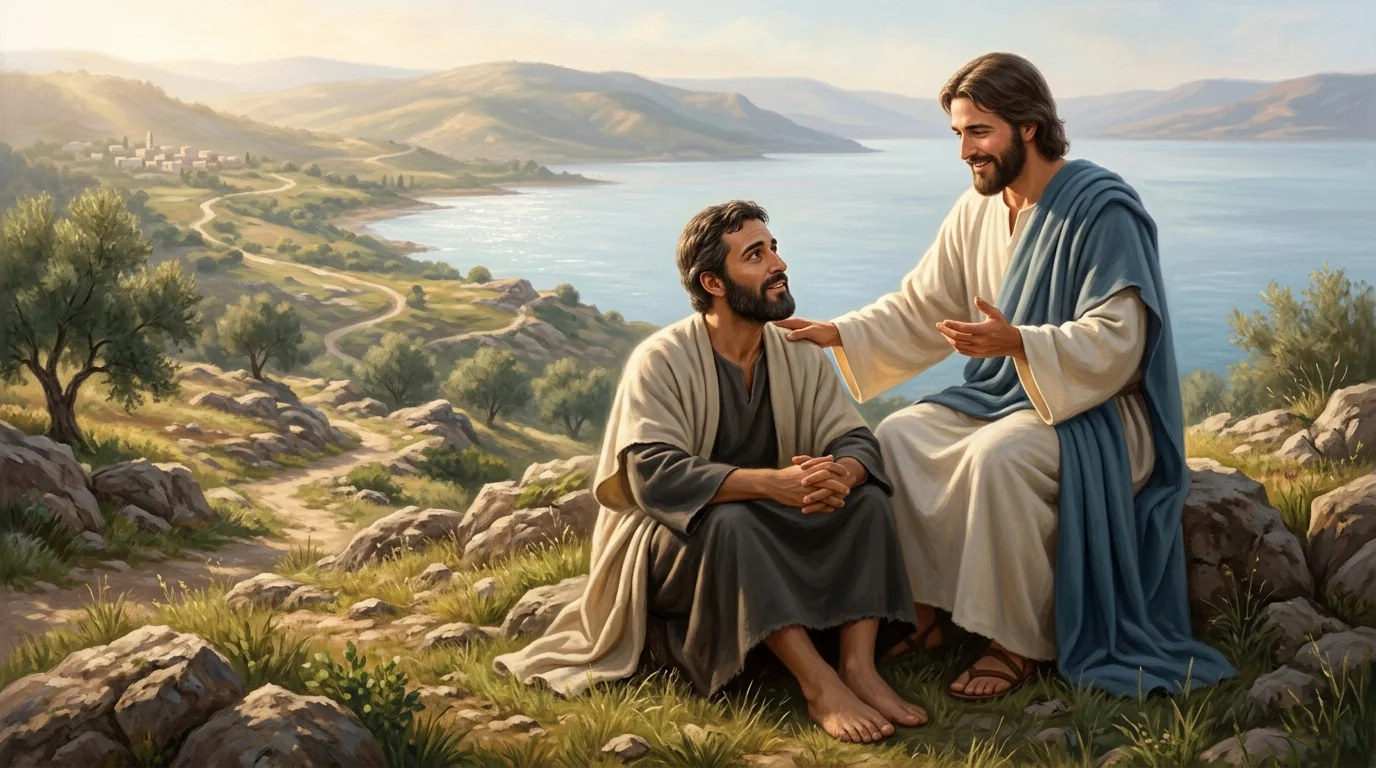
There, seated peacefully on the stones at the feet of Jesus, was the former madman.
Mark records three stunning transformations:
- He was sitting: The man who had run wildly across mountain crags for years was now at rest.
- He was clothed: Someone—perhaps Peter or John—had given him a clean tunic to cover his nakedness.
- He was in his right mind (Greek: sōphronounta): His wild, bloodshot eyes were clear; his fevered brain was tranquil; the tormenting voices had vanished forever.
One would expect the townspeople to erupt in weeping gratitude, embracing their delivered neighbor and throwing their arms around the Galilean Savior. But Mark records a tragic tragedy: "And they were afraid... Then the whole multitude of the surrounding region begged Him to depart from them, for they were seized with great fear!" (Luke 8:35, 37).
They did not mourn the man's former agony, but they fiercely mourned the loss of their pigs. Their ledger sheets were more valuable than a redeemed life. Terrified by a holy Power they could neither control nor exploit, they begged Jesus to leave their territory.
6. The First Missionary to the Decapolis
With heartbreaking sorrow, Jesus honored their request. He did not force His presence where He was rejected. Turning toward the boat, Christ prepared to embark.
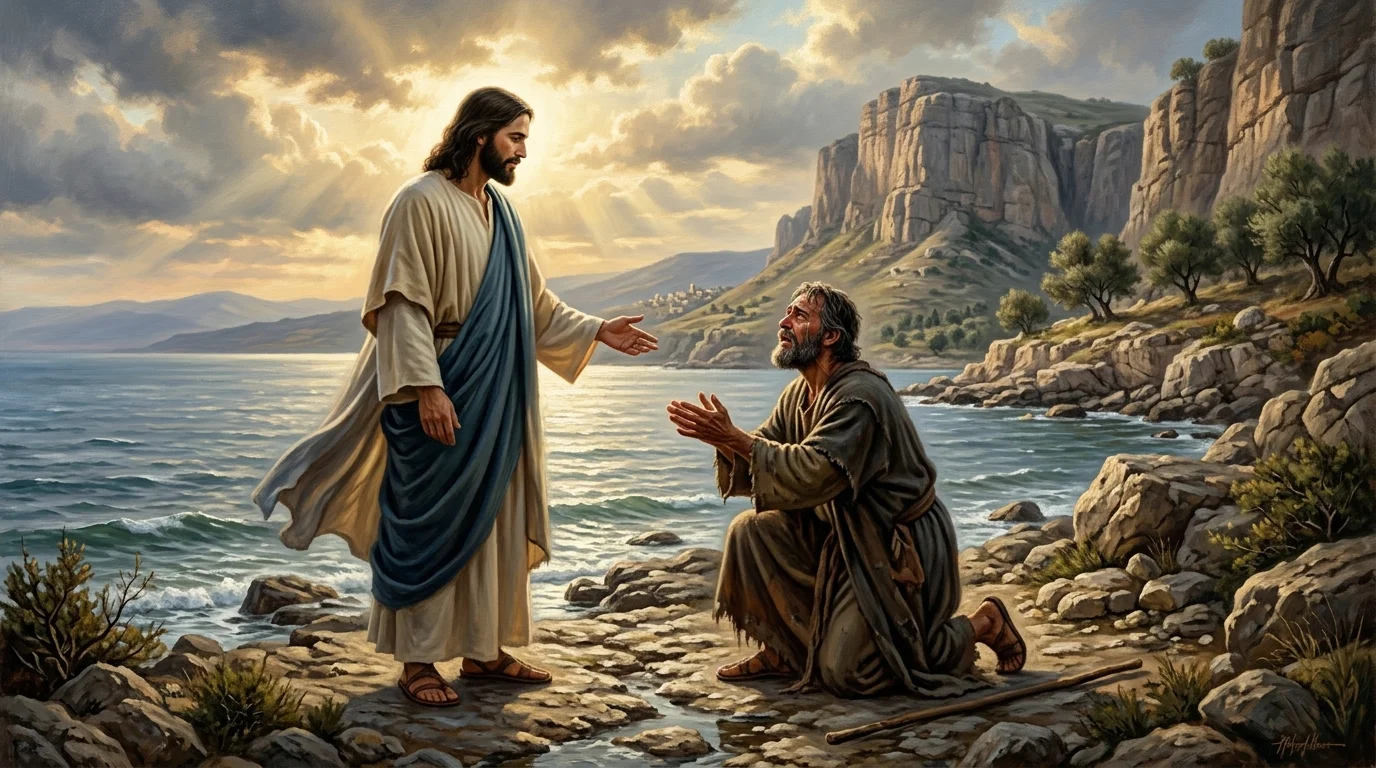
As Jesus stepped into the vessel, the delivered man rushed down to the water's edge, fell to his knees, and begged with all his heart that he might accompany Jesus as a full-time disciple: "Lord, let me go with You!" (Mark 5:18). Who could blame him? He wanted to stay near the One who had shattered his chains; he feared returning to the town that had chained him in the tombs.
Yet Jesus looked down upon him and spoke an unexpected, magnificent refusal:
"Go home to your friends, and tell them what great things the Lord has done for you, and how He has had compassion on you." (Greek: Hypage eis ton oikon sou pros tous sous, kai apangeilon autois hosa ho Kyrios soi pepoiēken...) (Mark 5:19).
Jesus told him: "The Decapolis does not want Me; they have closed their doors to My ministry. But they cannot close their doors to you! You are My living monument of grace. Go back to the homes and streets where people saw you running naked in chains, and show them what God's mercy can do!"
The man obeyed without hesitation. He did not merely go home; Mark records that he went throughout the entire Decapolis, proclaiming in all ten cities the staggering things Jesus had done for him.
And what was the fruit? When Jesus returned to this exact same region months later in Mark 7:31–37, the doors were no longer shut. Because of one faithful former demoniac who shared his testimony, over four thousand Gentile men and their families gathered on the hillside, waiting days to hear the words of Jesus and receiving the miraculous bread of life!
Ancient Near Eastern & Archaeological Context
The Decapolis ('Ten Cities') was a culturally Hellenistic confederation of cities located primarily east of the Jordan River and south of the Sea of Galilee, including Scythopolis, Gadara, Gerasa, Hippos, and Pella. Founded by veteran soldiers of Alexander the Great and reorganized under Roman general Pompey in 63 BC, the Decapolis enjoyed special imperial autonomous status, minting its own coins and worshiping the Greco-Roman pantheon (Zeus, Artemis, Dionysus). Unlike Jewish Galilee, the Decapolis was thoroughly Gentile: streets were lined with Corinthian colonnades, temples featured sacrificial altars, and local agricultural commerce relied heavily on massive swine herds for meat and Roman legionary rations. When Jesus crossed the lake into the territory of Gadara/Gerasa, He crossed a profound cultural, religious, and spiritual boundary. Landing on the rocky shores beneath Mount Kursi, Christ entered enemy-occupied territory where pagan necromancy, limestone burial caves, and demonic oppression held absolute sway. By liberating the demoniac, Jesus announced the invasion of the Kingdom of God directly into the Gentile pagan world.
Support Independent Biblical Research
Did this study bless you? Help support our independent bilingual research and interactive visual Bible tools.
⚡ Fast Facts
- The Decapolis was a confederation of ten Hellenistic, Gentile cities established after Alexander the Great, characterized by pagan temples, amphitheaters, and large-scale swine farming
- A Roman military 'legion' (legio) was the premier fighting division of the imperial army, consisting of roughly 5,000 to 6,000 heavily armed infantry soldiers and cavalry
- In Jewish ritual purity law, dwelling among corpses in tombs and herding swine represented the absolute zenith of double ceremonial defilement and spiritual desolation
- The healed man became the first Gentile missionary commissioned by Christ, evangelizing all ten cities of the Decapolis so effectively that thousands gathered when Jesus returned in Mark 7
❓ Frequently Asked Questions (FAQs)
The Gospel manuscripts record minor textual variations between Gadarenes (Matthew), Gerasenes (Mark and Luke), and Gergesenes. Historically and geographically, these refer to the same general district along the eastern shore of the Sea of Galilee. Gadara was the regional capital city six miles southeast of the lake, governing the territory extending to the shoreline (known as Kursi/Gergesa), while Gerasa was the prominent Decapolis metropolis further inland. Excavations at Kursi in 1970 uncovered ancient cliff precipices plunging directly into the water, precisely matching the topography of the herd plunging into the lake.
First, in this Gentile region, swine farming violated Mosaic law and symbolized pagan spiritual defilement. Second, the violent drowning of 2,000 swine demonstrated the horrifying, murderous nature of demonic possession—had they not been restrained, the demons would have annihilated the man himself. Third, the visible destruction of the swine gave the tormented man absolute, sensory proof that the army of demons had truly left his body forever. Finally, Christ showed that a single human soul created in God's image is worth vastly more than two thousand swine.
The citizens were dominated by economic terror and spiritual blindness. The catastrophic loss of two thousand swine represented an enormous financial blow to the local economy. Furthermore, seeing a holy Man who possessed supernatural authority over both nature and the demonic world struck unbearable dread into their pagan hearts. Rather than repenting and welcoming the Lord of Life who had restored their most dangerous citizen, they prized their livestock above the Messiah and begged Him to depart.