The crimson sun was dipping behind the western limestone ridges of Lower Galilee, casting long violet shadows across the tranquil waters of Lake Gennesaret. For twelve hours, Jesus had poured out His physical and spiritual strength, teaching the packed multitudes from the wooden prow of Simon Peter's fishing boat. His voice was hoarse; His human frame was exhausted. As dusk settled, the Master turned to His inner circle and issued a simple, sovereign directive: "Let us cross over to the other side." (Mark 4:35). Leaving the crowd behind, the veteran fishermen cast off the mooring ropes, raised the coarse linen sail, and steered their twenty-seven-foot oak craft eastward toward the dark hills of the Decapolis. But as night swallowed the lake, the tranquil mirror of water transformed into a howling watery grave. A violent cyclonic tempest—a megalē lailaps—slammed down from the Golan ravines, battering the vessel with monstrous breakers. As hardened sailors wept in terror and water swamped the hull, the Creator of the cosmos lay fast asleep on a wooden pillow in the stern.
1. Departure into the Deep
Mark's Gospel captures the scene with vivid eyewitness immediacy: "Now when they had left the multitude, they took Him along in the boat as He was. And other little boats were also with Him" (Mark 4:36).
The phrase "as He was" is deeply poignant. Jesus was so physically spent that He did not return ashore to fetch provisions, a mantle, or food. He simply collapsed where He was. Stepping to the stern—the slightly raised quarterdeck of the wooden fishing boat—Jesus placed His head upon the proskephalaion (the leather-covered wooden cushion used by the helmsman) and slipped into profound, exhausted sleep.
The crew consisted of men who had spent their entire lives on this water. Peter, Andrew, James, and John knew every mood of the Sea of Galilee. They knew its fishing banks, its prevailing drafts, and its deceptive calms. Setting out under the emerging desert stars, the oars dipped rhythmically into the water, and the gentle lapping of ripples against cedar planks promised an uneventful two-hour crossing to the Gentile eastern shore.
Jesus slept. It was the sleep of genuine, unfeigned humanity—a body bone-weary from ministry. But it was also the sleep of perfect, trinitarian peace. He who watched over Israel neither slumbers nor sleeps; yet the incarnate Son of God rested like a trusting child in the lap of His heavenly Father, knowing that His life was invulnerable until His appointed hour upon the cross.
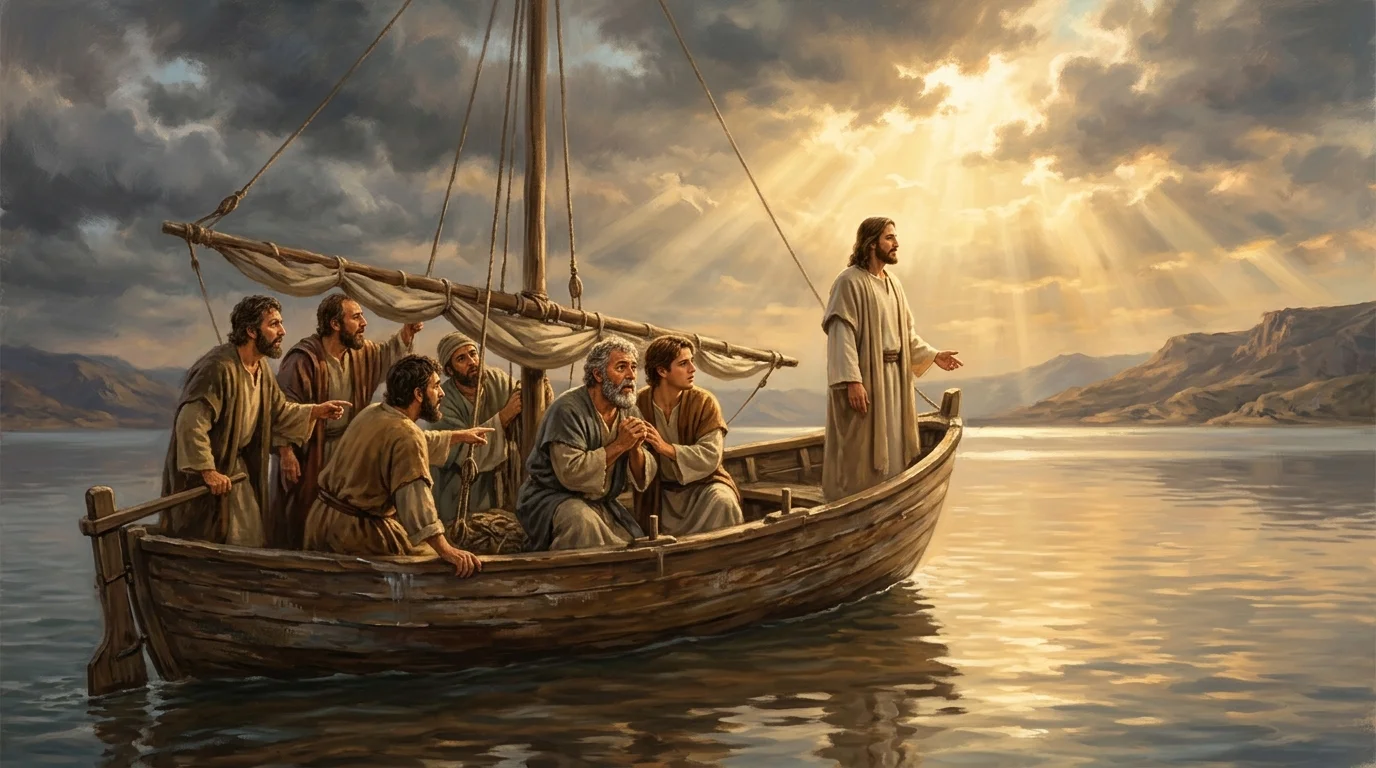
2. The Fury of the Lailaps
Without warning, the atmosphere ruptured.
Cool air masses funneling off the snow-covered peaks of Mount Hermon through the narrow basalt canyon of the Yarmuk River collided violently with the dense, humid heat trapped in the sunken 700-foot depression of the lake. The result was not an ordinary rainstorm, but what Mark designates as a megalē lailaps anemou—a hurricane-force cyclonic squall that screamed across the water with deafening fury.
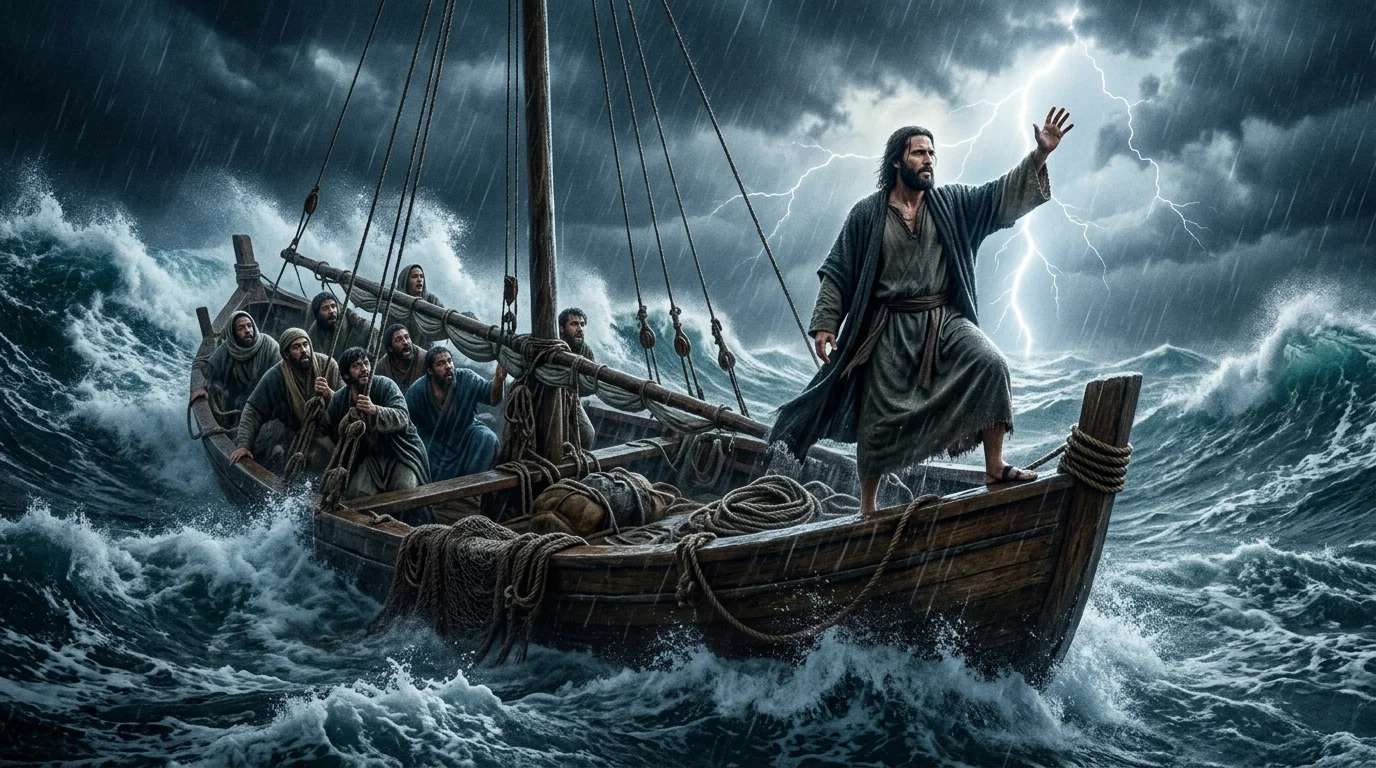
Within moments, the glassy surface was churned into a cauldron of boiling foam. The wind tore the linen sail from its mast; monstrous, black waves towered eight, ten, twelve feet in height, smashing relentlessly against the low wooden gunwales.
A first-century Galilean fishing boat had no enclosed lower deck. When waves broke over the sides, water flooded directly into the open cargo hold. Peter and Andrew grabbed wooden bailers, frantically throwing torrents of water back into the churning deep, while James and John fought the steering oars until their palms blistered. But for every gallon of water they hurled overboard, ten gallons of black lake water crashed over the gunwales.
The boat was filling rapidly (gemizesthai). The vessel grew heavy, sluggish, and unresponsive to the helm. Every experienced fisherman on board knew the cold mathematics of nautical disaster: in sixty seconds, the boat would capsize and plunge two hundred feet to the rocky bottom of the lake.
These were not squeamish landlubbers; these were seasoned, weather-beaten mariners. Yet Luke records: "They were in jeopardy!" Terror seized their throats. Death was staring them in the face.
3. The Sleeping Master & The Cry of Panic
Amidst the shrieking gale, the snapping ropes, the crashing timber, and the freezing spray, one man remained completely undisturbed: Jesus was asleep in the stern.
What an astonishing, paradoxical picture! The wind howled with demonic ferocity, freezing lake water splashed across His face and soaked His clothes, yet Christ slept on in serene tranquility.
Desperate and drenched, the disciples lunged toward the stern, shaking Him awake with cries of raw panic and thinly veiled accusation:
"Teacher, do You not care that we are perishing?" (Greek: Didaskale, ou melei soi hoti apollymetha?) (Mark 4:38).
Listen to the bitter sting in their cry: "Do You not care?" How often that same question echoes in the dark nights of our own trials! When financial storms batter our homes, when sickness swamps our bodies, when the waters rise and heaven seems silent, the human heart whispers the lie of the enemy: "God does not care. He is asleep. He has abandoned me to perish in the dark!"
Notice also what they said: "We are perishing!" They did not say: "We are in danger;" they had already written their own epitaph. They forgot that the Creator of the universe was in their boat!
4. "Siopa, Pephimoso!": The Sovereign Command
Awakened from His sleep, Jesus opened His eyes. He did not panic; He did not scramble for a bailer; He did not ask for a life preserver.
Rising to His feet, Christ steadied Himself on the pitching deck. His hair blew back in the screaming gale; His wet garments clung to His frame. He looked out into the howling darkness. He saw the black waves leaping like ravenous beasts; He heard the roaring hurricane wind.
Then, with the effortless majesty of the One who spoke light into the primeval void in Genesis 1, Jesus addressed the raging elements. He did not pray for deliverance; He did not plead with the storm to abate. He issued two sovereign divine imperatives:
"Peace, be still!" (Greek: Siōpa, pephimōso!) (Mark 4:39).
The Greek phrase is breathtaking in its raw authority:
- Siōpa: "Silence! Hold your peace!" An imperative commanding the screaming atmospheric winds to cease their vocal roar.
- Pephimōso: A perfect passive imperative meaning literally: "Be muzzled! Be gagged!" It is the exact term Jesus used in Mark 1:25 to muzzle a snarling demon in the Capernaum synagogue. Christ was putting a celestial muzzle on the chaotic jaws of the deep!
The response of creation was instantaneous and miraculous.
Normally in nature, when a gale winds down, the sea remains turbulent for hours; massive ground swells continue to crash and roll long after the wind has ceased. But the moment Christ spoke, the wind dropped dead in its tracks. And the lake did not merely subside—Mark records that there was an immediate galēnē megalē—a "great calm!"
The raging cauldron became a sheet of polished glass. The mirror-like surface of the lake reflected the serene moon and stars above. The only sound remaining was the gentle drip of water falling from the soaked garments of twelve speechless men.
5. The Rebuking of Unbelief
Standing on the calm deck, Jesus turned His gaze from the silenced sea to His trembling disciples. With tender yet piercing sorrow, He asked two diagnostic questions:
"Why are you so fearful? How is it that you have no faith?" (Mark 4:40).
The word Jesus used for "fearful" is not phobos (reverent fear), but deiloi—timid, cowardly, faithless panic.
Why did Jesus rebuke their lack of faith?
- They had His infallible promise: In verse 35, Jesus had commanded: "Let us cross over to the other side." He did not say: "Let us go halfway and drown in the lake." If the Son of God decrees that you are going to the other side, no demon in hell or squall on earth can sink the ship!
- They had His presence: Christ was in the boat. Could the eternal Son of God drown in a Galilean freshwater puddle? The boat carrying the Messiah was unsinkable!
- They doubted His character: Their cry: "Do You not care?" questioned His love, His fidelity, and His covenant goodness.
Jesus exposed their spiritual flaw: their faith was entirely dependent upon fair weather. When the sea was calm, they believed; when the storm arose, their faith evaporated like morning mist.
6. A Greater Fear: "Who Then Is This?"
Now came the true climax of the narrative. One would think the disciples would have erupted in high-fives, cheers, and celebration. But Mark records a reaction that cuts to the bone:
"And they feared exceedingly, and said to one another, 'Who then is this, that even the wind and the sea obey Him?'" (Greek: Ephobēthēsan phobon megan) (Mark 4:41).
Notice the shift in Greek vocabulary: They had been deiloi (cowardly afraid) of the storm, but now they were gripped by a phobon megan—a "great fear!" They were far more terrified of the Holy Man standing in their boat than they had been of the howling tempest!
Every Jewish disciple on that boat had grown up singing the Psalms in the synagogue. They knew the Hebrew Scriptures by heart. And they knew what Psalm 107 declared concerning Yahweh alone:
"Those who go down to the sea in ships... they see the works of the Lord, and His wonders in the deep. For He commands and raises the stormy wind, which lifts up the waves of the sea... Then they cry out to the Lord in their trouble, and He brings them out of their distresses. He calms the storm, so that its waves are still. Then they are glad because they are quiet; so He guides them to their desired haven!" (Psalm 107:23–30).
Who alone commands the storm? Yahweh! Who alone stills the raging waves? The God of Abraham, Isaac, and Jacob!
As Peter, James, and John stared at Jesus in the midnight moonlight, the terrifying, glorious truth dawned upon their souls: The One standing on their boat was not merely a gifted rabbi, an anointed healer, or an earthly prophet.
Standing before them in soaked linen garments was the uncreated Sovereign of the universe—the Lord of the wind and waves, Yahweh clothed in human flesh!
The disciples fell silent in adoration as the boat glided gently onto the eastern pebble shore of the Decapolis, ready for the next cosmic clash with the powers of darkness.
Ancient Near Eastern & Archaeological Context
The Sea of Galilee (Lake Kinneret) is a freshwater lake roughly thirteen miles long and eight miles wide, resting nearly 700 feet below sea level in the deep Afro-Arabian Rift trench. Surrounded by steep, semi-arid basalt hills that rise sharply over 2,000 feet toward the Golan Heights and Mount Hermon, the lake is an atmospheric crucible. In the late afternoon and evening, cool, dense air currents sweeping off the Mediterranean and down the Hermon mountain gorges collide violently with the warm, humid, low-pressure air pocket trapped over the sunken lake. This thermal clash triggers sudden, violent downdrafts known locally as 'sharkia' or Mediterranean squalls. Within minutes, sunny, glassy waters can be whipped into a foaming tempest with white-capped waves exceeding ten to twelve feet in height. First-century Galilean fishing boats (such as the ancient 27-foot wooden hull excavated near Migdal in 1986) were shallow-draft open vessels constructed of cedar and oak, powered by a single square sail and four rowing oars. While exceptionally seaworthy for netting fish, an open boat packed with thirteen grown men in the center of a blind squall possessed no high deck to deflect breaking rollers; as water poured over the gunwales, capsizing and drowning were imminent mortal realities.
Support Independent Biblical Research
Did this study bless you? Help support our independent bilingual research and interactive visual Bible tools.
⚡ Fast Facts
- The Sea of Galilee sits nearly 700 feet below sea level in the Syrian-African Rift Valley, making it notorious for sudden, violent violent microburst squalls funneling through narrow mountain ravines
- Mark 4:38 is the only passage in the entire New Testament that records Jesus physically sleeping, highlighting His authentic humanity alongside His cosmic omnipotence
- Jesus used the Greek imperative 'Pephimoso' (literally 'Be muzzled!'), the identical verb He used to muzzle and cast out violent demonic spirits in Mark 1:25
- The disciples' reaction shifted from mortal terror of the storm ('deiloi') to a far greater holy dread of Christ's divine majesty ('ephobēthēsan phobon megan')
❓ Frequently Asked Questions (FAQs)
Christ's sleep on the steersman's wooden pillow illustrates the profound mystery of the Incarnation. Having poured out His physical energy teaching the pressing multitudes all day, Jesus experienced genuine human exhaustion. Concurrently, His sleep in the midst of a violent storm demonstrated His perfect, unshakeable trust in the sovereign protection of the Father (echoing Psalm 4:8: 'I will both lie down in peace, and sleep; for You alone, O Lord, make me dwell in safety'). Jesus knew that no rogue wave could drown the Son of God before His appointed hour at Calvary.
While the Sea of Galilee's topography naturally breeds violent storms, the biblical language strongly suggests an element of spiritual warfare. Jesus did not merely speak to the storm as impersonal weather; He 'rebuked' (epetimesen) the wind and commanded the sea to be 'muzzled' (pephimōso)—the exact terminology used in Mark 1:25 to silence demonic entities. In ancient Jewish cosmology, raging chaotic waters were often associated with the abyss, Leviathan, and hostile cosmic forces opposing God's redemptive mission (Psalm 89:9). Satan sought to drown the Messiah before the cross, but Christ demonstrated effortless supremacy over nature and darkness.
Jesus did not rebuke them for waking Him; He rebuked the panic and unbelief embedded in their cry: 'Do You not care that we are perishing?' Jesus had already given them an authoritative divine promise in verse 35: 'Let us cross over to the other side'—not 'Let us go halfway and drown in the lake.' Real faith rests upon Christ's word. If Jesus is in your boat, the boat cannot sink! Their failure was not feeling the force of the wind, but concluding that God had abandoned them to death.