The dramatic transition from the house of Saul to the kingdom of David came through heartbreak, national tragedy, and ultimate divine fulfillment. As the Philistines launched a massive invasion, Saul's reign ended on the slopes of Mount Gilboa. Yet David did not rejoice over his enemy's fall; instead, he wept, composed a sacred lament, and entered his kingly calling with humility and justice.
1. The Tragic Battle of Mount Gilboa
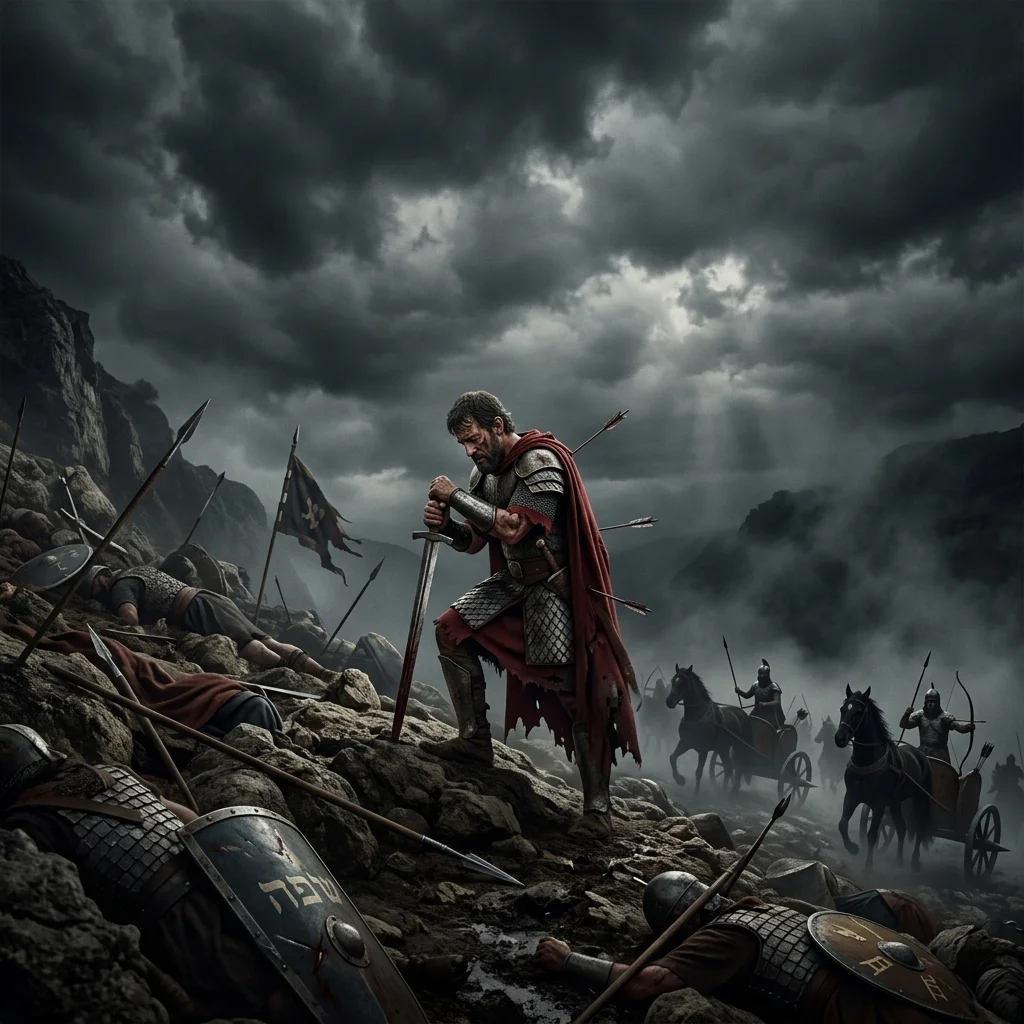
On the dark slopes of Mount Gilboa, the Israelite army was routed, and Saul and his three sons fell in battle.
The Philistines fought against Israel, and the Israelites fled before them, and many fell slain on Mount Gilboa. The Philistines were in hot pursuit of Saul and his sons, and they killed his sons Jonathan, Abinadab and Malki-Shua.
The fighting grew fierce around Saul, and when the archers overtook him, they wounded him critically. Saul said to his armor-bearer, "Draw your sword and run me through, or these uncircumcised fellows will come and run me through and abuse me." But his armor-bearer was terrified and would not do it; so Saul took his own sword and fell on it.
When the armor-bearer saw that Saul was dead, he too fell on his sword and died with him. So Saul and his three sons and his armor-bearer and all his men died together on that same day.
The next day, when the Philistines came to strip the dead, they found Saul and his three sons fallen on Mount Gilboa. They cut off Saul's head, stripped off his armor, and sent messengers throughout the land of the Philistines to proclaim the news in the temple of their idols and among their people. They put his armor in the temple of the Ashtoreths and fastened his body to the wall of Beth-shan.
When the valiant people of Jabesh-gilead heard what the Philistines had done to Saul, all their brave men marched through the night to Beth-shan. They took down the bodies of Saul and his sons from the wall, brought them to Jabesh, burned them there, buried their bones under a tamarisk tree, and fasted seven days—remembering how Saul had rescued them years before.
2. David's Grief and the Song of the Bow
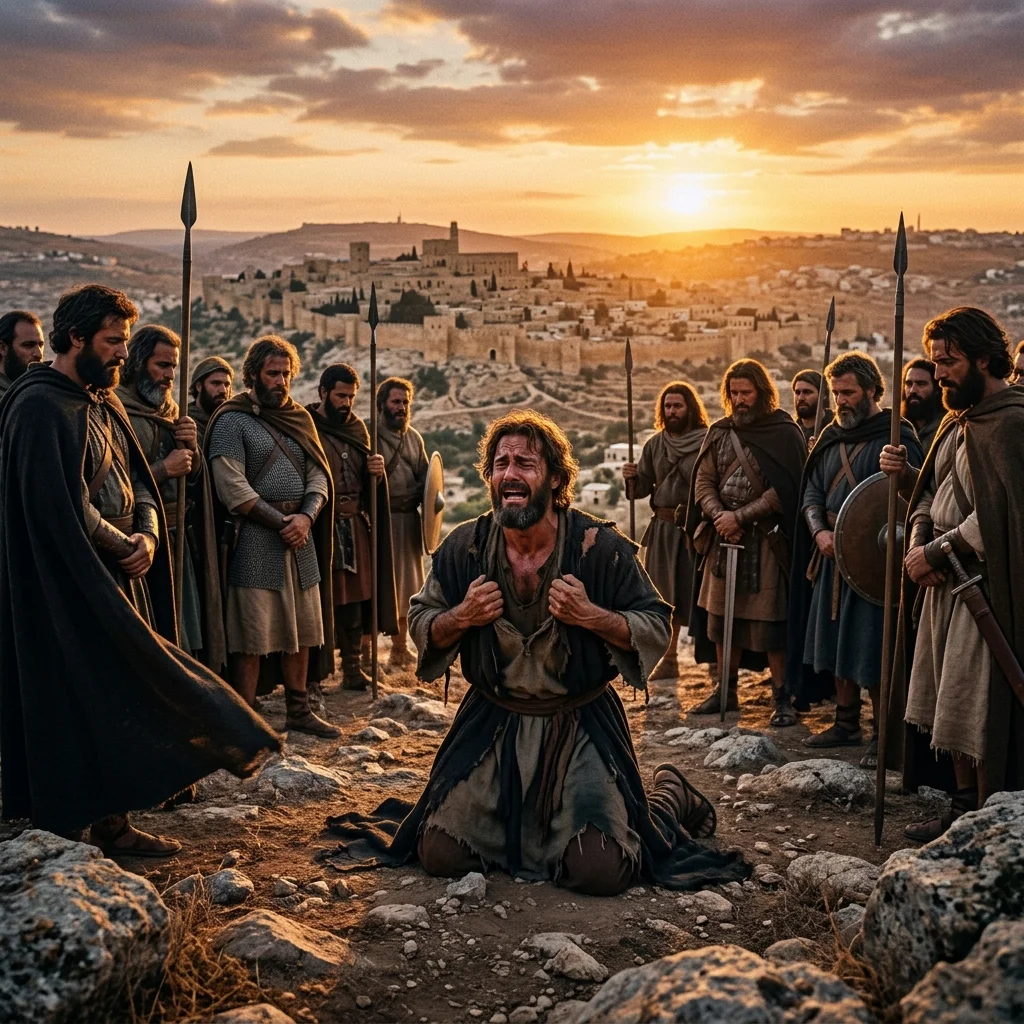 David tore his clothes and wept in deep grief over Saul and his beloved brother Jonathan, composing the Song of the Bow.
An Amalekite young man came to Ziklag to David, claiming he had killed Saul at Saul's request and bringing Saul's crown and armlet. He expected a reward. But David tore his clothes, and so did all the men with him. They mourned and wept and fasted until evening for Saul and his son Jonathan, and for the army of the Lord.
David said to the young man, "Why were you not afraid to lift your hand to destroy the Lord's anointed?" Then David called one of his men and said, "Go, strike him down!" So he struck him down, and he died.
David sang this tragic, beautiful lament for Saul and Jonathan (The Song of the Bow, 2 Samuel 1:19-27):
"A gazelle lies slain on your heights, Israel! How the mighty have fallen! Tell it not in Gath, proclaim it not in the streets of Ashkelon, lest the daughters of the Philistines be glad... Saul and Jonathan—in life they were loved and admired, and in death they were not parted. They were swifter than eagles, they were stronger than lions... I grieve for you, Jonathan my brother; you were very dear to me. Your love for me was wonderful, more wonderful than that of women. How the mighty have fallen! The weapons of war have perished!"
3. Anointed King of Judah at Hebron
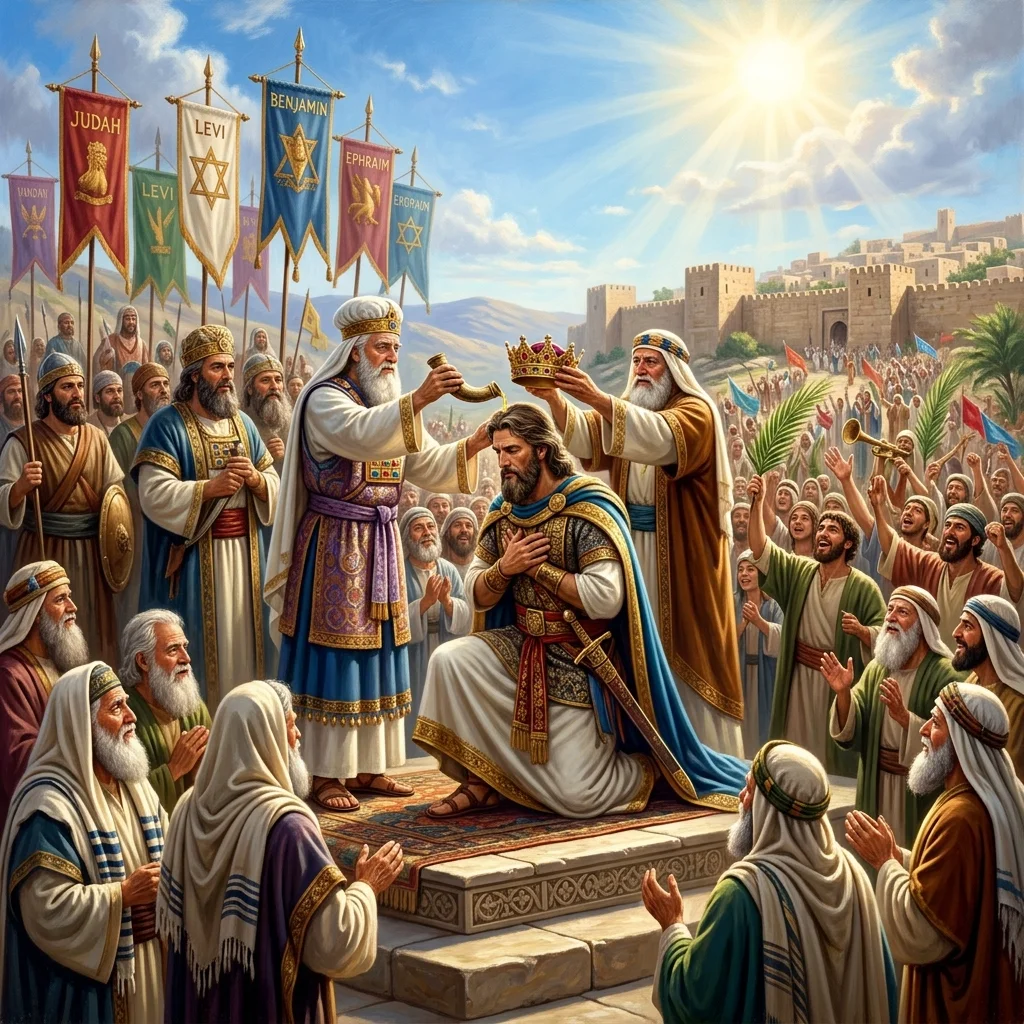 At Hebron, the elders of Israel anointed David king over all twelve tribes, establishing his royal reign.
In the course of time, David inquired of the Lord: "Shall I go up to one of the towns of Judah?"
The Lord said, "Go up."
David asked, "Where shall I go?"
"To Hebron," the Lord answered.
So David went up there with his wives and his men. Then the men of Judah came to Hebron, and there they anointed David king over the tribe of Judah. David commended the men of Jabesh-gilead for burying Saul.
Meanwhile, Abner son of Ner, the commander of Saul's army, had taken Ish-bosheth son of Saul and made him king over Israel at Mahanaim. Only the tribe of Judah remained loyal to David.
4. Civil War: The House of Saul vs. The House of David
The war between the house of Saul and the house of David lasted a long time. David grew stronger and stronger, while the house of Saul grew weaker and weaker.
Eventually, Abner quarreled with Ish-bosheth and made a secret treaty with David to turn all Israel over to him. However, Joab, David's army commander, murdered Abner in revenge for the death of his brother Asahel. David publicly denounced Joab's crime and wept at Abner's tomb.
Soon after, two of Ish-bosheth's captains assassinated Ish-bosheth in his bed and brought his head to David, expecting a reward. David executed them immediately for killing a righteous man in his own bed. David's uncompromising justice demonstrated that he would not climb to power through political murder.
5. King Over All Israel and the Capture of Jerusalem
All the tribes of Israel came to David at Hebron and said: "We are your own flesh and blood. In the past, while Saul was king over us, you were the one who led Israel on their military campaigns. And the Lord said to you, 'You will shepherd my people Israel, and you will become their ruler.'"
When all the elders of Israel had come to King David at Hebron, the king made a covenant with them at Hebron before the Lord, and they anointed David king over Israel.
David was thirty years old when he became king, and he reigned forty years—seven years and six months in Hebron over Judah, and thirty-three years in Jerusalem over all Israel and Judah.
The king and his men marched to Jerusalem to attack the Jebusites, who lived there. The Jebusites taunted David: "You will not get in here; even the blind and the lame can ward you off."
Nevertheless, David captured the fortress of Zion—which became the City of David. David took up residence in the fortress and called it the City of David. And David became more and more powerful, because the Lord God Almighty was with him. Hiram king of Tyre sent carpenters and masons, and they built a palace for David.
Reflections on the Story:
- No Joy in Enemy's Fall: David's heartbreak over Saul's death shows his pure heart. He did not celebrate the demise of his persecutor but honored Saul's position to the end.
- God's Timing in Exaltation: David was anointed as a teenager, but waited over 15 years through trials before being crowned king over all Israel at age 30. God prepares leaders through patient endurance.
- Shepherd Leadership: God called David to "shepherd" His people. True biblical leadership is marked by protective, humble care for God's flock.
⚡ Fast Facts
- Mount Gilboa Disaster: Saul and his sons Jonathan, Abinadab, and Malki-Shua died in battle.
- Song of the Bow: David composed a famous, touching lament for Saul and Jonathan.
- Reign in Hebron: David was anointed king over Judah first, reigning 7.5 years at Hebron.
- United Monarchy: Anointed king over all 12 tribes at age 30, reigning 33 years in Jerusalem.
❓ Frequently Asked Questions (FAQs)
The Amalekite claimed he killed Saul (though Saul actually fell on his own sword). David established that anyone claiming to murder 'the Lord's anointed' was guilty of treason and worthy of death.
David loved Saul as God's anointed leader and Israel's king. David possessed no personal malice, demonstrating pure, noble grief over Israel's fallen leader and his beloved friend Jonathan.
Jerusalem was located on the border between Judah and Benjamin, making it a neutral, unifying capital for both northern and southern tribes. It was also a strong natural fortress.