A heavy mantle of sorrow settled over the hills of Israel following the death of the venerable prophet Samuel. The entire nation gathered at Ramah to lament their spiritual father and bury him in his ancestral home. With Samuel's restraining presence gone and King Saul's madness untethered, young David withdrew further south into the hyper-arid badlands of the Wilderness of Paran and the rugged frontiers of Maon. In this sun-bleached borderland, where civilization met the untamed desert, David and his six hundred men lived in constant vigilance, maintaining order along an unprotected frontier.
In the town of Maon lived a man of immense material wealth whose pastoral operations were centered seven miles south of Hebron at Carmel. His name was Nabal, an influential scion of the prestigious clan of Caleb. Scripture describes his vast rural empire with vivid scale: "The man was very rich; he had three thousand sheep and a thousand goats" (1 Samuel 25:2). Yet wealth does not confer character. Scripture draws an immediate, razor-sharp character contrast: his wife was named Abigail, a woman described as "of good understanding (*tovath-sekhel*) and beautiful in appearance," but the man was "harsh and evil in his doings; and he was of the house of Caleb" (1 Samuel 25:3). Indeed, his very name in Hebrew, Nabal, meant 'fool' or 'morally senseless.'
During the long, perilous winter and spring months, Nabal's flocks and young shepherds had grazed alongside David's encampment in the wilderness of Carmel. In an era when desert raiders, Bedouin bandits, and Philistine marauders routinely plundered frontier estates, David's battle-hardened warriors had formed an impenetrable protective cordon around Nabal's herds. Nabal's own herdsmen later testified: "The men were very good to us, and we were not hurt, nor did we miss anything as long as we accompanied them, when we were in the fields. They were a wall to us both by night and by day, all the time we were with them keeping the sheep" (1 Samuel 25:15-16). David's men had asked for nothing, taking neither sheep nor wages.
The season of sheep-shearing (*gazaz*) arrived at Carmel—a festive ancient Near Eastern economic celebration comparable to harvest time, marked by lavish hospitality, bountiful feasts, and generous gratuities to allies and regional guardians. Hearing that Nabal was shearing his flocks, David sent ten young men up to Carmel with a courteous, dignified greeting: "Peace be to you, peace to your house, and peace to all that you have! Now I have heard that you have shearers... Therefore let the young men find favor in your eyes, for we come on a feast day. Please give whatever comes to your hand to your servants and to your son David" (1 Samuel 25:6-8).
When David's messengers delivered the message, Nabal's response was venomous, arrogant, and contemptuous. Turning on the young men with insolent sneers, the wealthy landowner barked: "Who is David, and who is the son of Jesse? There are many servants nowadays who break away each one from his master! Shall I then take my bread and my water and my meat that I have killed for my shearers, and give it to men when I do not know where they are from?" (1 Samuel 25:10-11). Nabal did not merely decline a polite request; he publicly slandered David as a rebellious runaway slave, repudiated his lineage, and treated his men like common vagrants.
When the ten youths returned and reported Nabal's insult, David's patience evaporated into white-hot, lethal rage. The injustice of having guarded Nabal's empire for months only to be spat upon as an outlaw struck David's warrior pride. David snapped a short, ominous command to his men: "Every man gird on his sword!" Four hundred armed warriors buckled on their bronze weapons and marched behind David, while two hundred stayed with the baggage. Striding furiously through the dust, David swore a terrifying, blood-curdling oath: "May God do so, and more also, to the enemies of David, if I leave one male of all who belong to him by morning light!" (1 Samuel 25:22).
Meanwhile, one of Nabal's young herdsmen rushed to Abigail, warning her of the impending catastrophe: "Look, David sent messengers from the wilderness to greet our master; and he reviled them! But the men were very good to us... Now therefore, know and consider what you will do, for evil is determined against our master and against all his household. For he is such a scoundrel that no one can speak to him!" (1 Samuel 25:14-17).
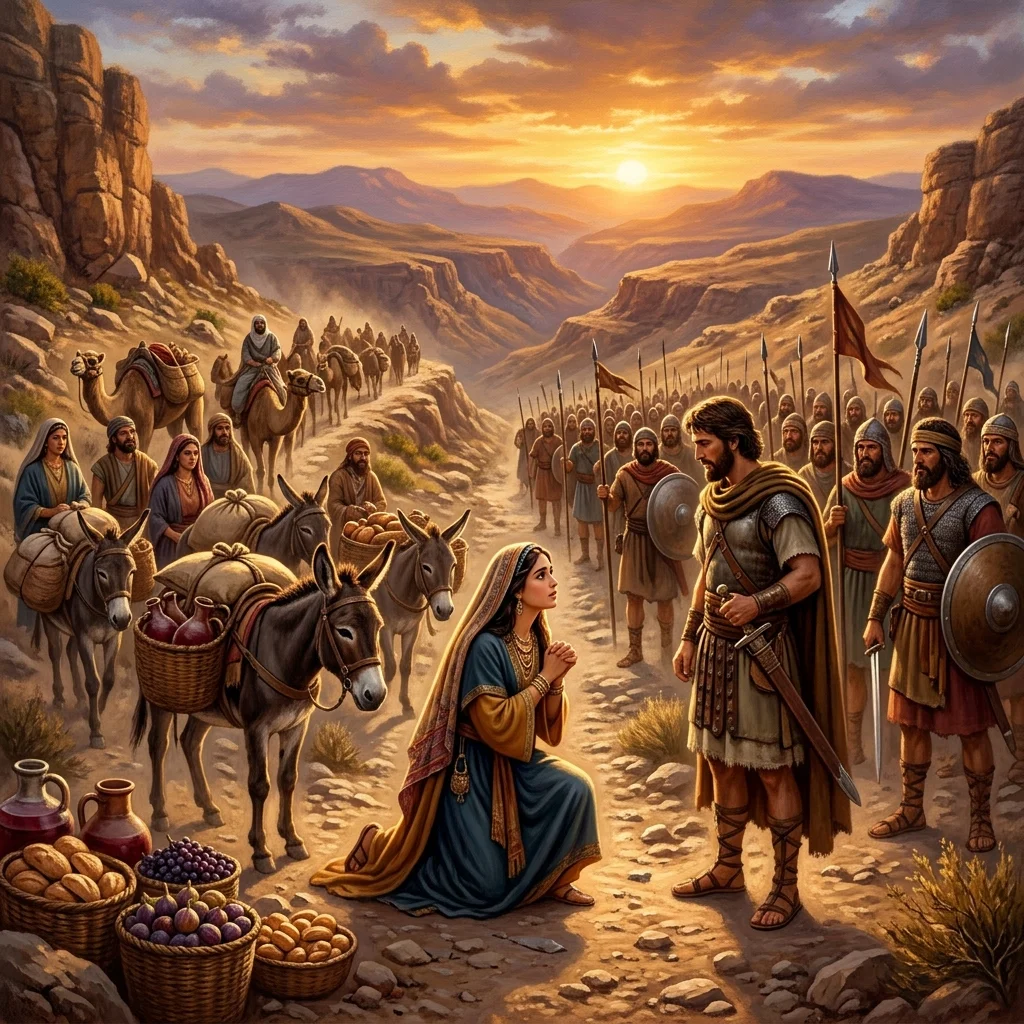
Recognizing that her husband's stubborn folly was about to bring swift military annihilation upon their entire estate, Abigail acted with breathtaking decisiveness. Without consulting Nabal, she marshaled her servants and assembled a lavish, emergency relief caravan: two hundred loaves of fresh bread, two large leather skins of matured wine, five butchered sheep ready for roasting, five seahs (about thirty-seven liters) of parched grain, one hundred clusters of raisins, and two hundred cakes of pressed figs. Loading the high-calorie provisions upon donkeys, she ordered her young men: "Go on before me; see, I am coming after you!"
Riding her donkey down a concealed mountain ravine, Abigail suddenly rounded a bend and came face to face with David and his four hundred armed men marching toward Carmel with drawn swords. The tension was electrifying. Without a moment's hesitation, Abigail dismounted, threw herself face-down upon the rocky soil, and prostrated herself before David's feet. Her opening words, recorded in 1 Samuel 25:24-31, represent one of the most sublime rhetorical and theological masterpieces in the entire Old Testament:
"On me, my lord, on me let this iniquity be! And please let your maidservant speak in your ears, and hear the words of your maidservant. Please, let not my lord regard this scoundrel Nabal. For as his name is, so is he: Nabal is his name, and folly is with him! But I, your maidservant, did not see the young men of my lord whom you sent... Now therefore, my lord, as Yahweh lives and as your soul lives, since Yahweh has held you back from coming to bloodshed and from avenging yourself with your own hand, now then, let your enemies and those who seek harm for my lord be as Nabal!"
Then, gesturing toward the laden donkeys behind her, Abigail presented her gift: "And now this present (*Berakhah*) which your maidservant has brought to my lord, let it be given to the young men who follow my lord. Please forgive the trespass of your maidservant." Abigail then soared into prophetic heights, declaring with divine clarity:
"For Yahweh will certainly make for my lord an enduring house, because my lord fights the battles of Yahweh, and evil is not found in you throughout your days! And though a man has risen to pursue you and seek your life, yet the soul of my lord shall be bound in the bundle of the living (*Tseror ha-Chayyim*) with Yahweh your God; and the souls of your enemies He shall sling out, as from the pocket of a sling (*Kela*)! And it shall come to pass, when Yahweh has done for my lord according to all the good that He has spoken concerning you, and has appointed you ruler over Israel, that this will become no grief to you, nor offense of heart to my lord, either that you have shed blood without cause, or that my lord has avenged himself. But when Yahweh has dealt well with my lord, then remember your maidservant!" (1 Samuel 25:28-31).
Abigail's words hit David's conscience like a shaft of divine light. In a single moment, she stripped away the red mist of vengeance, reminded him of his sacred calling as Yahweh's covenant champion, and saved him from staining his future throne with innocent blood. Trembling with awe, David praised the God of Israel:
"Blessed is Yahweh, God of Israel, who sent you this day to meet me! And blessed is your advice, and blessed are you, because you have kept me this day from coming to bloodshed and from avenging myself with my own hand! For indeed, as Yahweh God of Israel lives, who has kept me back from hurting you, unless you had hurried and come to meet me, surely by morning light not one male would have been left to Nabal!" (1 Samuel 25:32-34).
David received the provisions from her hand and pronounced the blessing of peace: "Go up in peace to your house. See, I have heeded your voice and respected your person."
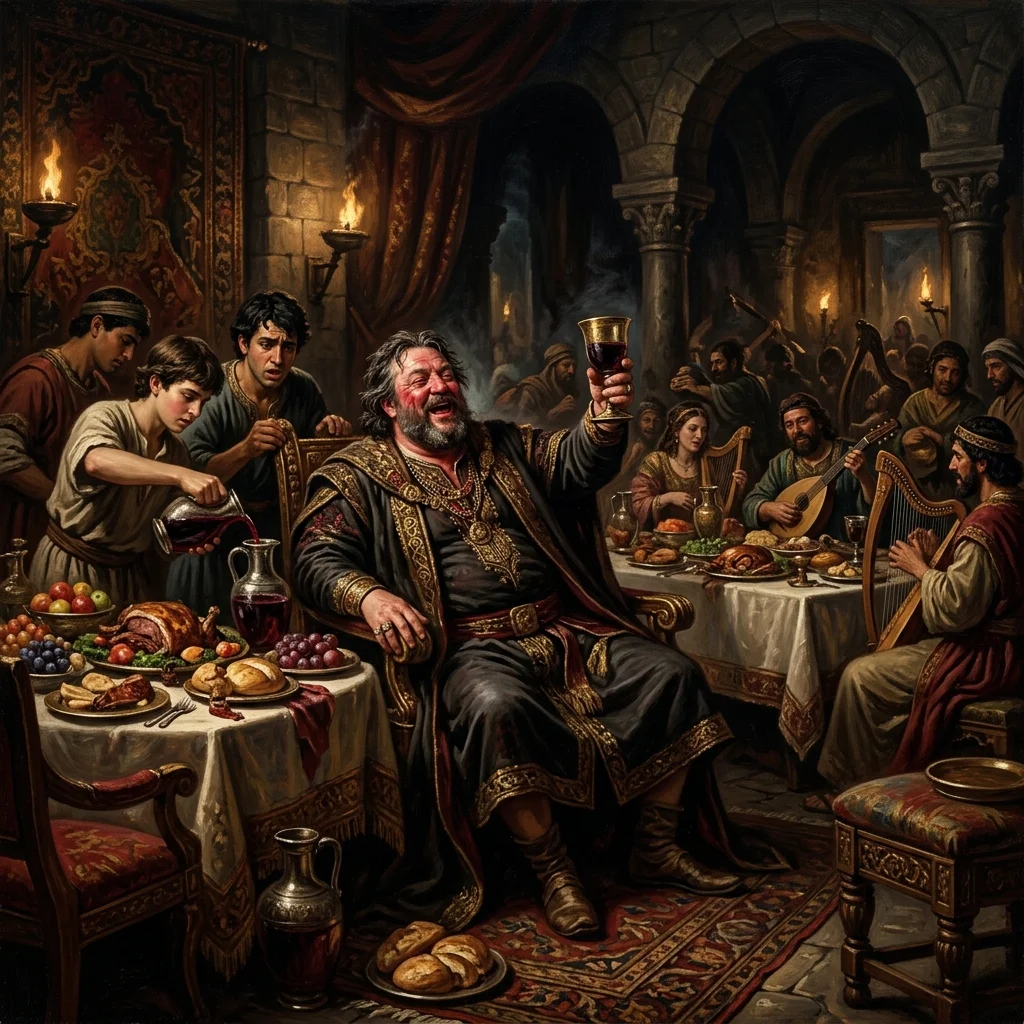
When Abigail arrived back at the estate in Carmel, she found Nabal holding a lavish feast in his hall, drinking heavily "like the feast of a king" (1 Samuel 25:36). His heart was merry with wine, and he was thoroughly intoxicated. Exhibiting remarkable wisdom, Abigail said nothing to him, great or small, until the morning light. At dawn, when the alcohol had worn off and Nabal was sober, Abigail recounted everything: the four hundred armed men, David's deadly vow, the gift of provisions, and how close his entire household had come to annihilation.
The psychological and physiological shock was devastating. As the terrifying reality sank in, Scripture records: "His heart died within him, and he became like a stone" (1 Samuel 25:37). Overcome by a catastrophic stroke or heart failure, Nabal lay paralyzed and comatose for ten days. Then, in the sovereign timing of heaven, "Yahweh struck Nabal, and he died" (1 Samuel 25:38).
When David heard that Nabal was dead, he fell to his knees in thanksgiving: "Blessed be Yahweh, who has pleaded the cause of my reproach from the hand of Nabal, and has kept His servant from evil! For Yahweh has returned the wickedness of Nabal on his own head" (1 Samuel 25:39). Recognizing the extraordinary spiritual depth, courage, and beauty of Abigail, David sent messengers to Carmel proposing marriage. Bowing her face to the earth, Abigail accepted in humble servant-hood: "Here is your maidservant, a servant to wash the feet of the servants of my lord." Arising quickly, Abigail mounted her donkey and, accompanied by five maidens, rode into the wilderness to become David's wife. In the dry plains of Carmel, Abigail proved that wise, sacrificial peacemaking is a power far greater than armies, guiding God's anointed safely toward his eternal throne!
Biblical Keywords & Theological Roots
Fool, foolish, senseless, or churlish. Denotes not intellectual incapacity, but moral degradation, spiritual stubbornness, and closed-hearted rebellion against God and common human decency.
Good understanding, prudent discernment, wisdom, or wise intellect. Applied to Abigail in 1 Samuel 25:3, emphasizing her strategic insight, practical tact, and spiritual comprehension.
The bundle of the living / pouch of life. Refers to a small leather pouch or knot in which shepherds and travelers tied their most precious treasures. Abigail declared that God binds David's life securely in His eternal protection.
The hollow pocket or sling-leather of a war sling from which stones are propelled with centrifugal velocity. Abigail's vivid metaphor for God violently expelling David's enemies into destruction.
Blessing, gift, present, or peace offering. Used by Abigail in 1 Samuel 25:27 for the extensive caravan of food provisions brought to alleviate David's hunger and reconcile the breach.
Ancient Near Eastern & Archaeological Context
The narrative of 1 Samuel 25 is situated in the semi-arid Judean highlands and the northern Negev desert, specifically around Maon and Carmel (Tell Maon and Khirbet el-Kirmil, 7 miles south of Hebron). During Iron Age I (c. 1015 BC), pastoral estates in this frontier zone relied heavily on regional security arrangements. In the absence of centralized royal policing from Saul's distant capital in Gibeah, pastoral clans were vulnerable to devastating raids from predatory Amalekite, nomadic Bedouin, and Philistine raiders. David's 600-man guerrilla force functioned as a de facto regional protective constabulary, shielding flocks and seasonal shearing encampments without extorting protection fees. Sheep-shearing (*gazaz*) was an ancient Near Eastern festival of immense economic wealth, lavish hospitality, and communal feasting, where customary etiquette mandated generous gifts to regional protectors and the destitute. Nabal was of the clan of Caleb—a prestigious, wealthy Judean lineage holding vast land grants dating back to the conquest of Hebron (Joshua 14:13-15). His churlish refusal violated sacred Semitic hospitality codes. Abigail's provisions—200 loaves of barley/wheat bread, two skins of fermented wine, five butchered sheep, five seahs of parched grain (*qali*), 100 clusters of raisins (*tsimmuqim*), and 200 fig cakes (*debhelim*)—represented high-calorie, long-shelf-life luxury provisions essential for wilderness sustenance.
Practical Discipleship & Spiritual Application
- Listen to Godly Voices That Intercept Your Rage: David was armed and galloping to commit mass murder when Abigail intercepted him. Instead of being blinded by pride, David had the humility to stop, listen, and recognize God's voice through a woman's wisdom. Never let pride keep you from listening to righteous restraint.
- Stand in the Gap as a Peacemaker: When your family, church, or community is threatened by conflict caused by someone else's foolishness, emulate Abigail. Step into the breach with humility, proactive generosity, and diplomatic grace, trusting God to use you to avert catastrophe.
- Rest Secure in God's Bundle of Life: No matter how severe the attacks of your enemies or how volatile your circumstances, your life is bound up in the 'bundle of the living' (*Tseror ha-Chayyim*) with the Lord Jesus Christ. Nothing can pluck you out of His sovereign hand (John 10:28).
- Entrust Vindication to Yahweh: When people treat you churlishly, repaying your kindness with slander, do not take the law into your own hands. Step back and let God work. Yahweh struck Nabal without David shedding a drop of blood, proving that God's justice is perfect and unfailing.
Support Independent Biblical Research
Did this study bless you? Help support our independent bilingual research and interactive visual Bible tools.
⚡ Fast Facts
- Abigail is described in 1 Samuel 25:3 with a rare dual compliment: she was both 'of good understanding' (*tovath-sekhel*) and 'beautiful in appearance' (*yephath to'ar*), contrasting sharply with Nabal who was 'harsh and evil in his doings.'
- Abigail's prophetic declaration that David's life is bound in the 'bundle of the living' (*Tseror ha-Chayyim*, 1 Samuel 25:29) has become one of the most famous Jewish epitaphs throughout history, abbreviated as the acronym 'TANZBA' on Jewish gravestones worldwide.
- Nabal's name in Hebrew (*Nabal*) is the exact reverse letters of the Hebrew word for 'heart' (*Levav*), symbolizing his spiritually inverted, backward, and stony heart.
- Nabal held a feast in his house 'like the feast of a king' (1 Samuel 25:36), ironically displaying royal pretension just hours before suffering a paralyzing stroke that turned his body like stone.
❓ Frequently Asked Questions (FAQs)
Why was David so enraged by Nabal's refusal to provide food (1 Samuel 25:10-13)?
David's furious reaction must be understood in its historical and socio-economic context. In the lawless Judean wilderness, David's 600-man guerrilla force had provided months of continuous, unpaid security for Nabal's shepherds and 3,000 sheep, serving as a defensive wall against desert bandits and Philistine raiders. Customary ancient Near Eastern hospitality mandated that on sheep-shearing day—a major economic harvest festival characterized by lavish feasting—wealthy landholders generously rewarded seasonal protectors. When David sent a respectful greeting with ten young men, Nabal did not merely decline; he hurled vile public insults, calling David an escaped runaway slave and questioning his parentage: 'Who is David, and who is the son of Jesse? There are many servants nowadays who break away each one from his master!' This was not merely an insult to David's dignity, but a slanderous challenge to his legitimacy and a denial of basic Semitic justice. However, while Nabal's conduct was despicable, David's impulsive decision to slaughter every male in the household was sinful overkill born of wounded pride, from which Abigail mercifully rescued him.
What makes Abigail's intercession before David one of the greatest speeches in Scripture?
Abigail's speech in 1 Samuel 25:23-31 is a rhetorical and theological masterpiece. First, she immediately identified with the offender, falling on her face and pleading: 'On me, my lord, on me let this iniquity be!' mirroring the substitutionary intercession of Moses and foreshadowing Christ. Second, she reframed the crisis spiritually, explaining that God Himself was orchestrating this moment to keep David from shedding innocent blood and avenging himself with his own hand. Third, she prophetically elevated David's perspective from a petty frontier feud to his divine destiny, reminding him that he fights the battles of Yahweh and that Yahweh will build him an enduring house. Fourth, she coined the immortal metaphor of the 'bundle of the living' (*Tseror ha-Chayyim*) versus the 'pocket of the sling' (*Kela*), reminding David that a man whose life is guarded by God has no need to soil his hands with petty vengeance. Finally, she asked to be remembered when God fulfilled His royal promise. Her speech disarmed David's anger completely, eliciting worship and gratitude.
What was the medical and spiritual nature of Nabal's death (1 Samuel 25:37-38)?
Scripture records that when Abigail told Nabal the next morning of her intervention—after his drunken stupor had worn off—'his heart died within him, and he became like a stone. Then it happened, after about ten days, that Yahweh struck Nabal, and he died.' Medically, the sudden realization of how narrowly he had escaped a military slaughter, combined with the severe physiological shock of coming down from an acute alcoholic binge, likely triggered a massive ischemic stroke, intracranial hemorrhage, or catastrophic myocardial infarction, leaving him comatose or paralyzed for ten days before organ failure ended his life. Theologically, however, Scripture is unequivocal: 'Yahweh struck Nabal.' God demonstrated that human vengeance is entirely redundant; divine justice is thoroughly capable of executing righteous retribution in His perfect timing without compromising the soul of His anointed.