Having united all twelve tribes of Israel under his shepherd-kingship at Hebron, King David turned his eyes toward the strategic mountain ridge crowned by the Jebusite fortress of Jebus. Perched precipitously above the Kidron and Tyropoeon Valleys, the limestone promontory was regarded by its inhabitants as utterly impregnable, prompting the Jebusites to boast that even the blind and the lame could defend its battlements. Yet David's elite warriors, led by Joab, scaled the vertical subterranean water shaft (*Tzinnor*), captured the fortress of Zion, and established Jerusalem as the federal capital of the United Monarchy—the eternal 'City of David.'
Yet for David, Jerusalem could never function merely as an administrative seat of human imperial power. Above all else, it had to become the dwelling place of the living God. For roughly seventy years, since the disastrous battle of Ebenezer and the fall of Shiloh, the sacred Ark of the Covenant—Yahweh's golden footstool flanked by cherubim—had languished in rustic obscurity inside the house of Abinadab in the border village of Kiriath-Jearim (Baale-Judah). David resolved to correct this historical anomaly. Mobilizing thirty thousand chosen men from across all twelve tribes, David marched toward Kiriath-Jearim to bring the Ark of God up to Zion with royal celebration.
However, an ominous theological mistake corrupted the joyous venture from its inception. Rather than consulting the sacred Torah, which strictly commanded that the Kohathite Levites must carry the holy Ark upon their shoulders using gold-covered acacia poles (Numbers 4:15; 7:9), the leaders of Israel mimicked the pagan Philistines (1 Samuel 6:7) by placing the Ark of God upon a brand-new wooden cart drawn by oxen. Abinadab's sons, Uzzah and Ahio, guided the cart, while David and all the house of Israel celebrated with exhilarating liturgical music, playing before Yahweh on harps, stringed instruments, timbrels, sistrums, and cymbals.
The joyous procession wound its way through the rugged Judean hills until it reached the threshing floor of Nacon. Suddenly, the oxen stumbled on the uneven limestone terrain. As the wooden cart lurched violently, Uzzah instinctively reached out his bare hand and grabbed hold of the sacred golden chest to steady it. In that terrifying instant, Scripture records the terrible flash of divine judgment: "Then the anger of Yahweh was aroused against Uzzah, and God struck him there for his error; and he died there by the Ark of God" (2 Samuel 6:7).
A stunned, suffocating silence fell upon the thirty thousand celebrants. David was deeply shaken and grieved because Yahweh had broken out against Uzzah, naming that place Perez-Uzzah (*Parats Uzzah*). In that dreadful moment, David realized that holiness is dangerous. Overcome by holy terror, David cried: "How can the Ark of Yahweh come to me?" (2 Samuel 6:9). Unwilling to move the Ark directly into Jerusalem, David diverted the sacred chest to the nearby estate of Obed-Edom the Gittite, returning to Jerusalem in solemn contemplation.
For three months, the Ark of the Covenant rested in the home of Obed-Edom. During those ninety days, far from bringing destruction, the manifest presence of God brought extraordinary blessings: "And Yahweh blessed Obed-Edom and all his household" (2 Samuel 6:11). When word reached David in Jerusalem that Obed-Edom's fields, cattle, and family were flourishing under divine favor, the king understood the spiritual lesson: the holiness of God does not destroy those who approach Him with consecrated reverence; it only consumes presumptuous disobedience.
David prepared a tent in Jerusalem and rectified the operational protocol with rigorous scriptural precision. Summoning Zadok, Abiathar, and the Levitical chiefs, David declared: "Because you did not do it the first time, Yahweh our God broke out against us, because we did not consult Him about the proper order!" (1 Chronicles 15:13). Consecrating themselves, the Levites lifted the Ark of God upon their shoulders with the golden poles, exactly as Moses had commanded.
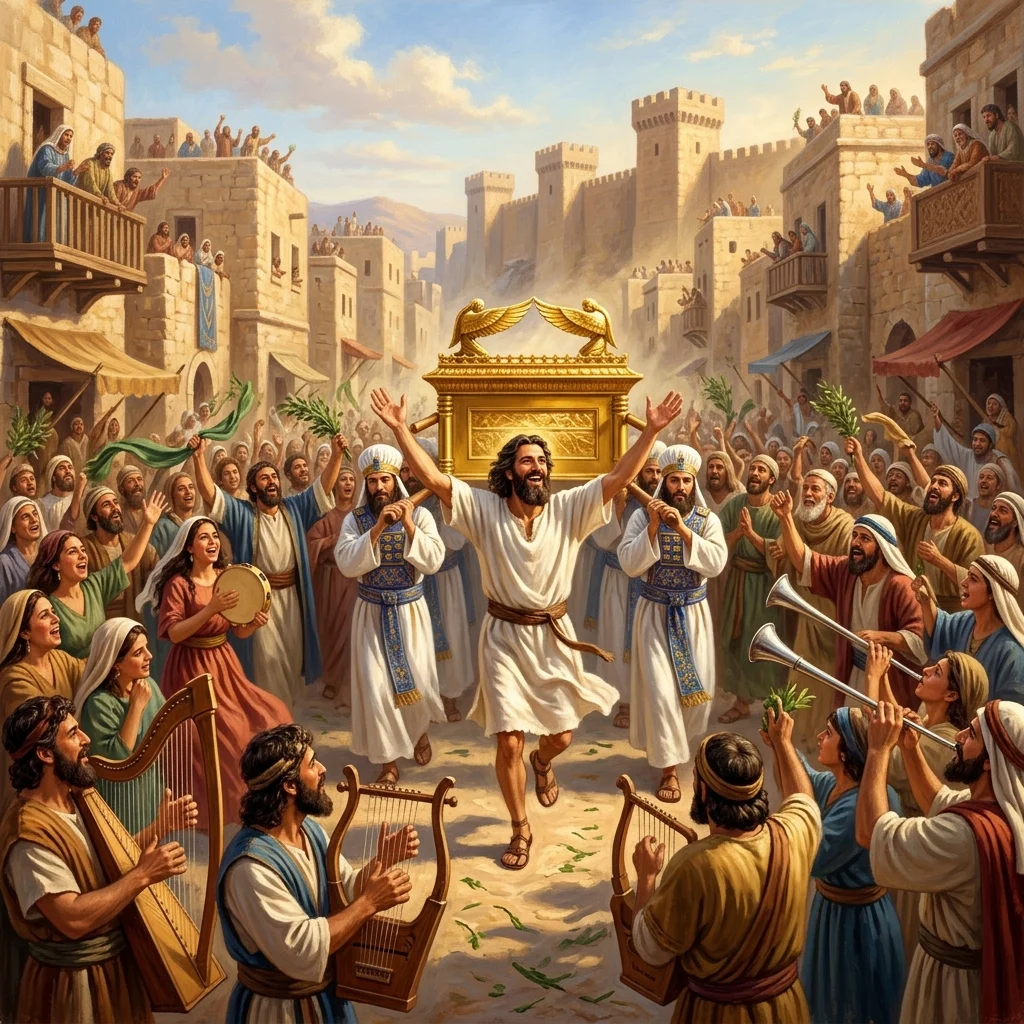
This second procession into Jerusalem was a breathtaking spectacle of holy abandon. When the Levites bearing the Ark had walked six measured paces without divine wrath, David halted the procession and sacrificed a prime ox and a fatted sheep, sanctifying the ground with blood. The journey transformed into an uninterrupted liturgy of sacrifice and praise. Horns sounded, trumpets blasted, and cymbals clashed as the sacred Ark ascended Mount Zion.
Leading the royal procession was King David himself. Stripping off his heavy royal mantle, his crown, and his military armor, the king wore only a simple linen ephod (*ephod bad*)—the humble vestment of a servant-priest. Overflowing with ecstatic joy, David danced before Yahweh with all his might (*Karkar*), leaping, spinning, and whirling through the streets in uninhibited celebration before the King of kings.
Yet as the joyful Ark entered the city gates, a pair of haughty eyes watched from an elevated palace window. Michal, Saul's daughter and David's wife, looked down upon the street. Seeing her royal husband dancing and whirling among common maidservants and soldiers without aristocratic reserve, Scripture records with chilling brevity: "She despised him in her heart" (2 Samuel 6:16). When David returned home to bless his household, Michal greeted him with venomous sarcasm: "How glorious was the king of Israel today, uncovering himself today in the eyes of the maids of his servants, as one of the base fellows shamelessly uncovers himself!"
David's reply was fearless and uncompromising: "It was before Yahweh, who chose me instead of your father and all his house, to appoint me ruler over the people of Yahweh, over Israel! Therefore I will play music before Yahweh. And I will be even more undignified than this, and will be humble in my own sight. But as for the maidservants of whom you have spoken, by them I will be held in honor!" (2 Samuel 6:21-22). Scripture solemnizes the consequence of Michal's proud contempt: "Therefore Michal the daughter of Saul had no children to the day of her death" (2 Samuel 6:23), terminating Saul's rejected dynastic line forever.
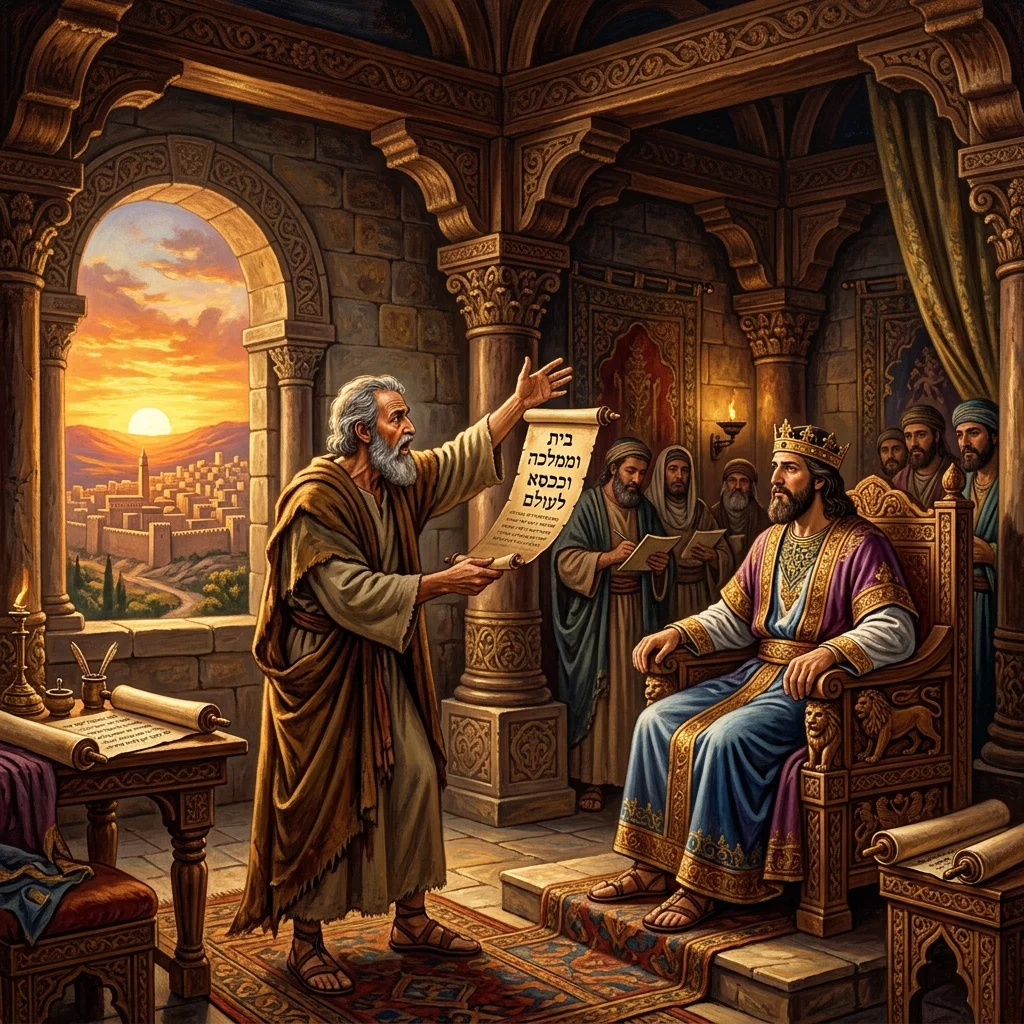
With the Ark resting safely in the holy tent on Mount Zion and peace established on every border, King David sat in his luxurious royal palace built from imported Phoenician cedar. Yet a holy unease troubled the monarch's heart. Summoning the court prophet Nathan, David confessed his conviction: "See now, I dwell in a house of cedar, but the Ark of God dwells inside tent curtains!" (2 Samuel 7:2). David longed to build a monumental stone temple worthy of the Lord of Hosts. Nathan initially encouraged the king: "Go, do all that is in your heart, for Yahweh is with you."
But that very night, the word of Yahweh came to Nathan, completely reversing the human proposal with a cosmic theological revelation. God instructed Nathan to return to David with a divine oracle:
"Would you build a house (*Bayit*) for Me to dwell in? For I have not dwelt in a house since the day that I brought the children of Israel up from Egypt, even to this day, but have moved about in a tent and in a tabernacle... Did I ever speak a word to anyone from the tribes of Israel, saying, 'Why have you not built Me a house of cedar?'" (2 Samuel 7:5-7).
Then Yahweh unveiled the sublime covenant mystery. David thought he was going to build God a house; instead, God announced that He was going to build David an eternal house:
"Also Yahweh tells you that He will make you a house (*Bayit*). When your days are fulfilled and you rest with your fathers, I will set up your seed after you, who will come from your body, and I will establish his kingdom. He shall build a house for My name, and I will establish the throne of his kingdom forever! I will be his Father, and he shall be My son. If he commits iniquity, I will chasten him with the rod of men... But My mercy (*Hesed*) shall not depart from him, as I took it from Saul, whom I removed from before you. And your house and your kingdom shall be established forever before you. Your throne shall be established forever (*Kisse Olam*)!" (2 Samuel 7:11-16).
This Davidic Covenant stands as the towering summit of Old Testament messianic prophecy. God promised David an unconditional, eternal kingdom—a promise pointing beyond Solomon's earthly temple to the eternal reign of Jesus Christ, the Son of David and King of kings, whose kingdom shall never end.
Overwhelmed by the staggering magnitude of divine grace, King David walked into the sacred tent, sat down before the Ark of Yahweh, and poured out his soul in reverent awe: "Who am I, O Lord Yahweh? And what is my house, that You have brought me this far? And yet this was a small thing in Your sight, O Lord Yahweh; and You have also spoken of Your servant's house for a great while to come. Is this the manner of man, O Lord Yahweh?... Now therefore, let it please You to bless the house of Your servant, that it may continue forever before You; for You, O Lord Yahweh, have spoken it, and with Your blessing let the house of Your servant be blessed forever!" (2 Samuel 7:18-19, 29). On the heights of Zion, the humble shepherd of Bethlehem worshipped the God who turns human weakness into eternal glory!
Biblical Keywords & Theological Roots
The breach of Uzzah; an outbreak of divine wrath upon Uzzah for touching the sacred Ark. From 'parats' (to break through, outburst, shatter) and 'Uzzah' (strength).
Whirling, leaping, dancing, or turning around with energetic abandon. Used in 2 Samuel 6:14, 16 to describe David dancing before Yahweh with all his physical might.
House, palace, temple, or royal dynasty. The central Hebrew theological pun in 2 Samuel 7: David desired to build God a physical temple ('bayit'), but God promised to build David an eternal royal dynasty ('bayit').
Steadfast love, lovingkindness, covenant mercy, and unwavering loyalty. In 2 Samuel 7:15, God promises that His hesed will never depart from David's lineage as it departed from Saul.
Throne of eternity / everlasting throne. The culminating covenant guarantee in 2 Samuel 7:16: 'Your throne shall be established forever,' fulfilled eternally in the kingship of Jesus Christ.
Ancient Near Eastern & Archaeological Context
The events of 2 Samuel 6–7 take place in the newly unified capital of Jerusalem (the City of David, occupying the narrow 12-acre southeastern Ophel ridge) circa 1000 BC. Following the capture of the natural karst limestone promontory from the Jebusites via the subterranean water shaft (the *Tzinnor* or Warren's Shaft), David strategically established Jerusalem as an extra-tribal federal and religious capital. The Ark of the Covenant had languished for approximately seventy years in the rustic border village of Kiriath-Jearim (modern Deir el-'Azar / Abu Ghosh) following its return by the Philistines. Modern archaeological excavations at Kiriath-Jearim directed by Israel Finkelstein and Thomas Römer uncovered a massive Iron Age IIA elevated monumental platform and terrace walls designed to house a regional cultic installation. The distance from Kiriath-Jearim to Jerusalem is approximately nine miles across steep Judean limestone hills. Transporting the Ark upon a new wooden cart drawn by oxen mirrored Philistine pagan practices (1 Samuel 6:7) rather than the strict Mosaic prescription requiring Kohathite Levites to bear the Ark using gold-covered acacia poles resting upon their shoulders (Numbers 4:15; 7:9). Royal Phoenician cedar logs imported from King Hiram of Tyre (2 Samuel 5:11) introduced sophisticated Aegean and Levantine palace architecture into Jerusalem, contrasting sharply with the nomadic linen tent housing the Ark.
Practical Discipleship & Spiritual Application
- Do God's Work in God's Prescribed Way: Sincerity and enthusiasm can never replace obedience to God's Word. David had good motives, but transporting the Ark on an ox-cart brought death. Always align your ministry methods, business practices, and family leadership with the clear instructions of Scripture.
- Worship with Unashamed, Wholehearted Passion: David shed his royal dignity to dance before the Lord in a linen ephod, utterly uncaring of human criticism. Never let social status, fear of man, or pride stifle your praise. Celebrate God's goodness with joyful, undignified passion.
- Rest in What God Builds for You, Not What You Build for God: David wanted to build a house for God, but God told him, 'I will build you a house.' Stop striving in your own strength to impress God. Rest in His sovereign grace, trusting that Christ builds your life, your family, and your spiritual legacy.
- Trust the Unfailing Covenant Love (*Hesed*) of God: God promised David that even when his descendants sinned, His steadfast love would never depart from them. In Christ Jesus, you are an heir to this everlasting covenant. Even when you stumble, run to His grace, for His mercy endures forever.
Support Independent Biblical Research
Did this study bless you? Help support our independent bilingual research and interactive visual Bible tools.
⚡ Fast Facts
- The Ark of the Covenant had remained at the house of Abinadab in Kiriath-Jearim for approximately seventy years from the days of Eli and Samuel until David brought it to Jerusalem (1 Samuel 7:1-2; 2 Samuel 6:2).
- David offered sacrifices of oxen and fatted sheep every six paces during the joyous procession into Jerusalem (2 Samuel 6:13), turning the nine-mile journey into a continuous liturgy of sacred praise.
- David wore a simple linen ephod (*ephod bad*, 2 Samuel 6:14)—the garment of a servant-priest rather than royal purple armor—symbolizing that in the presence of Yahweh, earthly kings are merely humble servants.
- Nathan's prophecy in 2 Samuel 7:12-16 contains the Hebrew root *Bayit* (house) seven times, forming a divine covenant wordplay contrasting David's earthly palace with God's eternal dynasty.
❓ Frequently Asked Questions (FAQs)
Why was Uzzah struck dead for touching the Ark of the Covenant (2 Samuel 6:6-7)?
To modern readers, Uzzah's death appears unduly severe for an instinctive gesture to prevent the Ark from falling. However, Scripture reveals that Uzzah's tragedy was the culmination of chronic, systemic irreverence. Under Numbers 4:15 and 7:9, the Ark was strictly commanded to be carried on the shoulders of the Kohathite Levites with poles; no human hand was ever to touch the sacred chest under penalty of death. Israel had committed theological malpractice by copying the pagan Philistines, transporting the Ark upon a mechanical ox-cart. Uzzah, having lived beside the Ark in his father's house for decades, had grown dangerously familiar with the holy. In that fatal moment, Uzzah assumed that his fallen human hand was cleaner than the dirt of the threshing floor. God struck Uzzah not out of caprice, but to re-establish the boundary of absolute divine holiness for a newly crowned king and a rejoicing nation: God cannot be approached on human terms.
Why was Michal struck with lifelong barrenness after mocking David's dancing (2 Samuel 6:20-23)?
Michal's disdain for David was not merely marital friction; it was a profound spiritual clash between two opposing worldviews. Looking down from the palace window, Saul's daughter despised David in her heart because she valued royal pride, worldly prestige, and carnal aristocratic decorum above wholehearted worship of Yahweh. Her father Saul had treated religion as a political tool; Michal expected David to maintain aloof monarchical dignity. When she sarcastically mocked David for 'uncovering himself like a vulgar fellow' before maidservants, David retorted that he was dancing before Yahweh who had rejected her father Saul and chosen David instead. In the ancient Near East, royal children secured dynastic succession. God closed Michal's womb until the day of her death, ensuring that the rebellious, rejected lineage of King Saul would never blend with the righteous, messianic dynasty of David.
What is the theological significance of the Davidic Covenant in 2 Samuel 7?
The Davidic Covenant (2 Samuel 7:8-16) represents the foundational messianic promise of the entire Old Testament. God promised David four unconditional guarantees: an enduring name, an undisturbed homeland for Israel, an eternal house (dynasty), and an eternal kingdom with a throne established forever (*Kisse Olam*). While partially fulfilled in Solomon—who built the physical temple and experienced paternal discipline when he sinned—the ultimate fulfillment transcends mortal history. The prophets continually pointed forward to a future 'Branch' of David who would reign eternally (Isaiah 9:6-7; Jeremiah 23:5-6). In Luke 1:32-33, the Angel Gabriel announced to Mary: 'He will be great, and will be called the Son of the Highest; and the Lord God will give Him the throne of His father David. And He will reign over the house of Jacob forever, and of His kingdom there will be no end.' Jesus Christ is the ultimate Son of David who establishes the true, eternal temple of God.