The wilderness of En-gedi, located near the dead sea, is a rugged desert terrain of steep limestone cliffs, hidden caves, and freshwater springs. Here, Saul brought three thousand elite troops to hunt David like a wild animal. In the darkness of these caverns, David faced the ultimate test of character: would he seize the throne by taking revenge into his own hands, or trust God to vindicate him in His timing?
1. The Dark Cave at En-gedi
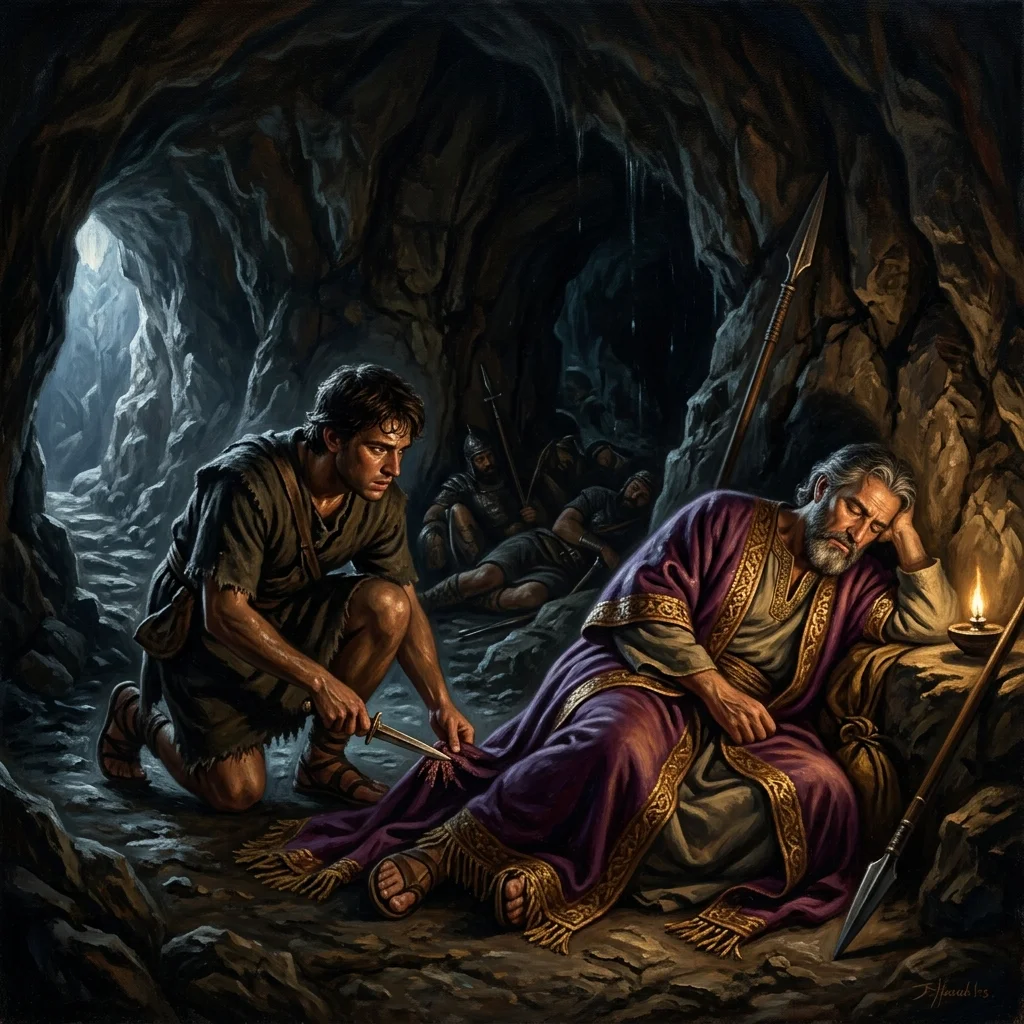
In the back of the dark cave at En-gedi, David quietly crept up and cut off a corner of Saul's royal robe.
When Saul returned from pursuing the Philistines, he was told, "David is in the Wilderness of En-gedi." So Saul took three thousand select troops from all Israel and set out to look for David and his men near the Crags of the Wild Goats.
He came to the sheep pens along the way; a cave was there, and Saul went in to relieve himself. David and his men were far back in the cave.
David's men whispered to him: "This is the day the Lord spoke of when he said to you, 'I will give your enemy into your hands for you to deal with as you wish.'"
Then David crept up unnoticed and cut off a corner of Saul's robe. Afterward, David was conscience-stricken for having cut off a corner of his robe. He said to his men: "The Lord forbid that I should do such a thing to my master, the Lord's anointed, or lay my hand on him; for he is the anointed of the Lord." With these words David sharply rebuked his men and did not let them attack Saul. And Saul left the cave and went his way.
2. Confrontation From the Cliff
Then David went out of the cave and called out to Saul: "My lord the king!" When Saul looked behind him, David bowed down and paid homage with his face to the ground.
David said to Saul: "Why do you listen when men say, 'David is bent on harming you'? This day you have seen with your own eyes how the Lord delivered you into my hands in the cave. Some urged me to kill you, but I spared you; I said, 'I will not lay my hand on my lord, because he is the Lord's anointed.'"
David held up the piece of cloth: "See, my father, look at this piece of your robe in my hand! I cut off the corner of your robe but did not kill you. See and acknowledge that I am not guilty of wrongdoing or rebellion. I have not wronged you, though you are hunting me down to take my life. May the Lord judge between you and me, and may the Lord avenge the wrongs you have done to me, but my hand will not touch you."
When David finished saying this, Saul asked, "Is that your voice, David my son?" And he wept aloud. "You are more righteous than I," he said. "You have treated me well, but I have treated you badly. You have just now told me about the good you did to me; the Lord delivered me into your hands, but you did not kill me. When a man finds his enemy, does he let him get away unharmed? May the Lord reward you well for the way you treated me today. I know that you will surely be king and that the kingdom of Israel will be established in your hands."
Saul returned home, but David and his men went up to the stronghold.
3. The Second Test: The Night Raid at Ziph
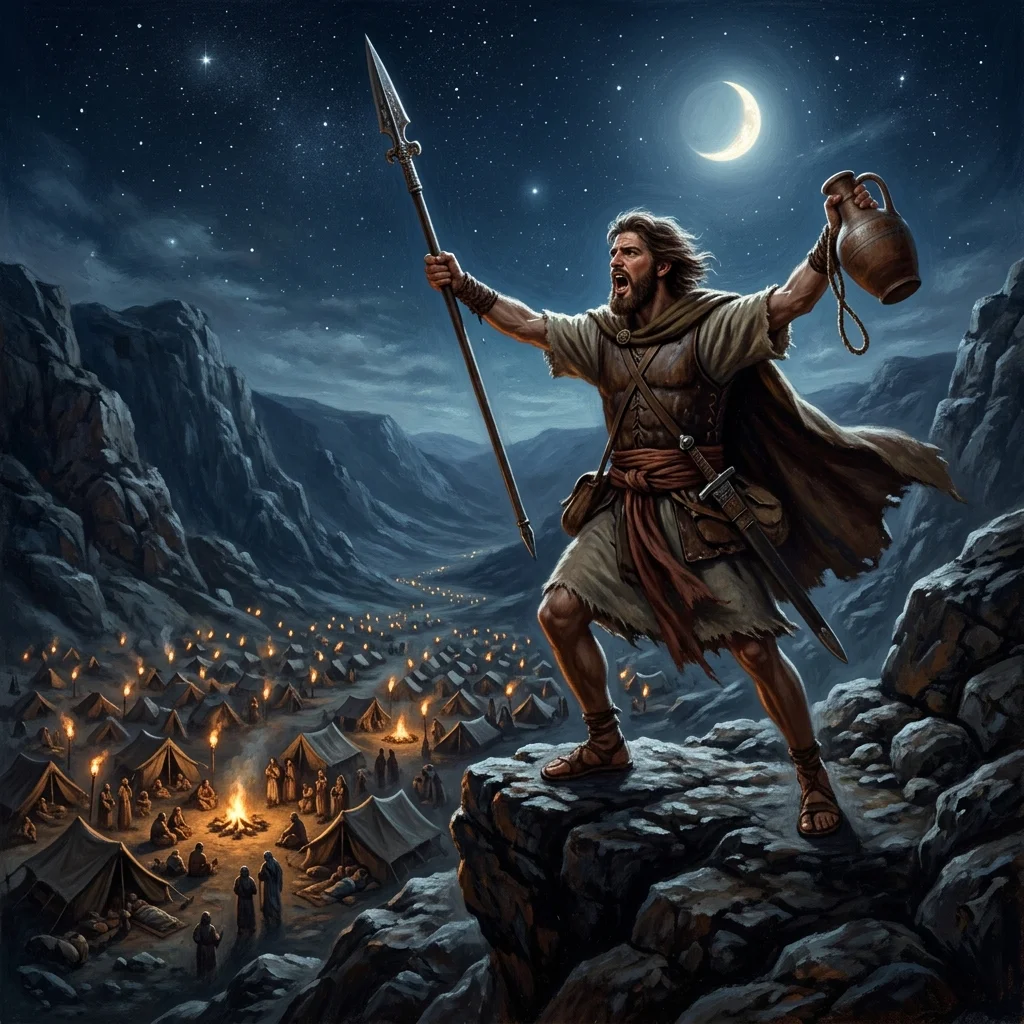 From the top of a hill, David held up Saul's spear and water jug, proving he had spared Saul a second time.
Despite his tears, Saul soon broke his promise and marched into the Desert of Ziph with 3,000 men to hunt David again. David sent out spies and learned that Saul had arrived.
David went to the place where Saul had camped. He saw where Saul and Abner son of Ner, the commander of the army, had lain down. Saul was sleeping inside the camp, with his spear stuck in the ground near his head and his army camped around him.
David asked Abishai son of Zeruiah and Ahimelech the Hittite, "Who will go down into the camp with me to Saul?"
"I'll go with you," Abishai said.
So David and Abishai went to the army by night. Saul was sleeping, his spear stuck in the ground near his head. Abner and the soldiers were lying around him.
Abishai said to David: "Today God has delivered your enemy into your hands. Now let me pin him to the ground with one thrust of the spear; I won't strike him twice."
But David said to Abishai: "Don't destroy him! Who can lay a hand on the Lord's anointed and be guiltless? As surely as the Lord lives, the Lord himself will strike him, or his time will come and he will die, or he will go into battle and perish. But the Lord forbid that I should lay a hand on the Lord's anointed. Now receive the spear and water jug that are near his head, and let's go."
4. The Call from the Hilltop
So David took the spear and water jug near Saul's head, and they left. No one saw or knew about it, nor did anyone wake up. They were all sleeping, because the Lord had put them into a deep sleep.
Then David crossed over to the other side and stood on the top of the hill some distance away; there was a wide space between them. He called out to the army and to Abner: "Aren't you going to answer me, Abner?"
Abner replied, "Who is it that calls to the king?"
David said, "You're a man, aren't you? And who is like you in Israel? Why didn't you guard your lord the king? Someone came in to destroy your lord the king. This thing you have done is not good. As surely as the Lord lives, you and your men must die, because you did not guard your master, the Lord's anointed. Look around you. Where are the king's spear and water jug that were near his head?"
Saul recognized David's voice and said, "Is that your voice, David my son?"
David replied, "Yes it is, my lord the king." And he added, "Why is my lord pursuing his servant? What have I done, and what wrong am I guilty of?... Here is the king's spear. Let one of your young men come over and get it. The Lord rewards everyone for their righteousness and faithfulness."
Then Saul said, "I have sinned. Come back, David my son. Because you considered my life precious today, I will not try to harm you again. Surely I have acted like a fool and have been terribly wrong." David went on his way, and Saul returned home.
Reflections on the Story:
- Refusing Carnal Shortcuts: David had the opportunity to kill Saul twice and claim the throne. He refused to use sinful shortcuts to obtain God's promises, waiting for God's perfect timing.
- Respect for God's Anointing: David honored the office of the king because Saul was anointed by God, leaving judgment entirely in God's hands.
- Overcoming Evil with Good: David repeatedly returned good for evil. His integrity exposed Saul's conscience and glorified God.
⚡ Fast Facts
- En-gedi Cave: David cut off a corner of Saul's robe while Saul was resting in the cave.
- Ziph Night Raid: David and Abishai slipped into Saul's camp, taking his spear and water jug.
- Key Principle: Refused to harm 'the Lord's anointed', leaving judgment entirely to Yahweh.
- Saul's Confession: Saul admitted, 'I have played the fool and have been terribly wrong.'
❓ Frequently Asked Questions (FAQs)
The hem of a royal robe represented royal authority and dignity. David felt cutting it was a mark of disrespect toward God's anointed king.
Abishai saw it as a military opportunity, but David saw it through spiritual covenant. David knew taking a life to seize power would ruin his integrity before God.
Saul experienced emotional remorse and shame when exposed, but his heart was not genuinely transformed, as he soon returned to hunting David.