Stripped in a matter of days of his royal military command, his royal residence, and the comforting fellowship of Crown Prince Jonathan, young David walked out of Gibeah as a hunted fugitive. King Saul's paranoid vendetta had escalated into state-sponsored execution decrees. With no provisions, no weapons, and accompanied only by a few faithful young men, David turned southward toward the sacred Levitical city of Nob. Situated on the slopes of Mount Scopus overlooking the Jebusite stronghold of Jerusalem, Nob served as an interim religious sanctuary where the Tabernacle's bronze altar and consecrated furnishings were housed under the care of High Priest Ahimelech, the great-grandson of Eli.
When David arrived trembling with fatigue at the sanctuary, Ahimelech came out to meet him in great agitation: "Why are you alone, and no one with you?" (1 Samuel 21:1). Knowing that exposing his fugitive status would instantly jeopardize the entire priestly colony, David masked his flight under the guise of an urgent, top-secret royal mission: "The king has ordered me on a business, and said to me, 'Let no one know anything about the business on which I send you'..." Pleading desperate hunger, David asked Ahimelech: "Now therefore, what have you on hand? Give me five loaves of bread, or whatever can be found."
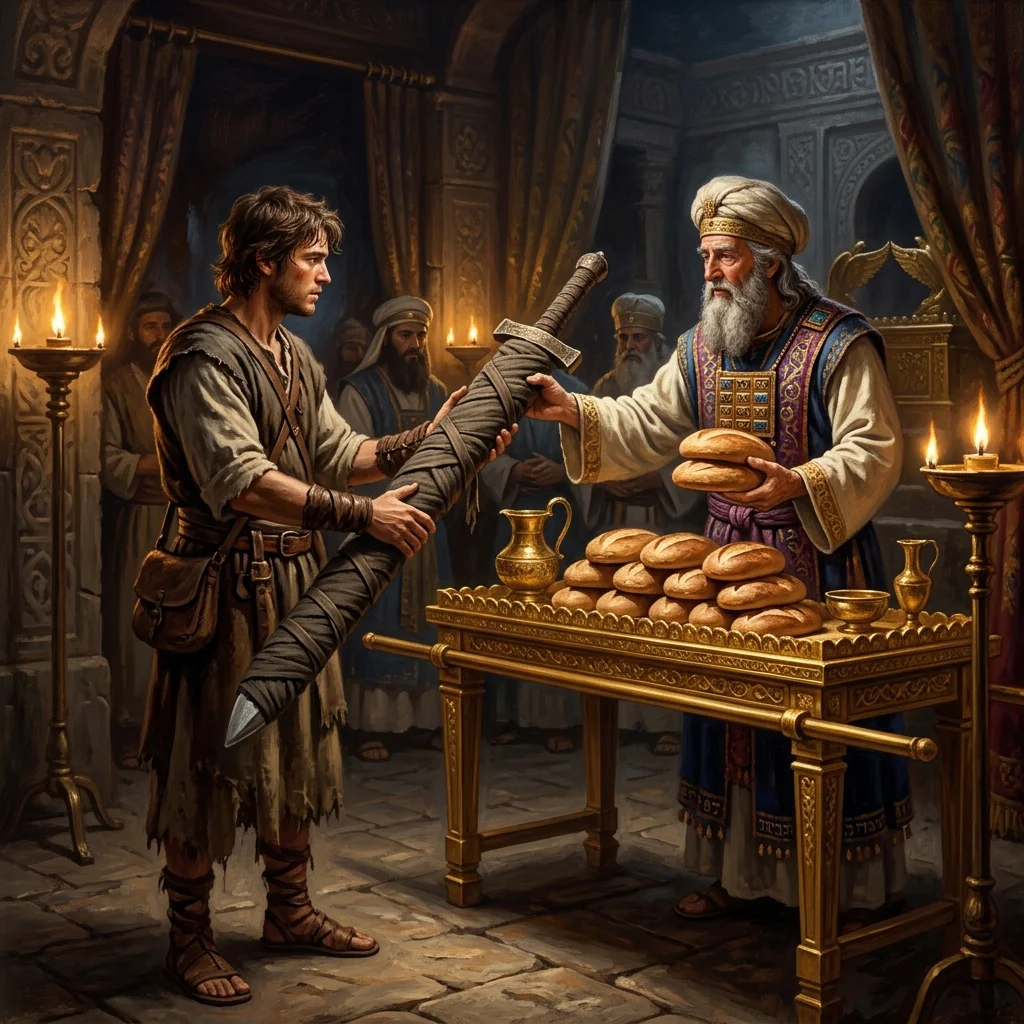
Ahimelech surveyed his sacred storeroom and replied: "There is no common bread on hand; but there is holy bread (*Lechem Panim*)—if the young men have kept themselves from women" (1 Samuel 21:4). Under Mosaic regulations (Leviticus 24:5-9), the twelve consecrated loaves placed perpetually before Yahweh in the Holy Place were reserved exclusively for the Aaronite priesthood. Yet Ahimelech possessed profound spiritual discernment: preserving human life took precedence over ceremonial technicalities. Assured by David that his men were ceremonially pure, the high priest handed him the consecrated Bread of the Presence. Centuries later, the Lord Jesus Christ Himself would vindicate Ahimelech's compassionate decision before the legalistic Pharisees, declaring that divine mercy and human sustenance transcend ceremonial regulations (Matthew 12:1-8).
David then asked the priest: "Is there not here on hand a spear or a sword? For I have brought neither my sword nor my weapons with me, because the king's business required haste." Ahimelech answered: "The sword of Goliath the Philistine, whom you killed in the Valley of Elah, there it is, wrapped in a cloth behind the ephod. If you will take that, take it. For there is no other except that one here." David's eyes flashed with solemn remembrance: "There is none like it; give it to me!" (1 Samuel 21:8-9). But an ominous shadow watched every transaction: Doeg the Edomite, Saul's ruthless chief herdsman, was detained that day before Yahweh at the sanctuary, memorizing every word with cold, treacherous calculation.
Girding Goliath's massive sword to his side, David fled southwest into the coastal plain directly to Gath—the Philistine royal stronghold and ironic hometown of Goliath himself. Seeking asylum outside Saul's military jurisdiction, David hoped to blend into the cosmopolitan city under King Achish. But the Philistine courtiers immediately recognized the legendary Hebrew champion: "Is not this David the king of the land? Did they not sing to one another of him in dances, saying: 'Saul has slain his thousands, and David his ten thousands'?" (1 Samuel 21:11). Terror seized David's heart. He was trapped in the lion's den with the severed sword of their native champion in his hands.
In a breathtaking stroke of survival instinct, David feigned utter madness before their eyes. Clientes and courtiers watched in bewilderment as the famed conqueror scratched frantically on the heavy timber city gates and let saliva dribble uncontrollably down his beard onto his garments. In the ancient Near East, the violently insane were viewed with superstitious terror as cursed by capricious deities, and ancient rulers strictly avoided executing them out of fear of divine vengeance. Disgusted, King Achish shouted to his officers: "Look, you see the man is insane! Why have you brought him to me? Do I lack madmen, that you have brought this fellow to play the madman in my presence? Shall this fellow come into my house?" (1 Samuel 21:14-15). Kicked out of the city gates, David scrambled away into the wilderness, his life spared by divine mercy.
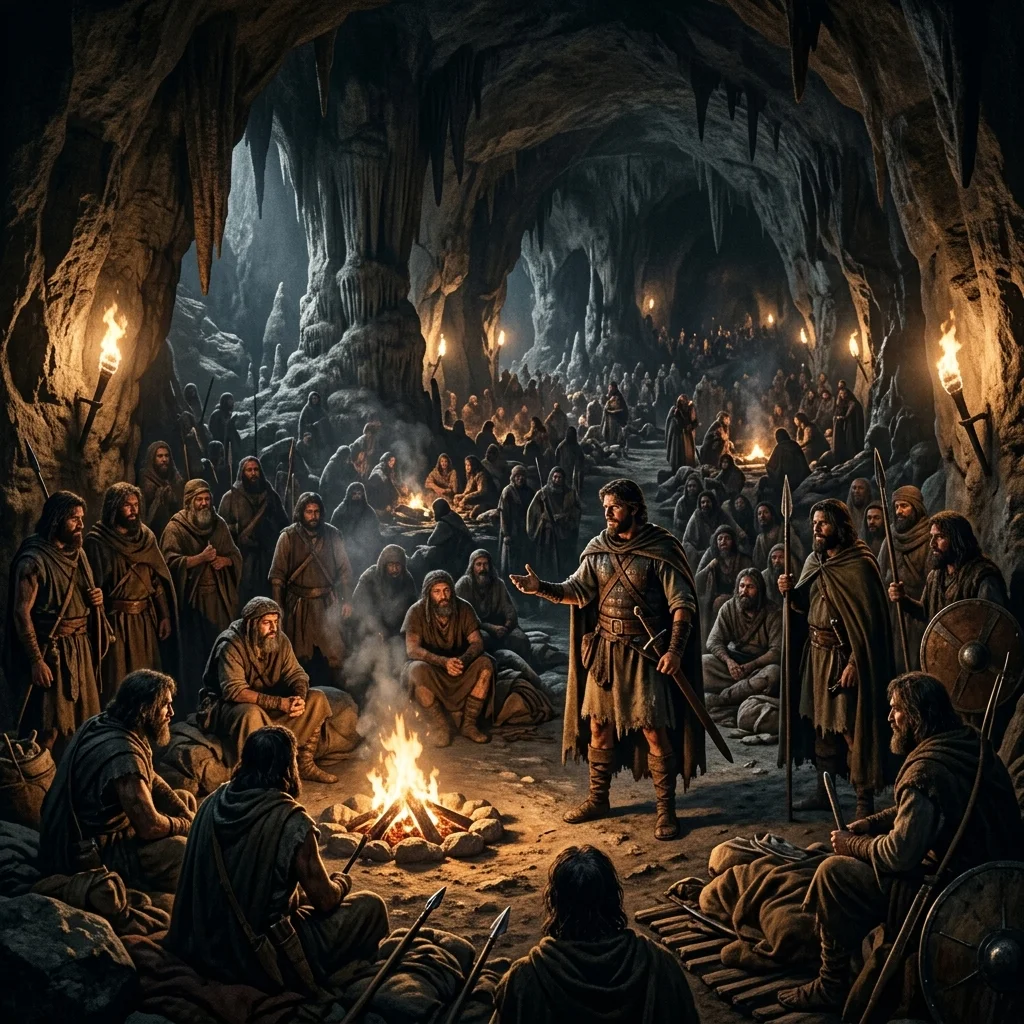
Exhausted and bruised, David found shelter in the vast, karstic limestone labyrinth of the Cave of Adullam, located in the rolling foothills of the Judean Shephelah. When word spread across Judah that David was encamped at Adullam, his elderly parents and brothers fled Bethlehem to join him, escaping Saul's wrath. But along with his family came a remarkable, ragtag multitude: "And everyone who was in distress, everyone who was in debt, and everyone who was discontented (*mar nefesh*) gathered to him. So he became captain over them, and there were about four hundred men with him" (1 Samuel 22:2).
Under Saul's paranoid tyranny, heavy taxation, corrupt conscription, and tribal favoritism had crushed the ordinary people of Israel. Bankrupt debtors, abused laborers, and disillusioned soldiers flocked to David. Rather than an army of noble elites, God handed David four hundred broken, wounded outcasts. In the pitch-black caverns of Adullam, David did not reject their misery; he discipled them. Through rigorous spiritual discipline, daily worship, and military training, David transformed these desperate fugitives into the most lethal, honorable brotherhood in the ancient world—the famous Gibborim or 'Mighty Men' who would later establish the borders of the kingdom of Israel.
In the quiet depths of those subterranean caves, David poured out his soul to Yahweh, composing enduring masterpieces of sacred hymnody. In Psalm 34, penned after his miraculous escape from Gath, David sang: "I will bless Yahweh at all times; His praise shall continually be in my mouth... The angel of Yahweh encamps all around those who fear Him, and delivers them. Oh, taste and see that Yahweh is good; blessed is the man who trusts in Him!" (Psalm 34:1, 7-8). In Psalm 142, written inside the cave itself, he cried: "I cry out to Yahweh with my voice; with my voice to Yahweh I make my supplication... Look on my right hand and see, for there is no one who acknowledges me; refuge has failed me; no one cares for my soul. I cried out to You, O Yahweh: I said, 'You are my refuge, my portion in the land of the living!'" (Psalm 142:1, 4-5).
To protect his vulnerable parents, David escorted them across the Jordan River to Mizpeh of Moab, securing royal protection from the King of Moab because of his great-grandmother Ruth's ancestral heritage. Then, warned by the prophet Gad to leave his forest stronghold, David moved deeper into the rugged forest of Hereth in Judah.
Meanwhile, King Saul held court in Gibeah under a tamarisk tree on a high hill, holding his spear in paranoid fury. Accusing his own Benjamite officers of treason—"All of you have conspired against me, and there is no one who reveals to me that my son has made a covenant with the son of Jesse!"—Saul was interrupted by Doeg the Edomite. With wicked malice, Doeg reported: "I saw the son of Jesse going to Nob, to Ahimelech the son of Ahitub. And he inquired of Yahweh for him, gave him provisions, and gave him the sword of Goliath the Philistine" (1 Samuel 22:9-10).
Enraged, Saul summoned Ahimelech and the entire priestly house of Nob to Gibeah. Ahimelech courageously defended David's absolute integrity: "And who among all your servants is as faithful as David, who is the king's son-in-law, who goes at your bidding, and is honorable in your house?" But Saul screamed: "You shall surely die, Ahimelech, you and all your father's house!" Turning to his royal bodyguards, Saul commanded: "Turn and kill the priests of Yahweh, because their hand also is with David!" But the king's Israelite soldiers feared God and refused to lift their hands against the consecrated priests of Yahweh.
Then Saul turned to the mercenary foreigner: "You turn and strike the priests!" Without hesitation, Doeg the Edomite fell upon the defenseless priests. That tragic day, Doeg slaughtered eighty-five men who wore the linen ephod. Marching upon the undefended sanctuary city of Nob, Doeg put the entire city to the sword—men, women, children, nursing infants, oxen, donkeys, and sheep—executing a demonic slaughter that Saul had once refused to execute upon the wicked Amalekites.
Only one son of Ahimelech escaped the massacre: a young priest named Abiathar. Fleeing into the wilderness, Abiathar found David at Keilah, carrying in his hands the high priestly ephod with the sacred Urim and Thummim. When Abiathar recounted the slaughter of Nob, David wept in agonizing grief, taking personal responsibility: "I knew that day, when Doeg the Edomite was there, that he would surely tell Saul! I have caused the death of all the persons of your father's house. Stay with me; do not fear. For he who seeks my life seeks your life, but with me you shall be safe" (1 Samuel 22:22-23).
Soon after, word reached David that the Philistines were raiding the agricultural city of Keilah, plundering the threshing floors. Inquiring of Yahweh through the ephod brought by Abiathar, David received divine confirmation: "Go and attack the Philistines, and save Keilah." Despite his men's initial fear, David struck the Philistines with a heavy blow, drove off their livestock, and delivered Keilah's inhabitants. But when Saul heard David was inside a walled city with gates and bars, he mobilized his army to besiege him. Inquiring of Yahweh again through Abiathar's ephod, David asked two specific questions: "Will Saul come down as Your servant has heard? And will the men of Keilah surrender me into his hand?" Yahweh answered clearly: "He will come down... They will surrender you."
Refusing to succumb to bitterness against the ungrateful city he had just delivered, David and his six hundred men evacuated Keilah into the wild, sun-bleached crags of the Wilderness of Ziph and the mountain strongholds of Horesh. There, in the dense thickets of Horesh, Crown Prince Jonathan made his final, dramatic journey to meet David one last time. Scripture records: "Jonathan arose and went to David in the woods and strengthened his hand in God" (1 Samuel 23:16). Jonathan spoke with prophetic certainty: "Do not fear, for the hand of Saul my father shall not find you. You shall be king over Israel, and I shall be next to you. Even my father Saul knows that." The two brothers renewed their covenant before Yahweh, embracing for the last time on earth.
Betrayed next by the local Ziphites, David fled southward into the Wilderness of Maon. Saul and his elite units closed in, surrounding David and his men on opposite sides of a rocky mountain in a deadly tactical pincer movement. Just as Saul was about to close the trap and capture David, an urgent royal courier dashed into camp with frantic news: "Hurry and come, for the Philistines have invaded the land!" Saul was forced to break off his pursuit to defend the border. David named that crag Sela Hammahlekoth—the 'Rock of Escape'—standing as a perpetual monument to the sovereign deliverance of Almighty God. Moving eastward to the majestic desert oases and limestone cliffs of Ein Gedi overlooking the Dead Sea, David rested secure in the shadow of the Almighty, living proof that no weapon formed against God's anointed shall ever prosper!
Biblical Keywords & Theological Roots
Bread of the Presence / Showbread. Literally 'Bread of the Face', referring to the twelve consecrated loaves placed perpetually before Yahweh inside the Holy Place, which only Levitical priests were legally permitted to eat (Leviticus 24:5-9).
Adullam, meaning 'refuge', 'retreat', or 'justice of the people'. A strategic fortified royal Canaanite city in the Shephelah surrounded by vast limestone caves where David hid and established his base of loyal companions.
Stronghold, fortress, mountain castle, or inaccessible rocky cliff. The natural wilderness heights of Ziph, Horesh, and Ein Gedi where David learned that Yahweh Himself is the ultimate fortress of His people.
Bitter in soul, deeply discontented, distressed, or grieving. Describes the broken, indebted, and socially disenfranchised outcasts of Israel who flocked to David at Adullam and were transformed under his leadership into mighty men of valor.
The high priestly linen vestment holding the Breastpiece of Judgment containing the Urim and Thummim, brought by Abiathar when escaping the slaughter of Nob, by which David inquired of Yahweh before battle.
Ancient Near Eastern & Archaeological Context
The narrative of 1 Samuel 21–23 unfolds during the Late Iron Age I (circa 1015–1010 BC) across several distinct topographical zones of southern Canaan: the fertile Shephelah foothills, the arid Judean wilderness bordering the Dead Sea rift valley, and the Philistine coastal plain. Nob, situated northeast of Jerusalem along the Mount Scopus ridge, served as a temporary Levitical sanctuary housing the tabernacle's relics following the destruction of Shiloh. Archaeological excavations at Tell es-Safi (biblical Gath) directed by Aren Maeir have uncovered massive late Iron I monumental fortification walls, elite residential complexes, and Philistine Aegean-style bichrome pottery, corroborating Gath's status as a major regional urban powerhouse during David's flight. The karstic limestone topography of the Judean Shephelah near Khirbet 'Id el-Minya (Adullam) and the rugged dolomitic crags of Ein Gedi, Keilah (Khirbet Qila), and Ziph (Tell Zif) feature intricate subterranean cave networks with cisterns capable of sustaining hundreds of guerrillas. Philistine seasonal incursions to plunder Israelite threshing floors (*goren*) at Keilah reflect standard Iron I predatory harvesting practices against agrarian hill settlements.
Practical Discipleship & Spiritual Application
- Recognize God's Grace Over Rigid Ritualism: Jesus specifically referenced David eating the holy showbread at Nob (Matthew 12:1-8) to teach that human life and divine mercy surpass ceremonial technicalities. In moments of crisis, God provides unexpected sustenance and welcomes the desperate.
- Let Seasons of Solitude Forge Spiritual Fortitude: In the wilderness caves, stripped of royal status, marriage, and mentors, David penned Psalms 34, 56, and 57, learning to say, 'The Lord is my rock, my fortress, and my deliverer.' Embrace wilderness seasons as God's premier training academy.
- Invest in the Broken and Discontented: David did not recruit elite mercenaries at Adullam; he welcomed the bankrupt, distressed, and bitter, discipling them into Israel's 'mighty men' (*gibborim*). Look at struggling people through eyes of faith, seeing their redeemed potential.
- Inquire of the Lord Before Taking Action: When Keilah was under attack, David repeatedly asked Yahweh through the ephod whether he should attack the Philistines. Never rely on worldly logic or emotions; consistently seek divine guidance in your daily decisions.
⚡ Fast Facts
- Jesus cited David eating the consecrated showbread (*Lechem Panim*) at Nob to vindicate His hungry disciples plucking grain on the Sabbath (Matthew 12:3-4; Mark 2:25-26; Luke 6:3-4).
- At Gath, David feigned insanity before King Achish by letting saliva run down into his beard and scratching frantically on the city gates, surviving Philistine custody (1 Samuel 21:12-15).
- Saul commanded Doeg the Edomite to slaughter the priests of Nob when Israelite guards refused; Doeg murdered 85 priests wearing the linen ephod, plus every man, woman, child, and animal in the city (1 Samuel 22:18-19).
- While hiding in the Cave of Adullam and the caves of Ein Gedi, David composed some of the most beloved Psalms in Scripture, including Psalm 34 ('O taste and see that the Lord is good') and Psalm 57 ('Be merciful to me, O God').
❓ Frequently Asked Questions (FAQs)
Under the Mosaic Law, the twelve loaves of the Bread of the Presence were consecrated every Sabbath and reserved exclusively for Aaron's priestly descendants to eat in the Holy Place (Leviticus 24:5-9). When David arrived at Nob exhausted, starving, and on the run from Saul, Priest Ahimelech had no common bread on hand. Ahimelech discerned that preserving human life took precedence over ritual exclusivity, provided David and his men were ceremonially clean from sexual contact. Centuries later, Jesus Christ cited this exact episode in Matthew 12:1-8 and Mark 2:25-28 to silence the legalistic Pharisees. Jesus affirmed that human necessity and active mercy transcend ceremonial regulations, declaring: 'The Sabbath was made for man, and not man for the Sabbath. Therefore the Son of Man is also Lord of the Sabbath.'
David fled to Gath because it lay completely outside Saul's jurisdiction in sovereign Philistine territory. David reasoned that Saul would never risk marching his royal army into enemy heartlands to capture a single fugitive. Furthermore, carrying Goliath's massive sword, David may have initially contemplated serving as an anonymous mercenary. However, the servants of King Achish immediately identified him: 'Is not this David the king of the land? Did they not sing to one another of him in dances, saying: Saul has slain his thousands, and David his ten thousands?' Realizing he was recognized as the champion who slaughtered their beloved giant Goliath, David was seized with mortal terror. In a brilliant stroke of desperate psychological survival, David feigned madness—clawing at the city gates and letting saliva drool down his beard. In the ancient Near East, the insane were viewed with superstitious dread as under demonic or divine curses and were typically avoided rather than executed. King Achish disgustedly banished the 'madman', allowing David to escape alive.
The gathering at Adullam marked the foundational turning point of David's royal destiny. First Samuel 22:2 describes these men with stark realism: 'Everyone who was in distress, everyone who was in debt, and everyone who was discontented (*mar nefesh*) gathered to him. So he became captain over them, and there were about four hundred men with him.' Saul's oppressive, paranoid monarchy had created widespread economic ruin, heavy taxation, and social disenfranchisement throughout Judah. Rather than an army of disciplined aristocrats, God gave David the bankrupt, the broken, the fugitive, and the hopeless. Through David's spiritual leadership, rigorous wilderness discipline, and compassionate brotherhood, this ragtag band of outcasts was molded into the most lethal, loyal military force in the ancient world—David's legendary 'Mighty Men' (*Gibborim*, 2 Samuel 23). This serves as a magnificent prophetic picture of Jesus Christ, who welcomes spiritual bankrupts, sinners, and outcasts into His heavenly kingdom.