In the triumphant aftermath of Goliath's catastrophic defeat in the Valley of Elah, an extraordinary spiritual alliance was forged in the royal palace of Gibeah. Young David, holding the severed head of the Philistine champion, stood before King Saul answering the monarch's inquiries with humble grace. Watching the scene was Saul's eldest son and heir apparent, Crown Prince Jonathan—a heroic, battle-hardened warrior who had single-handedly dismantled the Philistine garrison at Michmash. As Jonathan listened to David speak, Scripture records one of the most sublime emotional moments in biblical history: "The soul of Jonathan was knit to the soul of David, and Jonathan loved him as his own soul" (1 Samuel 18:1).
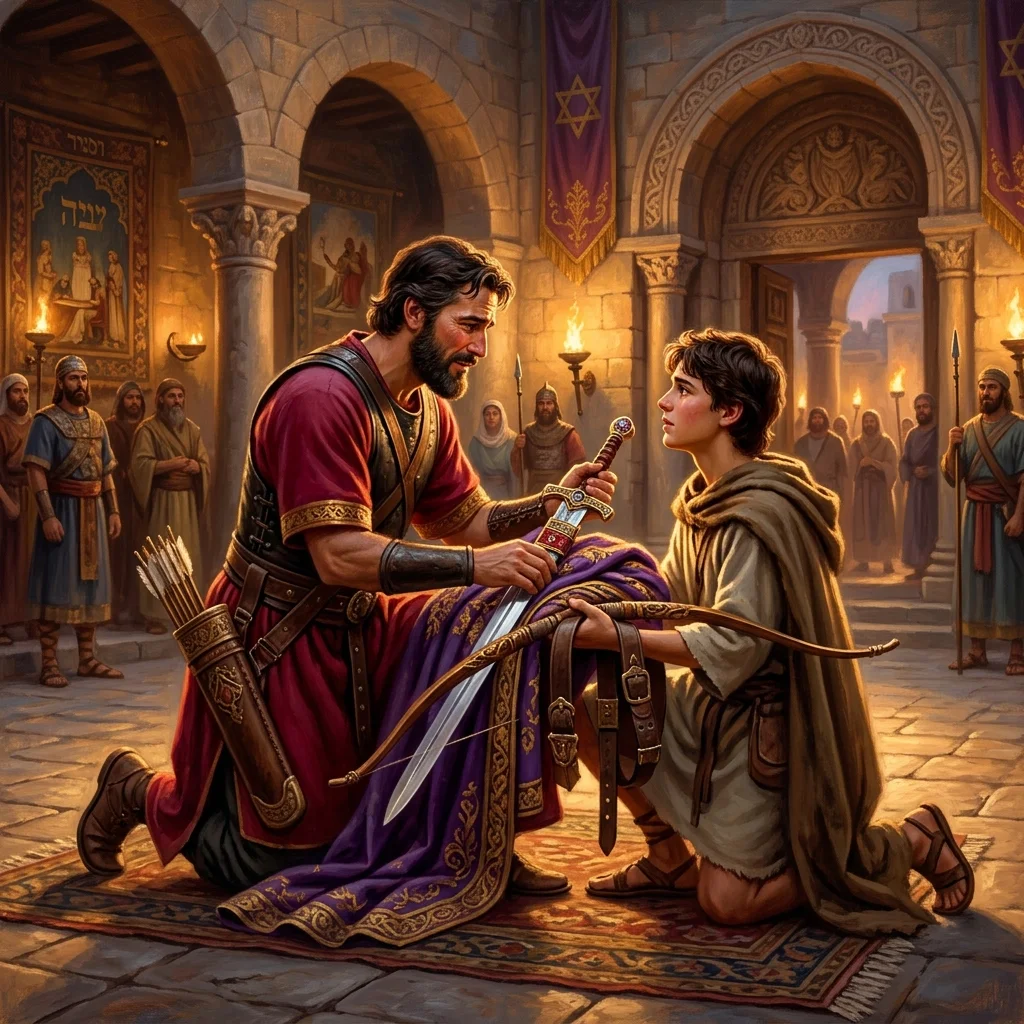
Then Jonathan did something utterly unprecedented in ancient Near Eastern dynastic history. Ancient princes routinely executed popular military champions who posed a threat to their dynastic succession. Instead, moved by divine love, "Jonathan stripped himself of the robe that was on him and gave it to David, with his armor, even to his sword and his bow and his belt" (1 Samuel 18:4). By divesting himself of his royal mantle (*me'il*) and military weapons, Jonathan performed a voluntary, prophetic abdication. Recognizing that Yahweh's anointing rested upon the young shepherd of Bethlehem, Jonathan joyfully laid his royal inheritance at David's feet, ratifying a solemn covenant (*berith*) of eternal brotherhood.
King Saul immediately took David into permanent royal service, placing him over his combat troops. Wherever Saul sent him, David behaved wisely, winning the admiration of the soldiers and the populace alike. But the seed of tragedy was planted during the grand victory parades celebrating the defeat of the Philistines. As the armies returned through the cities of Israel, women came out singing and dancing with timbrels, sistrums, and stringed instruments, chanting in antiphonal harmony: "Saul has slain his thousands, and David his ten thousands!" (1 Samuel 18:7).
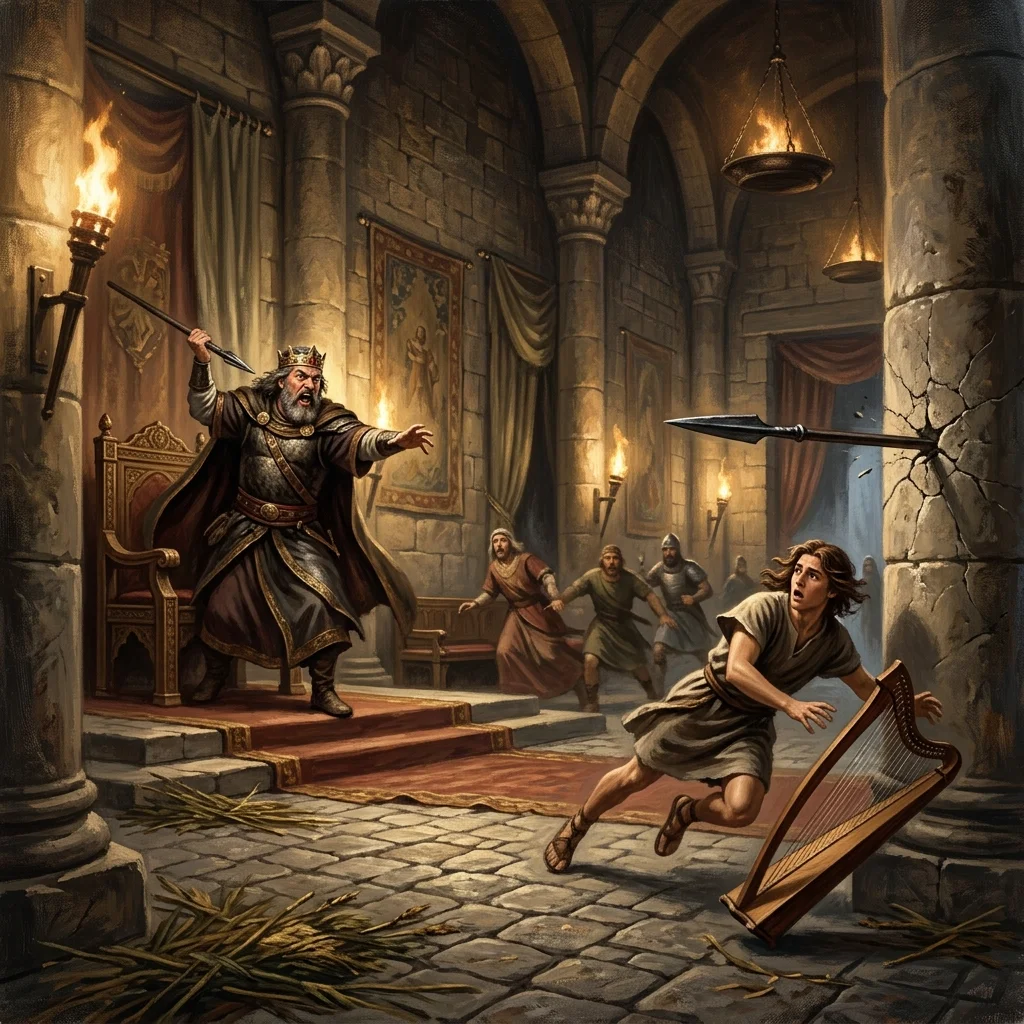
The words struck Saul like a venomous blade. His insecure ego unraveled into bitter resentment: "They have ascribed to David ten thousands, and to me they have ascribed but thousands. Now what more can he have but the kingdom?" (1 Samuel 18:8). From that fateful afternoon forward, Saul eyed David with dark, brooding suspicion. The next day, a distressing spirit from God came mightily upon Saul, driving him into frantic, raving fits inside the royal palace. David sat with his lyre, skillfully plucking the strings to soothe the tormented king as he had so often done. But Saul held a heavy war javelin in his hand. Suddenly, with murderous fury, Saul hurled the spear across the hall: "I will pin David to the wall!" But David dodged, and the bronze spear slammed into the plaster. Undeterred, Saul hurled it a second time, but David escaped his presence twice, for the hand of Yahweh shielded His anointed servant.
Terrified of David because Yahweh was with him and had departed from himself, Saul removed David from his personal court, demoting him to a field commander over a thousand. Yet David's wisdom and battlefield success only multiplied, endearing him deeper to all Israel and Judah. Saul then devised a sinister trap: he offered his younger daughter Michal to David in marriage, demanding a bride price calculated to ensure David's death: "The king does not desire any dowry but one hundred foreskins of the Philistines, to take vengeance on the king's enemies" (1 Samuel 18:25). Saul assumed the Philistines would slaughter the ambitious youth. But David and his men marched into Philistine territory, killed two hundred Philistine warriors, and brought their foreskins in full count to the king! Saul gave him Michal, but his paranoia calcified into unrelenting hatred; Saul became David's enemy continually.
When Saul commanded Jonathan and all his royal servants to assassinate David, Jonathan immediately intervened. Meeting David in a secret field, Jonathan warned him to hide, then confronted his father with courageous eloquence: "Let not the king sin against his servant, against David, because he has not sinned against you, and because his works have been very good toward you. For he took his life in his hands and killed the Philistine, and Yahweh brought about a great salvation for all Israel... Why then will you sin against innocent blood, to kill David without a cause?" (1 Samuel 19:4-5). Conscience-stricken, Saul swore an oath: "As Yahweh lives, he shall not be killed." David was brought back into Saul's presence as in times past.
Yet the respite was fleeting. When fresh war erupted with the Philistines and David scored another massive victory, the evil spirit fell upon Saul once more. As David played his lyre, Saul hurled his javelin a third time, burying the weapon into the wall as David slipped out into the darkness. That night, Saul sent royal assassins to watch David's house and kill him in the morning. But Michal, who loved David deeply, warned her husband: "If you do not save your life tonight, tomorrow you will be killed!" Michal let David down through a window to flee into the night. She then took a wooden household idol (*teraphim*), laid it in the bed, placed a quilt of goat's hair at its head, and covered it with blankets. When Saul's guards demanded David, Michal claimed he was sick. When Saul ordered him brought up in his bed to be slain, the deception was discovered, and Michal boldly endured her father's fury.
David fled northward to Ramah, seeking refuge with the prophet Samuel at Naioth. When Saul sent successive squads of royal messengers to seize David, the Spirit of God fell upon the soldiers, and they began prophesying alongside Samuel. Enraged, Saul went in person to Ramah, but the Spirit of God rushed upon Saul as well; stripping off his royal robes, he lay prophesying on the ground all that day and night, prompting the people to ask again: "Is Saul also among the prophets?"
Fleeing Naioth, David met secretly with Jonathan in the countryside, crying out in anguish: "What have I done? What is my iniquity, and what is my sin before your father, that he seeks my life?" Jonathan initially found it difficult to believe his father would break his sworn oath. To resolve all doubt, they devised a definitive tactical test centered upon the upcoming royal New Moon festival (*Rosh Chodesh*), where David's seat beside the king would be vacant for two days. If Saul asked for him, Jonathan would claim David had urgently traveled to Bethlehem for an annual family sacrifice. If Saul said, 'It is well,' there was peace; but if Saul became very angry, David would know that evil was determined against him.
In that open field, Jonathan and David renewed their sacred covenant before Yahweh. Jonathan said to David: "Yahweh, God of Israel, is witness!... You shall not only show me the kindness (*Hesed*) of Yahweh while I still live, that I may not die; but you shall not cut off your kindness from my house forever, no, not when Yahweh has cut off every one of the enemies of David from the face of the earth!" (1 Samuel 20:12-15). Jonathan then devised a covert archery signal to communicate the outcome without exposing David to Saul's spies: David was to hide beside the landmark stone Ezel on the third day. Jonathan would shoot three arrows beside the stone as if at a mark, and send a young servant boy to retrieve them. If Jonathan called to the boy, "Look, the arrows are on this side of you; get them and come," David was safe. But if he shouted, "Look, the arrows are beyond you—go your way, for Yahweh has sent you away!", David was to flee immediately.
On the second day of the festival, when David's place remained empty, Saul demanded: "Why has the son of Jesse not come to eat, either yesterday or today?" When Jonathan provided the agreed explanation, Saul's rage exploded with demonic fury. Cursing Jonathan as the "son of a perverse, rebellious woman," Saul shouted: "As long as the son of Jesse lives on the earth, you shall not be established, nor your kingdom! Now therefore, send and bring him to me, for he shall surely die!" When Jonathan courageously defended David—"Why should he be killed? What has he done?"—Saul hurled his war javelin directly at his own son to strike him down! In fierce, grieving anger, Jonathan arose from the table, tasting no food, crushed by his father's shameful behavior.
The next morning at dawn, Jonathan went out to the field near the stone Ezel, accompanied by a small boy. Running forward, the lad searched for the arrows. Jonathan drew his bow and shot an arrow far beyond him, shouting the fateful words that broke his heart: "Is not the arrow beyond you?... Hurry, make haste, do not delay!" The boy gathered the arrows, unaware of the cosmic drama taking place. Handing his weapons to the lad, Jonathan sent him back into the city.
As soon as the boy had gone, David arose from his hiding place beside the stone. Falling on his face to the ground, he bowed three times before Jonathan. The two godly friends ran into each other's arms, embraced, and wept bitterly—David weeping the most, their tears soaking the rocky soil of Benjamin. Finally, Jonathan choked back his grief and uttered the benediction of eternal peace: "Go in peace, since we have both sworn in the name of Yahweh, saying, 'May Yahweh be between you and me, and between your descendants and my descendants, forever!'" (1 Samuel 20:42). David arose and walked toward the lonely wilderness of exile, and Jonathan returned into the city. Though kings raged and dynasties crumbled, their covenant of loyal love remained unbroken, foreshadowing the eternal grace of Jesus Christ, the Greater Brother who lays down His life for His friends!
Biblical Keywords & Theological Roots
Covenant, solemn binding treaty, sacred pact ratified by oaths and mutual exchange of gifts. The unbreakable spiritual bond forged between Jonathan and David.
Sacrificial love, loyal covenant affection. Describing Jonathan loving David 'as his own soul' (*ke-nafsho*), prioritizing the beloved's welfare above royal ambition.
Robe, sleeveless royal mantle of nobility and status. Given by Prince Jonathan to shepherd David as a symbolic coronation acknowledging David's future kingship.
Arrow, piercing missile. The three signal arrows shot by Jonathan beyond the stone Ezel to communicate secretly to David that Saul was bent on his death.
The lovingkindness, steadfast covenant mercy, and steadfast loyalty of the Lord. The divine standard of faithful love that bounded David and Jonathan's descendants forever.
Ancient Near Eastern & Archaeological Context
The narrative of 1 Samuel 18–20 is set in the rugged hill country of Benjamin and Judah during the central decades of Saul's reign (circa 1020–1015 BC). The royal residence at Gibeah (Tell el-Ful) served as the administrative and military headquarters of the young kingdom. Anthropologically and politically, the friendship between Jonathan and David is one of the most radical counter-cultural alliances in ancient Near Eastern history. Under standard ancient dynastic protocol, a crown prince was expected to ruthlessly eliminate any popular military rival who threatened the throne; instead, Jonathan recognized that Yahweh's anointing had departed from his father Saul and rested upon David. The ceremonial stripping of the robe (*me'il*), armor (*maddim*), and weaponry (1 Samuel 18:4) represented a formal legal transfer of royal status and dynastic legitimacy in ancient Semitic treaty practice. The cultural celebration of the women singing antiphonal war songs with timbrels (*tupim*) and sistrums reflected ancient victory parades celebrating military deliverance (Exodus 15:20-21). Saul's dowry demand of one hundred Philistine foreskins (*orlot*) mirrored ancient Egyptian and ANE battle records (such as the Merneptah Stele and Medinet Habu reliefs), where severed phalluses or hands were counted by scribes to tally enemy casualties, proving that David's exploits were authentic and lethal.
Practical Discipleship & Spiritual Application
- Cultivate Godly, Sacrificial Friendships: True Christian brotherhood looks like Jonathan—rejoicing in another's promotion, defending them in their absence, and selflessly encouraging their spiritual destiny in Christ. Strive to be a friend who loves at all times (Proverbs 17:17).
- Root Out Envy Before It Poison Your Heart: Saul allowed a single song of comparison to open the floodgates of bitterness. When you see others praised, promoted, or blessed beyond you, do not harbor jealousy. Celebrate God's grace in their lives, knowing that your identity and reward are secure in Christ.
- Trust God's Protection in Toxic Environments: David continued to play his harp with excellence and integrity even while Saul held a spear ready to strike. You can maintain your peace, dignity, and professional excellence in hostile workplaces when you know the Lord is your shield.
- Honor Covenants Across Generations: David remembered his covenant with Jonathan years after Jonathan's death, elevating crippled Mephibosheth to the royal table. Be faithful to your vows, loyal to your spiritual family, and quick to extend grace to the descendants of those who blessed you.
⚡ Fast Facts
- Jonathan's name (*Yehonatan*) means 'Yahweh has given', reflecting his gracious character as God's gift of protection to David during his darkest trials.
- Saul demanded one hundred Philistine foreskins as a bride price for Michal, expecting the Philistines would kill David; David and his men went and killed two hundred Philistines and brought their foreskins in full count (1 Samuel 18:25-27).
- Michal saved David's life by letting him down through a window and placing household idols (*teraphim*) with a goat's-hair quilt in his bed to deceive Saul's assassins (1 Samuel 19:11-16).
- At the stone Ezel, Jonathan used a young boy and three arrows as a prearranged covert code: if the arrows were beyond the boy, David knew he had to flee for his life (1 Samuel 20:20-22, 35-40).
❓ Frequently Asked Questions (FAQs)
In the ancient Near East, personal clothing—especially the royal robe (*me'il*) and military armor—carried profound symbolic weight, representing the very essence, status, and authority of the owner. Jonathan was King Saul's eldest son and the recognized, legitimate crown prince of Israel. By voluntarily stripping himself of his royal robe, belt, sword, and bow and dressing David in them, Jonathan performed an extraordinary, prophetic act of voluntary abdication. Enlightened by the Holy Spirit, Jonathan recognized that God had chosen David, not himself, to be the next king of Israel. Rather than fighting David for dynastic preservation as his father Saul did, Jonathan surrendered his own crown to God's anointed in supreme covenant humility.
The women's musical celebration after Goliath's defeat struck directly at Saul's deepest narcissistic vulnerability. Their antiphonal song, 'Saul has slain his thousands, and David his ten thousands' (1 Samuel 18:7), gave David ten times more military glory than the reigning king. Saul was infuriated, brooding: 'They have ascribed to David ten thousands, and to me they have ascribed but thousands. Now what more can he have but the kingdom?' (1 Samuel 18:8). Saul already knew that Samuel had announced that Yahweh had rejected him and sought a neighbor better than him (1 Samuel 15:28). In that moment, Saul connected the dots: David was that neighbor. Blinded by envy and fear of losing his dynastic legacy, Saul's wounded ego spiraled into demonic obsession.
The stone Ezel (1 Samuel 20:19) served as a predetermined strategic landmark in the fields outside Gibeah where David could hide safely in the rocky terrain while Jonathan tested his father's intentions during the royal New Moon banquet. Because direct communication was dangerous due to Saul's spies, Jonathan devised an ingenious covert archery code. Jonathan brought a young servant to the field under the guise of target practice. If Jonathan shot an arrow and told the boy, 'The arrow is on this side of you,' David was safe to return. But if he shouted, 'The arrow is beyond you, hurry, make haste!', David knew Saul was determined to murder him. After dismissing the lad, the two friends embraced, wept bitterly—David weeping the most—and reaffirmed their sacred covenant before parting into the unknown.