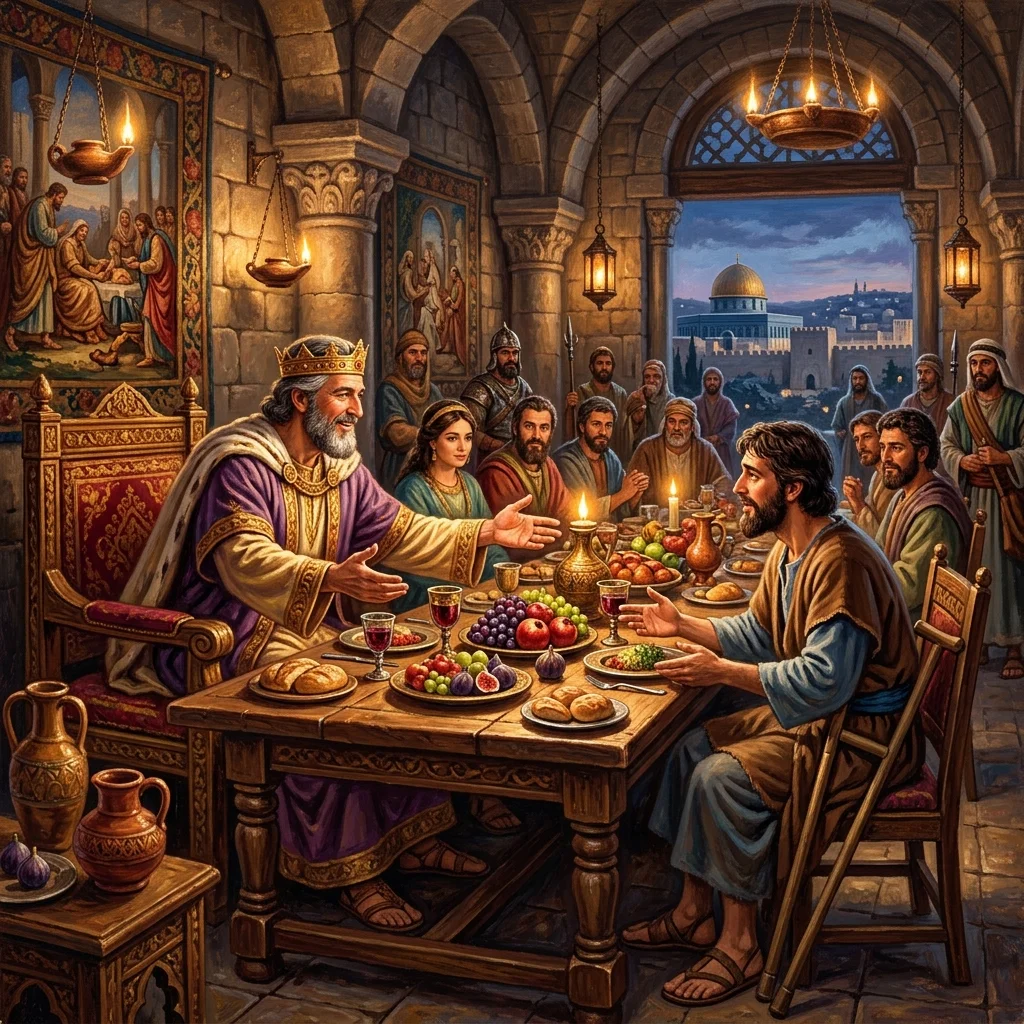
 The sounding of silver trumpets across the Citadel of Zion heralded an era of long-sought peace for the united tribes of Israel. King David, having subdued the surrounding Philistine garrisons, secured the borders of the kingdom from Moab to Damascus, and brought the Ark of the Covenant into the heart of Jerusalem, sat upon his cedar throne in quiet contemplation. The fierce storms of his wilderness wanderings, the perilous days in the caves of Adullam and En Gedi, and the bitter civil conflicts that followed the tragic fall of the house of Saul on Mount Gilboa had finally receded. Yet, as the sovereign ruler of a flourishing empire, David's thoughts did not drift toward monuments of personal aggrandizement or imperial conquests. Instead, deep within the chamber of his memory, an ancient, solemn vow began to resonate—a sacred covenant forged nearly two decades earlier under the shade of an open field in the territory of Benjamin.
It was there that Jonathan, the valiant son of Saul, had embraced David in tears and bound him by a sacred oath before Yahweh: "You shall not only show me the kindness of the LORD while I still live, that I may not die; but you shall not cut off your kindness from my house forever, no, not when the LORD has cut off every one of the enemies of David from the face of the earth" (1 Samuel 20:14–15). Jonathan had loved David as his own soul, laying down his princely robe, sword, and bow in acknowledgment of God's anointing upon the shepherd of Bethlehem. Now, Yahweh had fulfilled every syllable of that prophetic destiny. The enemies of David were cut off; Saul and Jonathan had perished side by side on Mount Gilboa; the rival pretender Ish-bosheth had fallen; and David reigned supreme over all twelve tribes.
In the ruthless geopolitical landscape of the ancient Near East, the standard procedure for an ascendant monarch was clear, cold, and universally practiced: eliminate every living male of the deposed dynasty. Dynastic purges were designed to eradicate any rallying point for future insurrections and wipe clean the royal line (*damnatio memoriae*). Yet King David operated not according to the ruthless customs of surrounding pagan despots, but according to the sacred law of the covenant God. Summoning his royal court officials, David posed a question that startled the assembly: "Is there still anyone who is left of the house of Saul, that I may show him kindness for Jonathan's sake?" (2 Samuel 9:1).
The courtiers scrambled to uncover the remnants of the fallen royal family. They located an elderly retainer named Ziba, who had once served as the chief steward of Saul's vast personal estate. When Ziba was ushered into the royal audience hall and bowed prostrate before the throne, David demanded, "Are you Ziba?" The servant replied with customary court deference, "At your service!" The king looked intently upon him and reiterated his solemn quest, elevating the stakes of the inquiry with theological precision: "Is there not still someone of the house of Saul, to whom I may show the kindness of God (*hesed Elohim*)?" (2 Samuel 9:3). David was not merely offering standard political philanthropy; he was seeking an instrument upon whom he could lavish the transcendent, unfailing, steadfast covenant mercy of the Almighty.
Ziba hesitated before delivering astonishing news: "There is still a son of Jonathan who is lame in his feet."
Fourteen years earlier, when news of the catastrophic slaughter at Jezreel had reached Gibeah—reporting that King Saul and his noble sons had fallen beneath the Philistine arrows—panic had seized the royal palace. A frantic nurse, terrified that Philistine raiding parties would storm the nursery, snatched Jonathan's five-year-old son from his bed. In her desperate rush to flee across the crags of Benjamin, she stumbled, dropped the child upon the unforgiving stone floor, and permanently crushed the bones of both his ankles and feet (2 Samuel 4:4). From that terrifying day onward, the boy, originally named Merib-baal ("contender with Baal"), lived as a helpless cripple. Stripped of his royal birthright, orphaned, and burdened with a name modified by common parlance to Mephibosheth ("from the mouth of shame"), he had vanished into obscurity.
"Where is he?" the king demanded without a moment's hesitation.
Ziba replied, "Indeed he is in the house of Machir the son of Ammiel, in Lo-Debar."
Lo-Debar lay far to the east, across the deep rift of the Jordan River in the rugged plateau of Gilead near Mahanaim. The very name of the settlement signified utter destitution: *Lo-Debar* literally meant "no pasture" or "a place of barren nothingness." There, under the discreet hospitality of Machir—a wealthy Transjordanian chieftain who maintained loyalty to Saul's memory—Jonathan's crippled son had grown to manhood, married, and fathered a young son named Mica. He lived each day in perpetual terror, knowing that as the sole legitimate grandson of King Saul, his discovery by David's royal scouts would almost certainly mean a swift and silent death sentence.
Immediately, King David dispatched a royal cavalry detachment across the Jordan to Lo-Debar. The thundering hooves of royal chariots pulling up outside the estate of Machir struck cold terror into the heart of the exile. The soldiers were not sent to assassinate, but by royal command, they carried Mephibosheth back across the Jordan, ascending the steep ridges toward the royal citadel of Jerusalem.
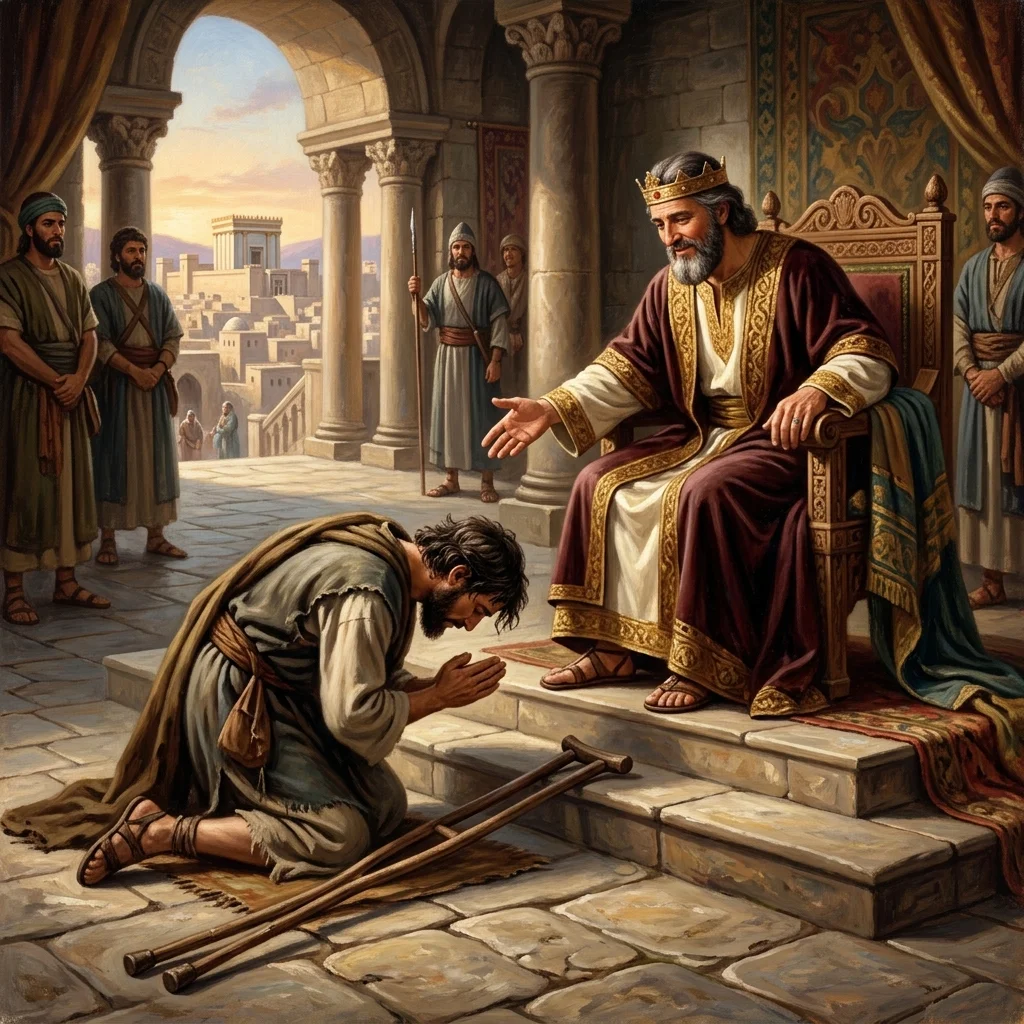 When Mephibosheth was brought into the grand throne room of Zion, the contrast between the two men was overwhelming. Upon the elevated seat of judgment sat David—victorious, majestic, clothed in royal splendor, surrounded by seasoned mighty men and bodyguards. Before him hobbled Mephibosheth, dragging his deformed, paralyzed feet across the polished limestone floor. Dropping his wooden crutches, the young man collapsed onto his face in the dust, trembling with an agony of dread, awaiting the inevitable command for his execution.
"Mephibosheth!" David called out softly.
From the floor, the terrified fugitive whispered, "Here is your servant!"
Instead of a decree of death, words of divine compassion shattered the silence of the court. "Do not fear," King David declared gently, "for I will surely show you kindness (*hesed*) for Jonathan your father's sake, and will restore to you all the land of Saul your grandfather; and you shall eat bread at my table continually" (2 Samuel 9:7).
The words fell upon Mephibosheth like rain upon parched desert soil. He could scarcely fathom what he was hearing. He had entered the palace expecting the executioner's blade; instead, he was receiving an imperial restoration beyond imagining. The entire ancestral estate of Saul—sprawling terraced vineyards, olive groves, and fertile wheat fields stretching across the tribal territory of Benjamin—was being returned to his ownership in a single royal decree. Even more staggering was the social elevation: he was granted a perpetual seat at the king's private table, an honor reserved exclusively for the king's closest family and highest dignitaries.
Overcome by the sheer magnitude of unmerited grace, Mephibosheth bowed himself again to the earth and cried out: "What is your servant, that you should look upon such a dead dog as I?" (2 Samuel 9:8). In ancient Semitic idiom, to refer to oneself as a "dead dog" was the ultimate expression of complete worthlessness, powerlessness, and insignificance. Mephibosheth saw only his shattered lineage, his crippled limbs, and his years of barren obscurity. But David saw the covenant face of Jonathan.
David immediately summoned Ziba back into the throne room and issued a binding royal decree: "I have given to your master's son all that belonged to Saul and to all his house. You therefore, and your sons and your servants, shall work the land for him, and you shall bring in the harvest, that your master's son may have food to eat. But Mephibosheth your master's son shall eat bread at my table always" (2 Samuel 9:9–10).
The logistical scope of this command was monumental. Ziba was the father of fifteen sons and commanded twenty household servants. This entire clan of thirty-six able-bodied laborers was legally bound to cultivate, irrigate, and harvest the vast agricultural estates of Saul on behalf of Mephibosheth and his household. Ziba bowed low and replied, "According to all that my lord the king has commanded his servant, so will your servant do."
The sacred narrative records the extraordinary conclusion of this divine adoption: "So Mephibosheth dwelt in Jerusalem, for he ate continually at the king's table. And he was lame in both his feet" (2 Samuel 9:13).
Every evening in the royal banquet hall, as King David sat down to dine with his household, the princely company gathered: Amnon, the heir apparent; the charismatic Absalom with his flowing hair; the brilliant Solomon; and the military generals of Israel. And alongside them sat Mephibosheth. As he took his place upon the royal couch, the rich linen tablecloth draped down, completely concealing his deformed and twisted feet. He sat not as a paroled prisoner or a tolerated beggar, but as a cherished son of the king, preserved and honored solely because of a covenant sealed in love before he was even born.
The profound depth of Mephibosheth's gratitude was tested years later during the dark season of Absalom's rebellion. When David was forced to flee Jerusalem in weeping and humiliation, Ziba had exploited the crisis. Presenting David with a train of donkeys laden with bread, raisins, and wine, Ziba slanderously claimed that Mephibosheth had remained in Jerusalem gloating that the house of Saul would finally regain the kingdom (2 Samuel 16:1–4). The heartbroken king, deceived by the steward's cunning treachery in the heat of battle, impetuously transferred all of Mephibosheth's estate to Ziba.
Yet when Absalom's revolt was crushed and King David returned across the Jordan in victory, Mephibosheth came down from Jerusalem to meet him. The true condition of his heart was visible to all: from the very day David had fled into exile until the day he returned in peace, Mephibosheth had refused to wash his feet, trim his beard, or wash his clothes in authentic, unbroken solidarity with his king's suffering (2 Samuel 19:24).
When David asked him, "Why did you not go with me, Mephibosheth?" the son of Jonathan revealed the truth: "My lord, O king, my servant deceived me. For your servant said, 'I will saddle a donkey for myself, that I may ride on it and go to the king,' because your servant is lame. And he has slandered your servant to my lord the king" (2 Samuel 19:26–27).
Recognizing the complex web of betrayal, David proposed a compromise: "You and Ziba divide the land." But Mephibosheth's response echoed the purest devotion of a true worshiper: "Rather, let him take it all, since my lord the king has come safely to his own house" (2 Samuel 19:30). Lands, harvests, and earthly riches were entirely secondary. For Mephibosheth, life was defined not by the soil of Benjamin, but by the presence of the king who had rescued him from the dust of Lo-Debar and brought him home to his table of grace.
Biblical Keywords & Theological Roots
Kindness or steadfast covenant loyalty of God. David specifically seeks to demonstrate not merely ordinary human philanthropy, but the divine, unfailing covenant love of Yahweh (2 Sam 9:3) that transcends enmity, merit, and death.
Literally 'from the mouth of shame' or 'scatterer of shame'. His birth name was Merib-baal ('contender with Baal', 1 Chron 8:34; 9:40). Scribes subsequently substituted 'bosheth' (shame) for 'baal' to blot out pagan idolatry, leaving him a name that bore generational stigma.
Literally 'no pasture' or 'place of nothingness'. A desolate town situated east of the Jordan in Gilead near Mahanaim, representing complete obscurity, poverty, spiritual barrenness, and an exile of hiding from the royal sword.
Smitten, stricken, or lame in both feet. Describes permanent bilateral physical disability resulting from trauma when his nurse dropped him in panic at age five upon hearing of Saul and Jonathan's deaths (2 Sam 4:4).
The King's Table. In ancient Near Eastern court protocol, sitting continuously at the monarch's table was the supreme emblem of covenant adoption, royal favor, and permanent royal status, transforming an outcast into an honored son.
Ancient Near Eastern & Archaeological Context
In the brutal geopolitics of the Ancient Near East, the establishment of a new dynasty was universally marked by a comprehensive dynastic purge (damnatio memoriae). Incoming monarchs routinely hunted down and systematically slaughtered all male offspring, grandsons, and relatives of the deposed ruling house to extinguish any possibility of future rebellion or rival claims to the throne. Saul's dynasty had disintegrated in catastrophic defeat at Mount Gilboa (circa 1010 BC), followed by the assassination of Ish-bosheth (2 Sam 4). By every political and cultural precedent of Syria-Palestine, Egypt, and Mesopotamia, Mephibosheth was a doomed fugitive marked for execution. He lived in exile across the Jordan in Lo-Debar near Mahanaim under the protection of Machir son of Ammiel, an influential Transjordanian chieftain. David's conscious invocation of 'hesed Elohim'—the unfailing covenant loyalty of God—flatly shattered ancient geopolitical norms. It honored the sacred treaty forged between David and Jonathan recorded in 1 Samuel 20:14–17, where Jonathan pleaded, 'Show me the steadfast love of the LORD... and do not cut off your steadfast love from my house forever.' Furthermore, archaeological excavations of ancient Judean and Israelite agricultural estates demonstrate the monumental economic value of restoring Saul's ancestral holdings in Gibeah and Benjamin, which required a staff of fifteen sons and twenty servants under Ziba to cultivate.
Practical Discipleship & Spiritual Application
- Honor Sacred Commitments Even When Circumstances Change: David was at the height of military supremacy and political security when he remembered his pledge to Jonathan. True integrity is demonstrated when we honor commitments made in weakness even after achieving power, prosperity, and comfort.
- Actively Seek Out the Broken and Forgotten: David did not wait for an heir of Saul to petition him for charity; he actively inquired, 'Is there anyone left?' We are called to imitate God's proactive mercy by searching out the vulnerable, the disabled, and those hiding in their own 'Lo-Debar' of shame.
- Rest in Justifying Grace Rather than Human Stigma: Mephibosheth called himself a 'dead dog' (2 Samuel 9:8), paralyzed by shame and physical trauma. Yet at the king's table, his crippled legs were covered under the royal linen. In Christ, our past failures and infirmities are fully covered by His righteousness.
- Prize Fellowship with the King Above Material Possessions: When David offered to divide the disputed estate between Mephibosheth and Ziba, Mephibosheth surrendered the land without hesitation, rejoicing simply that the king had returned safely. Cultivate a heart that cherishes Christ's presence far more than earthly rewards.
Support Independent Biblical Research
Did this study bless you? Help support our independent bilingual research and interactive visual Bible tools.
⚡ Fast Facts
- Mephibosheth was only five years old when his father Jonathan and grandfather Saul died on Mount Gilboa; in the chaotic flight, his nurse dropped him, resulting in permanent disability in both feet (2 Samuel 4:4).
- His original birth name was Merib-baal ('contender with Baal', 1 Chronicles 8:34; 9:40), preserved in genealogical records, before biblical scribes applied the epithet Mephibosheth ('shame') to reject pagan terminology.
- Saul's former estate was so vast that it required Ziba, along with his fifteen sons and twenty servants, to plow, harvest, and manage its extensive agricultural yields for Mephibosheth's household (2 Samuel 9:10).
- Mephibosheth had a young son named Mica (Micah), through whom Jonathan's lineage survived and multiplied into celebrated warriors and archers in Israel for generations (2 Samuel 9:12; 1 Chronicles 8:35–40).
❓ Frequently Asked Questions (FAQs)
Why was Mephibosheth terrified when summoned to appear before King David?
In the ancient Near East, the standard procedure for an enthroned king was to execute every surviving male member of the previous royal house to eliminate any potential claimants or rebel leaders. Living in hiding at Lo-Debar as the legitimate grandson of King Saul, Mephibosheth reasonably assumed the royal summons meant his immediate arrest and execution. David immediately allayed his terror with the words, 'Do not fear, for I will surely show you kindness for the sake of your father Jonathan' (2 Samuel 9:7).
Did Ziba lie to King David about Mephibosheth during Absalom's rebellion?
Yes. When David fled Jerusalem during Absalom's coup, Ziba met the exhausted king with provisions and falsely claimed that Mephibosheth stayed behind in Jerusalem expecting the kingdom to be restored to him (2 Samuel 16:1–4). In reality, because Mephibosheth was lame, Ziba had deliberately stranded him by refusing to saddle his donkey. When David returned victorious, Mephibosheth arrived unwashed, unshaven, and in deep mourning garments, proving his continuous grief over the king's exile and exposing Ziba's treacherous slander (2 Samuel 19:24–30).
How does David's treatment of Mephibosheth serve as a prophetic picture of the Gospel?
The narrative of Mephibosheth is one of the most vivid Old Testament typologies of God's redemptive grace in Christ. Like Mephibosheth, humanity is spiritually crippled by the Fall, hiding in the barren wilderness of sin, and fearful of divine judgment as natural enemies of God. Yet, purely for the sake of Another (the covenant of Jesus Christ), God seeks us out, calms our fears, adopts us as His beloved sons and daughters, restores our lost inheritance, and seats us perpetually at His royal banquet table, covering our infirmities with His righteousness.