Throughout the sun-drenched valleys of Galilee, the fame of Jesus of Nazareth spread like an unquenchable fire. Wherever His sandals trod, chains of darkness shattered and diseases fled. Yet two back-to-back encounters in the early Galilean ministry would unveil the supreme heights of Christ's mission: His willingness to reach across the forbidden chasms of human revulsion to touch an untouchable leper, and His sovereign prerogative to forgive the invisible guilt of human sin. In an isolated Galilean village and inside a packed Capernaum home, heaven demonstrated that no misery is too defiled for Christ's compassion, and no soul is too paralyzed for His redeeming grace.
1. The Untouchable Leper in the Dust
The first drama unfolded on an isolated road in Galilee. Luke, the physician, describes the sufferer with chilling diagnostic precision: "a man full of leprosy" (Luke 5:12). This was not an early stage of skin disease; the man's flesh was in advanced, rotting decay. His fingers were stumps, his joints swollen and disfigured, his face a grotesque mask of ulcerated sores.
In ancient Israel, leprosy was not merely a physical illness; it was a living death. Under the strict quarantine codes of Leviticus 13–14, the leper was declared ritually unclean, banished from his home, his wife, his children, and the worship of the Tabernacle. He was forced to live in caves and tombs outside the city walls. He wore tattered rags, kept his hair disheveled, and was legally required to cover his upper lip and cry aloud to every approaching traveler: "Unclean! Unclean!" (Tameh! Tameh!). For years, this man had felt no human warmth, received no embrace, and seen only terror and revulsion in the eyes of his fellow men.
Yet having heard of the Prophet of Nazareth, he broke the law of quarantine. Driven by desperate hope, he approached Jesus. Falling on his scarred face in the dust, he wept with agonizing faith:
"Lord, if You are willing, You can make me clean." (Mark 1:40).
Notice his confession: he did not doubt Christ's *power* ("You can"); he only wondered if someone so holy could ever have the *will* to touch someone so filthy ("if You are willing").
2. The Touch That Reversed the Curse
What happened next stunned the disciples and shattered ancient religious tradition:
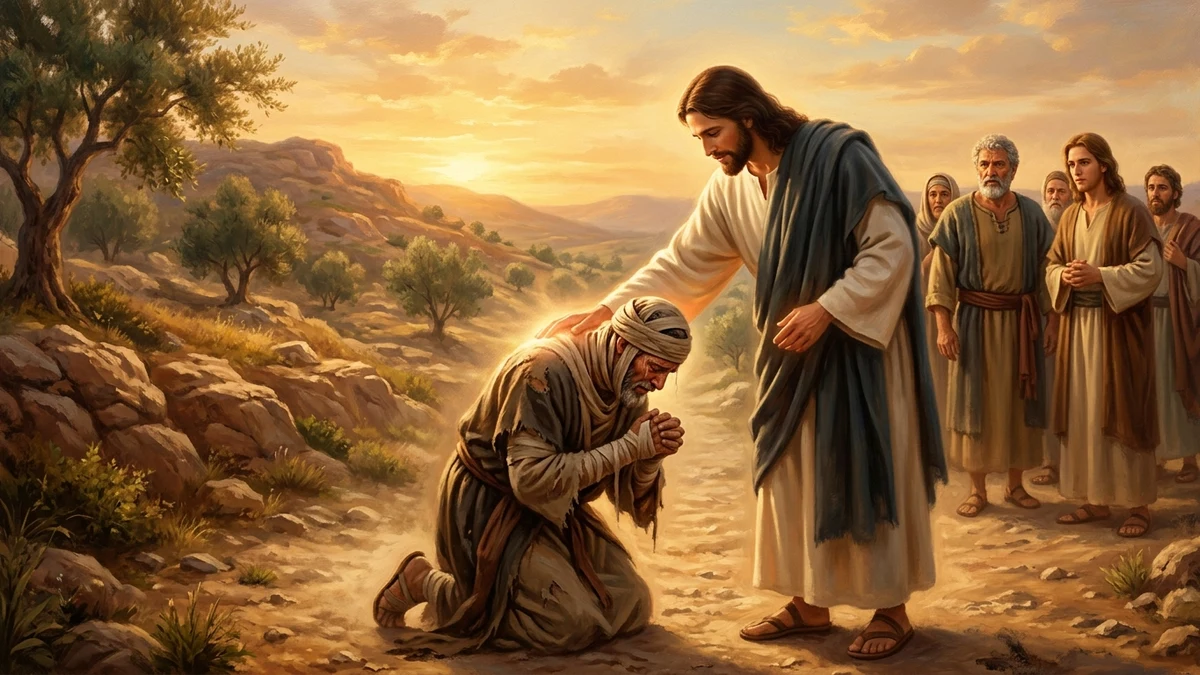
"Then Jesus, moved with compassion, stretched out His hand and touched him, and said to him, 'I am willing; be cleansed.'" (Mark 1:41).
The Greek text uses the profound word splanchnistheis—His deepest visceral bowels churned with holy, aching pity. Under the Levitical law, if a clean man touched an unclean leper, the clean man became defiled. But Jesus was not merely a clean man; He was the Fountain of Living Holiness!
Before the words had even left His lips, Jesus did the unthinkable: He reached out His hand and touched the leper! (Greek: hapsato).
For the first time in years, the outcast felt the warm, electric contact of a human hand. The defilement of the leper did not contaminate Jesus; instead, the incorruptible life of the Son of God surged into the rotting flesh of the leper!
"Immediately the leprosy left him, and he was cleansed." (Mark 1:42).
In an instantaneous flash of creative power, the rotting sores closed; the dead nerve endings fired with life; fresh, pink, baby-soft skin covered his face, hands, and limbs. Jesus commanded him to say nothing publicly, but to go immediately to Jerusalem and present the two cleansing birds to the Levitical priest as prescribed by Moses, providing an undeniable forensic testimony (martyrion autois) to the Sanhedrin that the Messiah had arrived.
3. The Packed House & The Blocked Door
Days later, Jesus returned to Capernaum. Word leaked out that He was inside a certain home—likely the home of Simon Peter. Within hours, a dense crowd packed the courtyard, jammed the entrance, and spilled into the stone alleys:
"And immediately many gathered together, so that there was no longer room to receive them, not even near the door. And He preached the word to them." (Mark 2:2).
Seated in the front rows, arms crossed and faces stern, were Pharisees and doctors of the law (nomodidaskaloi) who had traveled from every village of Galilee, Judea, and the capital city of Jerusalem to inspect this young Prophet. The air was charged with critical tension.
Down the street came four young men carrying their paralyzed friend on a woven sleeping mat (krabbaton). For years, this young man had lived motionless, dependent on others for every morsel of food. But his friends possessed an unshakeable conviction: if they could only bring him to Jesus, he would be healed.
Arriving at the house, their hearts sank. A wall of humanity blocked the entrance. People stood shoulder to shoulder; no one would yield an inch, not even for a stretcher.
4. Faith That Tears Through Roofs
Lesser men would have given up and carried their friend home. But true faith is never discouraged by obstacles; it finds a way or makes one!
Looking up, they saw the outside stone staircase leading to the flat roof. They carefully hoisted the stretcher up the stairs.
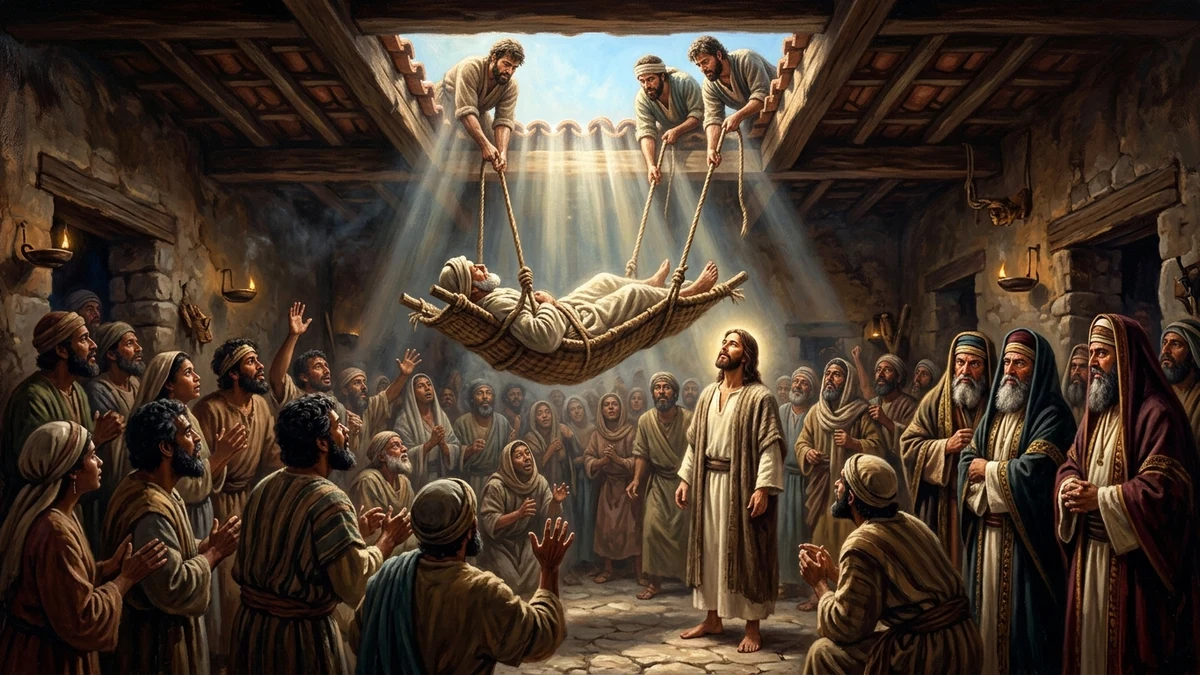
Capernaum roofs consisted of thick wooden rafters covered with branches, reeds, and packed marl clay. Getting to work with their bare hands and tools, they dug through the roof (Mark 2:4 - exoryxantes). Dust, dried clay, and twigs began falling upon the heads of the dignified Pharisees seated below.
As sunlight poured through a square opening in the ceiling, the four friends tied ropes to the four corners of the cot and carefully, steadily lowered the paralyzed man down through the rafters, depositing him directly at the feet of Jesus!
5. The Scandal of Forgiveness
Jesus looked up at the four sweating, smiling faces peering through the hole in the roof, and then down at the trembling man on the mat.
Mark records a profound phrase: "When Jesus saw their faith..." (Mark 2:5). Faith is not merely an invisible intellectual assent; true faith is visible in active, persistent love!
Then Jesus spoke words that stunned the room into shocked silence:
"Son, your sins are forgiven you." (Mark 2:5).
The Pharisees were horrified. Inside their minds, the theological gears began to grind: "Why does this Man speak blasphemies like this? Who can forgive sins but God alone?" (Mark 2:7).
Their theology was technically correct: sin is ultimately committed against God, and therefore only God Almighty possesses the moral right and authority to absolve human guilt. What they failed to recognize was that the God of Abraham, Isaac, and Jacob was standing in human flesh before their very eyes!
6. The Master Test of Divine Authority
Jesus immediately perceived in His spirit that they were reasoning this way within themselves. He did not hide; He confronted their silent skepticism head-on:
"Why do you reason about these things in your hearts? Which is easier, to say to the paralytic, 'Your sins are forgiven you,' or to say, 'Arise, take up your bed and walk'?" (Mark 2:8–9).
Consider the brilliant diagnostic logic: anyone can make the empty verbal claim, "Your sins are forgiven," because no human eye can verify an invisible spiritual transaction. But to command a hopeless paralytic whose limbs have been atrophied for years to immediately stand up, roll up his bed, and walk requires instantaneous, undeniable divine omnipotence!
Turning His gaze from the trembling Pharisees to the man on the mat, Jesus delivered the verdict of heaven:
"But that you may know that the Son of Man has power on earth to forgive sins—I say to you, arise, take up your bed, and go to your house!" (Mark 2:10–11).
The words hit the paralyzed body like lightning! Divine power surged through dead nerves, atrophied muscles, and withered joints.
Immediately the man leaped to his feet! He bent down, hoisted the heavy wooden cot onto his shoulders, and walked briskly through the parted crowd, praising God with tears of overflowing joy!
The Pharisees were speechless. The crowds were gripped with holy terror and awe:
"So that they were all amazed and glorified God, saying, 'We never saw anything like this!'" (Mark 2:12).
From the rotting leper cleansed on the road to the paralyzed sinner redeemed in Capernaum, Jesus proved that He is not merely a moral teacher or an earthly physician. He is the Son of Man who holds absolute authority to touch our deepest filth, forgive our heaviest guilt, and restore broken humanity into the glorious freedom of the sons of God!
Biblical Keywords & Theological Roots
Moved with compassion; visceral churning of the innermost bowels of mercy and love in response to human agony.
Touched / seized hold of; deliberate physical contact with the untouchable leper, transferring cleansing power rather than contracting defilement.
Dug out / broken through; physical excavation of the thick packed clay and thatch roof to lower the paralytic.
Your sins are forgiven; present passive divine declaration releasing the soul from the legal penalty, guilt, and power of sin.
Ancient Near Eastern & Archaeological Context
Biblical leprosy (Hebrew: 'tsara'ath'; Greek: 'lepra') was the most terrifying affliction in the ancient world, encompassing severe dermatological diseases including Hansen's disease that destroyed nerve endings, caused limbs to rot and fall off, and disfigured the human countenance. Under the Torah (Leviticus 13–14), the leper was declared ritually unclean, banished outside city walls, required to wear torn clothing, leave their hair uncombed, cover their mustache, and cry 'Unclean! Unclean!' to warn passersby. Anyone who touched a leper incurred instant ceremonial defilement and social quarantine. First-century domestic architecture in Capernaum consisted of single-story basalt stone compounds ('insulae') arranged around shared courtyards. The flat roofs were constructed of wooden crossbeams spaced about three feet apart, overlaid with branches, reeds, and packed marl clay, rolled flat with heavy stone cylinders. An outside stone staircase provided direct access to the roof. Lowering a bedridden man on a cot ('krabbaton') required digging through the clay and cutting through the branches between two structural beams without collapsing the ceiling upon the dense crowd below.
Support Independent Biblical Research
Did this study bless you? Help support our independent bilingual research and interactive visual Bible tools.
⚡ Fast Facts
- Under Leviticus 13–14, lepers were classified as 'walking corpses', banished outside city walls, required to cover their upper lip and cry 'Unclean, Unclean!'
- Touching a leper incurred instant ceremonial defilement; yet when Jesus touched the leper, holiness flowed outward, cleansing the disease without contracting impurity
- Capernaum homes had flat roofs made of wooden beams, reeds, thorn bushes, and thick packed clay, accessible by an exterior stone staircase
- The Greek word 'exoryxantes' (Mark 2:4) literally means 'having dug out', indicating the four friends literally tore through thick hardened clay and thatch
❓ Frequently Asked Questions (FAQs)
According to Leviticus 14, only an ordained Levitical priest in Jerusalem could legally declare a cleansed leper ceremonially pure and restore him to temple worship and society. By sending him with the required two birds, cedar wood, scarlet thread, and hyssop, Jesus provided an undeniable forensic testimony (martyrion autois) to the Jerusalem priesthood that the Messianic age of healing had arrived.
Jesus addressed the root cause of humanity's brokenness before the symptom. Physical paralysis is a temporal tragedy, but spiritual guilt and alienation from God are eternal damnation. By proclaiming 'Son, your sins are forgiven', Jesus claimed the exclusive prerogative of God Almighty, demonstrating that His primary mission was spiritual redemption rather than mere physical alleviation.
It is infinitely easier to say 'Your sins are forgiven' because invisible spiritual forgiveness cannot be verified by human eyes; anyone could make the empty verbal claim without proof. Conversely, commanding an incurable paralytic to instantly stand, carry his bed, and walk requires immediate, indisputable supernatural power. By performing the physically impossible, Jesus provided empirical proof that He possesses the divine authority to perform the spiritually invisible: forgiving sins.