Following the soaring proclamation of the Sermon on the Mount, Jesus descended the Galilean hills and re-entered His ministry headquarters in lakeside Capernaum. What unfolded over the next twenty-four hours would shatter every cultural, ethnic, and cosmic boundary. In Capernaum, an imperial Roman centurion—a pagan conqueror representing the iron fist of Caesar—displayed an astonishing humility and tactical faith that caused the Son of God to stop in wonder. Then, marching twenty-five grueling miles southwest to the dusty hillside village of Nain, Jesus confronted humanity's most ancient and dreaded adversary: death itself. At the stone gates of that weeping town, where two diametrically opposed processions collided—the Prince of Life marching with His joyful disciples, and the grim pallbearers carrying the lifeless corpse of a widow’s only son—Christ reached out His hand, touched the unclean bier, and proved that neither spatial distance nor the cold finality of the grave can withstand the sovereign voice of the Son of God.
1. The Roman Conqueror & The Dying Servant
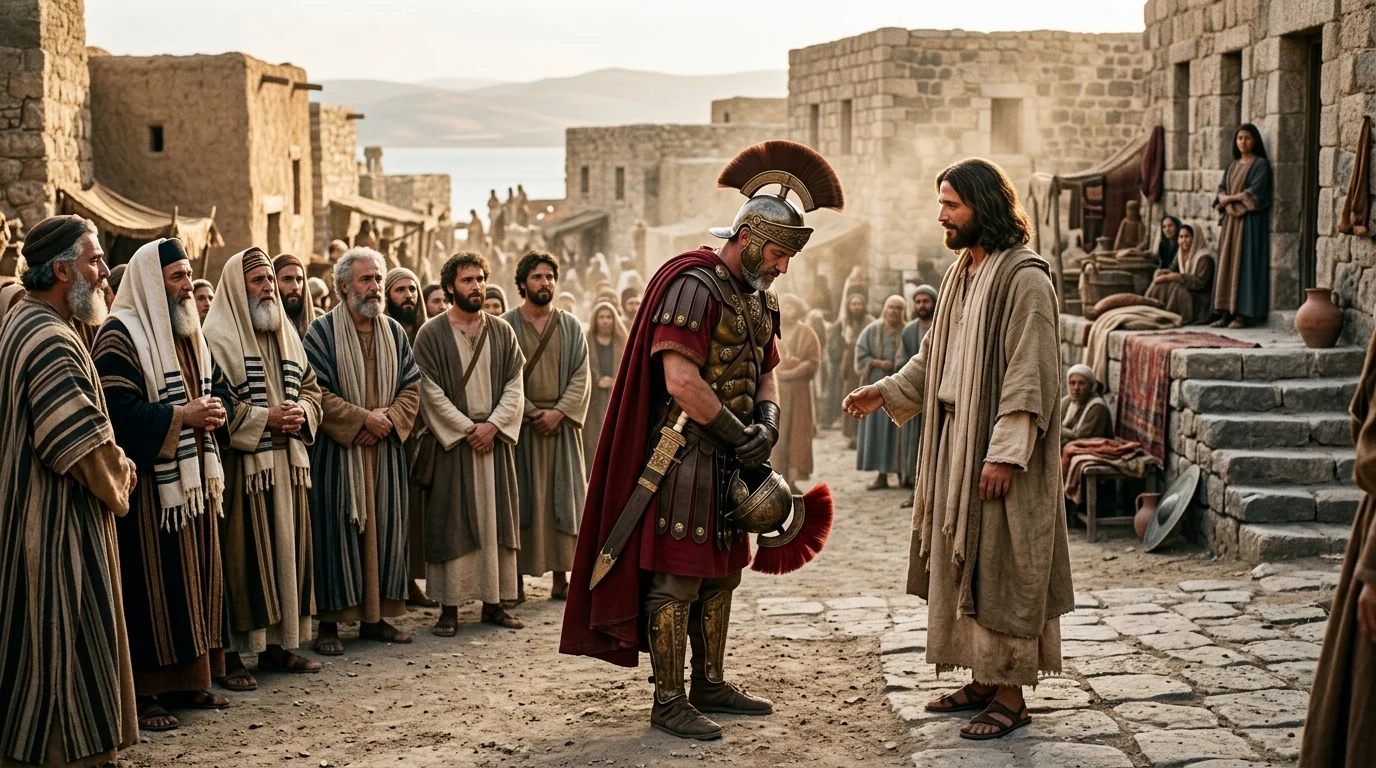
A Roman centurion (hekatontarchēs) was the iron backbone of the imperial military machine. Seasoned by brutal battlefield combat, these commanders were men of iron discipline, accustomed to unquestioned obedience and lethal violence. In Roman-occupied Galilee, centurions were generally feared, hated, and despised as symbols of foreign pagan oppression.
Yet the centurion stationed at Capernaum was an extraordinary anomaly. Luke records that he possessed a slave who was entimos—precious, deeply valued, and beloved by him. In the brutal Roman world, slaves were legally categorized as mere property, tools with voices (instrumentum vocale) that could be discarded or executed when sick. Yet this Roman officer loved his servant with a father’s tenderness.
The young servant was stricken with a violent paralysis and excruciating nerve torment (Matthew 8:6 - deinōs basanizomenos), hovering at the very threshold of death.
Having heard of the miracles of Jesus of Nazareth, the centurion reached out for help. But knowing that strict Jewish tradition forbade an observant rabbi from entering a Gentile house, he did not burst into Christ's presence. Instead, he dispatched an elite delegation of Jewish elders from Capernaum to intercede on his behalf.
The Jewish leaders pleaded earnestly with Jesus, saying: "He is worthy for You to grant this, for he loves our nation, and has built us a synagogue!" (Luke 7:4–5).
What an astonishing tribute! The conquered Jewish elders were enthusiastically vouching for a Roman pagan officer. He had not exploited the people; he had loved them and financed the grand black basalt synagogue where Jesus taught on the Sabbath. Jesus immediately turned and walked toward the centurion's villa.
2. The Military Logic of Sovereign Faith
As Jesus and the crowd drew near the house, a second delegation of friends rushed out to intercept Him with a stunning message direct from the centurion's lips:
"Lord, do not trouble Yourself, for I am not worthy that You should enter under my roof. Therefore I did not even think myself worthy to come to You. But say the word, and my servant will be healed!" (Luke 7:6–7).
Notice the breathtaking contrast! The Jewish elders had said, "He is worthy!" But the Roman centurion declared, "I am not worthy!" (Greek: hikanos - unfit, inadequate). The closer a human being draws to the holiness of God, the more acutely they recognize their own unworthiness.
Then the centurion unveiled the profound military architecture of his faith:
"For I also am a man placed under authority, having soldiers under me. And I say to one, 'Go,' and he goes; and to another, 'Come,' and he comes; and to my servant, 'Do this,' and he does it." (Luke 7:8).
Consider the brilliant tactical insight! The centurion did not say, "I am a man of authority." He said, "I am a man *under* authority." He understood the Roman chain of command. When he gave an order to a legionnaire, the soldier did not obey because of the centurion’s physical strength; the soldier obeyed because behind the centurion stood the invisible, irresistible majesty of the Roman Senate and Emperor Caesar!
Looking upon Jesus, the centurion recognized the supreme cosmic chain of command. He perceived that Jesus operated under the absolute authority of the God of the universe! Sickness, fevers, paralysis, and demons were not independent entities; they were lower-ranking subordinates under Christ’s imperial command! Jesus did not need to make an exhausting physical house-call; He did not need to perform dramatic incantations. He needed only to speak the royal decree across space, and disease would salute and retreat!
3. The Marvel of the Master
When Jesus heard these words, the Son of God stopped dead in His tracks. Luke records a word used only twice of Jesus in all the Gospels: "When Jesus heard these things, He marveled at him!" (Greek: ethaumasen - Luke 7:9).
The Creator of galaxies stood in awe of a human being’s faith! In His hometown of Nazareth, Jesus had marveled at their stubborn *unbelief* (Mark 6:6); here in Capernaum, Jesus marveled at a Roman soldier’s magnificent *faith*!
Turning to the Jewish multitude following Him, Christ proclaimed:
"I say to you, I have not found such great faith, not even in Israel!" (Luke 7:9).
Israel had the covenants, the temple, the priesthood, the prophecies, and the miracles of Moses—yet they constantly wavered in skepticism, demanding signs and proofs. This uncircumcised Roman warrior, with no covenant lineage, took Christ at His naked word!
In Matthew's account, Jesus added a prophetic warning that echoed through the corridors of redemptive history: "And I say to you that many will come from east and west, and sit down with Abraham, Isaac, and Jacob in the kingdom of heaven. But the sons of the kingdom will be cast out into outer darkness." (Matthew 8:11–12). The Gentiles were about to surge into the Kingdom of God!
Turning to the messengers, Jesus said: "Go your way; and as you have believed, so let it be done for you." (Matthew 8:13).
When the messengers returned to the villa, they found the servant who had been at the threshold of death completely whole, vigorous, and out of bed! Long-distance faith had met long-distance omnipotence.
4. The Road to Nain & The Collision of Two Processions
Luke immediately connects this triumph with the drama of the very next day: "Now it happened, the day after, that He went into a city called Nain; and many of His disciples went with Him, and a large crowd." (Luke 7:11).
Nain was a rugged agricultural settlement nestled on the northwestern slope of the Hill of Moreh in the Jezreel Valley, roughly twenty-five miles southwest of Capernaum. To walk twenty-five miles over mountainous terrain in a single day was an exhausting, forced march. Why did Jesus travel so urgently to this obscure hamlet? Because He had a divine appointment with a broken heart!
Late in the afternoon, as the golden rays of the sun dipped behind Mount Carmel, Jesus, His disciples, and a jubilant Galilean crowd ascended the rocky path toward the stone city gate of Nain.
Suddenly, at the narrow portal of the gate, two diametrically opposed worlds collided!
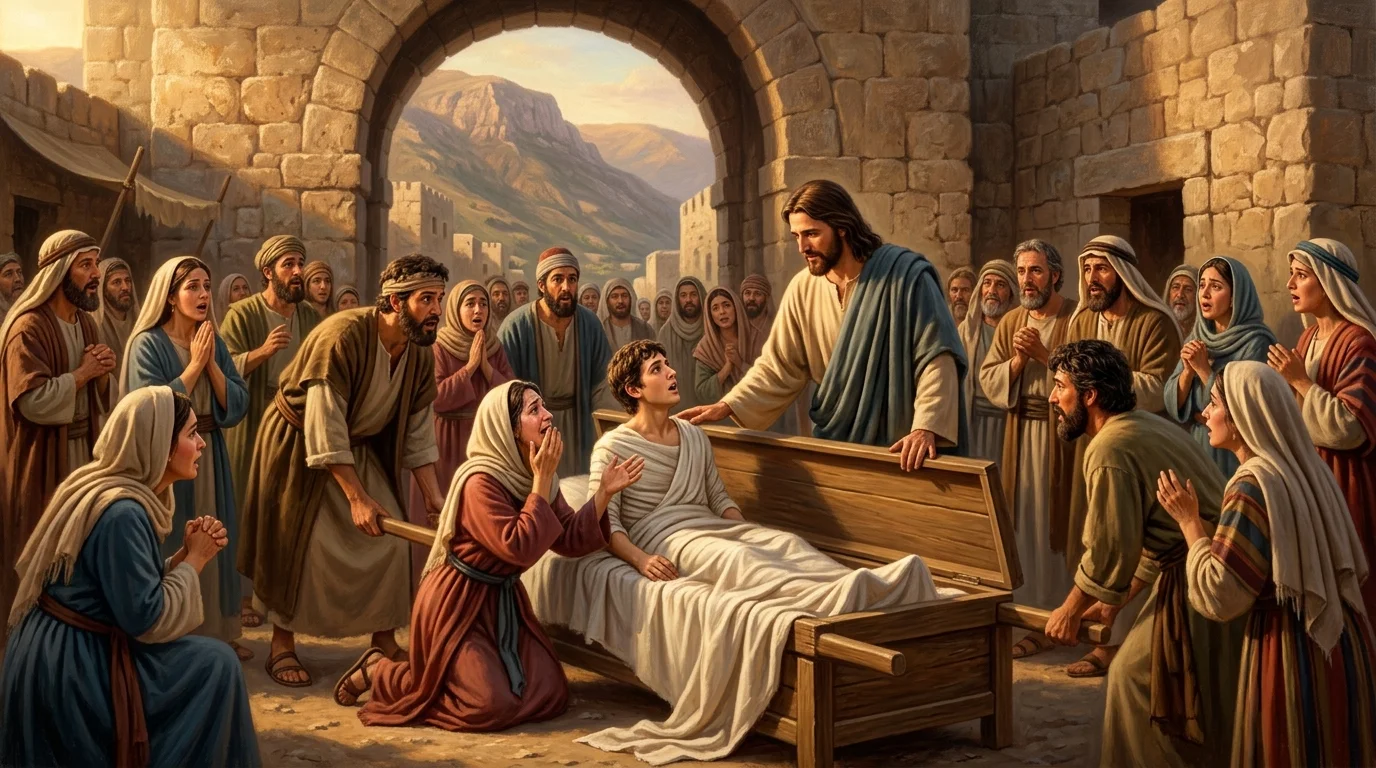
Exiting the gate was a somber, weeping funeral procession. Leading the throng were hired mourners wailing in high-pitched grief, professional flute players playing discordant dirges, and a crowd of townsfolk bearing witness to an unspeakable tragedy.
Luke describes the heart-wrenching scene in three devastating phrases:
- "A dead man was being carried out..."
- "The only son of his mother..."
- "And she was a widow." (Luke 7:12).
In first-century antiquity, this was the absolute zenith of human desolation. The woman had already stood beside the grave of her husband, tasting the bitter tears of widowhood. In ancient patriarchal culture, a widow had no pension, no social security, and no inheritance rights; she was entirely dependent upon the protection and labor of her son. Now, her only son—her sole joy, provider, and hope for the future—lay cold and dead upon a wooden plank. She was not only burying her child; she was burying her entire future, condemned to a life of destitution, starvation, and begging.
5. The Compassion That Touched the Coffin
As the weeping mother stumbled forward, blinded by her tears, Jesus looked upon her.
Luke, the physician, writes a phrase that pierces to the marrow of the Gospel: "When the Lord saw her, He had compassion on her..." (Luke 7:13).
The Greek verb is esplanchnistheis—His deepest visceral bowels churned with holy, aching grief. No one asked Jesus to intervene; the mother did not cry out for help; the crowd made no petition. Unprompted, sovereign, overflowing divine love moved the Son of God!
Walking directly to the sobbing widow, Jesus spoke three tender words that seemed almost impossible:
"Do not weep." (Greek: Mē klaie - Luke 7:13).
Coming from any mortal man, those words would have been a hollow, insensitive platitude. How could a mother not weep when burying her only child? But coming from the Prince of Life, it was a sovereign decree that tears were about to become completely unnecessary!
Then Jesus did what no pious Jewish rabbi would ever dare to do: He stepped forward and touched the open funeral bier! (Greek: soros - Luke 7:14).
Under Numbers 19:11, touching a corpse or the stretcher carrying it incurred seven days of severe ceremonial defilement. Yet when the Source of Life touched the vehicle of death, defilement did not flow into Jesus; instead, resurrection power exploded into the wood!
The four pallbearers carrying the bier froze in their tracks. The flutes silenced; the professional wailing ceased. A suffocating silence fell upon the hillside.
6. The Voice That Empties Graves
Standing over the open bier, Jesus looked upon the lifeless, pale corpse wrapped in linen burial cloths. He did not pray for assistance, nor did He stretch Himself upon the body as Elijah and Elisha had done. He spoke with the unborrowed authority of the Living God:
"Young man, I say to you, arise!" (Greek: Neaniske, soi legō, egerthēti! - Luke 7:14).
The voice that ignited the stars reverberated into the realm of the dead!
Instantly, the dead boy’s heart contracted and began to pump warm blood! Stiff lungs expanded with air; gray, lifeless skin flushed with rosy vitality; closed eyes fluttered open!
"So he who was dead sat up and began to speak!" (Luke 7:15).
The young man sat bolt upright on the stretcher, pushed back the burial shroud, and began talking! Luke adds one of the most tender sentences in all of world literature:
"And He presented him to his mother." (Luke 7:15).
Jesus did not keep the boy as a trophy of His power; He gently took the living young man by the hand, walked him over to the paralyzed, weeping widow, and placed his warm living hands into hers!
The funeral crowd stood petrified. Then, sheer holy terror (phobos) and explosive adoration swept through the multitudes:
"Then fear came upon all, and they glorified God, saying, 'A great prophet has risen up among us!' and, 'God has visited His people!'" (Luke 7:16).
Nine hundred years earlier, barely two miles away in the neighboring village of Shunem, the prophet Elisha had raised a dead boy to life (2 Kings 4). Now the people shouted: "A prophet greater than Elisha is here! Yahweh Himself has visited His people!"
From the centurion’s bedside in Capernaum to the open coffin at the gates of Nain, Jesus demonstrated that He holds universal dominion over space, sickness, distance, and death. There is no distance too great for His word to reach, and no grave too deep for His voice to awaken!
Ancient Near Eastern & Archaeological Context
Under the administrative reign of Herod Antipas in Galilee, military detachments were stationed in Capernaum to safeguard the imperial tax routes and maintain peace along the borders. A Roman centurion received roughly twenty times the pay of a common legionnaire and commanded enormous civic respect. For a pagan Gentile officer to love the subjugated Jewish nation, respect their monotheistic faith, and finance the construction of their local synagogue out of his own pocket was an astonishing historical rarity. Furthermore, Jewish ceremonial law strictly categorized a Gentile's house as ritually unclean; entering it would bar an observant Jew from temple worship. The centurion's extraordinary sensitivity to Jewish religious scruples, combined with his military insight that authority is projected through spoken command, made his faith unequaled in all Israel. In the second miracle, the town of Nain was an agricultural village perched on the northern slope of the Hill of Moreh in the Jezreel Valley, approximately twenty-five miles southwest of Capernaum—a rigorous full-day march. According to Jewish funeral customs, burial had to take place on the very day of death before sunset. The body, washed and wrapped in linen cloths with aromatic spices, was placed upon an open wooden frame (soros) and carried through the city gate toward hillside rock-cut tombs. Hired mourners and flute players accompanied the weeping family. Touching a funeral bier incurred seven days of severe defilement under Numbers 19:11; yet when Jesus touched the wood, death itself was instantly contaminated by eternal life!
Support Independent Biblical Research
Did this study bless you? Help support our independent bilingual research and interactive visual Bible tools.
⚡ Fast Facts
- A Roman centurion (hekatontarchēs) commanded a century of 80 to 100 legionnaires and represented the military backbone of the Roman imperial army
- Archaeological excavations of Capernaum's 4th-century limestone synagogue revealed the basalt foundations of the 1st-century synagogue built by this centurion
- Touching an open funeral bier (soros) incurred severe ceremonial defilement under Leviticus 21:1 and Numbers 19:11, yet Christ's touch imparted resurrection life rather than contracting death
- In the entire Gospel record, Jesus is recorded as 'marveling' (ethaumasen) only twice: once at the astonishing faith of this Gentile centurion (Luke 7:9), and once at the unbelief of His hometown Nazareth (Mark 6:6)
❓ Frequently Asked Questions (FAQs)
Under first-century Pharisaic law, entering the dwelling of a Gentile incurred ritual uncleanness and social controversy. Furthermore, the centurion recognized the infinite gulf between his sinful human status and the holy, divine authority of Jesus Christ. His confession of unworthiness was not cowardly hesitation, but the pinnacle of genuine reverence and spiritual self-awareness.
As an officer in the Roman army, the centurion understood delegated authority: when his superior commanded him, he obeyed; when he commanded a subordinate soldier 'Go!', the soldier went. He perceived that sickness, disease, and the forces of nature occupied a lower rank under Christ's absolute cosmic command. Jesus did not need to be physically present; He needed only to speak the sovereign word from afar, and disease would instantly obey.
In ancient Near Eastern culture, a woman possessed no independent legal status, property rights, or wage-earning capability; she was completely dependent on her male protector. Having already suffered the loss of her husband, the death of her only son meant total economic ruin, social destitution, and the extinguishment of her family name. By raising her son, Jesus not only defeated death, but rescued a defenseless widow from starvation, begging, and utter despair.