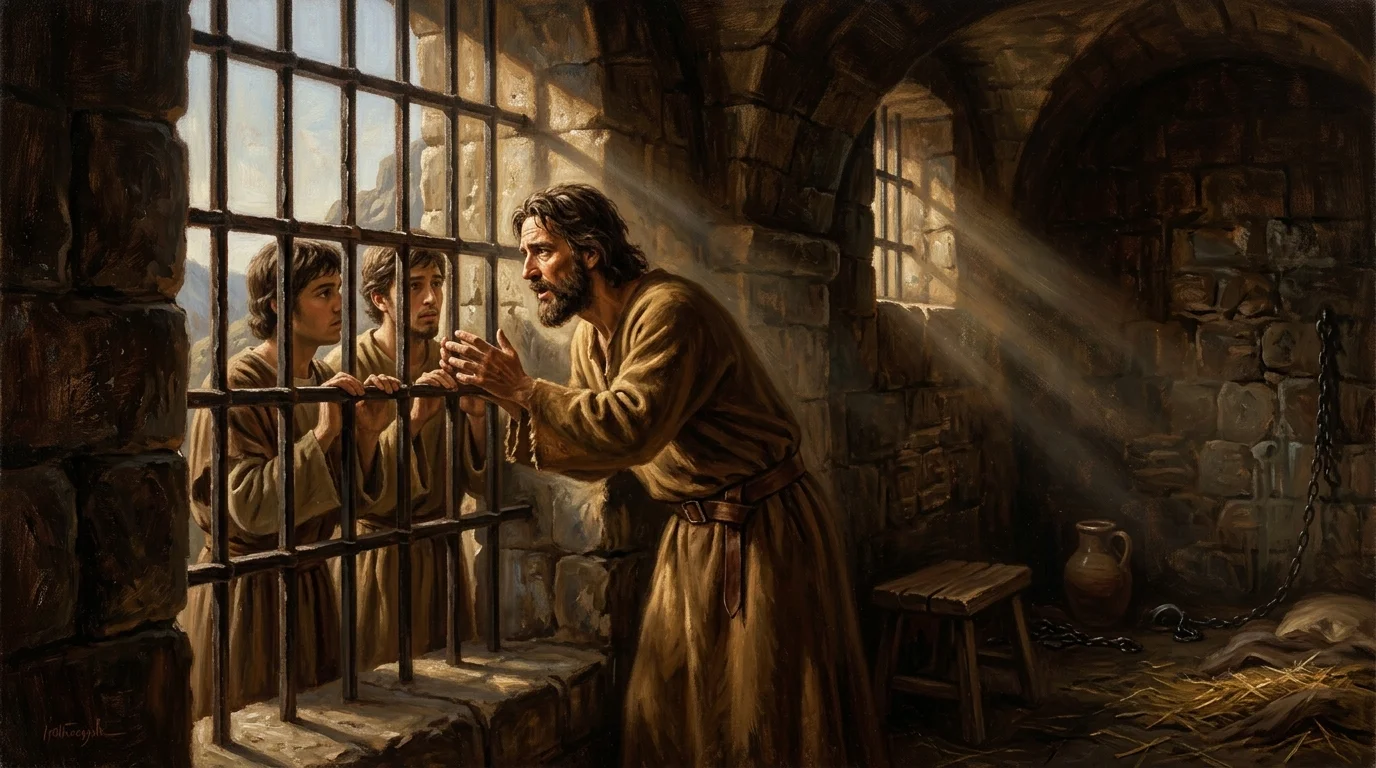
Deep within the suffocating limestone bowels of the desert fortress of Machaerus, three thousand feet above the dead, mineral-choked waters of the Salt Sea, John the Baptist sat bound in heavy iron chains. The fiery prophet who had shattered four centuries of prophetic silence, who had baptized Jesus beneath the opened heavens of the Jordan, and who had heard the Father's audible voice declaring Christ as the Beloved Son, was now engulfed in the cold, damp shadows of a subterranean dungeon. For months, Herod Antipas kept the prophet confined in darkness while rumors filtered down from the north: Jesus was healing lepers and dining with publicans, but no political revolution was brewing, no Roman garrison had fallen, and no celestial fire had consumed the wicked king on his throne. Caught in the agonizing vice of unmet prophetic expectations and bodily exhaustion, John dispatched two trusted disciples across the desert on a desperate mission to ask the master of Nazareth: "Are You the Coming One, or do we look for another?"
1. The Dark Night of the Forerunner
Machaerus was the ultimate geopolitical border outpost. Positioned at the precarious intersection between Herod Antipas' territory of Perea and the hostile Nabataean kingdom of King Aretas IV, it served as both a palace of decadent Hellenistic luxury and a grim dungeon for state enemies. In the upper banquet chambers, Roman wine flowed, pagan flutes echoed, and golden braziers cast flickering light across mosaic floors. But down below, carved directly into the barren volcanic bedrock, were cramped stone cisterns converted into holding cells.
In one of these subterranean cells languished the greatest man born of women. His once-sunburnt skin had grown pale and gaunt. His camel-hair tunic was caked with prison grime, and his iron fetters rattled with every breath. John was not an ivory-tower intellectual; he was a rugged wilderness ascetic accustomed to sleeping under desert stars, eating locusts and wild honey, and preaching with the thunderous roar of a desert torrent.
Yet physical torture was nothing compared to the psychological and theological anguish that gripped the prophet's soul. When John burst onto the banks of the Jordan, he had preached an apocalyptic message of unyielding judgment: "Even now the ax is laid to the root of the trees. Therefore every tree which does not bear good fruit is cut down and thrown into the fire... His winnowing fan is in His hand, and He will thoroughly clean out His threshing floor, and gather His wheat into the barn; but He will burn up the chaff with unquenchable fire!" (Matthew 3:10, 12).
John had looked for the Day of the Lord—a day of divine vengeance, the shattering of Roman tyranny, the cleansing of the corrupt Herodian dynasty, and the public vindication of God's holy law. Instead, reports from the disciples who visited his cell brought bewildering news. Jesus of Nazareth was not assembling an army in the hills; He was not marching on Jerusalem; He was not executing judgment upon wicked rulers. Instead, Christ was traveling quietly through rustic Galilean hamlets, touching untouchable lepers, eating bread with extortionate tax collectors, weeping with grieving widows, and speaking of peace, meekness, and mercy.
If Jesus was indeed the mighty Judge of heaven and earth, why was Herod Antipas lounging in silk upon his throne while God's faithful herald withered in chains? Was John mistaken? Had his eyes deceived him at the Jordan? Was Jesus merely another forerunner like himself, preparing the way for an even greater warrior-King yet to arise?
2. The Embassy of Honest Agony
Unlike modern religious hypocrites who conceal their doubts beneath pious masks, John the Baptist possessed a transparent, uncompromising integrity. He did not gossip, conspire, or nurture secret bitterness. When doubt hammered against his soul, he went straight to the source. Calling two of his faithful disciples who had smuggled food and water into the fortress, John whispered the desperate question that burned in his heart:
"Go to Jesus and ask Him: 'Are You the Coming One, or do we look for another?'" (Luke 7:19; Matthew 11:3).
The title John chose was freighted with deep theological gravity: Ho Erchomenos ("The Coming One"). It was the ancient messianic cipher drawn from Psalm 118:26 ("Blessed is He who comes in the name of the Lord") and Daniel 7:13. It encompassed every longing of patriarchal promise, Davidic kingship, and prophetic hope.
The two disciples set out on the seventy-mile journey northward, trekking up through the barren Jordan Valley, crossing the river, and ascending into the green, rolling hills of Lower Galilee. They found Jesus in the midst of a dense, swirling multitude.
Approaching the Master, the messengers delivered their master's raw inquiry: "John the Baptist has sent us to You, saying, 'Are You the Coming One, or do we look for another?'" (Luke 7:20).
The crowd surely held its breath. How would this celebrated miracle-worker react to such a blunt challenge from the very prophet who had baptized Him? Would Jesus rebuke John for his wavering faith? Would He express indignation that His premier forerunner was harboring skepticism?
3. The Exegetical Vindication: Isaiah's Blueprint
Jesus did not respond with philosophical arguments, defensive excuses, or theological rebuke. Luke records that in that very hour, before speaking a single word, Jesus turned to the surrounding crowd and performed an overwhelming deluge of divine mercies: "In that very hour He cured many of infirmities, afflictions, and evil spirits; and to many blind He gave sight" (Luke 7:21).
The messengers stood spellbound as they watched the Kingdom of God crashing into the fallen world. Blind eyes clouded with cataracts snapped open to the sunlight; crippled limbs twisted from birth straightened with supernatural strength; demonized victims howling in agony fell into serene peace; and lepers covered with rotting sores were cleansed in an instant.
Then Jesus turned to John's disciples and delivered a masterclass in prophetic exegesis:
"Go and tell John the things you have seen and heard: that the blind see, the lame walk, the lepers are cleansed, the deaf hear, the dead are raised, the poor have the gospel preached to them. And blessed is he who is not offended because of Me." (Luke 7:22–23; Matthew 11:4–6).
Every phrase that fell from Christ's lips was a direct quotation from the prophetic scroll of Isaiah. Jesus was pointing John back to the foundational scriptures the prophet had memorized in the desert:
- Isaiah 35:5–6: "Then the eyes of the blind shall be opened, and the ears of the deaf shall be unstopped. Then the lame shall leap like a deer, and the tongue of the dumb sing."
- Isaiah 61:1: "The Spirit of the Lord God is upon Me, because the Lord has anointed Me to preach good tidings to the poor; He has sent Me to heal the brokenhearted, to proclaim liberty to the captives..."
- Isaiah 26:19: "Your dead shall live; together with my dead body they shall arise!"
Ancient rabbinic Judaism recognized that while individual prophets like Elijah and Elisha had occasionally performed isolated wonders, the simultaneous convergence of all six of these signs—especially opening blind eyes and preaching good news to the impoverished outcasts—belonged exclusively to the Messianic age!
Jesus was answering John with profound clarity: "John, do not judge My mission by the categories of political militarism. The ax and the winnowing fan will indeed come in their appointed season at the consummation of the age. But before the King arrives to execute final judgment, He must first arrive as the Suffering Servant to bear humanity's sickness, conquer death, and ransom the brokenhearted!"
And then came Christ's tender, pastoral beatitude: "Blessed is he who does not stumble (skandalizō) over Me." Do not allow My gentle, compassionate methods to become a stumbling block to your faith. Trust that God's timetable is perfect, even when it leads through a prison cell.
4. The Supreme Eulogy of the Forerunner
As John's two disciples departed to carry the life-giving message back to Machaerus, Jesus turned to the surrounding multitude. Christ knew human nature. The crowd had overheard John's question. Many in the audience were undoubtedly thinking: "Look at John the Baptist. When he was out in the wilderness, he was bold as a lion, thundering against kings. But now that he is locked up in prison, his courage has evaporated; he is faltering and questioning his own testimony!"
Jesus would not allow His faithful servant's reputation to be tarnished by shallow public opinion. He stepped forward and delivered the most magnificent tribute ever spoken over a human life:
"What did you go out into the wilderness to see? A reed shaken by the wind?" (Matthew 11:7).
Along the banks of the Jordan, thousands of hollow river reeds (kalamos) bent and swayed with every prevailing gust of wind. Did the crowds flock to the desert to see a spineless, vacillating man who compromised his convictions to please the crowd? Absolutely not! John was an iron oak that had stood unbending against the hurricane of Herodian corruption.
"What then did you go out to see? A man clothed in soft garments? Indeed, those who wear soft clothing and live in luxury are in royal palaces." (Matthew 11:8; Luke 7:25).
John was not a pampered courtier seeking luxury or fame. He lived on camel hair and wild locusts, sacrificing every earthly comfort to herald the coming King.
"What then did you go out to see? A prophet? Yes, I say to you, and more than a prophet! For this is he of whom it is written: 'Behold, I send My messenger before Your face, who will prepare Your way before You.'" (Matthew 11:9–10; Malachi 3:1).
Then Jesus dropped the sovereign thunderbolt that established John's eternal legacy:
"Assuredly, I say to you, among those born of women there has not risen one greater than John the Baptist; but he who is least in the kingdom of heaven is greater than he!" (Matthew 11:11).
Consider the breathtaking scope of that declaration: In the estimation of God incarnate, John surpassed Abraham, Moses, David, Elijah, Isaiah, and Daniel! Why? Because while all earlier prophets pointed to a distant Messiah through types, shadows, and unfulfilled prophecies, John alone had the peerless privilege of pointing his finger directly at the incarnate Lamb of God and saying: "Behold Him!"
Yet in the very next breath, Jesus unveiled the staggering privilege of the New Covenant: "Yet he who is least in the kingdom of heaven is greater than he." John was the friend of the Bridegroom standing outside the wedding chamber; he belonged to the twilight of the Old Covenant. But every believer living on this side of the empty tomb and the outpouring of the Holy Spirit enjoys an intimate union with Christ, an indwelling of the Spirit, and a full adoption as a royal son or daughter of God that exceeds even John's earthly ministry!
5. Woes Upon Unrepentant Cities
Turning from His commendation of John, Jesus surveyed the towns across the northern shore of the Sea of Galilee. These villages—Capernaum, Bethsaida, and Chorazin—had witnessed the overwhelming majority of His mighty works (dynameis). They had seen lepers cleansed, the blind healed, and paralytics walking. Yet their response was not deep repentance, but casual entertainment, intellectual curiosity, and hardened spiritual indifference.
Filled with holy prophetic grief, Christ pronounced devastating woes:
"Woe to you, Chorazin! Woe to you, Bethsaida! For if the mighty works which were done in you had been done in Tyre and Sidon, they would have repented long ago in sackcloth and ashes. But I say to you, it will be more tolerable for Tyre and Sidon in the day of judgment than for you!" (Matthew 11:21–22).
And to His adopted hometown:
"And you, Capernaum, who are exalted to heaven, will be brought down to Hades; for if the mighty works which were done in you had been done in Sodom, it would have remained until this day!" (Matthew 11:23).
Spiritual privilege brings cosmic responsibility. To witness the dawn of God's Kingdom and yawn in self-satisfied complacency is far more damnable than the pagan ignorance of ancient Tyre, Sidon, or Sodom.
6. The Great Invitation: Solace for the Weary
Then, in one of the most breathtaking transitions in all of sacred scripture, Jesus moved from the terrors of divine judgment to the tenderest invitation ever uttered in human history.
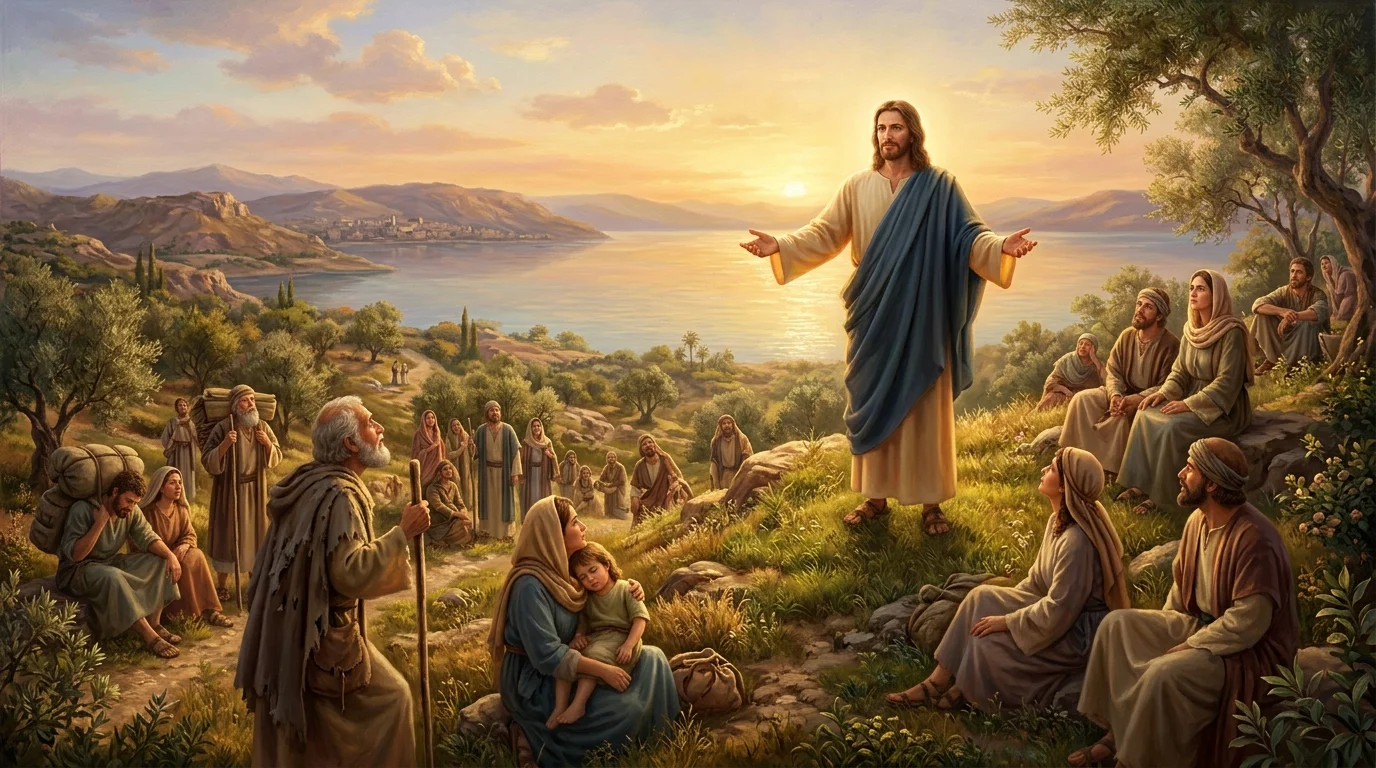
Looking out over the crowd of Galilean peasant farmers, impoverished fishermen, widows crushed by debt, and ordinary people suffocating under the tyrannical legalism of the Pharisees, Jesus prayed to the Father:
"I thank You, Father, Lord of heaven and earth, that You have hidden these things from the wise and prudent and have revealed them to babes. Even so, Father, for so it seemed good in Your sight." (Matthew 11:25–26).
The scribes and Pharisees, bloated with intellectual pride and rabbinic credentials, were blind to the Kingdom. But the humble, the contrite, and the broken—the spiritual "babes"—received the revelation of God.
Then Jesus turned toward the multitudes, opened His arms wide against the sky of Galilee, and spoke the immortal words that have anchored weeping souls for two millennia:
"Come to Me, all you who labor and are heavy laden, and I will give you rest. Take My yoke upon you and learn from Me, for I am gentle and lowly in heart, and you will find rest for your souls. For My yoke is easy and My burden is light." (Matthew 11:28–30).
Every syllable of that invitation is pure gospel gold:
- "Come to Me": Religion says: "Perform, achieve, climb the moral ladder, keep 613 laws, cleanse yourself." Jesus says: "Come to Me!" Salvation is not a philosophical system or a ritual code; it is a living person.
- "All you who labor (kopioōntes) and are heavy laden (pephortismenoi)": The first word describes those exhausted from working themselves to the bone; the second describes those crushed under a burden loaded onto their backs by another—specifically the unbearable weight of Pharisaic guilt, human sin, and religious performance.
- "I will give you rest (anapausō)": Christ does not offer temporary relaxation; He gives cosmic, spiritual rest—the peace of justification, the assurance of pardon, and freedom from striving to earn God's favor.
- "Take My yoke upon you and learn from Me": In antiquity, a farmer never yoked a young, inexperienced ox alone; he paired it with a seasoned, powerful lead ox who bore the brunt of the weight and set the steady pace. When we are yoked to Jesus, He pulls the load!
- "For I am gentle (praus) and lowly in heart (tapeinos te kardia)": In the entire Bible, this is the only passage where Jesus describes His own inner heart! He does not describe Himself as fierce, demanding, or aloof. He is gentle. He does not crush the bruised reed or quench the smoking flax. He welcomes the exhausted failure with tender compassion.
- "My yoke is easy (chrēstos) and My burden is light (elaphron)": The Greek word chrēstos means "custom-fitted, kindly, perfectly suited." Christ's yoke does not gall or chafe the neck. It fits our soul perfectly because He designed our souls to flourish in fellowship with Him.
Far away in the dark dampness of Machaerus, John's disciples returned and carried these words into the underground cell. The prophet heard of the blind seeing, the lame leaping, and the poor rejoicing. He knew his life's work was finished. The Messiah had arrived. His reign had begun. And though John would soon lay his neck upon the executioner's block to die a martyr's death, his soul rested in absolute peace, knowing that the Lamb of God who takes away the sin of the world was marching across history to redeem His people forever.
Ancient Near Eastern & Archaeological Context
Machaerus was an impregnable fortified ridge situated east of the Dead Sea in ancient Perea (modern Jordan), constructed by Hasmonean king Alexander Jannaeus and rebuilt by Herod the Great as a defensive bastion against Nabataean Arab incursions. Perched at 3,600 feet above the Dead Sea, Machaerus combined opulent royal banquet halls and romanized villas with brutal, subterranean rock-cut dungeon chambers chiseled directly into the barren basalt mountain. Herod Antipas utilized Machaerus as both a luxury desert pleasure retreat and a high-security political prison. It was here that John the Baptist was chained after courageously denouncing Herod Antipas for unlawfully marrying Herodias, the living wife of his half-brother Philip (Leviticus 18:16; 20:21). For months, John—a wild prophet accustomed to the vast winds of the Judean wilderness and the rushing waters of the Jordan—languished in stifling subterranean heat, surrounded by the clanking of iron chains and Roman guard boots, listening only to distant echoes of Christ's itinerant ministry in Galilee.
Support Independent Biblical Research
Did this study bless you? Help support our independent bilingual research and interactive visual Bible tools.
⚡ Fast Facts
- Machaerus (Mukawir), situated east of the Dead Sea in modern Jordan, was an isolated mountain palace-fortress equipped with deep underground dungeons built by Herod the Great and occupied by Herod Antipas
- Jesus authenticated His identity using Isaiah 35:5–6 and Isaiah 61:1, combining six distinct prophetic signs that ancient rabbis unanimously assigned solely to the Messianic age
- The Greek phrase 'sy ei ho erchomenos' ('Are You the Coming One?') used the definitive technical title for the long-awaited Messianic deliverer of Israel
- In Jewish rabbinic tradition, the 'yoke' ('ol') represented the crushing burden of 613 legalistic commandments and Pharisaic oral fences; Jesus offered a light, life-giving yoke of restful grace
❓ Frequently Asked Questions (FAQs)
John was not an apostate or unbeliever; he was an exhausted prophet enduring agonizing confinement in a dark fortress dungeon. John had boldly preached that the Messiah would arrive with a winnowing fan in His hand, thoroughly purging His threshing floor, executing righteous judgment, and burning unquenchable chaff with fire (Matthew 3:11–12). Instead, Jesus was traveling through Galilean villages touching untouchables, dining with sinners, preaching peace, and Herod Antipas still sat unchallenged on his luxurious throne while God's prophet languished in chains. John's question arose from an honest tension between his prophetic expectation of fiery apocalyptic judgment and Christ's unexpected first-advent ministry of suffering compassion and sacrificial mercy.
Jesus was not disparaging John's moral character or spiritual stature; He affirmed John as the pinnacle of the Old Testament prophetic order ('more than a prophet'). However, John stood on the prophetic threshold looking into the promised land of the New Covenant without living to experience its post-Pentecost fullness. Every believer living after the cross and resurrection possesses the indwelling Holy Spirit, a fully accomplished redemption, the completed canon of Scripture, and the positional status of an adopted child of God in Christ's inaugurated Kingdom—a theological privilege that surpasses even the greatest Old Covenant herald.
In first-century Jewish theology, rabbis spoke frequently of taking upon oneself the 'yoke of the Torah' ('ol Torah') and the 'yoke of the commandments' ('ol mitzvot'). Under Pharisaic legalism, this yoke had become an unbearable, exhausting burden of endless human traditions, external regulations, and anxiety over ceremonial purity. When Jesus invited the weary to 'Take My yoke upon you,' He used familiar rabbinic terminology to offer a radically new discipleship. Christ's yoke is custom-fitted ('chrestos'—easy, gentle, well-fitting) and His burden is light ('elaphron') because He bears the weight alongside us, imparting His own divine righteousness, peace, and spiritual rest.