Following the catastrophic waters of the Great Deluge, the family of Noah descended from the rugged heights of Mount Ararat into a revitalized earth. God renewed His primeval covenant mandate: "Be fruitful and increase in number and fill the earth" (Genesis 9:1). Yahweh’s design was clear: humanity was to disperse across continents, islands, and river basins, cultivating diverse cultures under the benevolent canopy of divine worship. But as the centuries rolled on, the memory of the waters faded, and human pride once again organized itself against the Sovereign Creator.
1. The Migration Eastward: The Plain of Shinar
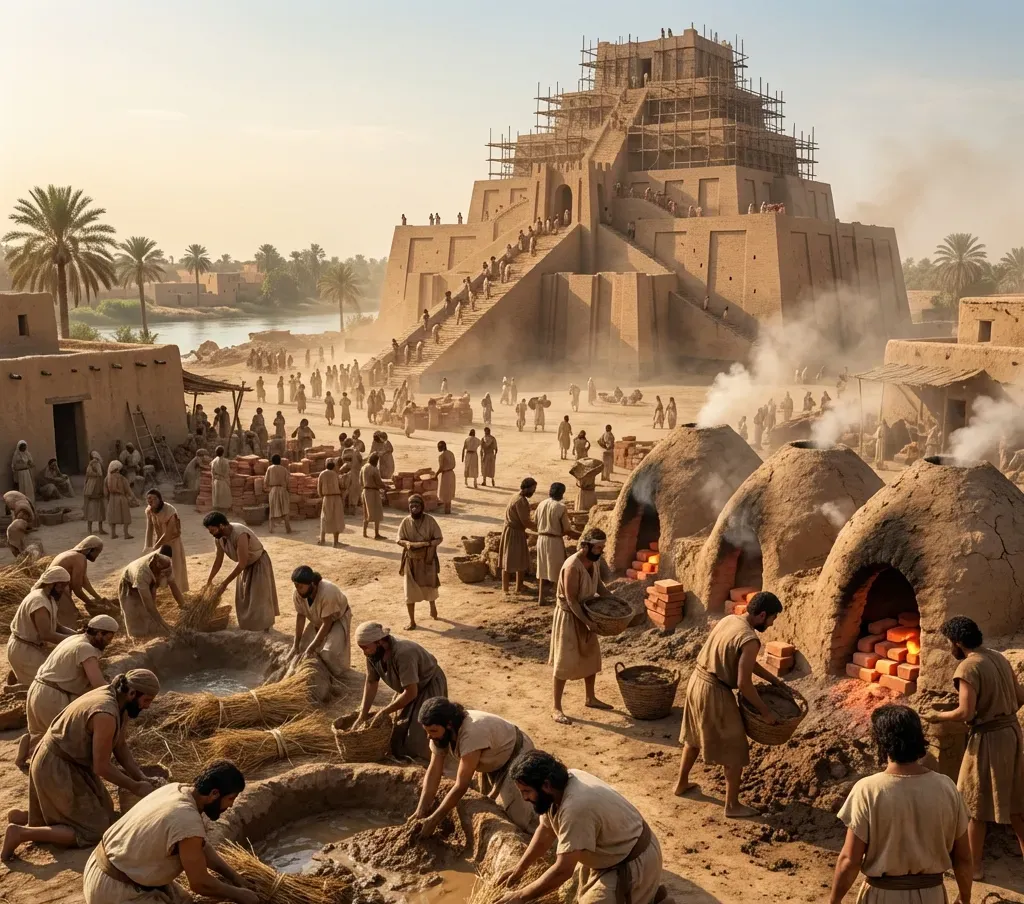 "Come, let us make bricks and bake them thoroughly" - The birth of technological self-reliance.
As the population multiplied, a massive unified migration traveled eastward, discovering a vast, remarkably fertile alluvial basin in the land of Shinar (ancient Sumer and Babylonia). The soil was rich, the Euphrates and Tigris rivers provided endless irrigation, and the flat landscape offered ideal conditions for urban centralization.
At this historical juncture, Scripture notes a profound sociological reality: "Now the whole world had one language and a common speech" (Genesis 11:1). Linguistic unity granted humanity frictionless communication, uninhibited collaboration, and unified cultural momentum. However, severed from reverence for Yahweh, this immense sociological cohesion was swiftly harnessed for systematic rebellion. Genesis 10:8-10 records that Nimrod, a mighty hunter before the Lord, began to establish the first imperial kingdom, the beginning of which was Babel, Erech, Accad, and Calneh in the land of Shinar. Human power, organized without God, inevitably generates tyrannical empire and idolatrous self-glorification.
In the plains of lower Mesopotamia, there were no natural stone quarries or forests of cedar such as existed in Canaan or Lebanon. But human ingenuity bridged the deficit through technological innovation: "Come, let us make bricks and bake them thoroughly" (Genesis 11:3). By mastering kiln-fired mud bricks and utilizing naturally occurring petroleum asphalt (bitumen) as adhesive mortar, they acquired the capacity to construct monumental, multi-tiered architecture capable of enduring weather and time. Technological advancement, rather than inspiring humble gratitude toward God, birthed intoxicating self-reliance.
2. The Manifesto of Pride: City, Tower, and Name
Emboldened by their material mastery, the leaders of Shinar issued a momentous cultural manifesto:
"Come, let us build ourselves a city, with a tower that reaches to the heavens, so that we may make a name for ourselves; otherwise we will be scattered over the face of the whole earth." (Genesis 11:4)
An exegesis of this declaration exposes the tripartite anatomy of fallen human rebellion:
- "A tower that reaches to the heavens": This was the birth of the Mesopotamian Ziggurat. The builders did not naively believe they could physically pierce the physical stars; rather, they were constructing an astrological staircase (dur-an-ki) designed to storm heaven, manipulate divine power, and domesticate God on human terms.
- "Let us make a name (shem) for ourselves": This is the essence of idolatry. Instead of glorifying the name of Yahweh, humanity sought to immortalize its own achievement, erecting an enduring monument to human supremacy.
- "Lest we be scattered": Direct defiance of God’s explicit commandment. God said: "Disperse and fill the earth"; humanity replied: "We will concentrate power, build walls, and remain right here." It was an imperialistic revolt against the Creator's global vision.
3. The Divine Irony: The Descent of the Almighty
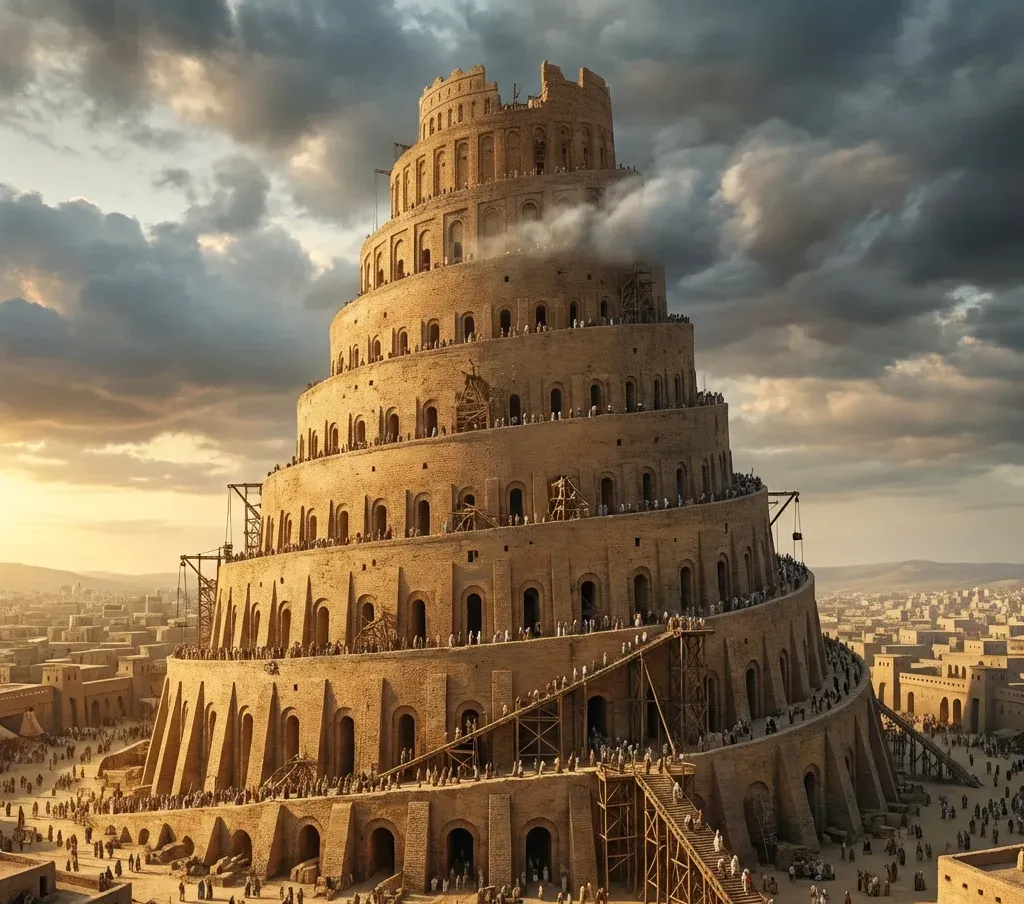
As the kiln fires roared and the colossal tower rose tier upon tier, dominating the flat Mesopotamian horizon, the builders congratulated themselves upon their triumph. From an earthly vantage point, it was the greatest technological achievement in history.
Yet the inspired narrator punctures this imperialistic delusion with devastating literary irony:
"But the Lord came down to see the city and the tower the people were building." (Genesis 11:5)
Here is sublime divine satire. Human engineering had expended decades of labor, burning millions of bricks to scrape the heavens; yet the Infinite God had to lean down and descend from the heights of eternity just to see their microscopic ant-hill! What appeared gargantuan to mortal eyes was utterly insignificant to the Creator of the galaxies.
Surveying the construction site, the Lord spoke within the Trinitarian council: "If as one people speaking the same language they have begun to do this, then nothing they plan to do will be impossible for them" (Genesis 11:6). God was not threatened or insecure; rather, as a loving Father, He recognized that fallen humanity, unified in rebellion and unchecked by linguistic boundaries, would rapidly engineer monstrous systemic evil and accelerate their own self-destruction.
4. The Great Confusion: From Harmony to Chaos
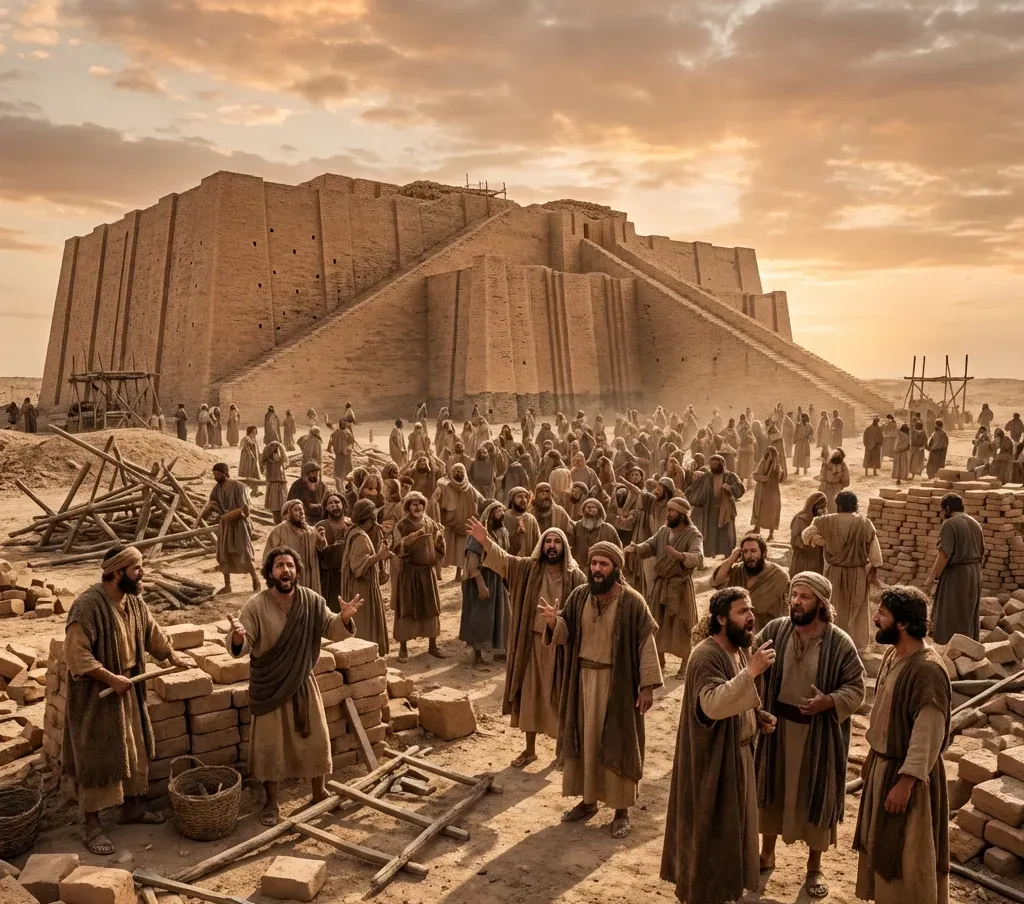 The rhythm of pride shattered: Linguistic confusion halts the imperial construction.
God delivered judgment not through a catastrophic earthquake, lightning, or deluge, but through a brilliant linguistic intervention: "Come, let Us go down and confuse their language so they will not understand each other" (Genesis 11:7).
In an instant, the cohesive rhythm of the construction site disintegrated. A master mason shouted for mortar, but the supplier heard unfamiliar, incomprehensible syllables. A bricklayer called for plumb-lines, but received stone hammers. Frustration boiled into misunderstanding, suspicion, and anger. Coordinated architectural execution became entirely impossible. The monumental scaffolding was abandoned, and the half-finished ziggurat stood as an eerie, silent monument to human folly.
The site was named Babel—a phonetic play on the Hebrew verb balal, meaning "to confuse." The Babylonians proudly called their city Bab-ili ("Gate of God"), but God exposed it as Babel: the capital of stammering confusion and broken pride.
5. The Global Dispersion: Fulfilling the Sovereign Mandate
Unable to communicate, kindred linguistic groups clustered together. Families packed their belongings and migrated away from the plain of Shinar, moving north into Europe, west into Africa, and east into Asia. What humanity attempted to avoid through defiant architecture, God accomplished through divine decree: "So the Lord scattered them from there over all the earth, and they stopped building the city" (Genesis 11:8).
The dispersion at Babel gave birth to the rich tapestry of human nationalities, languages, and ethnic traditions described in the Genesis 10 Table of Nations. God's purpose was never to abolish diversity, but to scatter humanity so that every corner of His earth would reflect His glory.
Yet Babel was not God’s final word on human language. Two millennia later, on the Day of Pentecost (Acts 2), the Holy Spirit was poured out upon the disciples in Jerusalem. As they spoke, visitors from every nation under heaven heard the Gospel proclaimed in their own native tongues! At Babel, human pride fractured language and scattered humanity; at Pentecost, the humility of the cross redeemed language and united humanity into one glorious, multi-ethnic family of God. Revelation 7:9 paints the final destination: a great multitude that no one could count, from every nation, tribe, people and language, standing before the throne and before the Lamb, worshipping God in eternal unity.
Biblical Keywords & Theological Roots
Let us make bricks; intense Hebrew alliteration conveying self-confident technological pride and manufactured autonomy.
Name, renown, lasting monument; humanity sought to make their own 'shem', directly contrasting with God making Abram's 'shem' great in Gen 12:2.
To confuse, mix, confound; the phonetic root of 'Babel', satirizing the Akkadian Bab-Ili ('Gate of God').
To descend, come down; divine literary satire illustrating that humanity's grandest monument was utterly insignificant to the Transcendent God.
Ancient Near Eastern & Archaeological Context
The Tower of Babel was situated in the fertile alluvial basin of Shinar (southern Mesopotamia/Sumer, modern southern Iraq). Lacking the stone quarries of the Levant and Upper Egypt, Mesopotamians engineered an epochal technological breakthrough: manufacturing artificial stone through kiln-fired mud bricks and cementing them with waterproof bituminous asphalt (slime/pitch), which naturally bubbled up from local oil seepages.
This engineering triumph enabled the construction of monumental Mesopotamian Ziggurats—towering terraced step-pyramids such as Etemenanki in Babylon ('The House of the Foundation of Heaven and Earth'). In Sumerian and Babylonian theology, the ziggurat was understood as a cosmic staircase (dur-an-ki, bond of heaven and earth) topped with a summit shrine (gigunu) where deities descended to receive human service and sacrifices. The Akkadian name for the city, Bab-ili, proudly proclaimed 'Gate of the Gods.' Genesis satirizes this religious arrogance: what proud imperialists hailed as the gateway to the divine, Yahweh demolished through linguistic confusion, branding it forever as Babel—the place of babbling nonsense and shattered ambition.
Practical Discipleship & Spiritual Application
- Dismantling Personal Towers of Self-Glory: Human pride constantly seeks to 'make a name for ourselves' through career advancement, social media status, or self-righteous achievements. True significance is found only in exalting the name of Jesus Christ.
- Trusting God's Disruptive Mercies: When God shatters our self-reliant plans, it is not cruelty, but protective grace. He graciously dismantles our towers before they collapse upon us and destroy our souls.
- Embracing God's Global Heart: God never designed humanity for monocultural isolationism. He desires the Gospel to penetrate every tribe, tongue, language, and nation, enriching the global body of Christ.
- Celebrating the Gospel Reversal at Pentecost: At Babel, pride scattered humanity into mutual incomprehension; at Pentecost, the Holy Spirit united people across all linguistic boundaries to hear the wonderful works of God in Christ.
⚡ Fast Facts
- Technological Revolution: Kiln-fired bricks and bitumen mortar allowed Mesopotamians to construct monumental architecture without natural stone.
- The Threefold Rebellion: The builders sought unified centralization, self-glorification ('make a name for ourselves'), and refusal to scatter and fill the earth.
- Divine Irony (Genesis 11:5): The tower humanity believed scraped the clouds was so microscopically tiny that Yahweh had to 'come down' to even perceive it.
- Pentecostal Reversal: The linguistic confusion and scattering at Babel was redeemed at Pentecost (Acts 2), where the Holy Spirit unified diverse nations in the Gospel.
❓ Frequently Asked Questions (FAQs)
The tower was a Mesopotamian Ziggurat—a sacred monumental stairway constructed not merely as an apartment skyscraper, but as a ritualistic portal to draw the gods down to earth and coerce divine favor through human religious engineering.
Human unity severed from God functions as an accelerator of evil. Without cultural checks and balances, fallen humanity would collectively engineer totalitarian wickedness and unrestrained idolatry, accelerating their own destruction.
Genesis 10 presents the geographical and linguistic distribution of the seventy nations descended from Noah's sons, while Genesis 11 provides the theological and historical catalyst (the judgment at Babel) that caused this global diaspora.