The plains of Moab, sprawling along the eastern banks of the Jordan River directly opposite the fortified city of Jericho, were cloaked in a suffocating atmosphere of dread and military panic. The triumphant march of the children of Israel had shattered the geopolitical equilibrium of the Transjordan. In rapid, devastating succession, the armies of Israel had annihilated Sihon, king of the Amorites, seizing his fortified cities from the Arnon to the Jabbok, and had utterly crushed Og, the giant king of Bashan, at Edrei. Now, a vast sea of over two million Hebrews was pitched upon the lowlands, their disciplined rows of black goatskin tents covering the horizon like an unstoppable locust swarm. King Balak, son of Zippor, monarch of Moab, gazed down from his palace ramparts upon the Israeli encampment and was gripped by paralyzing terror. Numbers 22:3 records the collective psychology of his court: "And Moab was exceedingly afraid of the people because they were many, and Moab was sick with dread because of the children of Israel."
Balak knew that his conventional armed forces—chariots, archers, and spearmen—were utterly incapable of withstanding the supernatural power that fought for Israel. If military force could not prevail, he would turn to the realm of the occult. King Balak formed a desperate geopolitical alliance with the sheikhs of Midian and dispatched a high-level diplomatic delegation with bags of silver and gold representing the 'fee for divination' (*qasam*). Their destination was Pethor, a distant Mesopotamian sanctuary city nestled along the upper Euphrates River in northern Syria—over four hundred miles away. Their target was Balaam, son of Beor, the most celebrated *barû* (ritual diviner, seer, and curse-broker) in the Ancient Near East. Balak’s mandate to the Mesopotamian seer was flattering and urgent: "Look, a people has come from Egypt; see, they cover the face of the earth, and are settling next to me! Therefore please come at once, curse this people for me, for they are too mighty for me... for I know that he whom you bless is blessed, and he whom you curse is cursed!" (Numbers 22:5–6).
When the Moabite ambassadors arrived in Pethor, jingling their bags of silver, Balaam invited them to lodge for the night while he consulted Yahweh. Balaam knew of Yahweh not as his personal Savior, but as the fearsome territorial deity of the Hebrews who had recently devastated Pharaoh's Egypt. That night, God visited Balaam with an uncompromising, absolute decree: "You shall not go with them; you shall not curse the people, for they are blessed!" (Numbers 22:12). The divine will was crystal clear. Balaam arose in the morning and dismissed the emissaries, stating that Yahweh refused to let him go. But when Balak received the refusal, he concluded that Balaam was simply playing the classic Near Eastern negotiation game to raise his fee. Balak immediately dispatched an even more prestigious delegation—distinguished royal princes bearing chests of glittering gold, royal vestments, and promises of astronomical promotion: "Let nothing hinder you from coming to me! For I will honor you greatly, and I will do whatever you say to me."
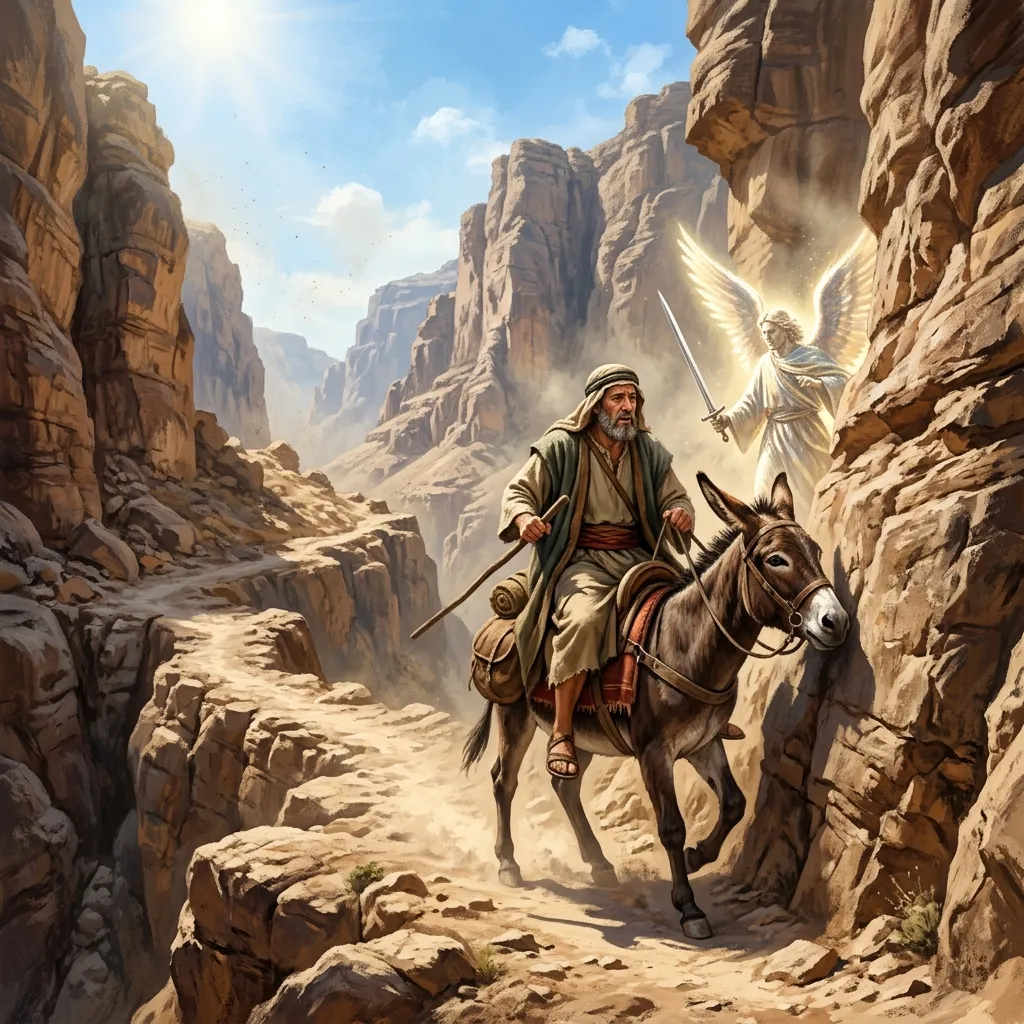
Balaam's covetous heart salivated. Though he uttered a high-sounding spiritual platitude—"Even if Balak were to give me his house full of silver and gold, I could not go beyond the word of Yahweh my God"—his actions betrayed his lust for wealth. Instead of shutting the door instantly upon the temptation, Balaam invited the princes to lodge with him again, secretly hoping that God might change His mind. Seeing that the diviner was obsessed with the treasure, God gave him over to his own foolish desires, permitting him to go, but placing him under strict prophetic constraint: "If the men come to call you, rise and go with them; but only the word which I speak to you—that you shall do." Notice the condition: *if they come to call you*. Yet early the next morning, without waiting for the men to summon him, Balaam eagerly arose, saddled his trusty female donkey (*aton*), and galloped off with the princes of Moab. His heart was intoxicated with dreams of royal riches, intending to find some ritual loophole to place a curse upon Israel.
Numbers 22:22 records the immediate consequence of his presumption: "Then God’s anger was kindled because he went, and the Angel of Yahweh took His stand in the way as an adversary against him." This was no ordinary angelic being; it was the Mal'akh Yahweh—a pre-incarnate Christophany, the eternal Son of God, descending in fiery holiness with a drawn sword glistening in His hand. As Balaam rode along the path accompanied by his two servants, a bizarre, humiliating scene unfolded. The great international seer, famous across the known world for his spiritual vision, was utterly blind to the supernatural realm! But his humble, beast of burden—the female donkey—saw the terrifying Angel of the Lord standing squarely in the middle of the road with His unsheathed sword ready to strike.
Terrified by the celestial vision, the donkey swerved off the road into an open field. Balaam, enraged by the animal's sudden insubordination, struck her violently with his staff to force her back onto the track. Further along, the path entered a narrow vineyard trail hemmed in on both sides by rough stone terrace walls (*gederoth*). Suddenly, the Angel of the Lord appeared again, blocking the narrow passage. Desperately trying to evade the divine warrior, the donkey pressed herself against the stone wall, crushing Balaam’s foot against the rough masonry. Howling in pain and fury, the prophet beat the animal mercilessly a second time.
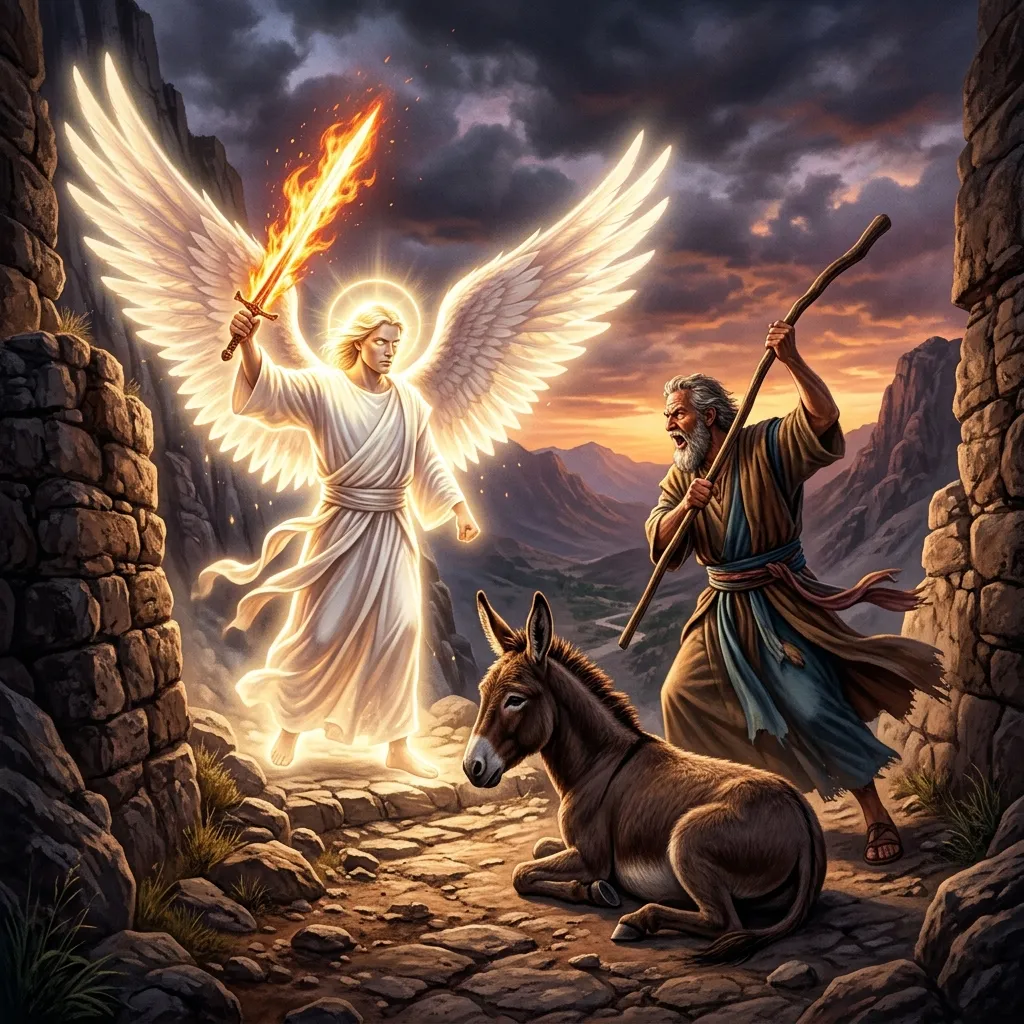
The Angel of the Lord moved further ahead and stood in a narrow mountain pass where there was no space to turn either to the right or to the left. When the terrified donkey saw the glowing sword hovering directly before her, she simply collapsed beneath Balaam, lying flat upon the dirt. Consumed by irrational rage, Balaam’s temper exploded. He gripped his heavy wooden staff and began thrashing the defenseless animal with ferocious, murderous blows.
Then occurred one of the most astonishing miracles recorded in human history. "Then Yahweh opened the mouth of the donkey, and she said to Balaam, 'What have I done to you, that you have struck me these three times?'" (Numbers 22:28). The beast of burden was endowed by the Creator with rational moral consciousness and articulate human speech! Yet Balaam was so blinded by narcissistic rage that he did not even pause to marvel at a talking animal; he engaged her in an indignant shouting match: "Because you have abused me! I wish there were a sword in my hand, for now I would kill you!"
The donkey replied with calm, devastating philosophical logic: "Am I not your donkey on which you have ridden, ever since I became yours, to this day? Was I ever disposed to do this to you?" Balaam was forced to answer with a sheepish, humiliated: "No." In that instant, the supernatural veil was stripped from Balaam’s eyes. Yahweh opened his sight, and the prophet suddenly beheld the terrifying reality: the Angel of the Lord standing directly before him with His drawn sword ready for execution. Paralyzed with horror, Balaam bowed his head and fell flat on his face in the dust.
The Angel of Yahweh spoke with chilling authority: "Why have you struck your donkey these three times? Behold, I have come out to stand against you as an adversary, because your way is perverse before Me! The donkey saw Me and turned aside from Me these three times. If she had not turned aside from Me, surely I would also have killed you by now, and let her live!" Shaking in terror, Balaam confessed his sin and offered to turn back. But the Angel commanded: "Go with the men, but only the word that I speak to you, that you shall speak." Balaam was taught an unforgettable lesson: he was nothing more than an instrument in the hands of the Living God, no more sovereign over his own tongue than the donkey had been over hers.
When Balaam arrived at the borders of Moab, King Balak rushed to meet him, rebuking him for the delay and reiterating his promises of immense honor. Over the ensuing days, Balak orchestrated a desperate, elaborate campaign to extract a supernatural curse upon Israel. He escorted Balaam to three distinct high places overlooking the vast Hebrew encampment: first to Bamoth-Baal, then to the summit of Mount Pisgah, and finally to the peak of Mount Peor. At each location, Balak spared no expense: he built seven stone altars and sacrificed fourteen royal animals—seven bulls and seven rams—seeking to manipulate the heavens with blood and fire.
Yet every single time Balaam opened his mouth to pronounce a curse, the Holy Spirit of God seized his vocal cords! Instead of venomous curses, sublime torrents of irrevocable divine blessing poured forth from his lips! In his first oracle, Balaam proclaimed: "How shall I curse whom God has not cursed? ... Who can count the dust of Jacob, or number one-fourth of Israel? Let me die the death of the righteous, and let my end be like his!" (Numbers 23:8–10). Balak was furious: "What have you done to me? I took you to curse my enemies, and look, you have blessed them bountifully!"
At Mount Pisgah, Balaam delivered his second oracle, announcing the immutable faithfulness of Yahweh: "God is not a man, that He should lie, nor a son of man, that He should repent. Has He said, and will He not do? Or has He spoken, and will He not make it good? Behold, I have received a command to bless; He has blessed, and I cannot reverse it! ... Yahweh his God is with him, and the shout of a King is among them!" (Numbers 23:19–21). No witchcraft, no divination (*nahash*), no sorcery can ever prevail against the people of God!
By the time they reached Mount Peor, Balaam no longer sought omens; he set his face toward the wilderness and looked upon the orderly tents of Israel abiding according to their tribes. The Spirit of God came upon him in mighty power, and he uttered his third oracle, praising the beauty, fertility, and unstoppable military dominion of Israel: "How lovely are your tents, O Jacob! Your dwellings, O Israel! Like valleys that stretch out, like gardens by the riverside... Blessed is he who blesses you, and cursed is he who curses you!" (Numbers 24:5–9). Balak’s anger blazed like fire; he clapped his hands in disgust and ordered Balaam to flee to his home without reward.
Before departing, however, the Holy Spirit forced Balaam to deliver a fourth, climactic prophetic oracle across the centuries—a vision of the end times: "I see Him, but not now; I behold Him, but not near; a Star shall come out of Jacob; a Scepter shall rise out of Israel, and batter the brow of Moab, and destroy all the sons of tumult... Out of Jacob One shall have dominion!" (Numbers 24:17–19).
This was the magnificent Messianic prophecy of the Kokhav mi-Ya'akov—the Star out of Jacob! Twelve hundred years before the birth of Christ, a pagan sorcerer on the mountains of Moab foretold the coming of the King of kings. That distant Star would pierce the darkness of human history; that royal Scepter would crush the powers of sin, Satan, and death. Centuries later, Persian Magi—astronomers studying ancient Mesopotamian scrolls in the very homeland of Balaam—beheld that very Star in the eastern sky and followed it across the desert to Bethlehem, falling down in worship before the newborn King. The story of Balaam and his talking donkey remains an eternal testament: the schemes of darkness can never overturn the promises of God; every curse launched against His people is sovereignly transformed into an everlasting blessing, and the Star of Jacob reigns supreme over all the earth!
Biblical Keywords & Theological Roots
To divine, practice divination, cast lots, or conjure mercenary omens; strictly forbidden in Torah (Deut 18:10), representing pagan attempts to manipulate divine forces for financial gain.
A female donkey; prized in antiquity for steady endurance, intelligence, and gentleness, serving as the humble vessel endowed with spiritual vision that rebuked the spiritually blind prophet.
The Angel of the Lord; a pre-incarnate Christophany standing as an adversary (*satan*) in the narrow vineyard way with an unsheathed sword of divine execution.
To open the mouth; miraculous divine bestowal of articulate human speech and rational moral consciousness upon an otherwise mute beast of burden.
The Star out of Jacob; the monumental royal Messianic prophecy (Numbers 24:17) prefiguring the King of kings whose light shatters all pagan dominion and darkness.
Ancient Near Eastern & Archaeological Context
Numbers 22–24 is set on the plains of Moab across the Jordan from Jericho, during the final year of the wilderness wanderings. Balaam son of Beor was not an Israelite, but a renowned international *barû* (Mesopotamian ritual diviner and omen priest) from Pethor (*Pitru*) along the Euphrates River in northern Syria. In 1967, sensational extra-biblical confirmation of Balaam was discovered at Tell Deir Alla in Jordan: a Late Bronze/Early Iron Age Aramaic plaster wall inscription explicitly referencing 'Balaam son of Beor, the seer of the gods' receiving nocturnal visions of divine destruction. Ancient Near Eastern royal diplomacy heavily relied on mercenary incantation priests to perform sympathetic execration magic—inscribing curses or casting hexes on clay figurines before military engagements. King Balak of Moab attempted this exact ritual strategy. The narrow path through the vineyards bordered by rough fieldstone walls (*gederoth*) represents authentic Transjordanian terrace agriculture of the Late Bronze Age.
Practical Discipleship & Spiritual Application
- The Fatal Poison of Loving the Wages of Unrighteousness: Balaam possessed genuine supernatural awareness, but his heart was corrupted by covetousness. The New Testament repeatedly warns against the 'way of Balaam' (2 Peter 2:15) and the 'error of Balaam for profit' (Jude 1:11). Never allow financial gain, worldly status, or professional flattery to compromise your spiritual integrity.
- God Confounding Human Pride Through Humble Vessels: When the renowned international seer was completely blind to the spiritual realm, his lowly female donkey saw the Angel of the Lord. God delights to use the foolish, weak, and overlooked things of this world to confound the wise and bring to nothing the arrogance of men (1 Corinthians 1:27).
- The Irrevocable Sovereignty of God's Blessing: King Balak built seven altars, sacrificed fourteen animals at each location, and brought Balaam to three strategic mountain vantage points to curse Israel. Yet God declared: 'Behold, I have received a command to bless; He has blessed, and I cannot reverse it' (Numbers 23:20). No demonic curse, witchcraft, or human conspiracy can harm those whom God has justified.
- Fixing Our Hope on the Star Out of Jacob: Balaam prophesied of a distant, glorious Ruler: 'A Star shall come out of Jacob; a Scepter shall rise out of Israel' (Numbers 24:17). This oracle pointed directly to the Lord Jesus Christ, the Bright and Morning Star (Revelation 22:16), whose eternal kingdom shatters every earthly oppressor and grants everlasting peace to His redeemed people.
⚡ Fast Facts
- Balaam was from Pethor along the Euphrates River in Mesopotamia—a journey of over 400 miles from Moab (Numbers 22:5).
- The 1967 archaeological discovery at Tell Deir Alla in Jordan contains an ancient 8th-century BC plaster wall inscription explicitly naming 'Balaam son of Beor, the seer of the gods.'
- King Balak built seven altars at three different mountain sites—Bamoth-Baal, Mount Pisgah, and Mount Peor—offering a bull and a ram on each altar in a desperate bid to curse Israel.
- Though unable to curse Israel with his words, Revelation 2:14 reveals that Balaam later taught King Balak how to tempt Israel into sexual immorality and idolatry at Baal-Peor.
❓ Frequently Asked Questions (FAQs)
Balaam was an internationally renowned pagan diviner (*barû*) who operated within the polytheistic magical worldview of ancient Mesopotamia. He lived in Pethor (Pitru) near the Euphrates River. When Balak's princes arrived with bags of silver and gold representing the 'fee for divination' (*qasam*), Balaam was familiar with Yahweh—not as his personal covenant Lord, but as the regional national deity of Israel whose catastrophic plagues in Egypt and victories over Sihon and Og had made headlines across the Near East. Balaam sought to manipulate Yahweh using pagan sacrificial techniques (erecting seven altars and seeking omens, Numbers 23:1; 24:1). However, the Living God did not allow Himself to be manipulated by an occultist. Yahweh sovereignly hijacked Balaam's vocal cords, seizing him by the Holy Spirit and compelling him to bless Israel. Ultimately, Scripture uniformly condemns Balaam: Peter condemns his covetousness (2 Peter 2:15), Jude exposes his greed for profit (Jude 1:11), and Jesus Himself denounces 'the doctrine of Balaam, who taught Balak to put a stumbling block before the children of Israel' (Revelation 2:14). Joshua 13:22 explicitly categorizes him as 'Balaam the soothsayer' (*ha-qosem*), who was eventually killed by the sword of Israel.
This apparent paradox disappears when examining the inner motives of Balaam's heart. In Numbers 22:12, God gave Balaam an absolute, unconditional negative command: 'You shall not go with them; you shall not curse the people, for they are blessed.' That was God's perfect will. However, when Balak sent more honorable princes with promises of astronomical wealth and royal promotion, Balaam's greedy heart salivated. Instead of standing firm on God's clear word, Balaam told them to stay the night, hoping God might change His mind. Seeing that Balaam was utterly obsessed with the gold, God granted him 'permissive' will: 'If the men come to call you, rise and go with them; but only the word which I speak to you—that you shall do' (Numbers 22:20). Notice the condition: *if they call you*. Yet early the next morning, without waiting for the men to summon him, Balaam eagerly saddled his donkey and set off! God was angry because Balaam went with the malicious, greedy intention of finding some loophole to curse Israel and collect the king's treasure. God met him as an adversary on the road to demonstrate that He alone controls the outcome.
Numbers 24:17 is one of the most stunning, climactic Messianic prophecies in the entire Hebrew Bible: 'I see Him, but not now; I behold Him, but not near; a Star shall come out of Jacob; a Scepter shall rise out of Israel, and batter the brow of Moab, and destroy all the sons of tumult.' Spoken by a pagan seer from the Euphrates twelve centuries before Christ, this oracle foretold a coming Monarch whose reign would transcend time and geography. In Ancient Near Eastern royal ideology, stars and scepters symbolized divine kingship, celestial authority, and cosmic dominion. While David partially fulfilled this by conquering Moab centuries later (2 Samuel 8:2), the ultimate fulfillment is found in Jesus Christ, the 'Root and Offspring of David, the Bright and Morning Star' (Revelation 22:16). Strikingly, it was Persian and Mesopotamian Magi—astronomers from the very region of Balaam along the Euphrates—who observed this celestial 'Star in the East' over a millennium later and followed it to Bethlehem to worship the newborn King of the Jews (Matthew 2:1–2).