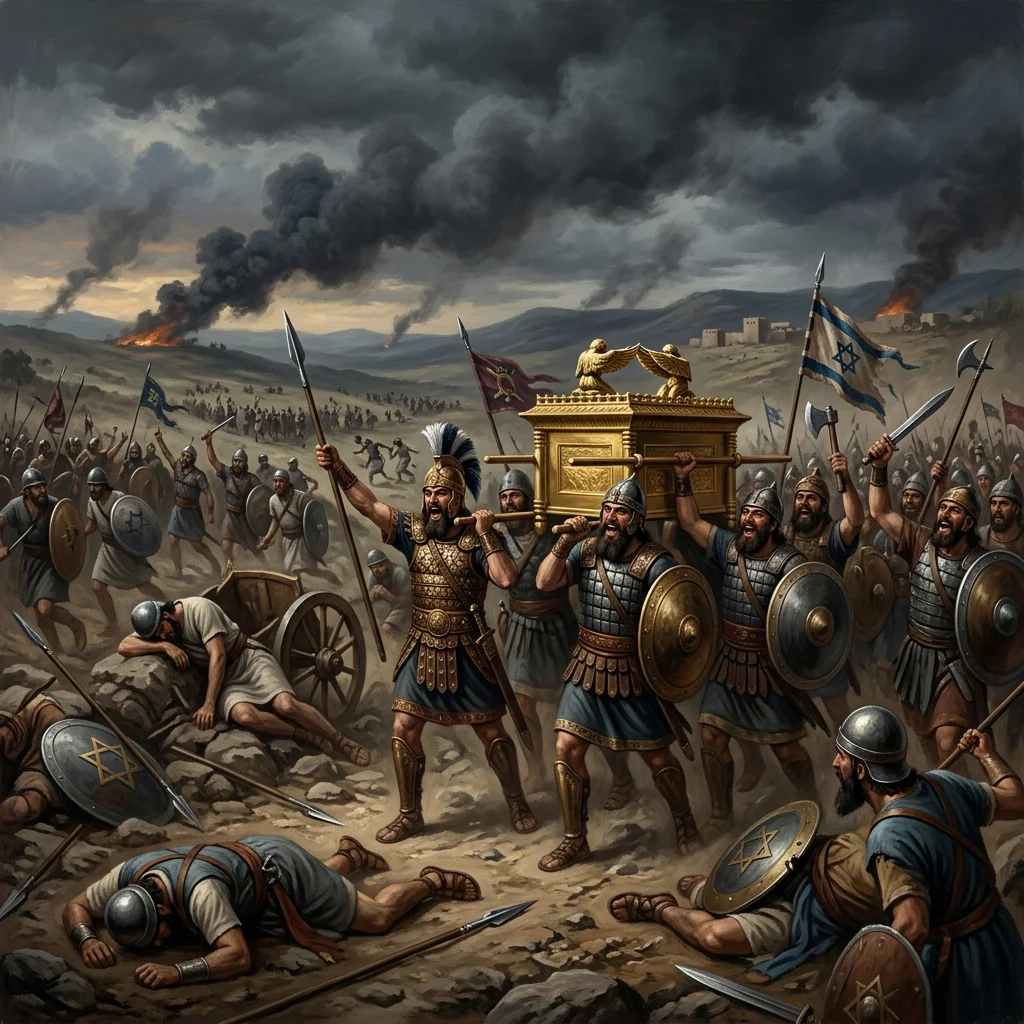
Following the long spiritual dark age of the Judges, during which the covenant people had grown accustomed to living without righteous kings or spiritual discernment, a sudden military crisis erupted along the coastal border of the Shephelah foothills. The Philistines—a technologically advanced Aegean seafaring coalition occupying the five fortified cities of the Pentapolis—marshaled their formidable chariots, bronze armor, and iron weapons to expand eastward into the highlands of Judah and Benjamin. The armies of Israel marched out to confront them at Ebenezer, near Aphek. The initial engagement proved disastrous: the Philistine battle lines shattered the Israelite front, leaving four thousand Hebrew infantrymen dead upon the rocky battlefield.
Stunned and humiliated by the rout, the elders of Israel retreated to their camp. Yet rather than falling on their faces in sackcloth and ashes to inquire what secret sin, idolatry, or moral rebellion had provoked the withdrawal of divine favor, they engaged in superstitious, paganized reasoning. "Why has Yahweh defeated us today before the Philistines?" they asked. But instead of repenting, they concocted a mechanical solution: "Let us bring the Ark of the Covenant of Yahweh from Shiloh to us, that when it comes among us it may save us from the hand of our enemies!" (1 Samuel 4:3). Notice their tragic theological distortion: they did not say "that Yahweh may save us," but "that IT may save us!" They viewed the gold-plated acacia chest not as the footstool of a holy, sovereign God who demands covenant loyalty, but as an invincible military weapon—a domesticated magical talisman that would compel the Almighty to fight on their behalf.
So the elders sent messengers north to Shiloh. The sacred Ark was removed from the Holy of Holies in the Tabernacle and carried down to the military camp at Ebenezer, accompanied by Eli's two corrupt, predatory sons, Hophni and Phinehas. When the Ark arrived in the camp, a tremendous wave of carnal euphoria swept through the ranks: "All Israel shouted with a great shout, so that the earth shook!" (1 Samuel 4:5). The roaring celebration echoed across the valley into the Philistine camp at Aphek, striking terror into the hearts of the uncircumcised soldiers. "God has come into the camp!" the Philistines cried in terror. "Woe to us! Who will deliver us from the hand of these mighty gods? These are the gods who struck the Egyptians with all the plagues in the wilderness!" But desperation fueled their valor: Philistine commanders rallied their troops to fight like men rather than become slaves to the Hebrews.
The ensuing clash was a catastrophe of biblical proportions. Israel had the holy box, the loud religious shouting, and the hereditary priests, but they did not have the living God! Stripped of divine protection, Israel suffered a crushing, unprecedented annihilation: thirty thousand Hebrew foot soldiers were slaughtered, the entire army routed in chaotic flight, and the two wicked priests, Hophni and Phinehas, fell by the sword. Most horrific of all, the unthinkable occurred: the sacred Ark of God was captured by the heathen armies of Philistia!
A lone Benjaminite runner, clothes torn and earth upon his head, sprinted twenty miles from the battlefield to Shiloh. At the gate of the city sat ninety-eight-year-old Eli upon his high seat, trembling in spirit, for his heart feared for the Ark of God. When the messenger shouted the catastrophic report—Israel fled, thirty thousand slain, Hophni and Phinehas dead—Eli endured the agony. But when the runner added the fatal words: "And the Ark of God has been captured!", the aged High Priest fell backward off his seat beside the gate, broke his neck, and died, having judged Israel forty years. At that same hour, Phinehas's pregnant wife went into sudden, agonizing labor. As she lay dying after bearing a son, the women attending her urged her to take comfort, but she answered not. With her final breath, she named the newborn infant Ichabod (*I-Khavod*), weeping: "The glory has departed from Israel, for the Ark of God has been captured!" (1 Samuel 4:21-22). Archaeological evidence confirms that shortly thereafter, Philistine forces marched up to Shiloh and razed the ancient sanctuary city to the ground in fire and ash (Jeremiah 7:12-14).
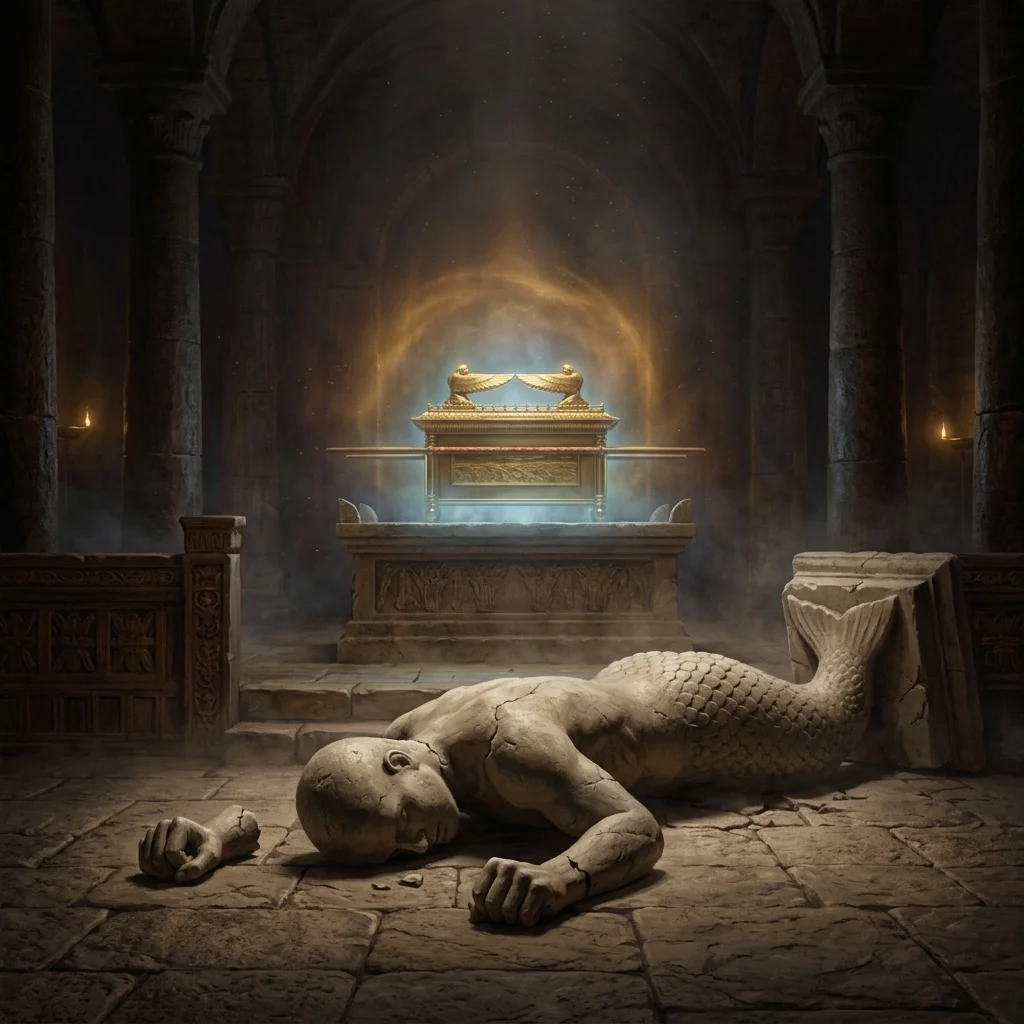
The Philistines rejoiced in their triumph, convinced that their chief deity, Dagon—the god of agricultural harvest and fertility—had overpowered Yahweh, the God of Israel. To display their decisive victory, they transported the captured Ark southward to the coastal metropolis of Ashdod and placed it inside the opulent temple of Dagon, setting it beside the towering statue of their idol as a trophy of war. The Philistine priests celebrated, believing that the Hebrew God had been permanently domesticated and subordinated to Dagon.
However, Yahweh needed no human swords, spears, or priestly rituals to defend His sovereign majesty. Early the next morning, when the citizens and priests of Ashdod entered the temple to pay homage, they were confronted with a stunning sight: Dagon had fallen flat on his face upon the stone floor before the Ark of Yahweh! Disturbed by the omen but attributing it to an unfortunate tremor or faulty pedestal, the priests hoisted the heavy idol upright and wedged him back into his place.
The following morning, when the priests returned at dawn, the humiliation of Dagon was absolute. Once more, the great idol had collapsed face-down in prostrate submission before the Ark of the Lord. But this time, Dagon had not merely fallen: his head—the emblem of divine wisdom and intelligence—and both palms of his hands—the symbols of power and authority—had been severed cleanly from his torso and lay shattered upon the temple threshold! Only the disfigured trunk of the fish-god remained upon the pedestal. The living God had entered the lion's den of paganism and executed cosmic judgment upon their idol. So profound was the terror of this event that from that day forward, neither the priests of Dagon nor any worshipper would ever step upon the threshold of Dagon in Ashdod, but leaped over it in superstitious dread (1 Samuel 5:5; Zephaniah 1:9).
The divine judgment did not stop with the wooden and stone idol. The hand of Yahweh fell heavily upon the people of Ashdod and its outlying territories, ravaging the population with excruciating pelvic tumors (*'ophalim*) and devastating plagues of swarming rodents that consumed their grain stores. Agonizing in terror, the lords of Ashdod cried out: "The Ark of the God of Israel must not remain with us, for His hand is harsh toward us and toward Dagon our god!"
In desperation, they summoned the lords of the Philistine Pentapolis and shuttled the Ark eastward to Gath. But no sooner had the Ark arrived in Gath than the hand of Yahweh struck that city also with heavy destruction: terrifying tumors broke out on small and great alike, triggering widespread civic panic. The terrified citizens of Gath then loaded the Ark onto a cart and shipped it north to Ekron. But as the sacred chest approached the city gates, the Ekronites shrieked in horror: "They have brought the Ark of the God of Israel to us to kill us and our people!" The cry of the dying cities rose up to heaven as the pestilence consumed the land.
For seven grueling months, the Ark resided in Philistine territory, leaving a trail of shattered idols, panic-stricken cities, and dying populations. Realizing they were powerless against the Almighty, the Philistine lords summoned their diviners and sorcerers: "What shall we do with the Ark of Yahweh? Tell us how we should send it to its place!" The priests warned them against hardening their hearts as Pharaoh and the Egyptians had done. They advised crafting a trespass offering of five golden tumors and five golden mice, representing the five lords and cities of the Philistines, to give glory to the God of Israel.
To conclusively test whether this calamity was truly from Yahweh or merely a random coincidence, the diviners devised a humanly impossible protocol. They constructed a brand-new wooden cart and hitched it to two milk cows that had recently calved and had never borne a yoke. Their calves were taken away and locked in a stall. By all natural maternal and animal instincts, unyoked cows deprived of their calves would resist the yoke, bellow continuously, and turn back toward their offspring. "And watch," the priests declared: "If it goes up the road to its own territory, to Beth-Shemesh, then He has done us this great evil. But if not, then we shall know that it is not His hand that struck us; it happened to us by chance" (1 Samuel 6:9).
The Philistines stood back and watched in breathless amazement. The moment the cows were hitched to the cart, the sovereign Spirit of God took control. The two milk cows turned directly east toward Beth-Shemesh, following the highway without turning to the right or to the left, lowing for their calves as they walked but never veering from the road! The five Philistine lords followed behind the cart in stunned silence all the way to the border of Beth-Shemesh.
In the valley of Beth-Shemesh, the men of Israel were reaping their wheat harvest. Lifting their eyes, they saw the cart approaching in the distance carrying the golden Ark of Yahweh, and their hearts exploded with ecstatic joy. The cart rolled into the field of Joshua of Beth-Shemesh and came to a halt beside a great stone. The Levites reverently took down the Ark of Yahweh and the chest of gold offerings; they split the wood of the cart and offered the two cows as a burnt offering to the Lord. Seeing this, the five lords of the Philistines turned back to Ekron, having witnessed the absolute supremacy of the God of Israel.
Yet tragedy soon struck Beth-Shemesh. Intoxicated by celebratory excitement, seventy men flippantly removed the Mercy Seat and looked irreverently into the uncovered interior of the Ark, violating the explicit Mosaic prohibition (Numbers 4:20). The holy wrath of Yahweh broke out against them, and the seventy men died instantly. Terrorized by God's blazing purity, the weeping inhabitants cried out: "Who is able to stand before this holy Lord God? And to whom shall He go up from us?" (1 Samuel 6:20).
They sent messengers to the men of Kiriath-Jearim, pleading with them to take the Ark. The men of Kiriath-Jearim came up, took the Ark into the house of Abinadab on the hill, and consecrated his son Eleazar to guard it reverently. There the Ark of God rested safely for twenty years, as all the house of Israel lamented after Yahweh, hungering for a true revival of holiness. In the furnace of defeat, God had revealed that He needs no human army to defend His honor: Yahweh alone is holy, sovereign, and worthy of undivided worship!
Biblical Keywords & Theological Roots
Ichabod; literally 'Where is the glory?' or 'No glory' (from 'i' [negative prefix / where?] and 'kavod' [weight, splendor, divine glory]). Given by Phinehas's wife when the Ark was captured.
The Ark of the Covenant; the gold-overlaid acacia chest containing the Ten Commandments, topped by the Mercy Seat (*Kapporeth*) and cherubim, representing Yahweh's earthly throne.
Dagon; chief deity of the Philistines, associated with grain (*dagan*) and fish (*dag*). Worshiped in massive temples at Ashdod and Gaza.
Threshold or doorsill of a temple or palace. The place where Dagon's head and severed hands lay shattered, establishing a Philistine superstition never to step on the threshold.
Ebenezer; 'Stone of Help' (from 'even' [stone] and 'ezer' [help]). The site of Israel's initial defeat, later consecrated by Samuel when Yahweh gave miraculous victory.
Ancient Near Eastern & Archaeological Context
The narrative of 1 Samuel 4–7 is firmly situated in the Early Iron Age I–IIA transitional period (circa 1075–1050 BC), characterized by geopolitical confrontation between the Sea Peoples (Philistines / *Peleset*) and the nascent Israelite tribal league. The Philistine Pentapolis—Ashdod, Ashkelon, Ekron, Gath, and Gaza—possessed advanced metallurgical technology, Aegean-style Aegean bichrome pottery, and formidable bronze/iron weaponry that gave them decisive tactical superiority in the Shephelah foothills. Archaeological excavations at Ashdod (Tel Ashdod) directed by Moshe Dothan have uncovered significant Iron I destruction layers and cultic installations dedicated to Dagon, a semitic deity of fertility and agricultural grain (often syncretized with maritime iconography). Excavations at Tell es-Safi (ancient Gath) by Aren Maeir and Tel Miqne (Ekron) by Trude Dothan and Seymour Gitin have confirmed the pentapolis confederate structure and the rapid transit networks connecting the coastal plain to Beth-Shemesh along the Sorek Valley. The sudden outbreak of *'ophalim* (painful pelvic hemorrhoids or bubonic buboes) accompanied by rodent infestations (*'akhbarim*) mirrors ancient epidemic contagion transmitted along trade corridors, which modern epidemiological historians frequently connect to rodent-borne bacterial outbreaks. The eventual destruction of Shiloh itself during this period is corroborated by thick ash and burned ceramic layers dating to circa 1050 BC (Jeremiah 7:12-14).
Practical Discipleship & Spiritual Application
- Never Treat God as a Useful Mascot for Personal Agendas: The Israelites carried the Ark into battle assuming God had no choice but to rescue them. Beware of treating prayer, church attendance, or Scripture as magical good-luck charms to validate your unrepentant lifestyle. True faith surrenders to God's will rather than demanding His co-signature.
- Rest Assured that God Defends His Own Glory: When institutional religion collapses, leaders fall into scandal, and the secular culture mocks the Gospel, do not despair. Yahweh needs no human press secretary or physical army to protect His honor; in the dark halls of Dagon, He will vindicate His name and bring every competing idol down.
- Guard the Presence of God Above All Earthly Treasures: The tragedy of Ichabod warns us that outward religious ritual can continue long after the Holy Spirit's tangible presence has departed. Cultivate daily personal repentance, humility, and holiness, cherishing the presence of Christ in your heart above career, reputation, or material comfort.
- Approach Holy Things with Deep Reverential Awe: The men of Beth-Shemesh died because they treated the holy Ark with flippant, casual curiosity. Familiarity with divine things must never lead to irreverence. When you worship, pray, or handle the Word of God, do so with trembling gratitude, remembering that our God is a consuming fire (Hebrews 12:28-29).
⚡ Fast Facts
- Thirty-four thousand Israelite soldiers died across the two battles of Ebenezer—four thousand in the first engagement, and thirty thousand in the second (1 Samuel 4:2, 10).
- Eli had judged Israel for forty years; at ninety-eight years old, he fell backward from his seat and broke his neck upon hearing the Ark was captured (1 Samuel 4:18).
- The Philistine priests established a centuries-long tradition of leaping over the threshold of Dagon's temple in Ashdod because Dagon's severed head and hands had landed there (1 Samuel 5:5; Zephaniah 1:9).
- The Ark was placed upon a brand-new cart drawn by two unyoked milk cows whose calves were penned at home, providing miraculous proof that the cows' straight path to Beth-Shemesh was driven solely by God's sovereign hand (1 Samuel 6:7-12).
❓ Frequently Asked Questions (FAQs)
The catastrophic capture of the Ark was a shocking wake-up call designed to purge Israel of superstitious idolatry. The Israelites had reduced the living God to a mechanical talisman; they believed that Yahweh was captive to His physical chest and therefore bound to grant them military victory regardless of their spiritual adultery. By abandoning the Ark into enemy hands and allowing the sanctuary at Shiloh to be sacked and razed (Psalm 78:56-61; Jeremiah 7:12), God forcefully taught that He is absolutely sovereign and unbound by any physical artifact. He would not allow His holy reputation to be co-opted to shield corrupt priests (Hophni and Phinehas) or an unrepentant nation from the righteous consequences of their covenant betrayal.
In the ancient Near East, placing a captured god's emblems inside the victor's temple signaled the utter subjugation of the defeated deity. When the Philistines triumphantly set the Ark inside the grand temple of Dagon at Ashdod, they proclaimed that Dagon had vanquished Yahweh. However, the next morning, Dagon was found lying face-down in prostration before the Ark of Yahweh. Thinking it a coincidence, the priests set him back up. The following morning, the humiliation was absolute: Dagon had fallen face-down once more, and this time his head (the seat of divine intelligence and wisdom) and both hands (the instruments of strength and power) were severed cleanly on the threshold, leaving only the disfigured trunk of the fish-god. God demonstrated conclusively that no idol possesses real wisdom or power; even in the heart of enemy territory without an army, Yahweh reigns as undisputed King.
When the Ark returned miraculously to Beth-Shemesh on the cow-drawn cart, the Israelites properly rejoiced and offered sacrifices. However, their joy rapidly degenerated into irreverent curiosity and sacred trespassing. According to the Mosaic Law (Numbers 4:5, 15, 20), even the Kohathite Levites who carried the sacred furniture were strictly forbidden from gazing upon the holy things even for a moment under penalty of death; the Ark was always to remain veiled under badger skins and blue cloth. The men of Beth-Shemesh boldly removed the Mercy Seat and looked directly into the uncovered Ark as though it were a common curiosity. God's severe judgment (striking seventy men) reinforced a foundational covenant principle: Yahweh is dangerously holy. His grace in returning the Ark must never be mistaken for casual familiarity; God's holiness demands trembling reverence.