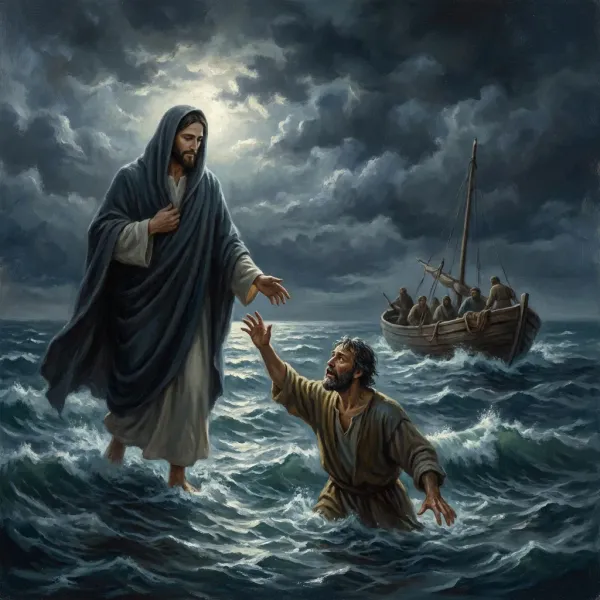
Immediately after miraculously feeding the five thousand, Jesus compelled His disciples to board their boat and cross to Capernaum while He dismissed the crowds and climbed a solitary mountain to pray. In the darkest hours before dawn, amid a howling Galilean squall, Jesus performed one of His most awesome demonstrations of cosmic divinity: walking across the churning whitecaps of the sea.
1. The Agony of the Midnight Row
The Sea of Galilee sits nearly 700 feet below sea level, surrounded by steep gorges that act as natural wind tunnels, funneling sudden, violent gales from Mount Hermon down upon the water. The disciples found themselves trapped in a ferocious headwind. For over eight brutal hours—from evening until the fourth watch (between 3:00 and 6:00 AM)—they rowed with all their might, yet had progressed only three or four miles. They were physically exhausted, soaked, and terrified.
2. The Mountain Intercessor Sees His Flock
Mark 6:48 reveals a deeply comforting truth: while Jesus was alone on the dark mountain praying, "he saw the disciples straining at the oars, because the wind was against them." Darkness could not hide them; distance could not blind Him; the storm could not sever His watchful care. When you feel trapped in prolonged adversity, Christ is actively interceding for you at the right hand of the Father, tracking every drop of your sweat and anxiety.
3. Treading Upon the Chaos
In Job 9:8, scripture declares that God alone "treads on the waves of the sea." In ancient Near Eastern mythology, the roaring sea was the personification of untamable chaos. By stepping out onto the liquid abyss and walking across it as though it were solid granite, Jesus demonstrated His absolute sovereignty over nature. When the terrified disciples screamed thinking He was a phantom, Jesus spoke words of eternal authority: "Take courage! It is I [Egō Eimi - I AM]. Don't be afraid" (Matthew 14:27).
4. Peter's Audacious Step and Sinking Gaze
Impetuous Peter shouted: "Lord, if it's you, tell me to come to you on the water." At Christ's one-word invitation—"Come"—Peter climbed over the gunwale and took real, physical steps on the liquid deep. But when he shifted his gaze from Jesus to the churning waves, fear seized his heart, and he began to sink. Crying out the most urgent three-word prayer in the Bible—"Lord, save me!"—Peter found that Jesus instantly caught him. Faith is not the absence of storms; it is fixing our undivided focus on Jesus in the midst of them.
5. Peace in the Vessel
The moment Jesus and Peter climbed into the boat, the gale abruptly died, and a great calm descended upon the lake. The exhausted disciples fell at His feet in trembling awe, declaring: "Truly you are the Son of God" (Matthew 14:33). Whatever tempest is currently battering your life, inviting Jesus into your vessel transforms terror into worship and brings supernatural peace.
Biblical Keywords & Theological Roots
To walk, tread, conduct oneself; Jesus walked on the surging waves of the Sea of Galilee as on solid pavement, demonstrating absolute mastery over creation.
'I AM'; the divine covenant name revealed to Moses at the burning bush (Exodus 3:14). Jesus told the terrified disciples: 'Take courage! I AM; do not be afraid.'
Little-faith, of brief or wavering confidence; Jesus reached out to rescue sinking Peter, gently asking: 'You of little faith, why did you doubt?'
🔑 Key Spiritual Takeaways
- Jesus Intercedes in the Storm: While the disciples rowed against furious headwinds, Jesus watched them from the mountain and interceded before walking out to deliver them.
- Walking on What Threatens You: The very waves that threatened to drown the disciples became the carpet beneath the feet of Jesus.
- Keep Your Eyes on Christ: Peter walked victoriously on water as long as his gaze was fixed on Jesus; the moment he looked at the boisterous wind, he began to sink.
- Immediate Supernatural Rescue: When Peter cried, 'Lord, save me!', Jesus did not lecture him; He immediately reached out His hand and caught him.
Support Independent Biblical Research
Did this study bless you? Help support our independent bilingual research and interactive visual Bible tools.
⚡ Fast Facts
- Fourth Watch of the Night: Jesus came walking on the water between 3:00 AM and 6:00 AM, after the disciples had rowed against the wind for over eight agonizing hours.
- Significant Distance: The disciples were three to four miles into the lake (John 6:19), in the deep middle where human rescue was completely impossible.
- Peter's Supernatural Walk: Peter is the only other human in history to walk on liquid water by the supernatural power of faith in Christ's word.
- Worship of the Son of God: When Jesus entered the boat and the wind ceased, the disciples worshipped Him, declaring: 'Truly you are the Son of God' (Matthew 14:33).
❓ Frequently Asked Questions (FAQs)
Why did the disciples scream in terror when they saw Jesus walking on the water?
In ancient Jewish and Mediterranean culture, the sea at night was associated with chaos, Leviathan, and demons. Coming out of dense mist at 4:00 AM, walking on surging waves, Jesus appeared as a phantasma (ghost/spirit). Their terror stemmed from the sheer shock of seeing human feet tread upon deep liquid water.
What did Jesus mean by saying 'Take heart; it is I; do not be afraid'?
The phrase 'It is I' in Greek is 'Egō Eimi'—the exact phrase used in the Septuagint for the divine covenant name Yahweh ('I AM WHO I AM', Exodus 3:14). Jesus was revealing His absolute divine identity: the Creator who 'alone stretches out the heavens and treads on the waves of the sea' (Job 9:8) had arrived.
Why did Jesus allow Peter to start sinking before catching him?
Peter did not sink because the water suddenly changed, but because his focus shifted from Christ's sovereign word ('Come') to the terrifying wind. Jesus allowed him to feel his human weakness so Peter would learn that faith is sustained entirely by clinging to Christ, not by self-confidence.