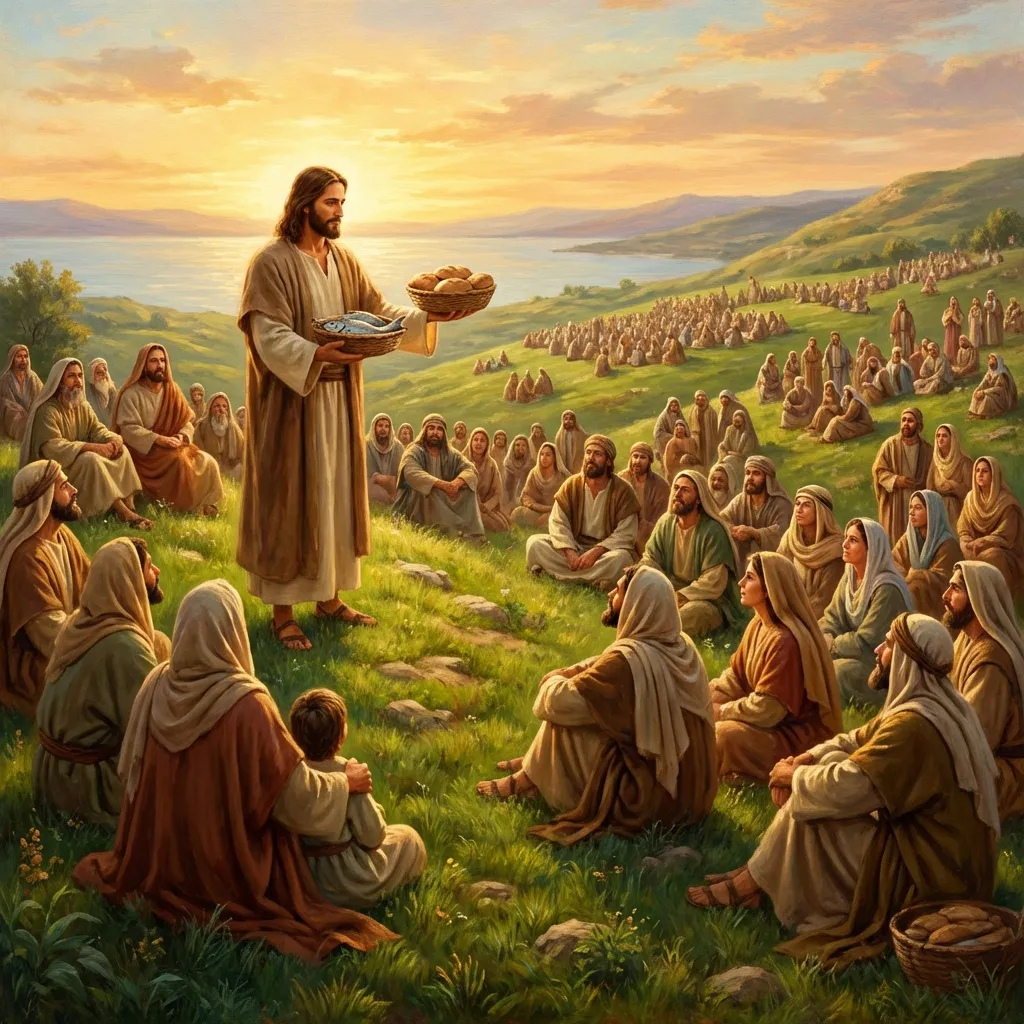
Set against the grassy hills northeast of the Sea of Galilee near Bethsaida, the feeding of the five thousand is the only public miracle recorded in all four Gospels. When an enormous multitude of fifteen to twenty thousand men, women, and children found themselves stranded in a desolate wilderness at twilight, Jesus demonstrated that He is the true Bread of Life who supernaturally sustains His people.
1. Divine Compassion Amid Personal Grief
Jesus had just received the heartbreaking news of John the Baptist's brutal beheading by Herod Antipas. Seeking quiet solace and prayer, He withdrew by boat to a desolate place. Yet when the desperate crowds ran on foot around the northern shore to intercept Him, Jesus felt no annoyance or resentment. Mark 6:34 records: "When Jesus landed and saw a large crowd, he had compassion on them, because they were like sheep without a shepherd. So he began teaching them many things." True divine love puts human brokenness ahead of personal convenience.
2. The Limitations of Human Calculation
As shadows lengthened, the disciples urged Jesus to dismiss the crowd so they could purchase food in surrounding hamlets. Jesus shocked them with an impossible counter-command: "You give them something to eat" (Matthew 14:16). Philip immediately calculated the financial cost: two hundred denarii (more than half a year's wages) would not buy each person a single bite. Andrew found a young boy with five barley flatbreads and two dried sardine-like fish, but lamented: "What are they among so many?" Human reason always measures problems by visible resources; faith measures problems by the omnipotence of God.
3. The Supernatural Mechanics of Multiplication
Jesus instructed the people to recline in orderly groups of fifties and hundreds on the green grass. Taking the boy's five barley loaves and two fish, Jesus looked up toward heaven, blessed the food, and broke the loaves. The miracle occurred in His hands as He continuously broke and distributed the bread to the twelve disciples, who carried it out to the endless rows of families. The supply never ceased until all were thoroughly satisfied (echortasthēsan—engorged to fullness).
4. Twelve Baskets: Proof of Covenant Overflow
Once the feast concluded, Jesus gave an essential command: "Gather the pieces that are left over. Let nothing be wasted" (John 6:12). The disciples filled twelve heavy travel baskets (kophinoi) with broken pieces of bread and fish. Each disciple walked away carrying a full basket of leftovers—a physical, undeniable reminder that those who surrender their lives to serve the King will never lack divine provision.
5. Christ as the Eternal Bread of Life
The feeding was not merely a humanitarian relief effort; it was an enacted parable of salvation. Just as physical bread must be eaten to sustain earthly biological life, so Christ's broken body must be received by faith to impart eternal life. As Jesus proclaimed the next day in Capernaum: "I am the bread of life. Whoever comes to me will never go hungry, and whoever believes in me will never be thirsty" (John 6:35).
Biblical Keywords & Theological Roots
To be moved with deep, visceral compassion in the inward parts; the gut-wrenching love that moved Jesus to feed the exhausted crowd.
To bless, praise, give thanks to God; Jesus took the five loaves, looked up to heaven, and blessed the meager meal.
Fragment, broken piece; the disciples gathered twelve full baskets of broken pieces left over after everyone was satisfied.
🔑 Key Spiritual Takeaways
- Compassion Over Convenience: Tired and grieving the death of John the Baptist, Jesus prioritized ministry to the weary crowd over His personal grief.
- Bring What You Have: Jesus did not ask the disciples to produce what they lacked; He commanded them to surrender what little they had into His hands.
- Supernatural Multiplication in the Breaking: The loaves multiplied not on the grass, but in the hands of Jesus as He broke them and distributed them.
- God Satisfies and Overflows: The miracle did not leave the crowd merely surviving; everyone was thoroughly filled, with twelve baskets of abundance remaining.
Support Independent Biblical Research
Did this study bless you? Help support our independent bilingual research and interactive visual Bible tools.
⚡ Fast Facts
- Present in All Four Gospels: The feeding of the 5,000 is the only public miracle recorded in all four Gospels (Matthew, Mark, Luke, and John).
- True Crowd Size: Matthew 14:21 notes there were 'about 5,000 men, besides women and children,' indicating a total crowd of 15,000 to 20,000 people.
- Boy's Humble Lunch: John 6:9 reveals the food came from an unnamed poor boy who offered five barley loaves (poor man's bread) and two small pickled fish.
- Twelve Baskets Left: After everyone ate to full satisfaction, exactly twelve wicker baskets (kophinoi) of leftovers were gathered—one for each disciple.
❓ Frequently Asked Questions (FAQs)
Why did Jesus test Philip by asking 'Where shall we buy bread for these people to eat?'
Philip was from nearby Bethsaida (John 1:44) and knew the regional geography. John 6:6 explicitly states that Jesus asked this to test him, because Jesus already knew what He was going to do. Jesus wanted Philip to realize the futility of human calculations (eight months' wages would not be enough) and look to divine resources.
What is the prophetic and theological connection between this miracle and Exodus?
This miracle deliberately echoes Moses feeding Israel manna in the wilderness. The crowds immediately recognized Jesus as 'the Prophet who is to come into the world' (Deuteronomy 18:15). In John 6, Jesus builds on this miracle to deliver His famous 'Bread of Life' discourse, declaring that He is the true bread from heaven.
Why did Jesus command the disciples to gather the broken fragments so that nothing was wasted?
Even in the midst of limitless supernatural abundance, God teaches stewardship and honor for His provision. The twelve overflowing baskets served as tangible, undeniable proof to each of the twelve apostles that Christ can sustain them fully in their future apostolic mission.