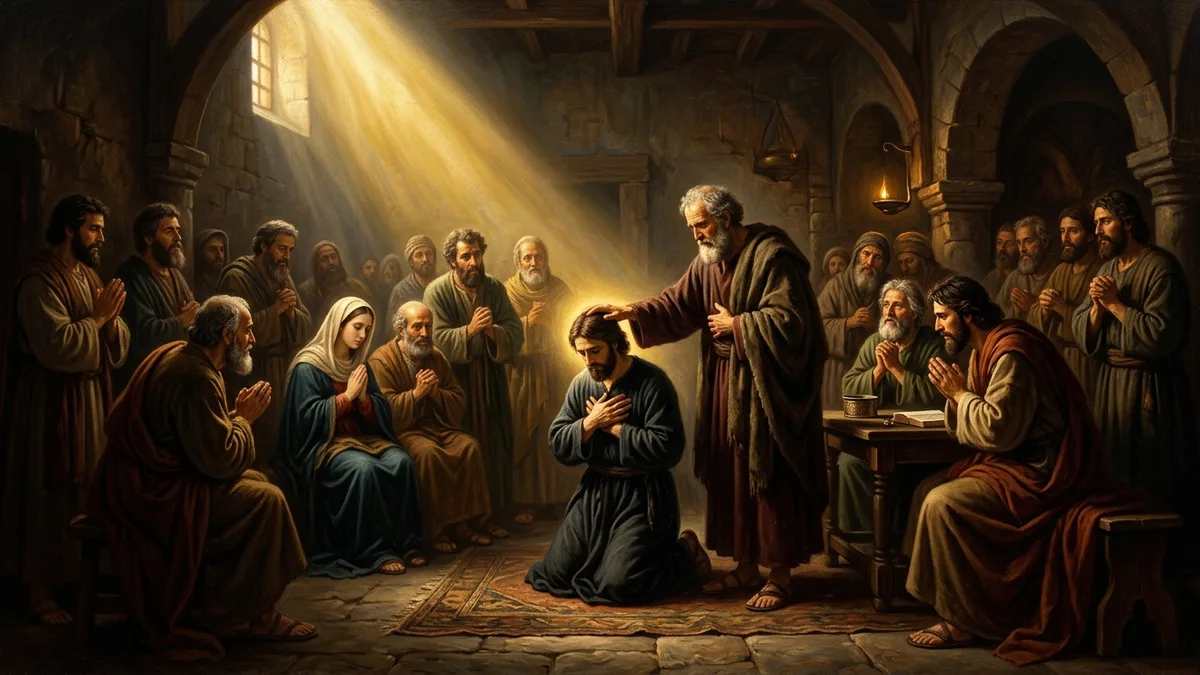
In the sacred annals of the early Church, no event captures the transition between the earthly ministry of the Incarnate Christ and the global explosion of the Holy Spirit's power quite like the dramatic scene in the Jerusalem upper room recorded in Acts 1. In that prayer-soaked sanctuary, surrounded by approximately one hundred and twenty disciples, the eleven apostles stood facing a heartbreaking and theological dilemma: the betrayal and horrific suicide of Judas Iscariot had left the twelvefold foundation of Israel's restoration broken. Into this sacred breach stepped a man whose entire life exemplified quiet, steadfast fidelity—Matthias the Apostle. Chosen by God through solemn prayer and sacred lot, Matthias became the twelfth pillar of the apostolic church, proving that the Lord meticulously prepares His servants in secret before placing them into eternal destiny.
1. The Crisis of the Vacant Office (Acts 1:15–20)
Following Christ's ascension from the Mount of Olives, the disciples returned to Jerusalem with great joy, ascending to the upper room where they continued with one accord in prayer and supplication (Acts 1:12–14). Yet amidst their spiritual unity, a solemn prophetic weight rested upon the leadership.
The number twelve was never an arbitrary figure. In the Old Testament, the twelve sons of Jacob formed the twelve tribes of Israel, embodying God's covenant people. When Jesus walked the earth, He deliberately called twelve apostles, promising them:
"Verily I say unto you, That ye which have followed me, in the regeneration when the Son of man shall sit in the throne of his glory, ye also shall sit upon twelve thrones, judging the twelve tribes of Israel." — Matthew 19:28
Furthermore, John's apocalyptic vision of the New Jerusalem reveals that the city wall possesses "twelve foundations, and in them the names of the twelve apostles of the Lamb" (Revelation 21:14). Judas Iscariot had not merely fallen into personal sin; he had betrayed the King of glory and abandoned his apostolic bishopric (Greek: episkope).
Standing before the gathered assembly, Simon Peter was illuminated by the Holy Spirit to interpret ancient Scripture. Quoting the Messianic imprecations of King David in Psalm 69:25 and Psalm 109:8, Peter declared:
"For it is written in the book of Psalms, Let his habitation be desolate, and let no man dwell therein: and his bishoprick let another take." — Acts 1:20
The apostolic office was an enduring sacred trust. The vacant throne had to be filled before the Holy Spirit was poured out at Pentecost.
2. The Exacting Apostolic Qualification: From the Jordan to the Ascension
Peter then laid down the strictest qualifications found anywhere in the New Testament for apostolic leadership:
"Wherefore of these men which have companied with us all the time that the Lord Jesus went in and out among us, beginning from the baptism of John, unto that same day that he was taken up from us, must one be ordained to be a witness with us of his resurrection." — Acts 1:21–22
Consider the monumental weight of these requirements! The new apostle could not be a recent convert, an eloquent newcomer, or a wealthy patron. He had to possess three uncompromising credentials:
- Unbroken Companionship: He must have walked beside Jesus continuously for over three years, witnessing His daily character, His private prayers, His weary travels, and His miraculous works.
- Full Historical Span: His personal observation had to stretch from the very beginning of Christ's ministry at John's baptism in the Jordan River all the way to His bodily ascension on the Mount of Olives.
- Eyewitness of the Resurrection: He had to have seen, heard, and touched the risen Lord with his own hands following the empty tomb.
Out of the hundred and twenty disciples gathered in the upper room, only two men met this extraordinary standard: Joseph called Barsabbas, who was surnamed Justus, and Matthias.
Think of the hidden beauty of Matthias' life! For three and a half years, while Peter, James, and John received public attention, Matthias had followed Jesus in complete obscurity. When the crowds dispersed after the hard sayings in John 6, Matthias stayed. When the Pharisees threatened arrest, Matthias remained steadfast. When the Lord sent out the Seventy disciples two by two into every village (Luke 10:1), ancient church fathers (including Clement of Alexandria and Eusebius) confirm that Matthias was among them, casting out demons and healing the sick in Jesus' name without ever demanding a title or public acclaim.
The Twelfth Pillar Restored: Apostle Matthias standing amidst the hundred and twenty disciples in the Jerusalem upper room as the sacred lot reveals God's sovereign choice.
3. The Sovereign Lot: Not Human Politics, But Divine Appointment
Faced with two equally righteous and qualified men, the early church did not engage in political campaigns, backroom lobbying, or impassioned debate. Instead, they fell upon their knees in unified, desperate prayer:
"And they prayed, and said, Thou, Lord, which knowest the hearts of all men, shew whether of these two thou hast chosen, that he may take part of this ministry and apostleship, from which Judas by transgression fell, that he might go to his own place." — Acts 1:24–25
They addressed God as Kardiognosta—"the Knower of all hearts." They acknowledged that outward qualifications mean nothing unless God has chosen the inward vessel.
Then, following the ancient biblical precedent prescribed in Proverbs 16:33 ("The lot is cast into the lap; but the whole disposing thereof is of the Lord") and the High Priestly stones of Urim and Thummim, they cast lots:
"And they gave forth their lots; and the lot fell upon Matthias; and he was numbered with the eleven apostles." — Acts 1:26
The Greek word translated "numbered with" is synkatapsephizomai, indicating an official, unanimous, divine enrollment. Matthias was not a second-rate substitute; he was God's chosen man from before the foundation of the world. On the Day of Pentecost just days later, when the Holy Spirit descended with the sound of a rushing mighty wind, Matthias stood side by side with Peter and the Ten, receiving the fiery baptism of power and preaching the wonderful works of God to thousands (Acts 2:14).
4. Missionary Labours in Judea, Cappadocia, and Colchis
Following the initial establishment of the Jerusalem church, Matthias devoted himself to carrying the Gospel into harsh and unreached territories. While historical records from this era are scattered due to intense imperial persecution, patristic writings provide consistent testimony regarding his missionary journeys.
According to the early church historian Nicephorus Callistus and regional Georgian traditions, Matthias first ministered throughout Judea and Samaria, confirming new converts in the apostolic faith. He then traveled northward into Cappadocia (central modern Turkey) and the rugged mountainous coastline of the Black Sea, known in antiquity as Colchis (modern-day western Georgia).
In Colchis, Matthias encountered fierce, pagan tribes who practiced sorcery, human sacrifice, and cannibalism. Undeterred by the barbaric customs of the region, Matthias preached the resurrected Christ with supernatural power. Ancient accounts record that he was cast into prison, blinded by demonic tormentors, and miraculously healed and delivered by an angel of the Lord. Through his unshakeable endurance, thousands of pagan barbarians turned from idols to worship the living God, establishing Christian communities along the eastern shores of the Black Sea.
5. Martyrdom by Stones and Battle-Axe: The Crown of Life
The earthly journey of Apostle Matthias concluded with the glorious crown of martyrdom. Two primary traditions preserve the manner of his death, reflecting his extensive travels:
The Western tradition recorded in ancient Roman martyrologies states that Matthias returned to Judea in his old age. Preaching in Jerusalem, he was seized by the Sanhedrin and hostile Temple authorities for publicly proclaiming Jesus of Nazareth as the resurrected Son of God. Refusing to recant his testimony, Matthias was dragged outside the city walls, condemned as a blasphemer, and stoned by an angry mob. As he lay bruised and bleeding upon the earth, thanking God for the privilege of suffering for the name of Jesus, a Roman soldier stepped forward and beheaded him with a halberd (a heavy battle-axe) to complete the execution.
The Eastern tradition maintains that he was martyred in Colchis (at the fortress of Gonio in modern Adjara, Georgia), where he was crucified or put to the sword by pagan rulers. To this day, the historic ruins of the Roman fortress of Gonio house an ancient tomb revered as the resting place of Apostle Matthias.
Whether his blood was shed outside the walls of Jerusalem or upon the shores of the Black Sea, Matthias fulfilled his calling with absolute perfection. He stepped into the tragic shadow of Judas Iscariot and transformed that vacancy into an eternal triumph of holy humility. His name is forever engraved upon the foundation stones of the New Jerusalem, shining as a testament to every quiet, steadfast believer: God sees your hidden faithfulness, and in His perfect time, He will crown your life with eternal glory!
Biblical Keywords & Theological Roots
Matthias; Greek form of Hebrew 'Mattithyah' (G4993/H4993), meaning 'Gift of Yahweh' or 'Gift of God'.
A lot, pebble, die used for casting; hence an assigned inheritance, portion, or sacred office allotted by divine providence.
To be numbered with, enrolled among by common vote or divine consensus, counted alongside the Eleven.
A witness, one who bears personal eyewitness testimony of facts, sealed if necessary with one's blood (martyr).
Oversight, superintendence, apostolic office, visitation of divine commission.
Ancient Near Eastern & Archaeological Context
Following Christ's glorious ascension from the Mount of Olives, the disciples retreated to the upper room in Jerusalem (Acts 1:12–14). The apostolic band numbered approximately one hundred and twenty faithful men and women, united in persistent, fervent prayer. However, a profound pastoral and prophetic void hung over the assembly: the seat of Judas Iscariot stood vacant. In fulfillment of the imprecatory psalms penned by King David (Psalm 69:25; 109:8), Simon Peter rose to propose the selection of a qualified replacement. The requirements were extraordinarily exacting: the candidate had to have been an uninterrupted companion of Jesus Christ from the baptism of John until the Ascension, serving as a first-hand eyewitness of the bodily resurrection. Two men met this rigorous standard: Joseph called Barsabbas (Justus) and Matthias. After solemn prayer, the lot fell upon Matthias, who was formally numbered with the Eleven. Patristic records by Clement of Alexandria and Eusebius attest that Matthias had previously served as one of the Seventy disciples (Luke 10:1). He subsequently preached in Judea, Cappadocia, and modern Georgia, sealing his witness with martyrdom.
Practical Discipleship & Spiritual Application
- Quiet Preparation in Anonymity: For over three years, Matthias followed Jesus faithfully in the background without title, office, or public acclaim. God observes your hidden faithfulness long before He elevates you to visible service.
- God's Sovereign Choice: In kingdom labor, human campaigning, charismatic self-promotion, and political maneuvering are worthless. God chooses those whose hearts are surrendered entirely to His sovereign will.
- The Supreme Qualification of a Disciple: Matthias qualified as an apostle because he had stayed with Jesus from beginning to end. Enduring, steadfast loyalty to Christ through every season is the truest mark of Christian character.
- Standing in the Gap: Stepping into the shoes of a fallen leader is one of the most sobering responsibilities in ministry. Matthias served with pure humility, redeeming a broken office with sacrificial love and blood.
Support Independent Biblical Research
Did this study bless you? Help support our independent bilingual research and interactive visual Bible tools.
⚡ Fast Facts
- The Sacred Replacement: Matthias was chosen in Acts 1:26 to fulfill Psalm 109:8 ('Let another take his office'), completing the twelve foundation pillars of the apostolic church.
- Lifelong Eyewitness Qualification: Peter established the strict apostolic criterion: Matthias had continuously accompanied Jesus and the Eleven from John's baptism to Christ's ascension (Acts 1:21–22).
- One of the Seventy Disciples: Early patristic historians, including Eusebius and Clement of Alexandria, unanimously identify Matthias as one of the original Seventy disciples sent out by Jesus in Luke 10.
- Martyred with Stone and Battle-Axe: According to historical church accounts, Matthias was stoned by hostile Temple authorities in Judea and subsequently beheaded with a Roman halberd or battle-axe for professing Jesus as Lord.
❓ Frequently Asked Questions (FAQs)
The number twelve carries profound redemptive symbolism throughout Scripture, representing the twelve tribes of Israel in the Old Covenant and the twelve foundational apostolic pillars of the New Jerusalem in the New Covenant (Revelation 21:14). Jesus explicitly promised the Twelve that they would sit on twelve thrones judging the twelve tribes of Israel (Matthew 19:28; Luke 22:30). Peter, illuminated by the Holy Spirit and interpreting Psalm 69:25 and Psalm 109:8, understood that the apostolic college must be fully reconstituted before the arrival of Pentecost.
Some commentators have speculated that the apostles acted prematurely and that God intended Paul to be the twelfth apostle. However, Scripture completely refutes this notion: (1) Acts 1:24 records earnest communal prayer invoking God's sovereign choice; (2) In Acts 2:14 and 6:2, Luke specifically numbers Matthias among 'the Twelve'; (3) The criteria in Acts 1:21–22 required personal companionship with Jesus throughout His earthly ministry, which Paul did not possess; and (4) Paul himself was specifically commissioned not as one of the original Twelve to Israel, but as the Apostle to the Gentiles (Galatians 2:7–8).
Casting lots was an ancient Old Testament practice ordained by God to ascertain divine will without human manipulation, as in the High Priest's Urim and Thummim and Proverbs 16:33 ('The lot is cast into the lap; but the whole disposing thereof is of the Lord'). Acts 1:26 represents the final biblical instance of casting lots, marking the transitional hinge between the Old Covenant mechanism and the permanent indwelling guidance of the Holy Spirit poured out at Pentecost in Acts 2.