In the vast canopy of New Testament literature, the voice of Apostle John resounds with an eagle's soaring majesty and a father's tender whisper. Leaning his head back upon the chest of the Incarnate Word at the Last Supper, standing unyielding at the blood-drenched foot of the Roman execution cross at Calvary, and beholding the cosmic curtain pulled back upon the storm-beaten cliffs of the Isle of Patmos, John was uniquely positioned to gaze into the eternal heart of God. Historically honored as John the Theologian (Greek: Ioannes ho Theologos), his life bridges the eyewitness generation of Galilee with the global expansion of the apostolic Church.
1. Leaning on the Master's Bosom: The Posture of Intimacy (John 13:21–26)
The Fourth Gospel records a poignant scene during the Passover meal in the Upper Room. Jesus, deeply troubled in spirit, testified: "Most assuredly, I say to you, one of you will betray Me." Perplexed and looking at one another, the disciples were paralyzed by uncertainty.
Scripture notes the unique physical position of John at the table:
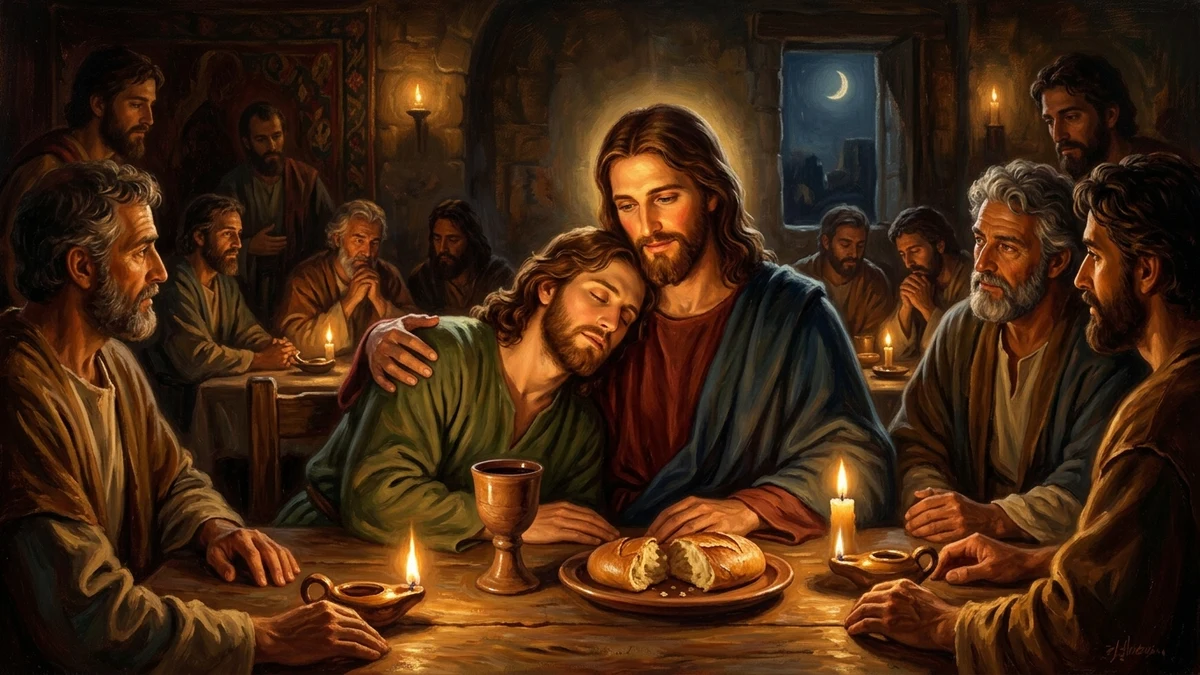
"Now there was leaning on Jesus' bosom one of His disciples, whom Jesus loved. Simon Peter therefore motioned to him to ask who it was of whom He spoke." (John 13:23–24)
In ancient Greco-Roman dining customs (*triclinium*), guests reclined on their left elbows upon low couches, using their right hands to eat. The guest placed immediately to the host's right was situated in the place of highest intimacy, reclining directly back toward the host's chest.
Peter, sitting further down the table, did not dare ask Jesus directly; he signaled to John to whisper the inquiry. Leaning back against the breast of the Messiah, feeling the physical heartbeat of God in human flesh, John asked: "Lord, who is it?" This posture defines John's entire theology: he did not view truth as abstract philosophical formulas, but as a living heartbeat heard through intimate communion.
2. Unyielding at Golgotha: The Transfer of Sacred Custody (John 19:25–27)
The ultimate test of discipleship does not transpire on the mountaintops of miracle, but in the valley of public rejection. When Jesus was arrested in Gethsemane, the male disciples panicked and fled into the darkness of the Kidron Valley. Peter denied Him with curses in Caiaphas' courtyard.
Yet on the hill of Golgotha, amidst the taunts of Roman legionaries and the mocking sneers of chief priests, stood a solitary male disciple alongside four holy women:
"Now there stood by the cross of Jesus His mother, and His mother’s sister, Mary the wife of Clopas, and Mary Magdalene. When Jesus therefore saw His mother, and the disciple whom He loved standing by, He said to His mother, 'Woman, behold your son!' Then He said to the disciple, 'Behold your mother!' And from that hour that disciple took her to his own home." (John 19:25–27)
While struggling for breath under the suffocating weight of crucifixion, Jesus looked down upon John and entrusted to him the single most precious earthly treasure He possessed: His weeping mother Mary. By Roman law, an executed criminal's family was marked with social shame. Yet John stepped forward, accepted the filial covenant, and escorted Mary from the horror of Golgotha into his own household.
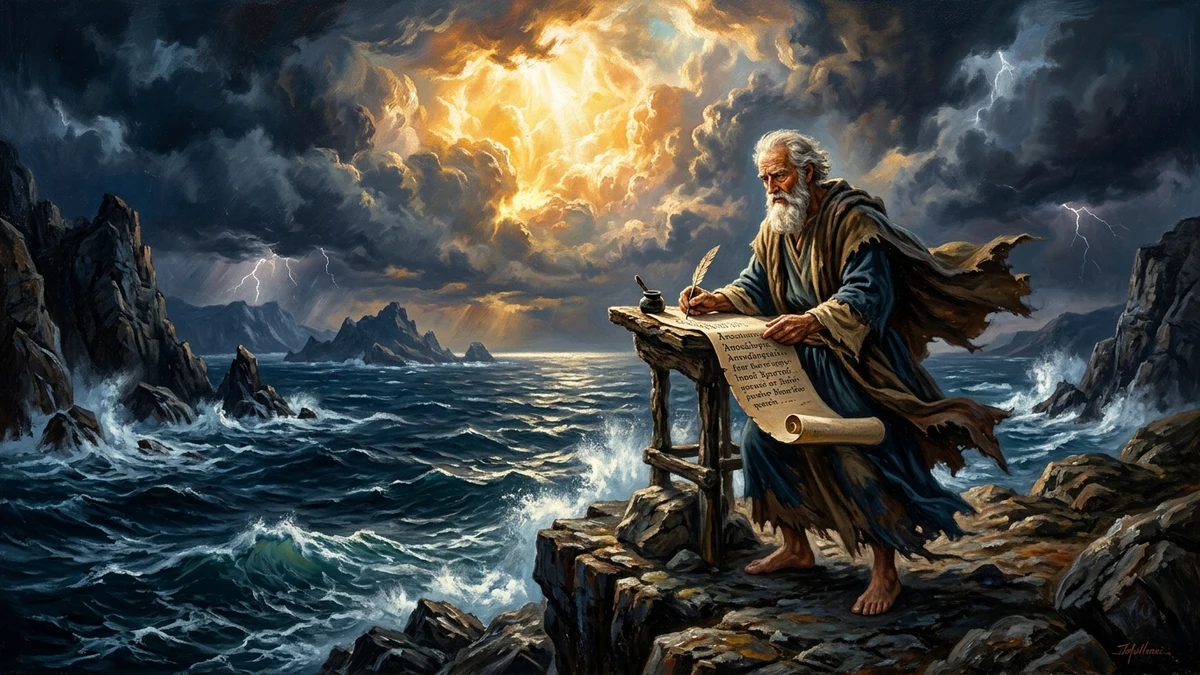 The Visionary of Patmos: Apostle John exiled upon the storm-beaten cliffs of the Aegean Sea, beholding the heavens opened and penning the eternal revelation of the glorified Lamb.
3. The Race to the Empty Tomb (John 20:1–10)
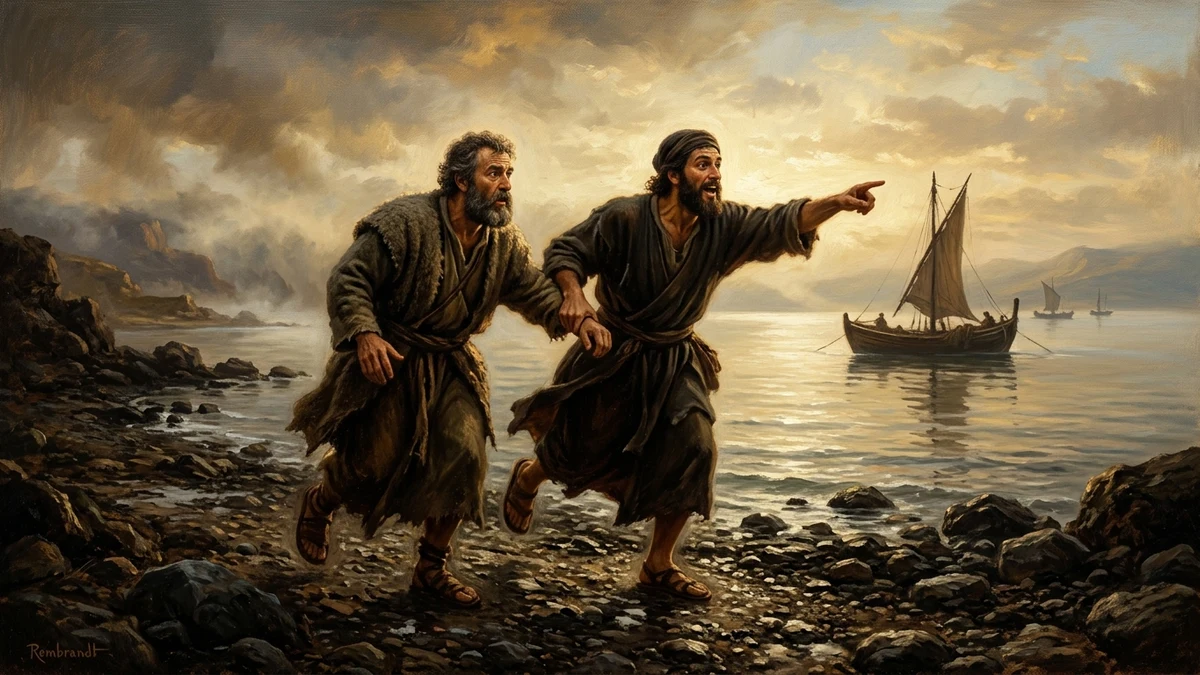
On the third morning, while dawn was still breaking over Jerusalem, Mary Magdalene sprinted from the garden tomb to where Peter and John were sheltering, breathless with shock: "They have taken away the Lord out of the tomb, and we do not know where they have laid Him!"
Instantly, Peter and John bolted toward the garden. John, being younger and swifter of foot, outran Peter and reached the sepulcher first. Stooping down, he peered into the shadowy limestone chamber, observing the linen burial cloths lying neatly folded.
When Peter arrived and barged straight into the tomb, John followed him inside:
"Then the other disciple, who came to the tomb first, went in also; and he saw and believed." (John 20:8)
What did John see? He did not see an empty slab left by grave robbers, who would have carried away the wrapped body or strewn the linens in chaos. He saw the grave clothes lying collapsed like an empty cocoon, and the face napkin (*sudarion*) rolled up in a place by itself. The bodily resurrection was immediately apparent. Without yet having seen the Risen Lord, John's perceptive love comprehended the truth: Christ was alive!
4. The Patriarch of Ephesus and the Defender of Truth
Following the destruction of Jerusalem in AD 70, John established his apostolic headquarters in Ephesus, the bustling intellectual and commercial center of Asia Minor. From Ephesus, John oversaw the seven churches of Asia (Ephesus, Smyrna, Pergamum, Thyatira, Sardis, Philadelphia, and Laodicea).
During this era, dangerous proto-Gnostic heresies began infiltrating the Church. False teachers such as Cerinthus argued that the physical world was inherently evil, denying that Jesus Christ had come in genuine human flesh.
Church Father Irenaeus of Lyons, who was discipled by John's student Polycarp, relates a famous historical anecdote illustrating John's fierce apostolic jealousy for doctrinal purity:
One day, Apostle John entered the public bathhouse in Ephesus to bathe. Learning that the heretic Cerinthus was inside, John leaped from the pool and rushed out the door without bathing, crying aloud: 'Let us flee, lest the bathhouse collapse upon us, since Cerinthus, the enemy of truth, is within!'
To counter these deceptive heresies, John penned the Fourth Gospel—proclaiming in monumental prose: "In the beginning was the Word, and the Word was with God, and the Word was God... And the Word became flesh and dwelt among us" (John 1:1, 14). In his first epistle, he grounded fellowship in tangible eyewitness reality: "That which was from the beginning, which we have heard, which we have seen with our eyes, which we have looked upon, and our hands have handled, concerning the Word of life" (1 John 1:1).
5. The Isle of Patmos and the Apocalypse of the Lamb (Revelation 1)
Around AD 95, during the brutal reign of Roman Emperor Domitian, Christian refusal to participate in imperial Caesar-worship resulted in widespread banishment and execution. Because of his unyielding testimony for Jesus, the nonagenarian Apostle John was arrested and banished to Patmos, a barren, volcanic penal island in the Aegean Sea:
"I, John, both your brother and companion in the tribulation and kingdom and patience of Jesus Christ, was on the island that is called Patmos for the word of God and for the testimony of Jesus Christ." (Revelation 1:9)
Condemned to harsh labor in the island's stone quarries, John was in the Spirit on the Lord's Day (Sunday). Suddenly, behind him, a voice like a trumpet shattered the silence. Turning, John did not see the gentle Nazarene of Galilee, but the ascended, glorified King of kings: His eyes like flames of fire, His voice like the sound of many waters, and His countenance like the sun shining in full strength.
Overwhelmed by divine glory, John fell at His feet as dead. But Christ placed His right hand upon the aged apostle, speaking the eternal words of victory:
"Do not be afraid; I am the First and the Last. I am He who lives, and was dead, and behold, I am alive forevermore. Amen. And I have the keys of Hades and of Death." (Revelation 1:17–18)
Upon that desolate penal rock, John penned the Book of Revelation, recording cosmic warfare, the final judgment of Babylon, the wedding banquet of the Lamb, and the descent of the New Jerusalem where God wipes away every tear from human eyes.
6. "Little Children, Love One Another": The Peaceful Departure in Ephesus
Following Domitian's assassination in AD 96, Emperor Nerva issued a general amnesty, permitting John to return from exile to Ephesus. Jerome, the great fourth-century scholar, records a touching portrait of John's final days:
In his extreme old age, when John was so frail that he had to be carried into the church gatherings by young disciples, he was unable to deliver long sermons. He would simply repeat to the congregation over and over: 'Little children, love one another.' When the disciples grew weary of hearing the same words and asked, 'Master, why do you always say this?', John replied: 'Because it is the Lord's commandment; and if this alone is done, it is enough.'
Around AD 98–100, at nearly one hundred years of age, the last surviving eyewitness of the Incarnate Christ fell asleep in the Lord in Ephesus. The disciple who had laid his head on the chest of Jesus at the Last Supper now rested eternally in the arms of the King he so passionately loved.
Biblical Keywords & Theological Roots
Unconditional, self-sacrificing, covenantal divine love that gives without demanding return; the defining attribute of God.
The divine Word, Reason, and Expression of God incarnate in Jesus Christ from all eternity (John 1:1).
Testimony, solemn eyewitness evidence presented with judicial weight and unassailable truth.
Intimate fellowship, sharing, communion, and joint participation in the divine life of the Father and the Son.
An unveiling, uncovering, or pulling back of the cosmic curtain to reveal the glorified Christ and the consummation of all things.
Ancient Near Eastern & Archaeological Context
John was the younger brother of James, born to Zebedee and Salome in Galilee. Possessing literary sensitivity and mystical depth, John was likely the youngest of the Twelve. After Jesus' ascension, John functioned alongside Peter as an undisputed pillar of the Jerusalem Church (Galatians 2:9). When Roman armies under Titus crushed the Jewish revolt and razed Jerusalem and the Temple in AD 70, John relocated to Ephesus, the great intellectual and commercial metropolis of Asia Minor. In this Greek cultural capital, surrounded by the cult of the goddess Artemis and the emerging philosophical heresies of Cerinthian Gnosticism, John pastored the churches of the Lycus Valley, providing eyewitness authority until his exile to the penal penal colony of Patmos under Emperor Domitian in AD 95.
Practical Discipleship & Spiritual Application
- Identity Rooted in Being Loved, Not in Performance: John did not identify himself by his preaching eloquence or apostolic status, but by the reality of being loved by Jesus. True spiritual security rests in His love for us.
- Faithfulness When Others Flee: When all the male disciples scattered in fear at Gethsemane, John alone stood at the foot of the Roman cross at Golgotha. Love casts out fear and stays near Christ in suffering.
- Communion Precedes Revelation: John rested on the bosom of Christ at the Last Supper before he was granted the cosmic visions of Patmos. Deep divine revelations are entrusted only to hearts of intimate love.
- God is Light and God is Love: We cannot separate doctrinal truth from sacrificial love; an orthodox intellect with an unloving heart is a spiritual deception.
Support Independent Biblical Research
Did this study bless you? Help support our independent bilingual research and interactive visual Bible tools.
⚡ Fast Facts
- The Longest-Living Apostle: John was the only member of the Twelve Apostles to survive into extreme old age, outliving all other apostles and dying of natural causes in Ephesus around AD 98–100.
- Author of Five Canonical Books: John wrote more individual books of the New Testament than anyone except Paul: the Fourth Gospel, three Catholic Epistles (1, 2, 3 John), and the Apocalypse (Revelation).
- Entrusted with Jesus' Mother: From the agony of Calvary, Jesus looked down and officially transferred filial care of His earthly mother Mary to John: 'Behold your mother!' (John 19:27).
- Boiling Oil Legend: Early patristic father Tertullian records that during the persecution under Emperor Domitian in Rome, John was plunged into a cauldron of boiling oil at the Latin Gate but miraculously emerged unharmed.
❓ Frequently Asked Questions (FAQs)
In his Gospel, John deliberately conceals his own name, employing the humble title 'the disciple whom Jesus loved' (John 13:23; 19:26; 20:2; 21:7, 20). Far from an arrogant claim of favoritism, this was an expression of profound, awe-filled gratitude. John's personal identity was not anchored in his lineage, achievements, or apostleship, but entirely in the unmerited, astonishing agape love of Christ for him.
Early in his ministry, John was a 'Son of Thunder' who wanted to incinerate Samaritan villagers with heavenly fire (Luke 9:54) and monopolized authority against outside exorcists (Mark 9:38). Through seventy years of walking in the Spirit, John was so profoundly sanctified by the Cross that he became the 'Apostle of Love,' penning the immortal definition: 'God is love, and he who abides in love abides in God, and God in him' (1 John 4:16).
Following the fall of Jerusalem in AD 70, John relocated to Ephesus, serving as the senior apostolic patriarch over the churches of Asia Minor. Church fathers Irenaeus and Polycarp recorded that John fiercely guarded apostolic doctrine against proto-Gnostic heretics like Cerinthus, taught young bishops, and established orthodoxy across the Greco-Roman world.