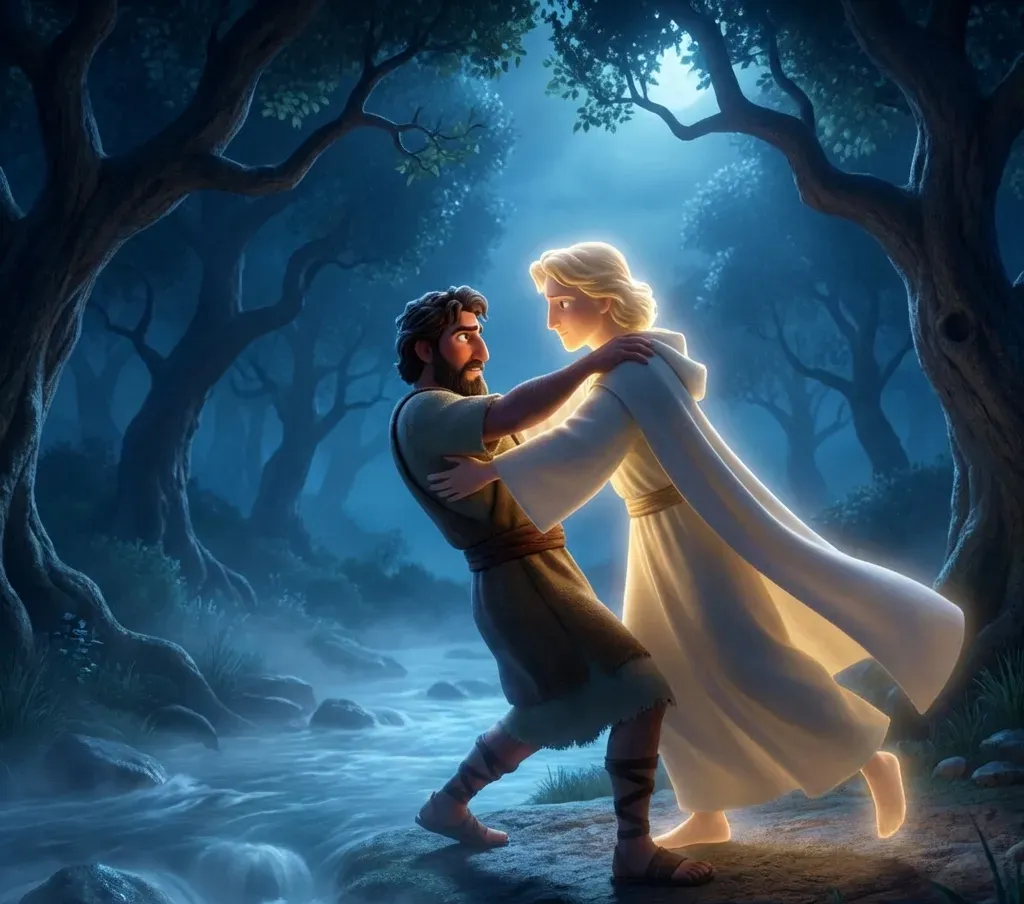
The cold night wind howling through the rocky gorges of Mount Gilead whipped against Jacob's weathered face. After twenty long years of grueling exile in Upper Mesopotamia, the fugitive patriarch was returning home to Canaan. But this was no triumphant homecoming. Behind him lay the bitter, fractured household of Laban; ahead of him, marching with chilling speed across the desert sands, was his twin brother Esau—accompanied by four hundred heavily armed desert warriors. Jacob was terrified, spiritually trapped, and violently brought to the end of himself.
1. The Terror at Mahanaim and the Great Dividing
Just days earlier at Mahanaim, God had granted Jacob an encouraging supernatural vision: two celestial camps of angelic hosts encamped around his family (Genesis 32:1-2). Yet when his scouting messengers returned with the terrifying report that Esau was advancing with an army, Jacob's faith instantly buckled under the weight of sheer panic.
The calculating instincts of the old supplanter immediately kicked into overdrive. Jacob divided his people, flocks, herds, and camels into two distinct companies, reasoning that if Esau attacked one camp, the other might escape. Next, he composed an agonizing, desperate prayer, quoting God's promise at Bethel: "Deliver me, I pray, from the hand of my brother... for I fear him, lest he come and attack me and the mother with the children" (Genesis 32:11).
Finally, Jacob orchestrated an elaborate psychological bribe. He selected over five hundred and fifty prize animals—goats, rams, milking camels with their colts, cows, bulls, and donkeys—and organized them into successive droves separated by strategic intervals. He commanded his servants to approach Esau wave after wave, bowing to the ground and presenting each herd as a lavish gift: "It is a present sent to my lord Esau from your servant Jacob." Jacob thought to himself, "I will appease him with the present that goes before me, and afterward I will see his face; perhaps he will accept me."
2. The Solitary Night at the Jabbok Ford
Night descended rapidly over the rugged Transjordan mountains. Under the cover of total darkness, Jacob arose and hurried his two wives, two concubines, eleven sons, and all his remaining possessions across the swift, cold currents of the Jabbok River (*Wadi az-Zarqa*).
Once every living being and material asset was safely across the southern bank, Jacob retreated back across the rushing waters to the northern side. He stood entirely alone in the pitch-black wilderness. The babble of children, the bleating of sheep, and the clatter of bronze cooking pots had faded into the distance. All his human shields, his clever defensive schemes, and his accumulated wealth were gone. The master negotiator was stripped of everything.
It was precisely in that terrifying silence that redemptive history reached a boiling point. Scripture records with stunning brevity: "Then Jacob was left alone; and a Man wrestled with him until the breaking of day" (Genesis 32:24).
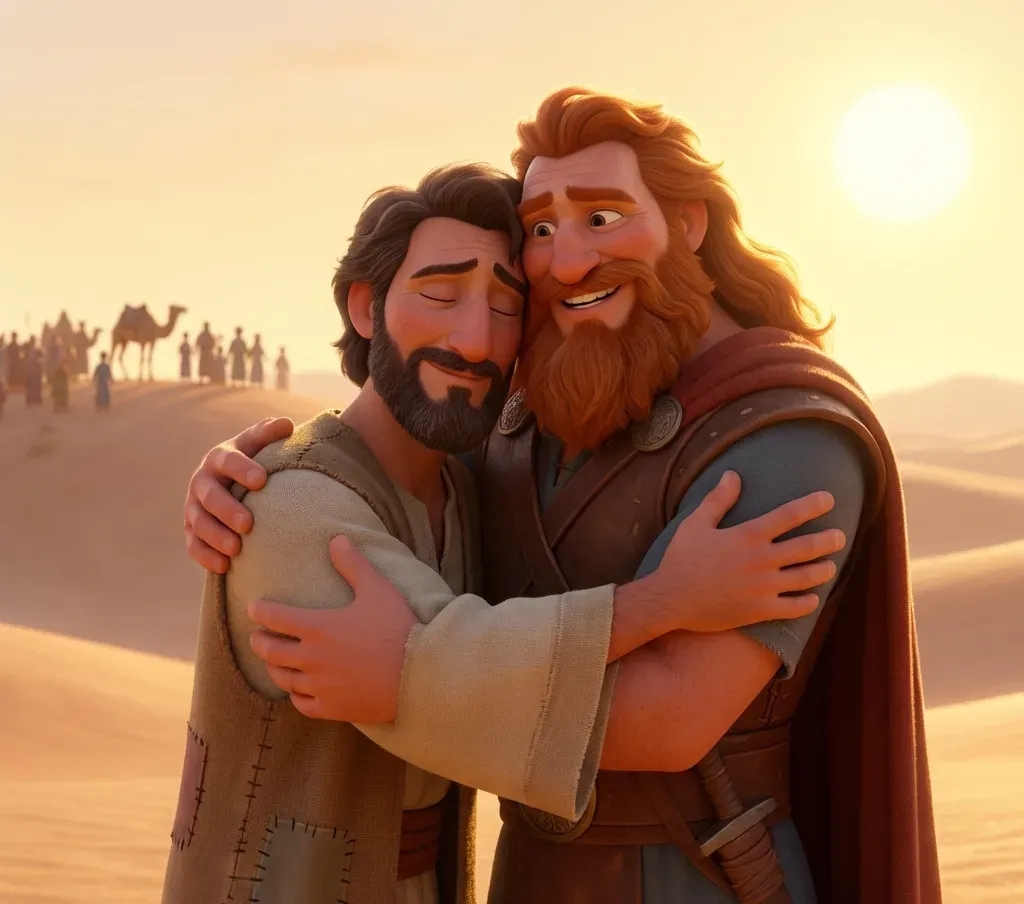
The Face of God in Reconciliation: Transformed by Peniel, Jacob bows seven times before Esau, discovering that surrender to God melts the wrath of men.
3. The Cosmic Wrestling Match in the Dust
Out of the shadows of the wilderness emerged a mysterious warrior who seized Jacob in an intense, violent grip. This was no psychological nightmare or mystical trance; it was a grueling, bone-crushing, physical grapple in the dirt (*Abak*). Hour after hour, muscle strained against muscle. Jacob, who had rolled the massive stone well-cap alone and survived twenty years of pastoral hardship, threw every ounce of his seasoned physical stamina into the combat.
Who was this nocturnal assailant? The Prophet Hosea unveils the mystery: Jacob "wrestled with the Angel and prevailed; he wept, and sought favor from Him" (Hosea 12:4). This was the Angel of Yahweh, a pre-incarnate theophany of Jesus Christ! The Lord had not come to merely observe Jacob; He had come to confront him, to break his self-sufficiency, and to dethrone the manipulator before he could cross into the land of promise.
As the blackness of night began to give way to the gray twilight of dawn, the divine Wrestler saw that Jacob's stubborn tenacity refused to yield. With a display of effortless omnipotence, the Stranger simply reached out and touched the hollow of Jacob's hip socket.
Instantly, with a sickening crack, the ball-and-socket joint of Jacob's femur was dislocated, tearing the sciatic nerve and severing his muscular balance. In a fraction of a second, the seasoned wrestler was utterly crippled. His physical power dissolved into agony. He could no longer push, pivot, or hold his footing.
4. The Clinging Cry: "I Will Not Let You Go!"
Now helpless, Jacob did not fall back into the dirt and surrender to defeat. Instead, with tears streaming down his dust-caked cheeks, he wrapped his arms around the neck of the divine Warrior with the desperate grasp of a drowning man.
The Stranger spoke with absolute authority: "Let Me go, for the day breaks." The dawn in the ancient Near East signified the unveiling of God's unshielded glory, a brilliance that no mortal man could look upon and live (Exodus 33:20). But Jacob, perceiving that his opponent was none other than the Almighty, cried out through sobs of agony:
"I will not let You go unless You bless me!" (Genesis 32:26)
Notice the profound spiritual transformation in this cry. Jacob was no longer scheming to trick his father, manipulate Laban, or bribe Esau. He knew that four hundred soldiers were marching toward his family, and that his wealth could not save him. His only hope in time and eternity was the sovereign, unmerited blessing of God. He won the victory not by overpowering God, but by weeping, clinging, and surrendering to Him!
5. From Jacob to Israel: The New Name of Grace
The divine Challenger looked down upon the shattered, weeping patriarch and asked a penetrating, diagnostic question:
"What is your name?"
God did not ask for information; He demanded a confession. Twenty years earlier, in the darkened tent of his blind father Isaac, Jacob had been asked that exact same question: "Who are you, my son?" And Jacob had deceitfully replied, "I am Esau, your firstborn." He had stolen a blessing disguised in another man's clothes.
Now, pinned in the dust before the Holy One of Heaven, all masks were shattered. Jacob replied with total, agonizing honesty: "Jacob"—the deceiver, the heel-catcher, the crook.
The moment the patriarch confessed his true identity, the Lord bestowed the sovereign antidote of covenant grace:
"Your name shall no longer be called Jacob, but Israel; for you have struggled with God and with men, and have prevailed." (Genesis 32:28)
Jacob asked, "Tell me Your name, I pray." But the divine Being replied, "Why is it that you ask about My name?" and blessed him there. The name of the Lord was too holy and wonderful to be packaged in human vocabulary (Judges 13:18); His blessing spoke for itself.
6. The Sun Rises upon Peniel: The Holy Limp
Jacob named the sacred place Peniel ("The Face of God"), declaring with trembling gratitude: "For I have seen God face to face, and my life is preserved."
As the golden sun crested over the jagged mountain peaks of Gilead, Jacob crossed over Penuel. But he was no longer the arrogant, fast-talking schemer who had fled Canaan twenty years before. The text records an unforgettable physical detail: "And he limped on his hip" (Genesis 32:31).
That permanent limp was Jacob's badge of honor, his lifelong sermon in motion. Every uneven step reminded him that his strength was in God alone. When he met Esau hours later, Jacob did not hide behind his caravan; he walked at the very front of his family, bowing seven times to the earth in profound humility. And the sovereign God who broke Jacob at the Jabbok melted the vengeance of Esau: the warrior ran to meet him, threw his arms around his neck, kissed him, and they both wept.
At Peniel, the supplanter died, and Israel was born—a living testimony that when God breaks a man's pride, He raises him up as a prince of grace.
Biblical Keywords & Theological Roots
To wrestle, grapple, or bedust oneself in vigorous physical combat; picturing combatants rolling in the fine dust of the earth until completely covered.
Face of God (derived from 'Panim' [face/presence] and 'El' [God]); the sacred site where Jacob beheld God face to face and his life was preserved.
Israel: 'He strives with God', 'God contends', or 'Prince with God'; the covenant name bestowed upon Jacob after he prevailed through brokenness and clinging faith.
To limp, halt, or walk with an uneven gait due to hip dislocation; signifying a perpetual mark of physical weakness that testifies to spiritual transformation.
To be pleased with, accept with favor, or delight in reconciliation; used in Genesis 33:10 when Jacob saw Esau's face as though seeing the face of God.
Ancient Near Eastern & Archaeological Context
Geographically and topographically, the encounter at Peniel took place along the torrential gorge of the Jabbok River (modern Wadi az-Zarqa in the Hashemite Kingdom of Jordan). The Jabbok is a perennial river that carves a dramatic, deep canyon through the rugged mountains of Gilead before descending precipitously over 3,000 feet to empty into the Jordan River rift valley. In the Bronze Age, the northern ridge of the Jabbok served as a formidable natural border demarcating the tribal spheres of the Arameans, Amorites, and early Canaanite confederations.
Crossing the Jabbok was an arduous and terrifying military maneuver, particularly with large herds of sheep, cattle, camels, and nursing mothers with infants. By sending his wives, children, and livestock south across the churning waters of the ford while remaining entirely alone on the northern bank, Jacob was physically trapped. He had burned his bridges; behind him lay the volatile border of Laban, and ahead of him lay the south-bank approach of Esau's four hundred mounted desert warriors. He was stripped of all human shields, advisors, and possessions.
In the religious literature of the ancient Near East, river fords were notoriously feared as demonic threshold locations where hostile territorial river spirits attacked night travelers. However, Genesis 32 radically shatters pagan mythologies. The nocturnal adversary who meets Jacob is not a pagan river demon, but Yahweh Himself in the form of the Angel of the Covenant. In ancient Mesopotamian and Canaanite warfare, night combat was avoided due to chaos; yet God initiated this nocturnal duel to confront the darkness of Jacob's own heart before he could enter the Promised Land.
Practical Discipleship & Spiritual Application
- The Inevitable Crucible of Solitude with God: Jacob could not experience true spiritual transformation until he was stripped of his herds, wealth, wives, and human schemes and left completely alone in the dark. God often leads us into barren seasons of solitude to disconnect us from earthly crutches and bring us face to face with our own spiritual bankruptcy.
- Surrendering Self-Sufficiency and Embracing the Holy Limp: Jacob wrestled with his own muscular strength until God touched his hip socket. God must touch and break the area of our greatest natural pride—our intellect, charisma, or resourcefulness—so that we learn to lean solely upon Christ. A holy limp is far greater than worldly swagger.
- Desperate, Persistent Prayer that Refuses to Let Go: When crippled and weeping in the dust, Jacob did not surrender in despair; he locked his arms around God and cried, 'I will not let You go unless You bless me!' God delights in the holy desperation of believers who lay hold of His promises and refuse to let go until they experience His reviving grace.
- The Power of Confessing our True Identity: Before receiving the glorious name of Israel, the patriarch had to confess his true name: 'I am Jacob' (the deceiver, the supplanter). True spiritual breakthrough begins with radical honesty and repentance. When we confess who we really are in our fallenness, Christ confers upon us His royal identity of righteousness.
⚡ Fast Facts
- The Wordplay of the Jabbok: The Hebrew verb for 'to wrestle' (*Yeafeq*, from *Abak*) forms an intentional literary wordplay with both the name *Yaaqov* (Jacob) and the *Yabboq* (Jabbok River), signifying that Jacob was thoroughly shaken in the dust at the Jabbok until his identity was broken.
- A Pre-Incarnate Christophany: The mysterious 'Man' who wrestled Jacob is identified in Genesis 32:30 as God Himself (*Elohim*) and in Hosea 12:4-5 as the 'Angel of Yahweh'—a visible manifestation of the pre-incarnate Son of God.
- The Perpetual Limp of Surrender: Touching the socket of Jacob's hip displaced his sciatic nerve, forcing him to limp for the rest of his earthly life as an enduring physical memorial that his true victory came through human weakness.
- Dietary Memorial of the Sinew: To this day, orthodox Jewish kosher laws forbid eating the sciatic nerve (*Gid ha-Nasheh*) on the hip socket of animals (Genesis 32:32) in perpetual remembrance of Jacob's encounter at Peniel.
❓ Frequently Asked Questions (FAQs)
Throughout his entire life, Jacob relied upon his superior intellect, cunning negotiations, and physical agility to survive and prosper. By physically dislocating the strongest joint of his body—the hip socket that powers a wrestler's stance—God instantly stripped Jacob of his self-reliance. Incapable of fighting or fleeing, Jacob could do nothing but cling helplessly to God and weep for mercy (Hosea 12:4). True blessing begins where human self-sufficiency ends.
The name *Jacob* (*Yaaqov*) literally meant 'heel-catcher' or 'supplanter'—a deceiver who trips others up to gain an advantage. The new name *Israel* (*Yisra-el*) means 'he strives with God' or 'God rules as prince.' God did not merely give Jacob an honorary title; He erased his past identity of guilt and deceit, ordaining him as the father of a consecrated covenant nation that prevails through spiritual surrender.
The question was not for God's information, but for Jacob's public confession. Twenty years earlier, when his blind father Isaac asked, 'Who are you, my son?' Jacob had lied: 'I am Esau, your firstborn' (Genesis 27:18-19). Now, pinned in the dust before the Holy One of Israel, the question forced him to strip away all pretense and confess his true, fallen character: 'I am Jacob' (the deceiver). Only when we confess our true identity can God confer His new name of grace.