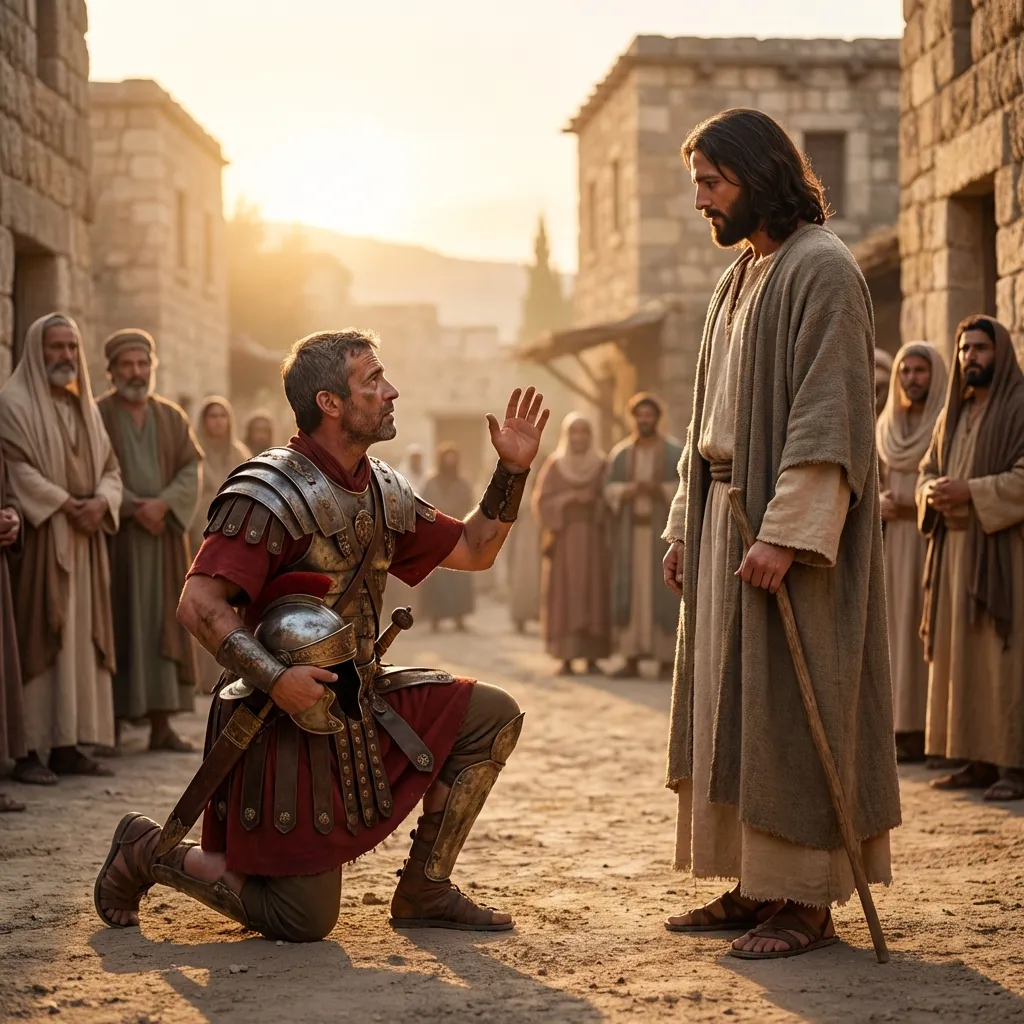
Upon entering Capernaum, the headquarters of His Galilean ministry, Jesus was approached by an extraordinary Roman centurion. Representing the brutal iron fist of the Roman military occupation, this centurion broke every cultural mold: he loved a dying slave, honored the Jewish community, and possessed an understanding of spiritual authority so profound that Jesus marveled at his faith.
1. A Commander with a Tender Heart
In first-century Roman culture, slaves were treated as chattel—disposable property without human rights. When a slave became chronically ill or paralyzed, Roman agricultural manuals advised selling or abandoning them to die. Yet this hardened centurion treasured his servant (pais), who lay paralyzed at home, suffering terribly from excruciating pain. True leadership is not demonstrated by domineering strength, but by compassion toward the most vulnerable.
2. The Roman Grasp of Sovereign Authority
When Jesus graciously offered, "I will come and heal him," the centurion replied with breathtaking insight: "Lord, I do not deserve to have you come under my roof. But just say the word, and my servant will be healed. For I myself am a man under authority, with soldiers under me. I tell this one, 'Go,' and he goes; and that one, 'Come,' and he comes" (Matthew 8:8-9). Having spent decades in the imperial military, he understood that authority operates by chain of command. He recognized that Jesus possessed absolute cosmic command over disease, demons, and nature.
3. The Marvel of the Savior
Matthew 8:10 records a staggering reaction: "When Jesus heard this, he was amazed and said to those following him, 'Truly I tell you, I have not found anyone in Israel with such great faith.'" The religious leaders of Israel demanded signs, questioned His genealogy, and accused Him of blasphemy. Yet here was a Roman soldier who needed no sign, no touch, and no physical presence—merely the spoken word of Christ.
4. The Prophetic Gathering of the Nations
Jesus used this Gentile breakthrough to deliver a sweeping prophetic warning: "I say to you that many will come from the east and the west, and will take their places at the feast with Abraham, Isaac and Jacob in the kingdom of heaven. But the subjects of the kingdom will be thrown outside into the darkness" (Matthew 8:11-12). Membership in God's Kingdom is not determined by biological pedigree, circumcision, or ethnic heritage, but by living, humble faith in Jesus Christ.
5. The Spoken Word Executed at a Distance
Turning to the centurion, Jesus declared: "Go! Let it be done just as you believed it would." Matthew records: "And his servant was healed at that moment" (Matthew 8:13). Across the streets of Capernaum, without Jesus ever taking a step toward the residence, the paralysis vanished and the boy sat up completely whole. Faith in the authority of God's word unleashes heaven's power anywhere on earth.
Biblical Keywords & Theological Roots
Centurion; Roman military commander of a century (100 soldiers), representing the occupying imperial superpower.
Authority, jurisdiction, executive power; the centurion understood that just as his soldiers obeyed his orders, disease obeyed Christ's word.
To marvel, wonder, be astonished; Jesus marveled at the Roman Gentile's faith—one of only two times in the Gospels Jesus marveled.
🔑 Key Spiritual Takeaways
- Faith Understands Authority: The centurion understood spiritual authority because he lived under military hierarchy; he knew one word from Jesus was enough.
- Humility Precedes Breakthrough: High worldly rank combined with profound spiritual humility makes faith irresistible to God.
- Distance is Meaningless to God: Jesus never entered the house, laid hands, or saw the paralyzed servant; the word spoken in the street accomplished the cure.
- The Global Ingathering of Gentiles: Jesus used this miracle to prophesy that Gentiles from east and west would feast at Abraham's table while unbelieving children of the Kingdom would be cast out.
Support Independent Biblical Research
Did this study bless you? Help support our independent bilingual research and interactive visual Bible tools.
⚡ Fast Facts
- A Gentile's Great Faith: In Matthew 8:10, Jesus marveled and declared: 'Truly I tell you, I have not found anyone in Israel with such great faith.'
- Deep Love for a Slave: In the Roman Empire, slaves (pais/doulos) were treated as disposable property; this centurion dearly loved and valued his dying servant.
- Generosity to Jews: Luke 7:5 reveals that local Jewish elders pleaded for him because 'he loves our nation and has built our synagogue' at Capernaum.
- Unworthiness Confessed: Despite his imperial military rank, the centurion confessed: 'Lord, I do not deserve to have you come under my roof' (Matthew 8:8).
❓ Frequently Asked Questions (FAQs)
Why did Jesus marvel at the Roman centurion's faith?
In the Gospels, Jesus marvels only twice: once at the unbelief of His hometown Nazareth (Mark 6:6), and once at the extraordinary faith of this Gentile soldier (Matthew 8:10). The centurion had no Hebrew scriptures or covenant heritage, yet he grasped Christ's cosmic authority better than Israel's chief priests.
Why did the centurion tell Jesus not to come under his roof?
Under strict rabbinic law, entering a Gentile's house caused ritual defilement. The centurion respectfully sought to protect Jesus from Jewish criticism. More deeply, he recognized his own unworthiness before God's holiness, knowing that Christ's spoken word had no physical limits.
What does this miracle teach us about modern prayer?
We do not need physical apparitions, audible voices, or physical proximity to receive divine breakthroughs. When we pray according to Christ's authority in scripture, His spoken word crosses all distances to heal and restore.