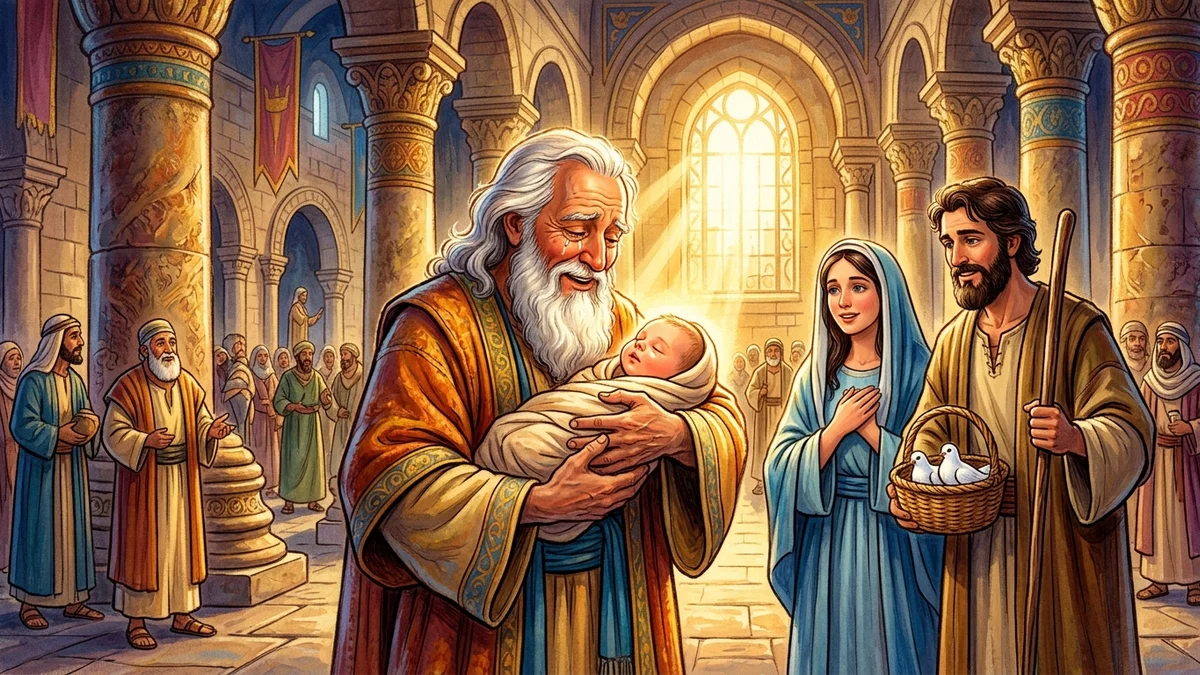
For twelve silent years, the small village of Nazareth—tucked away like an eagle's nest in the southern ridges of lower Galilee—guarded the greatest secret in the universe. The hands that had spoken galaxies into existence learned to wield the carpenter's adze, saw, and mallet; the voice that had commanded light to blaze across primeval darkness spoke the daily Aramaic dialect of Galilean peasants. Yet beneath this quiet village rhythm beat the unclouded consciousness of the incarnate Son of God. When Jesus reached the pivotal age of twelve, on the threshold of adult accountability to the Torah, the Holy Family joined the festive spring pilgrimage to Jerusalem for the Feast of the Passover. In the marble courts of Mount Moriah, the silence of Christ’s youth was broken for the only time in the biblical record, revealing the brilliant dawn of His divine mission!
1. The Pilgrim Caravan and the Songs of Ascents
Luke introduces this solitary window into Christ's boyhood with cultural precision: "His parents went to Jerusalem every year at the Feast of the Passover. And when He was twelve years old, they went up to Jerusalem according to the custom of the feast." (Luke 2:41-42).
Under the Mosaic covenant (Exodus 23:14-17; Deuteronomy 16:16), every Jewish male was commanded to appear before Yahweh at three annual pilgrimage feasts: Passover, Pentecost, and Tabernacles. While the Law strictly bound men, devout families like Joseph and Mary made the arduous eighty-mile journey together every spring. For a boy of twelve, this was a momentous milestone. At age thirteen, a Jewish youth became a *Bar Mitzvah* ("Son of the Commandment"), legally responsible for the moral and ritual precepts of the Torah. Age twelve was the year of formal preparation, when young men were taken to Jerusalem to observe the sacrificial liturgy firsthand.
They traveled not as an isolated trio, but in a vast, singing caravan (*synodia*) consisting of dozens of extended families, cousins, and neighbors from Nazareth and surrounding Galilean villages. As they wound their way south along the Jordan Valley and ascended the steep rocky roads toward Jerusalem, their voices reverberated against the limestone canyons, chanting the ancient Songs of Ascents: "I was glad when they said to me, 'Let us go into the house of the Lord.' Our feet have been standing within your gates, O Jerusalem!" (Psalm 122:1-2).
Entering the holy city, their senses were overwhelmed. Jerusalem's population swelled from 50,000 to several hundred thousand. White smoke from thousands of sacrificial Passover lambs billowed from the bronze altar of the Temple into the azure spring sky, mingling with the aroma of roasting bitter herbs and unleavened bread. For seven days, young Jesus observed the solemn memorial of the Exodus, knowing with absolute clarity that He Himself was the true, unblemished Passover Lamb foreshadowed by every stream of sacrificial blood!
2. The Returning Caravan and the Missing Son
When the seven days of the feast were concluded, the massive crowd prepared to return home. Luke records the sudden, terrifying crisis that unfolded:
"When they had finished the days, as they returned, the Boy Jesus lingered behind in Jerusalem. And Joseph and His mother did not know it; but supposing Him to have been in the company, they went a day's journey, and sought Him among their relatives and acquaintances." (Luke 2:43-44).
Modern readers often wonder how loving, hyper-vigilant parents could travel an entire day without realizing their twelve-year-old son was missing. But ancient Middle Eastern caravan travel explains the scenario completely. In large pilgrim bands, the women, nursing mothers, and younger children traditionally traveled in the vanguard at a slower pace, while the men, older youths, and pack animals brought up the rear. During the day's march along the crowded roads, family members moved freely back and forth.
Joseph naturally assumed Jesus was up front with Mary and the women of Nazareth; Mary just as naturally assumed the twelve-year-old boy was walking in the rear with Joseph and the men. Only when the caravan halted at sunset to pitch tents and share the evening meal at Beeroth—nearly twenty miles north of Jerusalem—did the devastating truth emerge.
Mary ran to Joseph’s campfire; Joseph had not seen Him. Frantic, they moved from tent to tent, calling His name among uncles, cousins, and neighbors. No one had seen the boy since they exited the city gates. The awful reality struck their hearts: The Son of the Most High, the holy deposit entrusted to their guardianship by the Archangel Gabriel, had been lost!
3. Three Days of Agonizing Search
Luke records: "So when they did not find Him, they returned to Jerusalem, seeking Him. Now so it was that after three days they found Him in the temple..." (Luke 2:45-46).
Those "three days" were a crucible of parental anguish. Day One was the full day's march northward away from the city. Day Two was the grueling, breathless march back south along the bandit-infested Jericho-Jerusalem road, their minds haunted by terrifying scenarios. Had He fallen into the hands of Roman legionaries? Had He been seized by ruthless slave traders or crushed in the stampede of departing pilgrims?
Day Three was an exhausting, door-to-door search through the labyrinthine streets, bazaars, and pilgrim inns of Jerusalem's Lower and Upper Cities. Finally, exhausted, weeping, and desperate, Joseph and Mary climbed the southern steps to the Temple Mount—perhaps to pray for a miracle, or as a last, desperate resort.
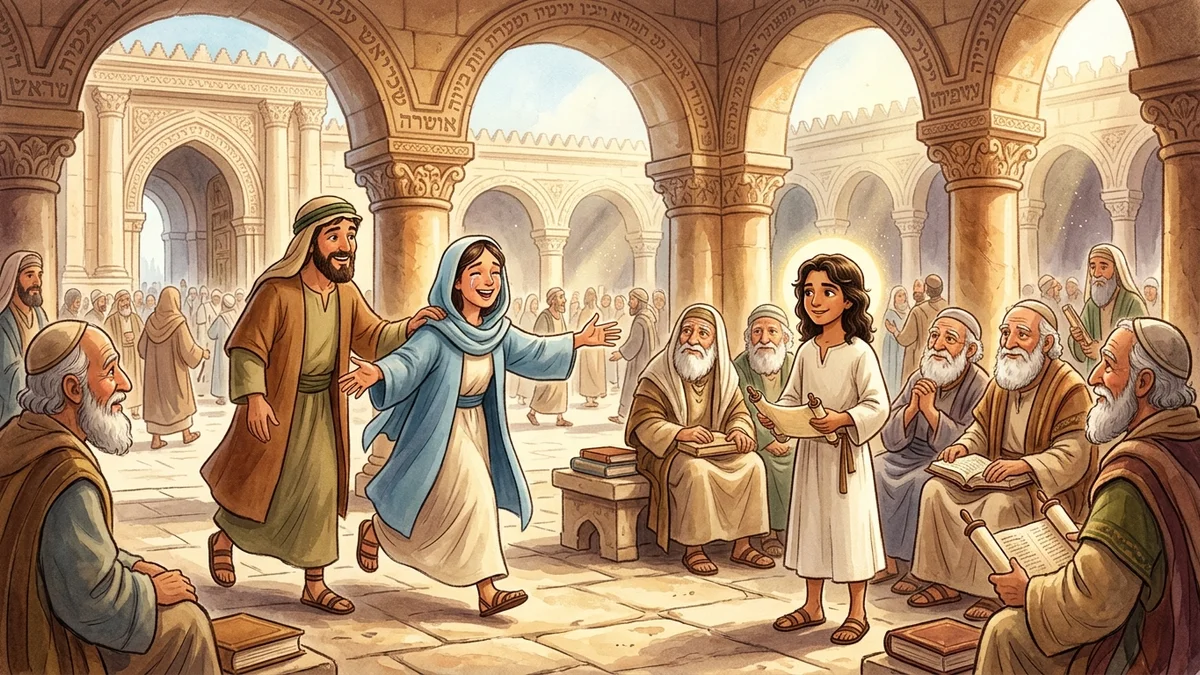 William Holman Hunt's detailed masterpiece 'The Finding of the Saviour in the Temple' (1860), capturing the exact dramatic moment Mary and Joseph find the youthful Christ captivating the venerated rabbis of Israel.
4. Astonishing the Doctors of the Law
Crossing the vast Court of the Gentiles and entering the shaded marble colonnades of Solomon's Porch, they witnessed a sight that stopped them dead in their tracks:
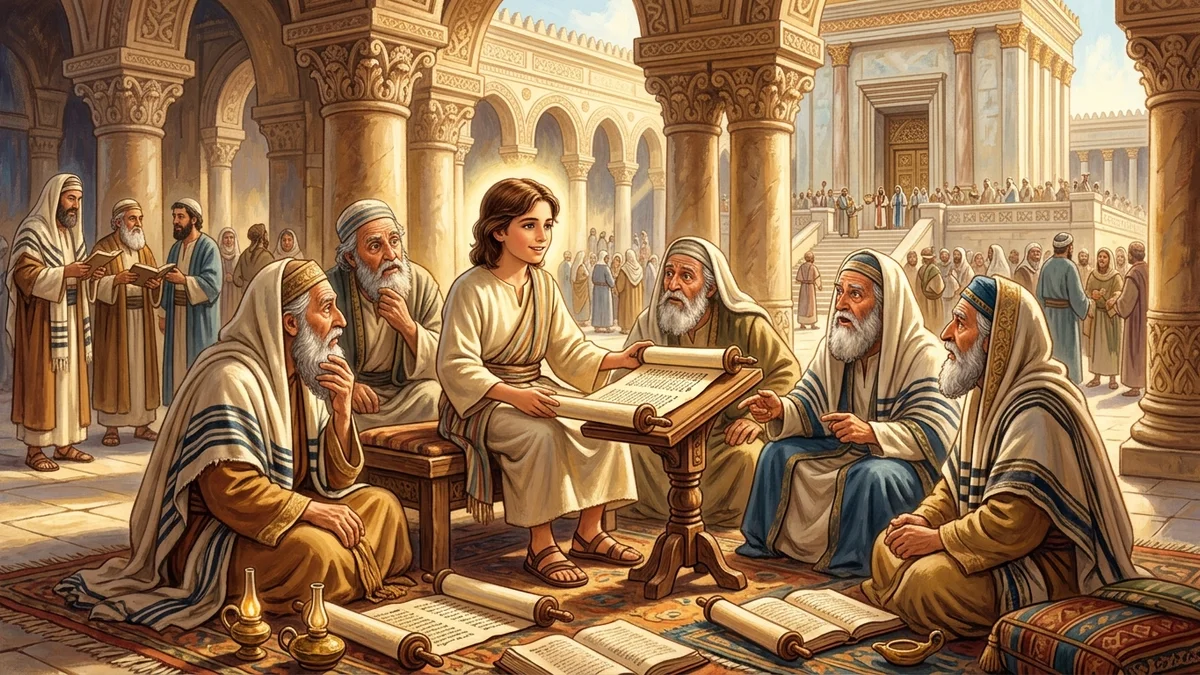
"...they found Him in the temple, sitting in the midst of the teachers, both listening to them and asking them questions. And all who heard Him were astonished at His understanding and answers." (Luke 2:46-47).
During the Passover season, prominent members of the Great Sanhedrin—scholars trained in the legendary academies of Hillel and Shammai—held public theological forums in the Temple colonnades. These revered, white-bearded masters sat on raised benches or cushions, expounding complex points of Mosaic jurisprudence, prophetic interpretation, and Messianic expectations, inviting questions from pilgrims.
There, seated in the center of the semicircle of Israel’s greatest legal minds, sat the twelve-year-old Galilean boy! Luke's description is exquisitely balanced: Jesus was not acting with arrogant insolence or preaching down to the elderly scholars. He was "both listening to them and asking them questions." In ancient Jewish rabbinic pedagogy, brilliant students demonstrated their mastery not merely by answering questions, but by framing penetrating, multi-layered inquiries that probed the very foundations of the text.
The rabbis were "astonished" (Greek: existanto—literally, thrown out of their normal senses, dumbfounded). The twelve-year-old boy possessed a supernatural comprehension of the Torah that transcended decades of scribal study. The Author of the Law was discussing His own Word with the teachers of the Law, and their sophisticated dialectics dissolved before His pure, luminous understanding!
5. The First Words: My Father's House
Joseph and Mary stood frozen on the periphery of the circle. Luke records: "So when they saw Him, they were amazed" (Greek: exeplagesan—struck with overwhelming wonder). But the intense relief of finding their lost son collided with days of bottled-up maternal fear. Mary stepped forward, interrupting the august assembly with an emotional cry:
"Son, why have You done this to us? Look, Your father and I have sought You anxiously!" (Luke 2:48).
Notice Mary's words: "Your father and I." She referred to Joseph, the faithful legal guardian who had protected Him from Herod and taught Him the trade of woodworking.
Then came the moment that reverberated across the corridors of eternity. The twelve-year-old looked up at His weeping mother with calm, loving, unruffled serenity, speaking the very first recorded words of the Messiah in the biblical canon:
"Why did you seek Me? Did you not know that I must be about My Father's business?" (Luke 2:49).
The original Greek phrasing is intensely compressed and profound: "en tois tou patros mou dei einai me". It can be translated either as "in the things of My Father" or "in My Father's house."
Notice the divine realignment: Mary said, "Your father [Joseph] and I sought You." Jesus answered, "Did you not know that I must be in the house of MY FATHER [Yahweh]?" With gentle, holy majesty, the twelve-year-old boy established His true paternity. Joseph was His earthly guardian, but God Almighty in heaven was His true Father. Furthermore, He used the word "must" (Greek: dei)—the word of divine necessity that Jesus would use throughout His ministry: "The Son of Man must suffer... the Son of Man must be lifted up."
Even at age twelve, Jesus was fully conscious of His identity, His eternal Sonship, and His redemptive mission. He did not remain behind in Jerusalem out of childish mischief, rebellion, or carelessness. He was drawn to the Temple by the gravitational pull of His divine destiny.
6. The Hidden Years of Submission and Stature
Luke records with poignant honesty: "But they did not understand the statement which He spoke to them." (Luke 2:50). The mystery was too vast for their human comprehension.
Yet what did the King of the universe do next? He did not demand that the rabbis crown Him or that His parents bow down before Him. In supreme, breathtaking humility:
"Then He went down with them and came to Nazareth, and was subject to them, but His mother kept all these things in her heart." (Luke 2:51).
The Greek word for "subject" is hypotassomenos—a military term meaning to place oneself under the rank and order of an authority. The One who holds the planets in their orbits voluntarily submitted Himself to the daily authority of a Galilean peasant carpenter and his wife for the next eighteen silent years! He swept wood shavings in the carpenter's shop, honored the fifth commandment, and lived a blameless, working-class human life.
Luke concludes this sacred chapter with a summary of Christ's flawless growth:
"And Jesus increased in wisdom and stature, and in favor with God and men." (Luke 2:52).
In His authentic human nature, Christ developed along every vital dimension: intellectually (wisdom), physically (stature), spiritually (favor with God), and socially (favor with men). The boy in the Temple proved that true spiritual greatness is not displayed in self-promotion, but in knowing who you are in the Father, and walking in humble obedience until the appointed hour of divine manifestation!
Biblical Keywords & Theological Roots
A traveling company, caravan, or pilgrim band journeying together for mutual protection and fellowship (Luke 2:44).
To be utterly amazed, astounded, thrown out of one's normal senses by supernatural comprehension or wonder (Luke 2:47).
To submit oneself voluntarily, to place oneself in an ordered military rank of obedience under authority (Luke 2:51).
Ancient Near Eastern & Archaeological Context
Under Exodus 23:14–17 and Deuteronomy 16:16, every adult Jewish male was required to make pilgrimage to the Jerusalem Temple for the three major pilgrim feasts: Passover (Pesach), Pentecost (Shavuot), and Tabernacles (Sukkot). At age twelve, young boys entered their final year of instruction before assuming adult religious responsibility at age thirteen (Bar Mitzvah). During the feast, prominent rabbis of the Great Sanhedrin, including disciples of the legendary schools of Hillel and Shammai, would sit in the public colonnades of the Temple (such as Solomon's Porch) to publicly debate theological points, inviting questions from students and pilgrims.
Support Independent Biblical Research
Did this study bless you? Help support our independent bilingual research and interactive visual Bible tools.
⚡ Fast Facts
- Age twelve was the pivotal preparatory year before a Jewish boy became a 'Bar Mitzvah' ('Son of the Commandment') at age thirteen, assuming full personal accountability to the Law
- Galilean pilgrim caravans often traveled with women and children in the lead and men in the rear, explaining why Joseph and Mary each assumed Jesus was with the other group
- Christ's question 'Did you not know that I must be about My Father's business?' (Luke 2:49) contains His first recorded spoken words in the entire New Testament canon
- The Greek word 'hypotassomenos' (Luke 2:51) indicates voluntary, continuous filial submission to Joseph and Mary during the eighteen silent years in Nazareth
❓ Frequently Asked Questions (FAQs)
The 'three days' encompassed: Day 1—a full day's journey northward from Jerusalem to their evening encampment (roughly twenty miles); Day 2—the grueling journey walking back south to Jerusalem; and Day 3—searching through the teeming marketplaces, pilgrim inns, and residential quarters of Jerusalem before finally ascending the Temple Mount.
Not at all. In Jewish culture, Jesus' reply was not insolence, but a gentle, revelatory realignment of priorities. While Mary had said 'Your father and I have sought You,' Jesus lovingly pointed to His ultimate heavenly origin: 'I must be in the house of My Father,' revealing that His supreme allegiance belonged to God's redemptive mission, even while He subsequently returned home in total obedience to them.
In the Incarnation, Christ possessed two full natures: fully divine and fully human. As a genuine human boy, Jesus grew intellectually (wisdom), physically (stature), spiritually (favor with God), and socially (favor with man), experiencing authentic human development without sin.