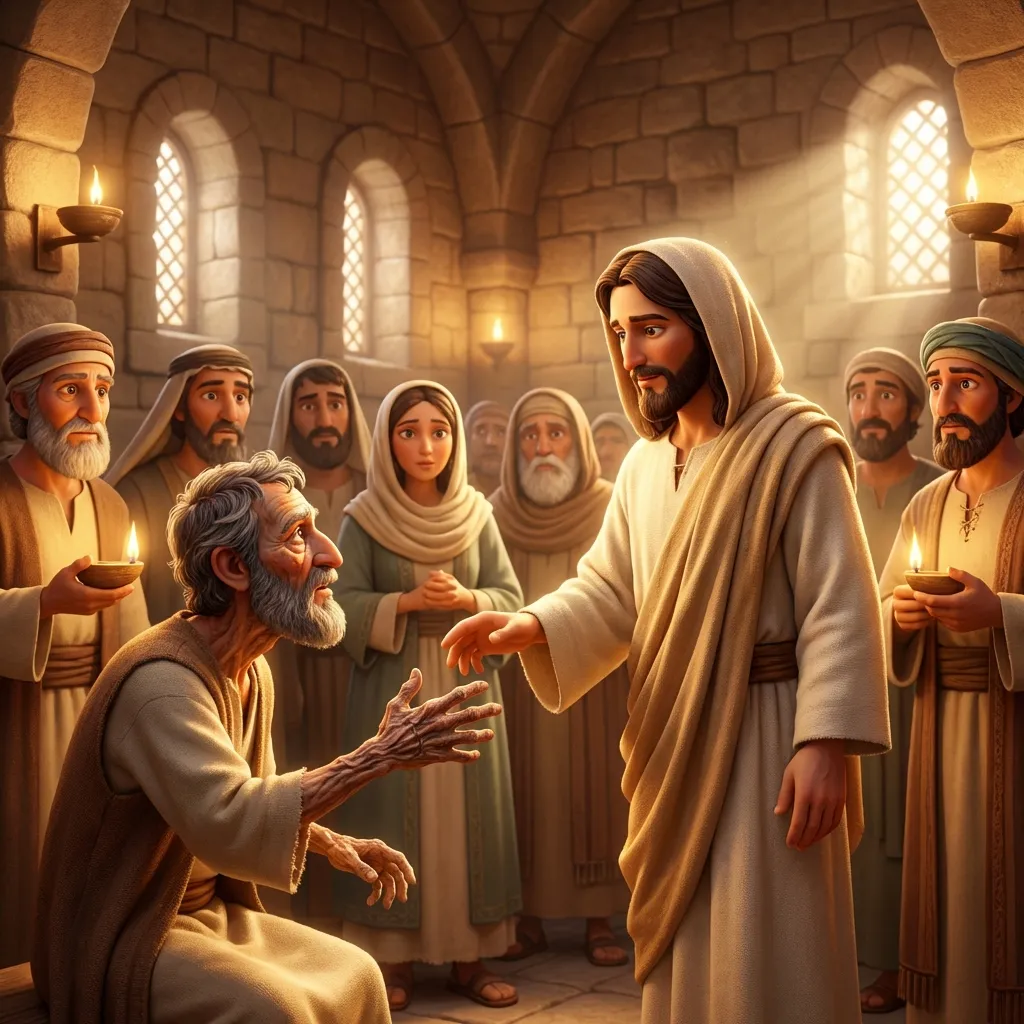
On another Sabbath, Jesus entered the local synagogue to teach. Sitting among the congregants was a man whose right hand was completely withered and atrophied. Recorded in Matthew 12:9-14, Mark 3:1-6, and Luke 6:6-11, this public confrontation brought the conflict between dead religious legalism and the compassionate heart of God to an explosive climax.
1. The Trap in the Synagogue
The Pharisees were not attending Sabbath worship to seek God or love their neighbor. Mark 3:2 notes they kept their eyes fixed on Jesus, looking for an opportunity to accuse Him of breaking Sabbath laws. Rabbinic tradition permitted medical aid on the Sabbath only if a patient's life hung in the balance. Since a withered hand was a chronic, stable disability, healing it was classified as illegal labor. They viewed this suffering craftsman merely as legal bait in a theological trap.
2. Standing in the Center
Knowing their secret thoughts, Jesus did not evade the trap. He took the initiative, commanding the disabled man: "Stand up in front of everyone." In full view of the assembly, Jesus posed a penetrating moral question to the scribes: "Which is lawful on the Sabbath: to do good or to do evil, to save life or to kill?" The religious experts remained stony silent. To remain passive before human suffering when you have the power to help is, in God's eyes, to participate in evil.
3. The Holy Anger and Grief of the Savior
Mark 3:5 records one of the most vivid emotional portraits of Jesus in scripture: "He looked around at them in anger and, deeply distressed at their stubborn hearts." This was not selfish irritability; it was holy indignation against callous self-righteousness that prioritized theological loopholes over human restoration. Yet His anger was mingled with profound grief over their self-inflicted spiritual blindness.
4. The Stretch of Faith
Turning to the man, Jesus gave a physically impossible command: "Stretch out your hand." For years, the nerves had been dead, the tendons contracted, and the fingers frozen in paralysis. Yet when the man heard Christ's command, he did not protest his natural limitation. He believed, willed his muscles to move, and extended his arm. In the very act of reaching out in faith, divine power surged through the limb, and his hand was completely restored, as healthy as the other.
5. The Murderous Irony of Legalism
The miracle was undeniable, but the reaction of the religious leaders was horrific: "Then the Pharisees went out and began to plot with the Herodians how they might kill Jesus" (Mark 3:6). Notice the tragic hypocrisy: they considered it a sin for Jesus to heal a crippled hand on the Sabbath, yet they felt completely justified plotting murder on the exact same holy day! Religion without love degenerates into lethal hatred.
Biblical Keywords & Theological Roots
Withered, dried up, shriveled, atrophied; Luke 6:6 specifies it was his right hand—his dominant hand for livelihood and craftsmanship.
'Stretch out!'; the impossible command that tested the man's faith to obey Christ by attempting what he naturally could not do.
Righteous anger, holy indignation mixed with grief; Jesus looked around at the Pharisees with anger, deeply grieved by their hardness of heart.
🔑 Key Spiritual Takeaways
- Mercy Surpasses Ritual: Jesus established the divine principle that it is always lawful to do good and save life on the Sabbath; people matter more than traditions.
- The Command of Faith: Jesus told the man to do the very thing he was physically incapable of doing: 'Stretch out your hand!' In attempting the impossible, divine power met human obedience.
- Righteous Anger Against Hardness: Jesus was angry not at personal insults, but at religious self-righteousness that rejoices in rules while ignoring human suffering.
- True Rest in Christ: The Sabbath was made for humanity, not humanity for the Sabbath; Christ restores wholeness to bring authentic rest to weary souls.
Support Independent Biblical Research
Did this study bless you? Help support our independent bilingual research and interactive visual Bible tools.
⚡ Fast Facts
- Right Hand Atrophied: Luke the physician specifically notes it was the man's right hand—rendering him incapable of earning a living as a craftsman or stonemason.
- Sabbath Entrapment: The Pharisees were not attending the synagogue to worship; Mark 3:2 notes they were 'watching Jesus closely to see if he would heal him on the Sabbath.'
- Jesus' Holy Anger: Mark 3:5 contains one of the rare Gospel descriptions of Jesus feeling righteous anger, combined with grief at their hard hearts.
- Conspiracy with the Herodians: Outraged by the healing, the ultra-religious Pharisees immediately conspired with the secular, Roman-collaborating Herodians to murder Jesus.
❓ Frequently Asked Questions (FAQs)
Why was it considered a violation of the Sabbath to heal a withered hand?
Rabbinic traditions permitted medical treatment on the Sabbath only if a patient's life was in immediate danger. Because a chronic withered hand was not life-threatening, Pharisees considered healing it on Saturday an illegal act of professional work.
Why did Jesus tell the man to stand in front of everyone?
Jesus refused to perform the miracle in secret. By placing the disabled man in the center of the room, Jesus forced the religious leaders to look at a suffering brother and confront whether their theology had room for divine compassion.
Why was Jesus both angry and grieved at the Pharisees?
Mark 3:5 balances two divine emotions: holy anger against their callous indifference to human misery, and deep grief (syllypoumenos) over the tragic spiritual blindness that was condemning their souls.