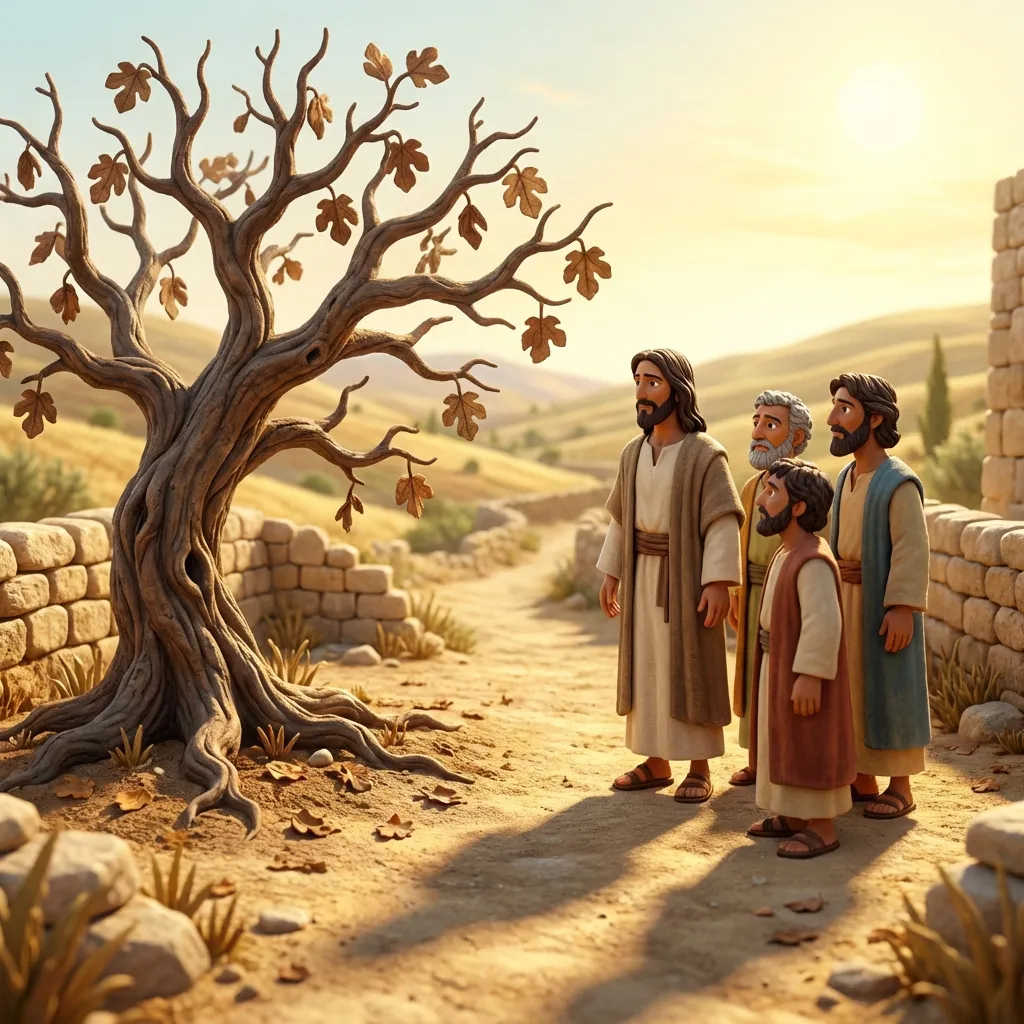
During Passion Week, as Jesus walked from Bethany to Jerusalem on the morning after His triumphal entry, He felt physical hunger. Spotting a leafy fig tree in the distance, He approached it looking for fruit. In Matthew 21:18-22 and Mark 11:12-25, this encounter produced the only miracle of judgment in the Gospels—an enacted prophetic parable condemning hypocritical religion.
1. The False Advertising of Leaves
In the Judean hills around Passover (early spring), common fig trees (Ficus carica) did not yet bear their full summer crop. However, when early spring leaves appeared, the tree customarily produced small, edible precursor buds called taqsh in Arabic. Seeing a tree covered in luxuriant green leaves from a distance, any hungry traveler would legitimately expect to find these edible buds. But upon parting the foliage, Jesus found nothing but leaves. The tree was a hypocrite, falsely advertising fruit it did not possess.
2. The Prophetic Parable of the Temple
Jesus answered the tree: "May no one ever eat fruit from you again!" (Mark 11:14). This was not petulant irritation; it was a solemn, enacted prophetic judgment. In the Old Testament prophets (Jeremiah 8:13; Hosea 9:10), the fig tree was the preeminent symbol of Israel. The tree with leaves but no fruit symbolized the Jerusalem Temple: teeming with priests, animal sacrifices, and chanting choirs, yet completely destitute of true repentance, justice, and spiritual fruit.
3. Withered from the Roots
Immediately after cursing the tree, Jesus entered the Temple and drove out the money changers. The next morning, as Jesus and the disciples walked back along the same path, Peter gasped in astonishment: "Rabbi, look! The fig tree you cursed has withered!" (Mark 11:21). The tree had not merely wilted; it had completely dried up from its subterranean roots. Within forty years, in AD 70, the Roman legions under Titus would completely raze the barren Temple to the ground, leaving not one stone upon another.
4. The Call to Mountain-Moving Faith
Jesus used Peter's astonishment to impart a foundational lesson on prayer: "Have faith in God. Truly I tell you, if anyone says to this mountain, 'Go, throw yourself into the sea,' and does not doubt in their heart but believes that what they say will happen, it will be done for them" (Mark 11:22-23). Standing on the Mount of Olives overlooking the Temple Mount, Jesus declared that the Old Covenant mountain was being displaced by the unshakeable spiritual Kingdom of faith.
5. The Filter of Forgiveness
Jesus concluded with an indispensable condition for answered prayer: "And when you stand praying, if you hold anything against anyone, forgive them, so that your Father in heaven may forgive you your sins" (Mark 11:25). You cannot possess mountain-moving faith while harboring bitterness. Authentic faith bears the fruit of active, unconditional forgiveness.
Biblical Keywords & Theological Roots
To dry up, wither away, desiccate from the roots; the fig tree instantly shriveled under Christ's prophetic curse.
'Have faith in God'; Jesus used the withered tree to teach absolute mountain-moving confidence in divine sovereignty.
Jesus answered the tree (Mark 11:14); treating the deceptive tree as a moral object lesson speaking judgment on fruitlessness.
🔑 Key Spiritual Takeaways
- Leaves Without Fruit is Hypocrisy: Lush green foliage promised fruit to hungry travelers; barren religion that boasts in rituals without real righteousness is cursed.
- Judgment on Dead Religion: Immediately before and after cursing the tree, Jesus cleansed the Temple, connecting the withered tree directly to corrupt Temple trade.
- The Power of Unwavering Prayer: Jesus used the withered tree to promise: 'If you have faith and do not doubt, you can say to this mountain, 'Be thrown into the sea,' and it will be done.'
- Forgiveness As Prerequisite: Immediately after teaching mountain-moving faith, Jesus added: 'When you stand praying, if you hold anything against anyone, forgive them.'
Support Independent Biblical Research
Did this study bless you? Help support our independent bilingual research and interactive visual Bible tools.
⚡ Fast Facts
- Sole Destructive Miracle: The withering of the fig tree is the only miracle of destruction or judgment performed by Jesus in the Gospels.
- Passover Timing: Occurring during Passion Week between Bethany and Jerusalem, fig trees normally bore early edible green buds (taqsh) before full foliage.
- Prophetic Prop: The tree had lush leaves proclaiming fruitfulness, but was completely barren—a living symbol of the Jerusalem Temple's outward hypocrisy.
- Withered from the Roots: Mark 11:20 emphasizes the tree withered 'from the roots' overnight—signaling the imminent collapse of the Old Covenant Temple system.
❓ Frequently Asked Questions (FAQs)
Why did Jesus curse a fig tree if Mark 11:13 says 'it was not the season for figs'?
In Palestine, fig trees produced small edible buds (taqsh) alongside early leaves before the main summer crop. A tree displaying full green foliage advertised that it had these early edible buds. By having abundant leaves but zero fruit, the tree was a deceptive hypocrite—a living metaphor for the Jerusalem Temple.
Why is this miracle sandwiched around the cleansing of the Temple?
Mark uses a literary technique called 'sandwiching' (intercalation): Cursing the tree (Mark 11:12-14), Cleansing the Temple (Mark 11:15-19), and Observing the withered tree (Mark 11:20-25). The tree explains the Temple: outward religious activity with zero spiritual fruit faces imminent divine judgment.
What does 'saying to this mountain be cast into the sea' mean?
Standing on the Mount of Olives overlooking the Temple Mount, 'this mountain' symbolically referred to the corrupt Temple Mount itself, which would be destroyed in AD 70. More broadly, it promises that faith in God can remove seemingly insurmountable spiritual obstacles.