Approaching the fortified stone gate of Nain, a Galilean town perched on the slopes of the Hill of Moreh, Jesus and His disciples encountered a heartbreaking scene: a funeral procession carrying a young man to a hillside cemetery. In Luke 7:11-17, the Lord of Life confronted the tragedy of human grief, demonstrating that no grave is final when Jesus speaks.
1. The Collision of Two Crowds
Luke paints a dramatic cinematic contrast: two large crowds converged at the city gate. Entering the gate was a joyous procession following Jesus, celebrating signs, healings, and the dawn of the Kingdom. Exiting the gate was a wailing funeral procession wrapped in black mourning garments, following an open wicker bier carrying a deceased youth. Light met darkness; Life met death at the city gate.
2. The Plight of the Brokenhearted Widow
Luke 7:12 reveals the crushing depth of the tragedy: "A dead person was being carried out—the only son of his mother, and she was a widow." In the ancient world, to be a widow was difficult; to be a widow who buried her only son was absolute catastrophe. She had no husband to provide for her, no son to inherit family land, and no social safety net. She was walking toward a future of begging, exploitation, and utter abandonment.
3. The Sovereign Compassion of the Lord
Notice that nobody asked Jesus for help. The mother was blind with weeping; the crowd was absorbed in professional lamentation. But Luke records: "When the Lord saw her, his heart went out to her and he said, 'Don't cry.'" From human lips, 'Don't cry' is an empty cliché before an open coffin. But from the lips of the Resurrection and the Life, it is an authoritative declaration that sorrow is about to be abolished.
4. Touching the Open Bier
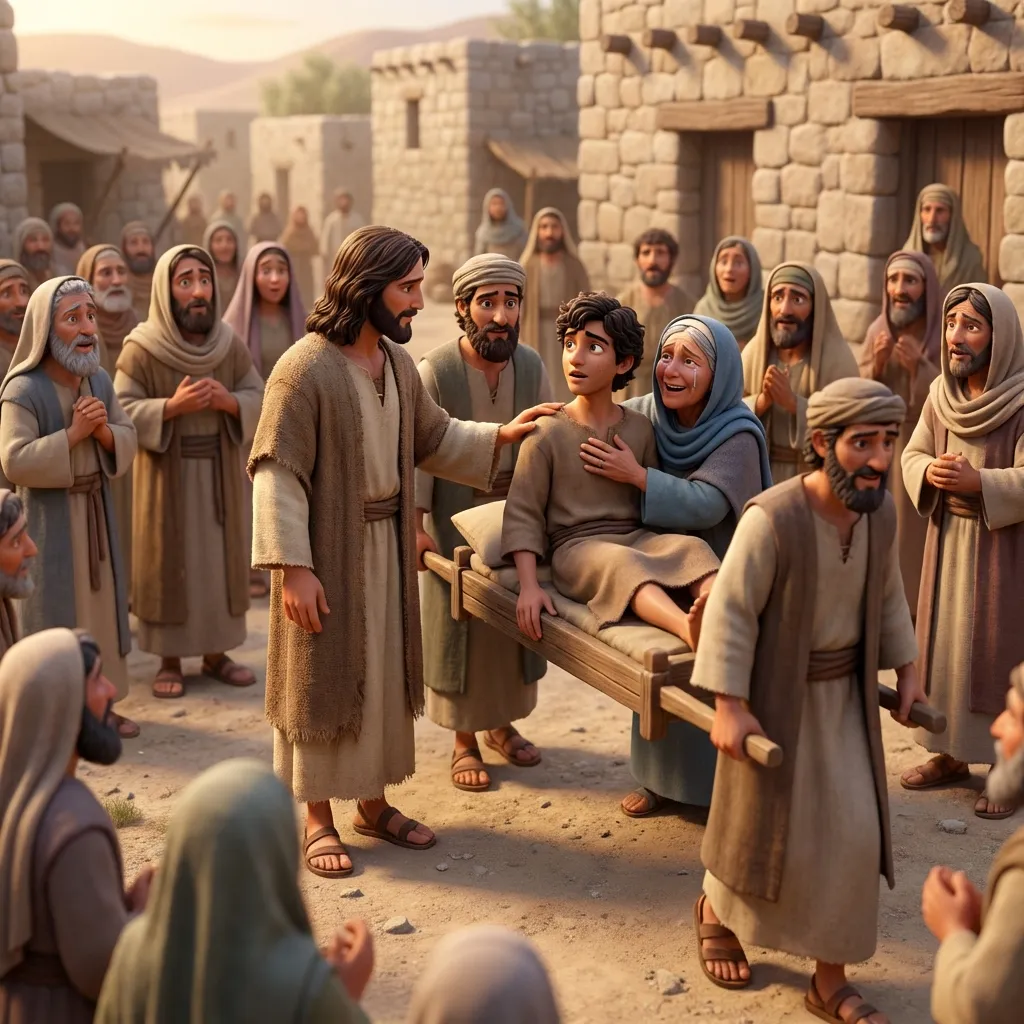
Jesus stepped forward and touched the wooden bier. Under Levitical law, touching a corpse or its stretcher incurred seven days of ceremonial uncleanness. But the pallbearers abruptly stopped, sensing divine power. Looking down at the lifeless corpse, Jesus spoke as only God can speak: "Young man, I say to you, get up!" The dead youth sat up, opened his eyes, and began to speak! Death fled instantly at the sound of Christ's voice.
5. Giving Him Back to His Mother
Luke records the most tender detail in verse 15: "Jesus gave him back to his mother." Christ did not recruit the young man into His traveling entourage; He placed his living hand back into the trembling hand of his weeping mother. The crowd was filled with holy awe, shouting: "A great prophet has appeared among us! God has visited his people!"
Biblical Keywords & Theological Roots
Only-begotten, unique, sole child; the young man was the only son of his mother, and she was a widow, leaving her utterly destitute.
He had deep, visceral compassion on her; the Lord saw her weeping and His heart ached with gut-wrenching mercy.
'Young man, I say to you, arise!'; Christ speaking directly to the corpse with the vocal authority of resurrection life.
🔑 Key Spiritual Takeaways
- Compassion Initiates the Miracle: Neither the dead boy nor the weeping widow asked for a miracle; Jesus acted purely out of unprompted, sovereign compassion.
- Tender Words in Grief: Jesus said to the weeping mother: 'Do not weep'—a meaningless phrase from human lips, but an omnipotent guarantee from the Lord of Life.
- The Collision of Two Processions: The procession of death leaving the city gate collided with the procession of Life entering the gate; Life conquered death.
- A Great Prophet Has Arisen: The crowds recognized that after 400 silent years, God had visited His people, echoing Elijah's resurrection of the widow's son in 1 Kings 17.
Support Independent Biblical Research
Did this study bless you? Help support our independent bilingual research and interactive visual Bible tools.
⚡ Fast Facts
- Exclusive to Luke: The resurrection at Nain is recorded exclusively in the Gospel of Luke (Luke 7:11-17), highlighting Christ's concern for widows.
- Total Destitution: In ancient Israel, a widow who lost her only son lost her financial support, social protection, and family lineage, doomed to begging.
- The Touch on the Bier: Touching an open funeral bier (soros) transmitted severe ceremonial defilement, yet Jesus touched it without hesitation.
- Delivered to His Mother: Luke 7:15 movingly notes that after the young man sat up and began to speak, Jesus 'gave him back to his mother.'
❓ Frequently Asked Questions (FAQs)
Where is Nain and why is its location spiritually significant?
Nain lies on the northern slope of the Hill of Moreh in Galilee, only a few miles from Shunem, where the prophet Elisha raised another widow's son from the dead (2 Kings 4). The crowd immediately connected Jesus to Elisha, shouting: 'A great prophet has appeared among us!'
Why was the widow's plight so catastrophic in first-century culture?
Without a husband or son, a woman in the ancient Near East had no legal standing, no inheritance rights, and no means of earning wages. She was facing immediate poverty, exploitation, and destitution. Jesus saved not only the son from death, but the mother from economic ruin.
What happened when Jesus touched the funeral bier?
Under Numbers 19:11-16, touching a corpse or funeral stretcher rendered a person ceremonially unclean for seven days. But when the Holy One touched the wooden stretcher, the pallbearers stopped dead in their tracks, and life instantly reversed corruption.