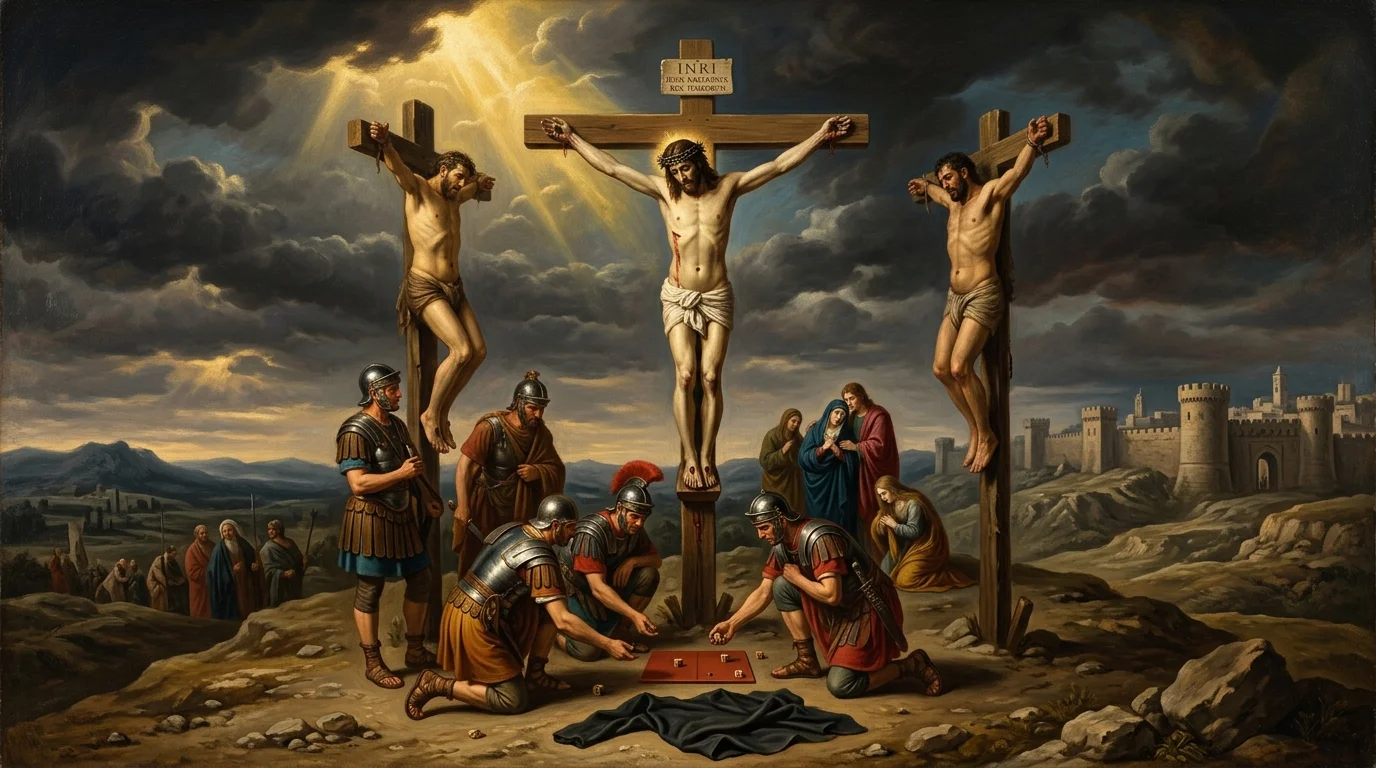
"Surely he took up our pain and bore our suffering, yet we considered him punished by God, stricken by him, and afflicted. But he was pierced for our transgressions, he was crushed for our iniquities; the punishment that brought us peace was on him, and by his wounds we are healed. We all, like sheep, have gone astray, each of us has turned to our own way; and the Lord has laid on him the iniquity of us all."
"He himself bore our sins in his body on the cross, so that we might die to sins and live for righteousness; 'by his wounds you have been healed.' ... God made him who had no sin to be sin for us, so that in him we might become the righteousness of God."
Isaiah 53:4-6 represents the absolute summit of Old Testament prophetic revelation: 'Surely he took up our pain and bore our suffering, yet we considered him punished by God, stricken by him, and afflicted. But he was pierced for our transgressions, he was crushed for our iniquities; the punishment that brought us peace was on him, and by his wounds we are healed. We all, like sheep, have gone astray, each of us has turned to our own way; and the Lord has laid on him the iniquity of us all.' Here is the pure heart of the Gospel—the glorious doctrine of penal substitutionary atonement.
1. The Misunderstood Sufferer: Isaiah 53:4
When the crowds gazed upon Jesus hanging on the cross, blood streaming from His lacerated brow and torn back, their immediate theological conclusion was that He was cursed by God: 'We considered him punished by God, stricken by him, and afflicted.' In Deuteronomy 21:23, anyone hanging on a tree was under God's curse. The Sanhedrin gloated that God was executing this Galilean blasphemer. But Isaiah reveals the breathtaking irony: He was indeed being struck by God, but not for His own sins! He was carrying our griefs and bearing our sorrows!
2. Pierced and Crushed for Our Sins: Isaiah 53:5
The prophet uses four violent verbs of crushing impact: pierced (*mecholal*), crushed (*medukka*), punished (*musar*), and wounded (*chabburah*). But in each case, the cause is placed squarely on us: 'for our transgressions... for our iniquities.' The punishment that brought us shalom—reconciliation, wholeness, peace with holy God—fell like a hammer upon Him. The scourge marks that tore open His flesh became the very medicine that heals our dying souls.
3. The Universal Wandering Sheep: Isaiah 53:6
Verse 6 opens with a sweeping indictment: 'We all, like sheep, have gone astray; each of us has turned to our own way.' Notice the diagnostic precision: humanity's fundamental sin is autonomy—turning to our own way, dethroning God to be our own gods. Intellectual elites, religious moralists, and hedonistic rebels all share the exact same fatal diagnosis: lost sheep careening toward the cliff of eternal judgment. We were completely unable to find our way back.
4. The Sovereign Transfer of Guilt
Then comes the climax of the verse: 'and the Lord has laid on him the iniquity of us all.' The Hebrew verb for 'laid on him' is hifgia—meaning to cause to fall upon, to strike with force, or to cause to collide. Imagine the accumulated sewage of human history: every murder, every act of child abuse, every lie, every blasphemy, every adulterous thought. At the Cross, Yahweh collected this colossal tidal wave of cosmic treason and caused it to crash down with full punitive fury onto the soul of His beloved Son!
5. The Great Exchange
In 1 Peter 2:24, the Apostle Peter sums up this prophecy: 'He himself bore our sins in his body on the cross, so that we might die to sins and live for righteousness; by his wounds you have been healed.' Martin Luther famously called this 'The Sweet Exchange' (*Der fröhliche Wechsel*): Christ took our filthy rags, our death, our curse, and our hell; in exchange, He gave us His immaculate robe, His indestructible life, His Father's favor, and His eternal heaven. We stand justified forever through the stripes of the Crucified Servant!
Biblical Keywords & Theological Roots
To bear, carry, lift up; taking the heavy burden of another's guilt and carrying it completely away.
Stripe, laceration, blow-mark; the deep contusions left by the Roman scourging whip that bring spiritual healing.
To cause to light upon, lay upon, strike down; Yahweh causing the collective iniquity of all sinners to collide onto the Servant.
Ancient Near Eastern & Archaeological Context
Under the Mosaic sacrificial system (Leviticus 16), on the annual Day of Atonement (*Yom Kippur*), the High Priest laid both hands upon the head of a live scapegoat, confessed all the sins of Israel over it, and sent it into the desert, symbolically transferring guilt. Isaiah 53 unveiled the staggering reality behind this ritual: the coming Messiah would not be a mere animal, but God’s sinless Servant upon whom the actual, collective guilt of humanity would be legally transferred by Yahweh Himself.
🔑 Key Spiritual Takeaways
- Salvation is not achieved by human moral effort or ritual penance, but received entirely through Christ's vicarious substitution on the cross.
- God's justice and love met at Calvary; divine wrath was fully satisfied while divine mercy was lavishly poured out upon repentant sinners.
- Every wound, spike, and laceration Christ bore was specifically purchased for our physical, emotional, and eternal spiritual healing.
- We are no longer condemned wandering sheep; the Good Shepherd absorbed our penalty and brought us home to the Shepherd and Overseer of our souls.
Support Independent Biblical Research
Did this study bless you? Help support our independent bilingual research and interactive visual Bible tools.
⚡ Fast Facts
- The Center of Isaiah 53: Isaiah 53:5-6 forms the theological epicenter of the Old Testament: 'He was pierced for our transgressions... the Lord has laid on him the iniquity of us all.'
- The All-Inclusive 'All': In verse 6, the first 'all' describes human universal sin ('All we like sheep have gone astray'), while the second 'all' describes Christ's universal atonement ('the Lord laid on him the iniquity of us all').
- Peter's Apostolic Summary: In 1 Peter 2:24, the apostle quotes Isaiah 53:5 verbatim: 'He himself bore our sins in his body on the cross, so that we might die to sins and live for righteousness; by his wounds you have been healed.'
- Penal Substitutionary Atonement: In 2 Corinthians 5:21, Paul distills this prophecy into the golden rule of salvation: 'God made him who had no sin to be sin for us, so that in him we might become the righteousness of God.'
❓ Frequently Asked Questions (FAQs)
What does 'vicarious substitution' mean in Christian theology?
'Vicarious' means acting on behalf of another; 'substitution' means taking another's place. Vicarious substitution means that Jesus Christ stood legally in the place of guilty sinners, bearing the exact penalty of death demanded by God's holiness, so that sinners could be declared righteous and reconciled to God.
What does 'by his wounds we are healed' refer to?
The primary context of Isaiah 53 is spiritual healing from the lethal disease of sin, guilt, and estrangement from God (1 Peter 2:24). However, Matthew 8:16-17 reveals that physical healing is also grounded in the Atonement, providing a foretaste of the complete bodily resurrection at Christ's return.
How does Isaiah 53:6 use the metaphor of sheep?
'All we like sheep have gone astray; each of us has turned to our own way.' Sheep are notoriously prone to wander blindly into danger, incapable of defending or saving themselves. The metaphor exposes humanity's universal spiritual foolishness and utter inability to rescue themselves from destruction.