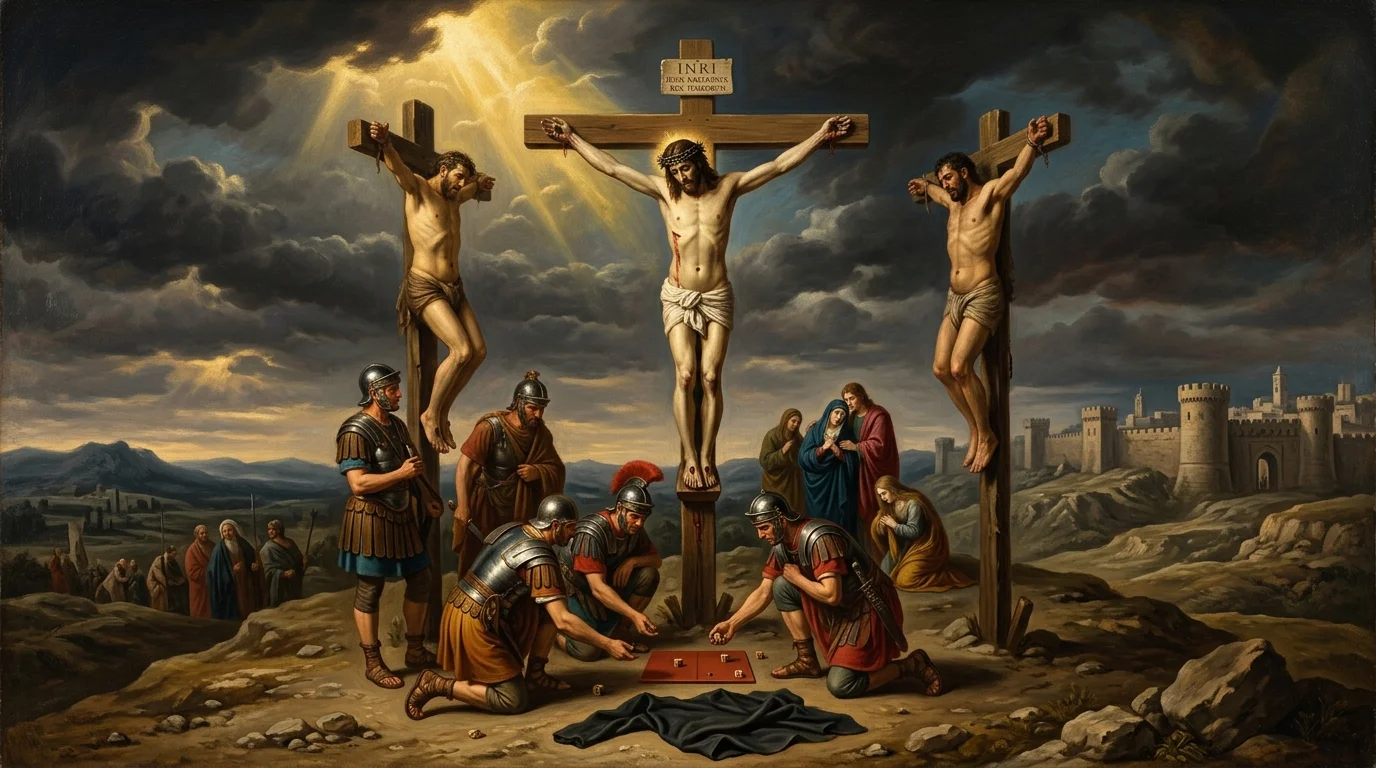
"For he bore the sin of many, and made intercession for the transgressors."
"Jesus said, 'Father, forgive them, for they do not know what they are doing.' And they divided up his clothes by casting lots."
Isaiah 53:12 reaches its breathtaking theological climax in its final phrase: 'and made intercession for the transgressors.' When Jesus was hoisted onto the wood of Golgotha, His first recorded words were not a call for vengeance or an appeal for angelic rescue, but a sublime prayer of intercession: 'Father, forgive them, for they do not know what they are doing' (Luke 23:34). In that single petition, the Messiah fulfilled ancient prophecy and forever redefined the nature of divine love.
1. The Context of the First Word
Consider the physical reality when this prayer was spoken. Jesus had just been marched through the streets of Jerusalem, bearing the heavy crossbeam until His strength failed. At Golgotha, His clothes were stripped off, reopening the clotted lacerations on His back. As the heavy iron spikes were driven through His hands and feet, the pain was blinding. Standard crucifixion victims reacted with violent thrashing, guttural curses, and desperate screams. Into this atmosphere of demonic brutality, Jesus spoke words that stunned heaven and earth: 'Father, forgive them...'
2. The Grammar of Perpetual Grace
In Luke 23:34, the Greek verb for 'said' is in the imperfect tense: Iesous de elegen ('Jesus kept on saying'). This was not a single, muttered sentence; it was His continuous, repeated prayer throughout the ordeal! As the soldiers drove the nails, He prayed, 'Father, forgive them.' As the cross thudded into the socket, He prayed, 'Father, forgive them.' As the crowd hurled insults and the priests wagged their heads, He continued to intercede. His blood fell to the ground, but His prayers rose to the throne of God.
3. Ignorance and the Ground of Mercy
Jesus pleaded: 'for they do not know what they are doing.' Did the Roman soldiers understand who He was? No; to them He was just another Jewish rebel. Did the Jewish populace understand? As Peter proclaimed in Acts 3:17: 'Now, fellow Israelites, I know that you acted in ignorance, as did your leaders.' Paul wrote in 1 Corinthians 2:8: 'None of the rulers of this age understood it, for if they had, they would not have crucified the Lord of glory.' Their ignorance did not make them guiltless—it made them accountable sinners—yet Christ used their blindness as a plea for divine patience and mercy.
4. The Immediate and Ongoing Answers
God answered Jesus’ dying prayer with astonishing rapidity. First, the hardened Roman centurion watching Him die glorified God and confessed: 'Surely this was a righteous man... the Son of God!' (Luke 23:47, Matthew 27:54). Second, the mocking thief beside Him was transformed by that prayer into a citizen of Paradise. Third, on the Day of Pentecost, Peter pointed his finger at the crowds in Jerusalem: 'You with the help of wicked men put him to death by nailing him to the cross' (Acts 2:23). When they cried, 'What shall we do?', Peter proclaimed the very forgiveness Christ had prayed for! Over three thousand souls were saved that day.
5. Our Eternal Intercessor at the Throne
Christ’s intercession was not confined to Golgotha. The author of Hebrews writes: 'Therefore he is able to save completely those who come to God through him, because he always lives to intercede for them' (Hebrews 7:25). Romans 8:34 asks: 'Who then is the one who condemns? No one. Christ Jesus who died—more than that, who was raised to life—is at the right hand of God and is also interceding for us.' The very One who prayed for His executioners on the cross now stands as our eternal Advocate before the Father, guaranteeing our eternal security forever.
Biblical Keywords & Theological Roots
To intercede, intervene, arbitrate, step in between two opposing parties to plead for mercy.
To forgive, pardon; an exclusive prerogative of God completely wiping away the offense.
To know, understand, perceive; 'they do not know what they are doing' indicates tragic spiritual ignorance.
Ancient Near Eastern & Archaeological Context
Under Roman execution procedures, victims of crucifixion routinely screamed horrific profanities, spat at the soldiers, cursed the day they were born, and called down violent ancestral curses upon their executioners. The legionnaires were calloused veterans accustomed to dealing with violent, thrashing outlaws. When Jesus opened His parched lips not to curse, but to tenderly intercede for the soldiers' forgiveness, it shook the hardened Roman centurion to the core of his soul.
🔑 Key Spiritual Takeaways
- Jesus practiced the radical love He preached; having commanded 'Love your enemies and pray for those who persecute you' (Matthew 5:44), He lived it on the Cross.
- Forgiveness is not conditional upon the abuser's apology; Christ extended forgiveness while the hammers were still striking the spikes.
- Spiritual ignorance does not excuse sin, but it provides the ground upon which divine mercy pleads for human restoration.
- Because Jesus lives forever to make intercession, our salvation is eternally secure and no accusation against God’s elect can stand.
Support Independent Biblical Research
Did this study bless you? Help support our independent bilingual research and interactive visual Bible tools.
⚡ Fast Facts
- First Words from the Cross: In Luke 23:34, as the iron spikes were being driven into His limbs, Jesus prayed: 'Father, forgive them, for they do not know what they are doing.'
- Imperfect Tense of Prayer: In Greek, Luke 23:34 uses the imperfect tense (*elegon*—'He kept saying'), indicating that Jesus repeatedly prayed this petition throughout His crucifixion.
- Stephen's Martyr Echo: In Acts 7:60, the first Christian martyr Stephen modeled his dying prayer directly on Jesus: 'Lord, do not hold this sin against them.'
- Everlasting Heavenly Intercession: Hebrews 7:25 and Romans 8:34 affirm that Christ's intercession did not end at Calvary; He lives forever at God's right hand to intercede for believers.
❓ Frequently Asked Questions (FAQs)
Who was included in Jesus' prayer: 'Father, forgive them'?
The scope of Christ's intercession was comprehensive: it included the Roman legionnaires driving the spikes, Pontius Pilate who passed the cowardly sentence, Caiaphas and the Sanhedrin who plotted His murder, the mob screaming 'Crucify him!', and ultimately every sinner whose transgressions nailed Him to the tree.
How was this prayer answered historically?
The prayer began bearing immediate fruit: the Roman centurion confessed 'Surely this was the Son of God!' (Matthew 27:54), and fifty days later at Pentecost, over 3,000 individuals—many of whom had participated in the mob—repented and received forgiveness of sins (Acts 2:37-41).
How does Christ's heavenly intercession function today?
According to Hebrews 7:25 and 1 John 2:1, Christ intercedes today not by repeatedly begging the Father, but by His perpetual bodily presence as the risen, glorified Lamb. His blood continually speaks of full redemption, silencing every demonic accusation against believers.