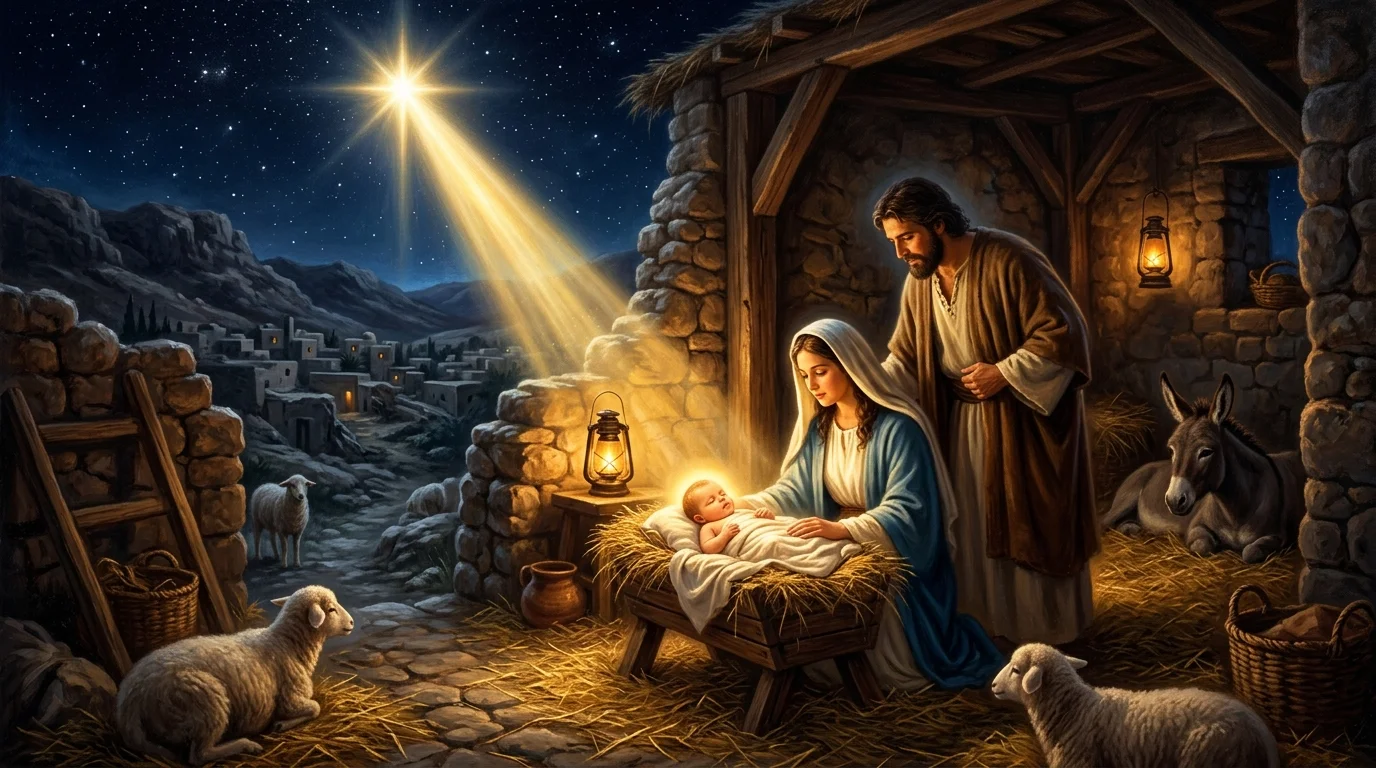
"In you all the families of the earth shall be blessed... and in your offspring shall all the nations of the earth be blessed, because you have obeyed my voice."
"The promises were spoken to Abraham and to his seed. Scripture does not say 'and to seeds,' meaning many people, but 'and to your seed,' meaning one person, who is Christ."
Genesis 12:1-3 and 22:18 form the bedrock foundation of the covenant of grace. Calling a solitary childless nomad out of pagan Mesopotamia, God issued a staggering sevenfold blessing that charted the spiritual destiny of the entire globe, promising that through Abraham's singular 'Seed,' all the families of the earth would be redeemed.
1. The Call from Ur and the Universal Promise
The Lord summoned Abram: "Go from your country, your people and your father's household to the land I will show you... and all peoples on earth will be blessed through you" (Genesis 12:1-3). At age seventy-five, with a barren wife, Abraham received a promise of global proportions. God was not interested in merely establishing a localized Middle Eastern tribe; His eternal heart beat for the redemption of all nations. The Abrahamic covenant was from its inception a global missionary mandate.
2. The Singular Seed: Paul's Grammatical Insight
In Galatians 3:16, the Apostle Paul conducts an inspired grammatical exegesis that unlocks the entire Old Testament: "The promises were spoken to Abraham and to his seed. Scripture does not say 'and to seeds,' meaning many people, but 'and to your seed,' meaning one person, who is Christ." While Israel as a collective nation was the vessel through which the oracles of God were preserved, the ultimate focal point of the covenant was not a multitude of descendants, but a singular King. Jesus Christ is the ultimate offspring in whom every promise finds its 'Yes' and 'Amen' (2 Corinthians 1:20).
3. The Akedah: Mount Moriah and the Gospel in Shadow
In Genesis 22, God commanded Abraham: "Take your son, your only son, whom you love—Isaac—and go to the region of Moriah. Sacrifice him there as a burnt offering" (Genesis 22:2). For three agonizing days, Isaac was as good as dead in Abraham's heart. Isaac carried the wood for the sacrifice on his own back up the mountain, just as Jesus would carry His own wooden cross up the slopes of Golgotha. When Isaac asked, "Where is the lamb for the burnt offering?" Abraham answered prophetically: "God himself will provide the lamb." At the critical moment, the Angel of the Lord stayed the knife, and Abraham saw a ram caught in a thicket by its horns. Abraham named the place Yahweh Yireh ('The LORD will provide'), prophesying: "On the mountain of the LORD it will be provided." Two thousand years later, on that very mountain ridge, God did not spare His own Son, but gave Him up for us all (Romans 8:32).
4. Blessing to the Gentile Nations
In Genesis 22:18, God swore an unconditional oath: "And through your offspring all nations on earth will be blessed, because you have obeyed me." The Hebrew phrase goyei ha'aretz encompasses every Gentile ethnic group. For centuries, Gentiles were excluded from citizenship in Israel and foreigners to the covenants of promise (Ephesians 2:12). But through the death and resurrection of Christ, the dividing wall of hostility was shattered. Galatians 3:8 declares: "Scripture foresaw that God would justify the Gentiles by faith, and announced the gospel in advance to Abraham: 'All nations will be blessed through you.'"
5. Justification by Faith: The Heritage of Abraham
Matthew opens the New Testament with the words: "This is the genealogy of Jesus the Messiah the son of David, the son of Abraham" (Matthew 1:1). To be in Christ is to enter the fullness of Abraham's blessing. Abraham was justified not by circumcision or the works of the Mosaic Law—which came over 400 years later—but by simple, childlike faith in the promise of God (Genesis 15:6; Romans 4:3). When a sinner places their trust in Jesus Christ today, they become a true son and daughter of Abraham, inheriting the riches of eternal life.
Biblical Keywords & Theological Roots
Blessing, gift of divine favor; the universal covenant promise that all families of the earth would be blessed through Abraham's Seed.
Seed (singular); specifically analyzed by the Apostle Paul in Galatians 3:16 to denote not many descendants, but one: Jesus Christ.
Covenant, treaty, solemn binding pledge ratified in blood; the eternal Abrahamic covenant fulfilled in Christ.
Ancient Near Eastern & Archaeological Context
In the early 2nd millennium BC, Abraham was called out of Ur of the Chaldeans—a wealthy, sophisticated polytheistic metropolis worshipping the moon-god Nanna. God entered into an ancient Near Eastern covenant with him. In Genesis 15, God confirmed the covenant through a formal *cutting* ceremony (*karath berith*): animal carcasses were split in half, and in typical treaties, both parties walked between the pieces, swearing that if they broke the covenant, they would be slaughtered like the animals. However, in Genesis 15, God caused a deep sleep to fall on Abraham, and God alone—symbolized by a smoking firepot and a blazing torch—passed between the pieces, taking the entire unconditional curse upon Himself if the promise failed.
🔑 Key Spiritual Takeaways
- The Christocentric Abrahamic Covenant: The promises given to Abraham were never merely about physical dirt or ethnic pedigree; they were fundamentally about Jesus Christ.
- Universal Salvation for the Nations: The Gospel was preached in advance to Abraham: 'All nations will be blessed through you' (Galatians 3:8).
- Justification by Faith: Abraham believed God and it was credited to him as righteousness, establishing the pattern for every Christian believer.
- The Mount Moriah Sacrifice: Just as God provided the ram caught in the thicket to substitute for Isaac, God provided the Lamb of God to die in our place.
Support Independent Biblical Research
Did this study bless you? Help support our independent bilingual research and interactive visual Bible tools.
⚡ Fast Facts
- 2,000-Year Time Gap: Spoken to Abraham around 2091 BC in Genesis 12:3 and reaffirmed upon Mount Moriah in Genesis 22:18, roughly two millennia before Christ's birth.
- Paul's Grammatical Precision: In Galatians 3:16, the Apostle Paul bases a foundational doctrine on grammatical number: 'The promises were spoken to Abraham and to his seed. Scripture does not say "and to seeds," meaning many people, but "and to your seed," meaning one person, who is Christ.'
- The Opening of the New Testament: Matthew begins the entire New Testament canon with this exact credential: 'This is the genealogy of Jesus the Messiah the son of David, the son of Abraham' (Matthew 1:1).
- The Akedah (Binding of Isaac): Genesis 22 prefigured the Father sacrificing His only beloved Son on the exact mountain range (Moriah) where Jerusalem and Golgotha stood.
❓ Frequently Asked Questions (FAQs)
How does Galatians 3:16 prove that the 'seed of Abraham' refers specifically to Jesus Christ?
Paul points out that the Hebrew word *zera* and Greek word *sperma* are used in the singular: 'and to your seed' (not 'seeds'). While 'seed' can be a collective noun, Paul, under the inspiration of the Holy Spirit, reveals that the ultimate, singular focus of the Abrahamic promise was the Messiah Himself.
How are Gentile believers considered 'children of Abraham' today?
According to Galatians 3:29: 'If you belong to Christ, then you are Abraham's seed, and heirs according to the promise.' Through faith in Jesus Christ, Gentiles are spiritually adopted into the covenant family of Abraham without needing physical circumcision or Mosaic ritual observance.
What is the prophetic significance of Mount Moriah in Genesis 22?
Mount Moriah, where Abraham offered Isaac and declared 'The LORD will provide' (*Yahweh Yireh*), is the exact geographical ridge where the Temple of Jerusalem was built and adjacent to Golgotha, where God the Father offered His only Son as the ultimate substitutionary sacrifice.
