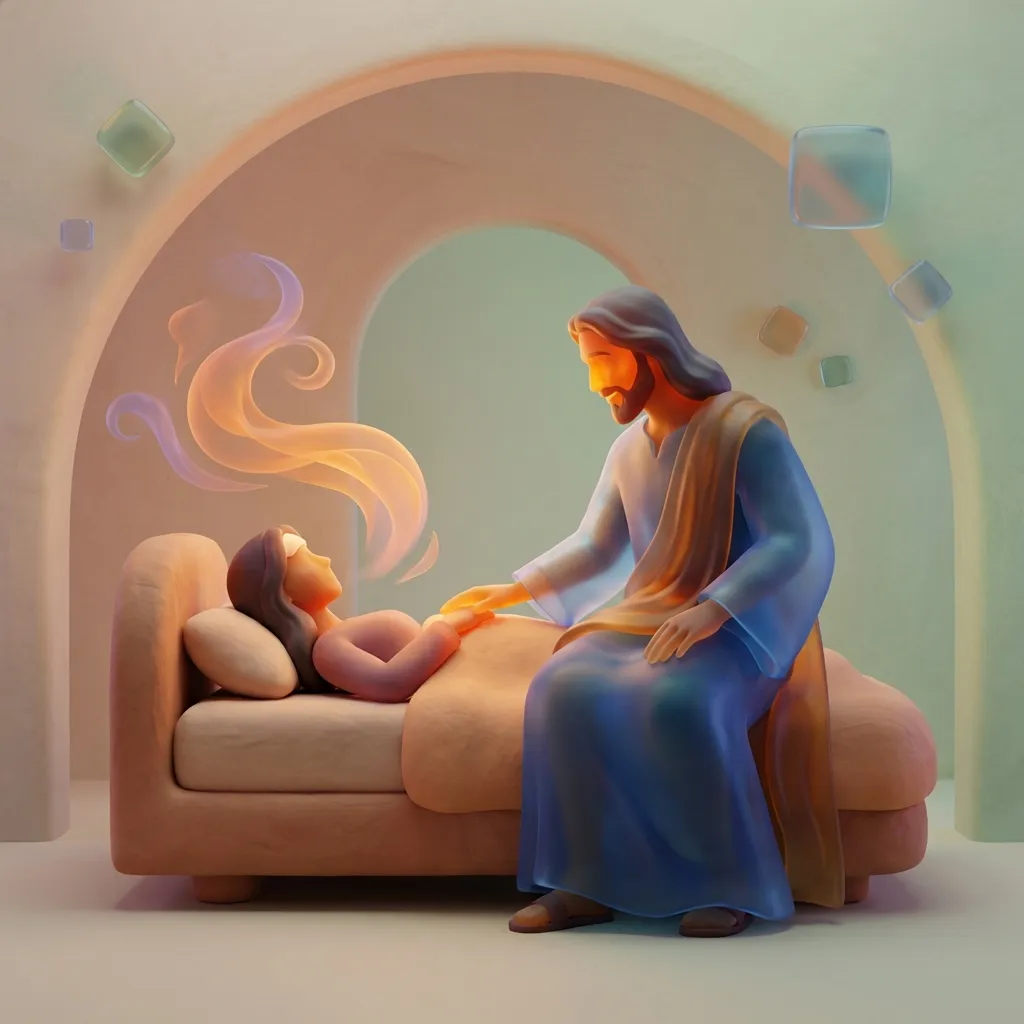
Immediately after casting out an unclean spirit in the Capernaum synagogue on the Sabbath, Jesus walked into the nearby home of Simon Peter and Andrew. Inside, Peter's mother-in-law lay helpless in bed with a dangerously high fever. Recorded in Matthew 8:14-15, Mark 1:29-31, and Luke 4:38-39, this tender miracle reveals Christ's deep personal concern for the private needs of His disciples' families.
1. A Crisis in the Disciple's Home
In antiquity, without antibiotics or modern fever-reducers, a severe fever (pyretos megas) was frequently life-threatening, causing organ failure and dehydration. Luke, the trained physician, uses the technical medical diagnosis 'great fever.' The household was anxious and distressed; a servant of God cannot minister with joy when a family member is dying in the back bedroom. They immediately told Jesus about her.
2. Standing Over the Sickness
Luke 4:39 paints a vivid picture: Jesus "bent over her and rebuked the fever." Jesus treated the fever not as an inevitable natural biological occurrence, but as an intruder born of the fallen cosmic order. Just as He rebuked the storm on the lake and the demons in the synagogue, He rebuked the fiery heat raging in her blood. Disease has ears when the Son of God speaks.
3. The Touch That Banished Weakness
Mark 1:31 adds that Jesus "went to her, took her hand and helped her up." In rabbinic culture, touching a sick woman bedridden with fever risked ceremonial uncleanness. But Jesus reached out His living hand and took hers. The moment their hands met, the fever left her body. The burning heat vanished, her brow cooled, and atrophied muscles were flooded with supernatural energy.
4. Immediate, Joyful Diakonia
When normal fevers break, convalescence takes days—patients remain weak, shaky, and exhausted. But Mark records: "The fever left her and she began to wait on them" (Greek: diēkonei). She did not need an afternoon nap or chicken broth; she bounded out of bed and joyfully cooked and served a meal for Jesus and His disciples. When Jesus heals us, He restores us for active, loving ministry.
5. The Sunset Revival at the Doorstep
That evening, as the sun dipped beneath the western hills and the Sabbath restrictions lifted, the entire city of Capernaum gathered at Peter's front door. The home became a trauma center and revival ground. Jesus laid His hands on every single sick person and cast out demons, fulfilling Isaiah 53:4: "He took up our infirmities and bore our diseases."
No family crisis is too small or insignificant for the King of kings. When you welcome Jesus into your home and share your burdens, His healing touch transforms domestic sickness into an altar of joyful ministry and divine peace.
Biblical Keywords & Theological Roots
Burning fever, fiery inflammation; Luke 4:38 specifically notes she had a 'great fever' (pyretō megalō), a severe medical categorization.
She began to serve, minister, wait on them; the immediate, joyous fruit of healing was active deacon-like hospitality.
To rebuke, reprove, censure; Luke notes Jesus 'rebuked the fever' just as He rebuked the wind and demons.
🔑 Key Spiritual Takeaways
- Healing in the Home: Jesus does not only minister in synagogues and public squares; He enters our private living rooms and family crises.
- Healing Leaves No Weakness: Christ’s touch not only broke the burning fever, but immediately imparted supernatural energy and stamina.
- Healed to Serve: The immediate result of being touched by Jesus was loving service (diakonia) to others.
- The Power of Touch: Jesus took her by the hand and helped her up; touch communicates compassionate authority to the sick and bedridden.
Support Independent Biblical Research
Did this study bless you? Help support our independent bilingual research and interactive visual Bible tools.
⚡ Fast Facts
- Peter was Married: This passage proves that Simon Peter was married, directly aligning with 1 Corinthians 9:5 where Paul mentions Peter's wife.
- Medical Distinction: Luke the physician uses the technical ancient Greek term 'great fever' (pyretos megas), distinguishing it from mild fevers.
- No Convalescence Needed: Fevers leave patients weak and exhausted for days; she was restored with such supernatural vitality that she immediately cooked and served.
- Evening Healing Revival: At sunset, when the Sabbath ended, the entire city of Capernaum gathered at Peter's doorstep, bringing sick and demon-possessed people.
❓ Frequently Asked Questions (FAQs)
Why did Jesus rebuke the fever in Luke 4:39?
By rebuking (epitimaō) the fever, Jesus treated the illness as an invasive consequence of the fallen, disordered creation under spiritual oppression, demonstrating that all sickness is subject to His sovereign command.
Why did the people wait until sunset to bring the sick to Peter's house?
Under rabbinic Sabbath law, carrying burdens (such as sick people on stretchers) was forbidden until three stars appeared in the night sky, officially ending the Sabbath at sunset (Mark 1:32).
What does this miracle reveal about Jesus' priorities?
After casting out a demon in the synagogue, Jesus did not bask in fame; He immediately entered Peter's humble home to attend to a sick, bedridden mother-in-law, showing that individual family members matter deeply to God.