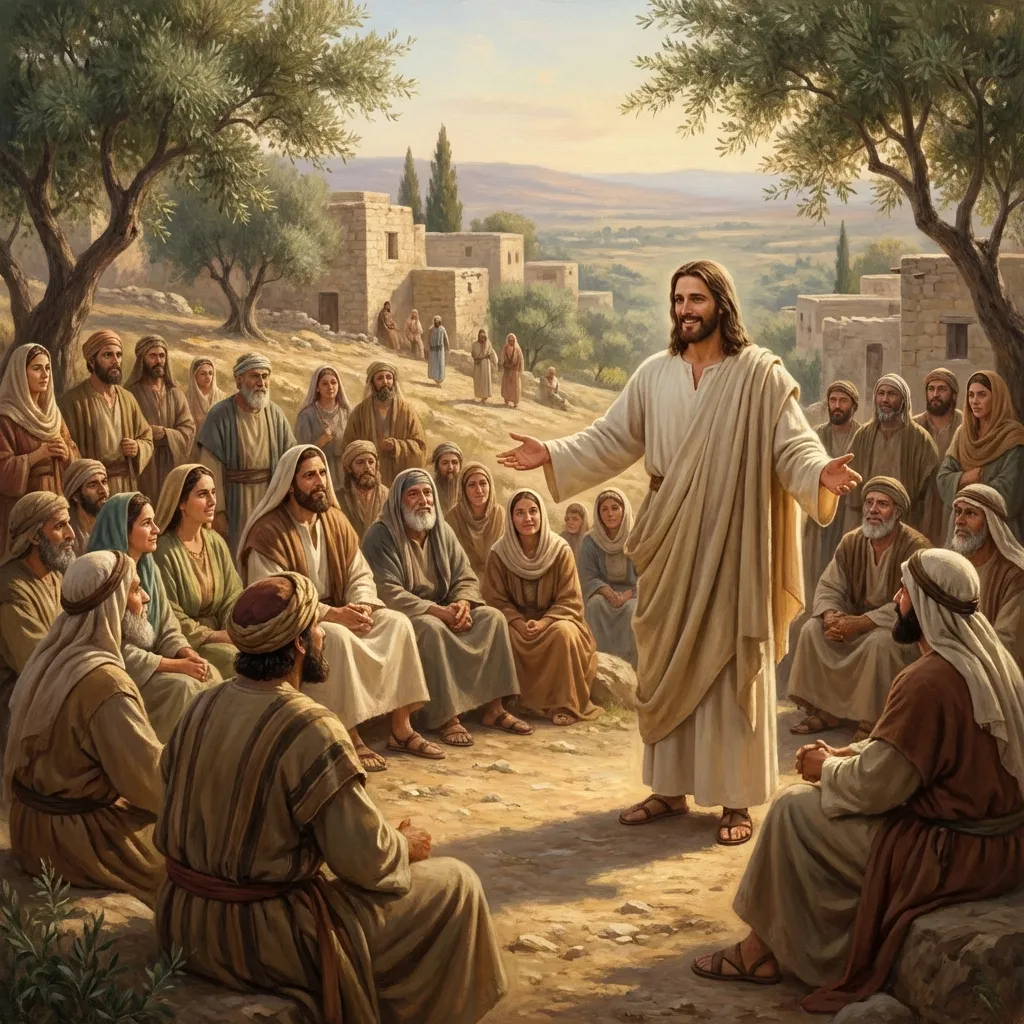
"Hearing that Jesus had silenced the Sadducees, the Pharisees got together. One of them, an expert in the law, tested him with this question: 'Teacher, which is the greatest commandment in the Law?'"
"Jesus replied: 'Love the Lord your God with all your heart and with all your soul and with all your mind.' This is the first and greatest commandment. And the second is like it: 'Love your neighbor as yourself.' All the Law and the Prophets hang on these two commandments." (Matthew 22:34–40)
1. The Theological Trap and the Historical Setting
In first-century Second Temple Judaism, the rabbinic community engaged in intense, continuous debate over which commandments of the Mosaic Law carried the greatest weight. Jewish tradition had codified the Pentateuch into 613 discrete mitzvot (248 positive prescriptions and 365 negative prohibitions). Rabbis routinely divided these statutes into "light" (kal) and "heavy" (hamur) commandments. When the lawyer (a Pharisaic scribe) approached Jesus, he was not merely asking an innocent theological question; he was posing a sophisticated forensic trap designed to entangle Jesus in sectarian politics or expose Him to accusations of neglecting other holy statutes.
If Jesus elevated one legal prescription over another, His critics could accuse Him of trivializing the remaining 612 commandments. Yet, with transcendent rabbinic authority and divine clarity, Jesus bypassed trivial legalistic quibbles and pierced directly to the beating heart of biblical revelation.
2. The First Commandment: The Shema and Supreme Devotion
Jesus began His answer by citing the sacred confession that every pious Israelite recited twice daily: the Shema from Deuteronomy 6:4–5 ("Shema Yisrael, Adonai Eloheinu, Adonai Echad" — "Hear, O Israel: The LORD our God, the LORD is one"). In doing so, Jesus anchored the highest ethical imperative not in an isolated moral rule, but in the exclusive, covenantal oneness of God Himself.
The call to love God is all-encompassing, demanding four distinct dimensions of human devotion:
- With all your Heart (Levav): In biblical psychology, the heart is not merely the pump of emotional sentiment, but the command center of human intellect, rational decision-making, and moral volition. Loving God with all one's heart means surrendering every private ambition, desire, and intellectual resolve to His sovereignty.
- With all your Soul (Nephesh): Nephesh signifies the breath of life, the vitality of existence, and one's whole being. Loving God with all your soul means laying down your life, even unto physical martyrdom, in unshakeable allegiance to His kingdom.
- With all your Mind (Dianoia): In Matthew's Greek rendering of Jesus' synthesis, the faculty of critical thinking and philosophical meditation is explicitly emphasized. Christian discipleship rejects anti-intellectual mysticism; it demands rigorous mental devotion, seeking truth, and aligning human thoughts with divine revelation.
- With all your Strength (Me'od): As found in Deuteronomy 6:5 and Mark 12:30, me'od denotes force, capacity, material wealth, and physical vigor. Love for God must incarnate itself through practical stewardship, financial generosity, and tireless physical labor.
3. The Second Commandment: The Horizontal Axis of Love
Without pause, Jesus declared: "And the second is like it: 'Love your neighbor as yourself.'" Quoting Leviticus 19:18, Jesus elevated what was traditionally viewed as a standard civil injunction to equal dignity alongside the primary command to love Yahweh. In the original Greek of Matthew 22:39, the phrase homoia aute ("like unto it") signifies that the second commandment is of identical moral nature, necessity, and eternal durability.
In Christ's worldview, these two commandments form the inseparable vertical and horizontal axes of the universe. True vertical devotion to God cannot coexist with horizontal hatred or indifference toward human beings created in the divine image (Imago Dei). As the Apostle John later synthesized in 1 John 4:20: "Whoever claims to love God yet hates a brother or sister is a liar. For whoever does not love their brother and sister, whom they have seen, cannot love God, whom they have not seen."
4. "All the Law and the Prophets Hang on These Two"
Jesus concluded His verdict with a profound architectural metaphor: the entire Hebrew canon (Tanakh), encompassing all ceremonial, civil, and moral laws, along with the passionate declarations of the Prophets, "hang" (Greek: kremannutai) upon these two golden pegs. Just as a door collapses when ripped from its hinges, so too every biblical precept loses its theological coherence and spiritual power when detached from sacrificial love.
The Ten Commandments naturally reflect this exact duality: the first four commandments delineate our vertical obligations toward the holiness of Yahweh, while the final six command our horizontal honor, integrity, and purity toward our neighbors. All statutory details—dietary boundaries, civil restitution, Sabbath rests, and harvest gleanings—were pedagogic reflections of divine love in daily communal life.
5. Theological Fulfillment in the New Covenant
By defining holiness through the prism of love, Jesus anticipated His own substitutionary sacrifice upon the Cross of Calvary. On the Cross, Christ displayed the apex of vertical love toward His Father's righteous will (John 14:31) and the ultimate horizontal love for broken sinners (Romans 5:8). Under the New Covenant, the Law of Love is no longer etched upon external stone tablets; it is inscribed upon the regenerated human heart through the indwelling presence of the Holy Spirit (Jeremiah 31:33; Romans 5:5).
Biblical Keywords & Theological Roots
Covenantal, sacrificial love; a deliberate act of loyalty, dedication, and affection that binds God to His people and disciples to one another.
The inner person, the seat of the intellect, will, emotions, and moral intention in classical Hebrew anthropology.
Soul, life-force, breathing creature, or the entire living being; the complete embodiment of personal vitality.
Unconditional, self-giving, divine love that chooses the highest welfare of the beloved regardless of personal cost.
Support Independent Biblical Research
Did this study bless you? Help support our independent bilingual research and interactive visual Bible tools.
⚡ Fast Facts
- The Shema (Deut 6:4-5), cited by Jesus, was written on parchment scrolls inside Tefillin (phylacteries) and Mezuzot on Jewish doorposts.
- In ancient rabbinic law, the 613 commandments were mathematically categorized as 248 positive mitzvot (equal to human bones) and 365 negative mitzvot (days of the solar year).
- Leviticus 19:18 ('love your neighbor as yourself') was uniquely elevated by Jesus from an isolated social precept to co-equal status with the Shema.
- The Greek term used for love in Matthew 22:37 is 'Agape'—denoting deliberate, sacrificial, covenant commitment rather than fleeting emotional attraction.
❓ Frequently Asked Questions (FAQs)
Did Jesus abolish the Old Testament Law by giving these two commandments?
No. In Matthew 5:17, Jesus explicitly declared, 'Do not think that I have come to abolish the Law or the Prophets; I have not come to abolish them but to fulfill them.' By boiling the 613 commandments down to love for God and love for neighbor, Jesus revealed the true intention and spiritual heart behind every single commandment.
Who is considered my 'neighbor' in biblical theology?
In the Parable of the Good Samaritan (Luke 10:25-37), Jesus radically redefined 'neighbor' beyond ethnic, religious, or geographical boundaries. A neighbor is anyone in need whom God places in your path, including social outcasts and cultural enemies.
How can a believer practically love God with 'all their mind'?
Loving God with your mind means actively engaging your intellect in the study of Scripture, renewing your thought life through biblical truth (Romans 12:2), defending Christian faith with gentle reasoning (1 Peter 3:15), and refusing to conform to deceptive worldly philosophies (Colossians 2:8).