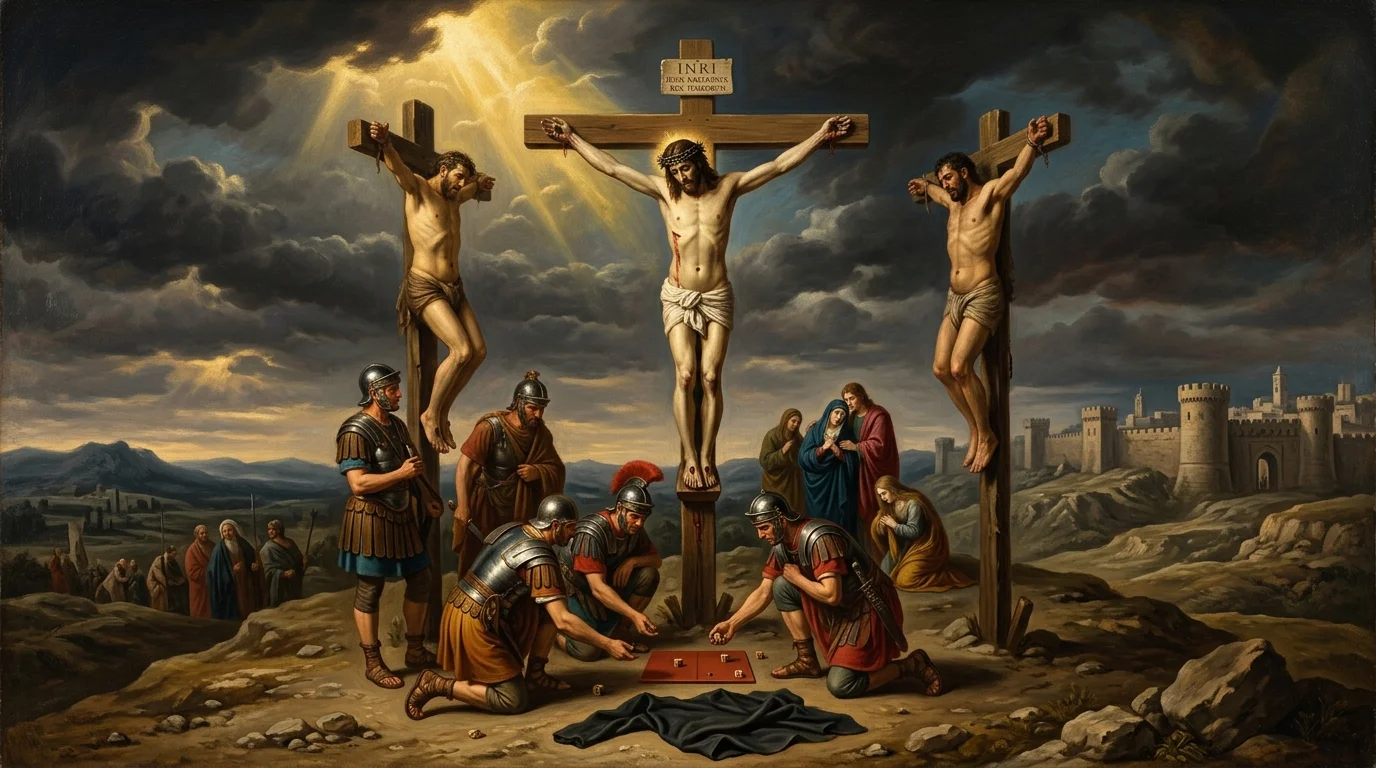
"Because he poured out his life unto death, and was numbered with the transgressors."
"They crucified two rebels with him, one on his right and one on his left. And the scripture was fulfilled that says, 'He was numbered with the transgressors.'"
Isaiah 53:12 contains one of the most stunning declarations of messianic solidarity with fallen mankind: 'Because he poured out his life unto death, and was numbered with the transgressors. For he bore the sin of many, and made intercession for the transgressors.' In Luke 22:37, hours before His arrest, Jesus commanded His disciples to recognize that this prophecy must find its fulfillment in Him, reaching its vivid climax on Golgotha when He was hoisted between two convicted outlaws.
1. The Upper Room Mandate: Luke 22:37
As the Passover meal ended, Jesus prepared the disciples for the traumatic upheaval of Passion Week. He told them: 'It is written: And he was numbered with the transgressors; and I tell you that this must be fulfilled in me. Yes, what is written about me is reaching its fulfillment' (Luke 22:37). Jesus did not view His execution as a miscarriage of justice that thwarted His mission; He actively embraced being classified with criminals because that was the very foundation of atonement.
2. Hoisted Between Two Bandits: Mark 15:27
On Golgotha, Roman legionnaires erected three crosses. Mark records the fulfillment: 'They crucified two rebels with him, one on his right and one on his left' (Mark 15:27). The Greek word used is lestai—violent insurrectionists and bandits. In the ancient world, the central cross was reserved for the most infamous criminal, the ringleader of the syndicate. By placing Jesus in the middle, the Sanhedrin and Pontius Pilate visually proclaimed that Jesus was the chief outlaw of Judea. The King of Glory hung between two violent felons.
3. The Mystery of Imputation
Why was the sinless Son of God numbered with outlaws? The theological answer is the glorious doctrine of imputation. On the cross, God treated Jesus as if He had personally committed every theft, murder, adultery, and lie of all who would ever believe in Him. He was numbered among transgressors legally so that guilty transgressors could be numbered among the righteous citizens of heaven! As 2 Corinthians 5:21 declares: 'God made him who had no sin to be sin for us, so that in him we might become the righteousness of God.'
4. The Penitent Thief: Paradise Won
Standing in the center of transgressors, Jesus immediately began exercising His royal saving power. Initially, both criminals mocked Him (Matthew 27:44). But as the hours passed, one criminal watched Jesus suffer without retaliation, heard Him pray for His killers, and recognized His divinity. Rebuking his companion, the dying outlaw cried out: 'Jesus, remember me when you come into your kingdom' (Luke 23:42). Jesus turned to him and spoke words of boundless grace: 'Truly I tell you, today you will be with me in paradise' (Luke 23:43). The King was numbered with transgressors in order to rescue transgressors!
5. Our Everlasting Advocate
Isaiah 53:12 does not end with being numbered with outlaws; it declares that He 'made intercession for the transgressors.' Jesus used His dying breath to pray for sinners, and today in heaven, He lives forever to make intercession for us (Hebrews 7:25). When Satan accuses us before the throne of God, pointing to our failures and sins, Jesus steps forward as our Advocate (1 John 2:1). He displays His pierced hands and declares: 'I was numbered with their transgressions, and my blood has cleansed them forever!'
Biblical Keywords & Theological Roots
To count, reckon, number, classify; legally numbering the Holy One in the register of common felons.
Transgressor, rebel; one who commits intentional, arrogant revolt against divine or civil authority.
To pour out, bare, empty completely; voluntarily pouring out one's soul unto death like a sacrificial drink offering.
Ancient Near Eastern & Archaeological Context
Under Roman military law, multi-victim crucifixions were organized hierarchically. Placing the most notorious offender in the center between two accomplices visually designated the central figure as the ringleader of the criminal enterprise. By crucifying Jesus between two *lestai* (violent insurrectionists or bandits), the Roman authorities and Jewish accusers publicly categorized the Prince of Peace as a violent threat to the Roman order.
🔑 Key Spiritual Takeaways
- The sinless Son of God was legally classified as a common criminal so that condemned sinners might be numbered among the righteous sons of God.
- God's grace reaches the lowest and most despised; even from the cross, Christ saved a dying criminal who repented in his final hours.
- Do not be ashamed if the world classifies you as foolish, subversive, or contemptible for following Christ; our Master was numbered with outlaws.
- Christ's placement between two thieves symbolizes His role as the Great Mediator standing between heaven and earth, reconciling sinners to God.
Support Independent Biblical Research
Did this study bless you? Help support our independent bilingual research and interactive visual Bible tools.
⚡ Fast Facts
- Isaiah's Imperial Reckoning: Isaiah 53:12 foretold: 'Because he poured out his life unto death, and was numbered with the transgressors.'
- Jesus' Explicit Upper Room Quote: In Luke 22:37, hours before His arrest, Jesus said: 'It is written: And he was numbered with the transgressors; and I tell you that this must be fulfilled in me.'
- Crucified Between Two Thieves: Matthew 27:38 and Mark 15:27 record that two insurrectionist robbers (*lestai*) were crucified with Him, one on His right and one on His left, with Jesus in the center.
- Crucifixion Position of Prominence: Placing Jesus between two criminals was the Sanhedrin and Pilate's deliberate insult, visually branding Him as the ringleader of criminals.
❓ Frequently Asked Questions (FAQs)
What is the textual note regarding Mark 15:28?
Some early manuscripts omit Mark 15:28 ('And the scripture was fulfilled which says, He was numbered with the transgressors'). However, the prophecy’s authenticity is unquestionable because Jesus Himself explicitly quoted Isaiah 53:12 in Luke 22:37, declaring that it must be fulfilled in His impending passion.
Who were the two criminals crucified with Jesus?
The Greek text uses *lestai*, which in first-century Judea referred not to petty shoplifters, but to violent political insurrectionists and highway bandits associated with guerrilla revolts against Rome—the exact category of Barabbas.
What is the theological significance of the Penitent Thief?
In Luke 23:39-43, one thief rebuked the other, confessed his own guilt, recognized Jesus' innocence, and asked to be remembered in His Kingdom. Jesus promised him: 'Today you will be with me in paradise.' This proves that salvation is entirely by grace through faith apart from works, rituals, or baptism.