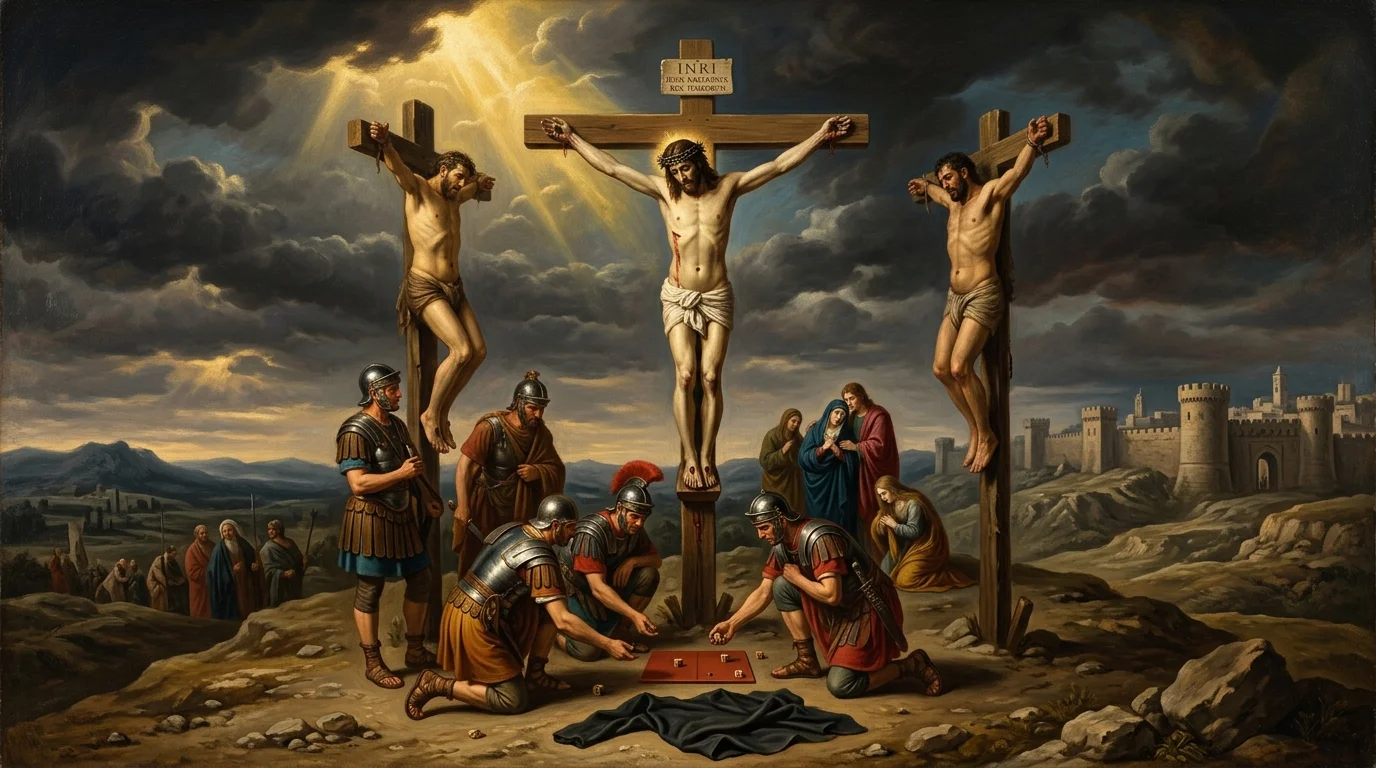
"They put gall in my food and gave me vinegar for my thirst."
"There they offered Jesus wine to drink, mixed with gall; but after tasting it, he refused to drink it... Later, knowing that all was now completed, and so that Scripture would be fulfilled, Jesus said, 'I am thirsty.' A jar of wine vinegar was there, so they soaked a sponge in it, put the sponge on a stalk of the hyssop plant, and lifted it to Jesus’ lips. When he had received the drink, Jesus said, 'It is finished.'"
Psalm 69:21 foretold one of the most painfully specific details of the Crucifixion: 'They put gall in my food and gave me vinegar for my thirst.' A millennium later, on Golgotha’s barren crest, the Roman executioners offered Jesus two distinct drinks—first an analgesic of bitter gall which He refused, and finally a sponge of sour vinegar which He accepted—fulfilling the holy scriptures to the absolute syllable.
1. The Agony of Crucifixion Dehydration
Few physical torments rival the dehydration of crucifixion. Having sweated drops of blood in Gethsemane, walked miles through nocturnal interrogations, and bled profusely under the Roman flagrum, Jesus was in extreme hypovolemic shock. Hanging under the scorching Mediterranean sun, every breath required agonizing exertion. Psalm 22:15 had prophesied: 'My mouth is dried up like a potsherd, and my tongue sticks to the roof of my mouth; you lay me in the dust of death.' His throat was an open furnace of thirst.
2. The First Cup: Refusing the Narcotic (Matthew 27:34)
Before driving the spikes into His hands, the soldiers offered Jesus a cup: 'There they offered Jesus wine to drink, mixed with gall; but after tasting it, he refused to drink it' (Matthew 27:34). Mark 15:23 notes it was wine mixed with myrrh. According to the Talmud (Sanhedrin 43a), compassionate noblewomen of Jerusalem provided this narcotic mixture to condemned criminals to stupefy their senses. Jesus tasted it to verify what it was, but refused to drink. He refused to be drugged. He had come to drink the cup of the Father’s unmitigated wrath against human sin, and He resolved to drain that cup with total mental clarity.
3. The Second Cup: Fulfilling Scripture (John 19:28-29)
Six hours later, as the supernatural three-hour darkness began to lift, Jesus reached the climax of His earthly mission. John records: 'Later, knowing that everything had now been finished, and so that Scripture would be fulfilled, Jesus said, I thirst. A jar of wine vinegar was there, so they soaked a sponge in it, put the sponge on a stalk of the hyssop plant, and lifted it to Jesus’ lips' (John 19:28-29). This vinegar was posca, the cheap sour wine kept by Roman guards to quench their thirst in the heat.
4. The Hyssop Branch and Passover
Notice the exquisite typological detail recorded by the Apostle John: the sponge of vinegar was lifted upon a stalk of the hyssop plant. On the night of the first Passover in Egypt, the Israelites were commanded to take a bunch of hyssop, dip it in the blood of the slaughtered lamb, and strike the lintel and doorposts to be spared from the Angel of Death (Exodus 12:22). Here at Calvary, the hyssop branch reappears at the sacrifice of the ultimate Passover Lamb!
5. It Is Finished!
When Jesus had received the sour wine, His parched tongue and throat were moistened for one final, triumphant proclamation. He did not whisper in defeat; Matthew 27:50 records He cried out with a loud voice: 'It is finished!' (Tetelestai!—Paid in Full!). Then He bowed His head and gave up His spirit. He drank the sour vinegar of our sinful rebellion so that we might drink the sweet, eternal waters of life in the Kingdom of God forever!
Biblical Keywords & Theological Roots
Gall, bitter poisonous plant (hemlock/wormwood); symbol of intoxicating bitterness and agony.
Vinegar, sour fermented wine (*posca*); cheap acidic beverage drunk by poor laborers and Roman soldiers.
Thirst; excruciating physical dehydration combined with spiritual longing for the living waters of God.
Ancient Near Eastern & Archaeological Context
Crucifixion produced catastrophic dehydration. Massive blood loss from scourging, hours of exposure under the scorching Mediterranean sun, and rapid hyperventilation dried out mucous membranes until the tongue adhered to the jaws (Psalm 22:15). Wealthy women of Jerusalem historically provided wine mixed with frankincense or gall to condemned criminals to dull their pain (Proverbs 31:6). Roman soldiers also drank *posca*—a cheap, sour vinegar wine diluted with water—which was kept in jars at execution sites.
🔑 Key Spiritual Takeaways
- Jesus refused narcotic pain relief so that He might consciously drink every single drop of the cup of the Father's wrath for our sins.
- The Creator who carved the riverbeds and poured out the oceans experienced the excruciating physical torment of burning thirst.
- By taking the sour vinegar of our fallen rebellion, Christ offers us the sweet, eternal living water of the Holy Spirit (John 7:37-39).
- Even in His final dying gasps, Jesus remained completely conscious of and dedicated to the absolute fulfillment of Old Testament scripture.
Support Independent Biblical Research
Did this study bless you? Help support our independent bilingual research and interactive visual Bible tools.
⚡ Fast Facts
- Psalm 69 Exact Prophecy: Psalm 69:21 predicted: 'They put gall in my food and gave me vinegar for my thirst.'
- Two Distinct Offerings: The Gospels record two separate drinks offered to Jesus: first, wine mixed with gall/myrrh before crucifixion (which He refused, Matthew 27:34), and second, sour wine (*posca*) immediately before His death (which He received, John 19:29-30).
- Refusal of Stupefaction: Jesus refused the first narcotic drink because He resolved to face the full agony of bearing the world's sins with a clear, unmedicated mind.
- Apostolic Connection: John 19:28 explicitly emphasizes that Jesus said 'I thirst' precisely 'so that Scripture would be fulfilled.'
❓ Frequently Asked Questions (FAQs)
Why did Jesus refuse the first drink of wine mixed with gall?
In Matthew 27:34, soldiers offered Him wine mingled with gall (*chole*) and myrrh. This was a narcotic analgesic designed to dull consciousness. Jesus tasted it to acknowledge the offer, but refused to drink it because He was determined to endure the full atoning penalty of human sin without any numbing of His faculties.
Why did Jesus accept the second drink of vinegar in John 19?
In John 19:28-30, having hung for six hours and finished His atoning work, Jesus said 'I thirst.' Receiving the sour wine on a sponge moistened His parched throat and vocal cords, enabling Him to proclaim His final triumphant shout across Golgotha: 'It is finished!' (*Tetelestai!*).
What is the spiritual symbolism of gall and vinegar?
Gall represents the bitter curse and poison of human sin (Deuteronomy 29:18, Acts 8:23). Vinegar represents sour decay. Humanity offered its Creator bitter gall and sour wine; in return, Christ gives humanity the new wine of the Kingdom and the living water of eternal life.