"They divide my clothes among them and cast lots for my garment."
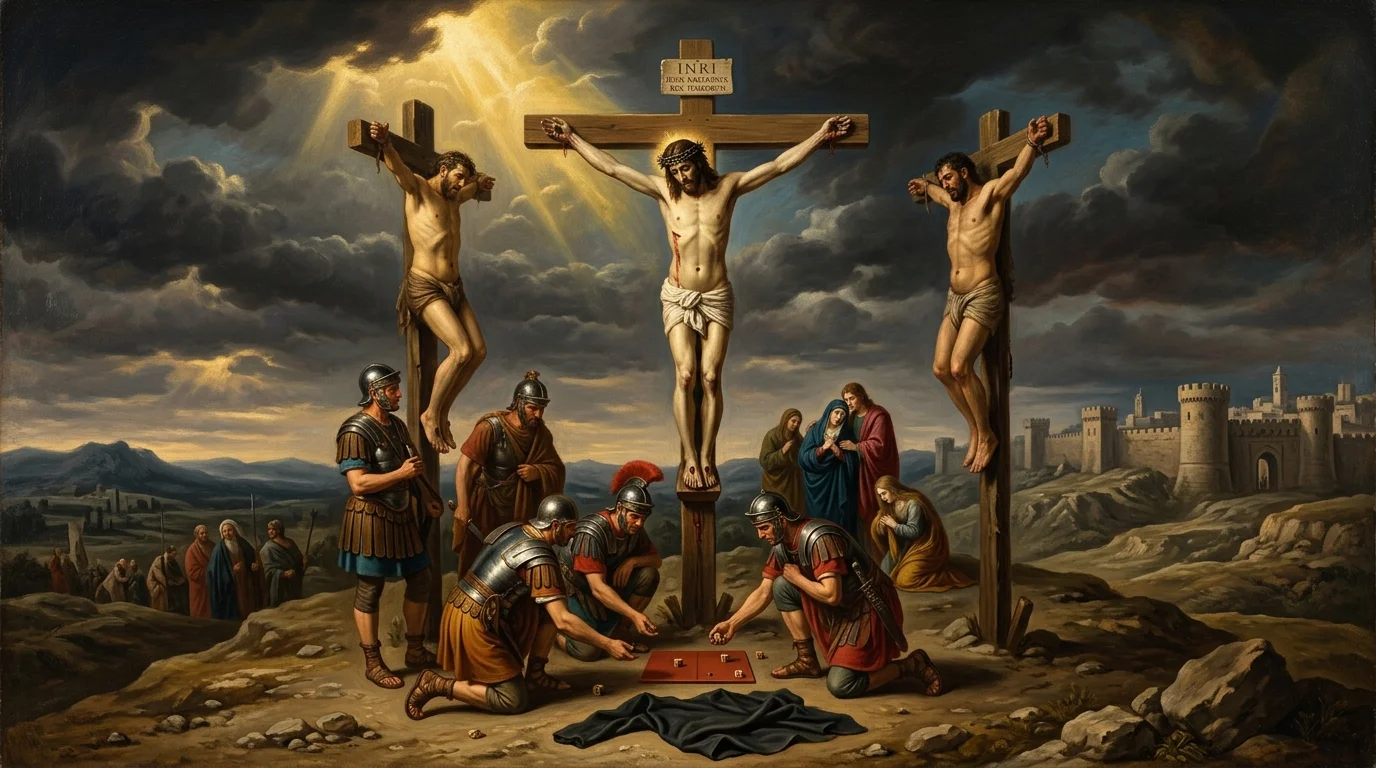
"When the soldiers crucified Jesus, they took his clothes, dividing them into four shares, one for each of them, with the undergarment remaining. This garment was seamless, woven in one piece from top to bottom. 'Let’s not tear it,' they said to one another. 'Let’s decide by lot who will get it.' This happened that the scripture might be fulfilled that said, 'They divided my clothes among them and cast lots for my garment.'"
Psalm 22:18 contains an extraordinary poetic nuance: 'They divide my clothes among them and cast lots for my garment.' Written a millennium before Golgotha, King David distinguished between the plural outer garments divided into pieces and the singular inner vesture awarded by casting lots. In John 19:23-24, this exact scenario unfolded at the foot of Jesus' cross, demonstrating that even the casual dice-rolling of pagan legionnaires was superintended by heaven.
1. The Poetic Precision of Psalm 22
Hebrew poetry is renowned for parallelism, but Psalm 22:18 is not mere repetitious poetry; it is predictive prophecy. David uses two distinct words: begaday (plural: 'my clothes / outer garments') and levushi (singular: 'my robe / special vesture'). One group of clothing was to be divided (*yechallequ*), while the other specific garment was to be gambled for with lots (*yapilu goral*). No human author could have fabricated such a peculiar legal distinction unless directed by the omniscient Holy Spirit.
2. The Execution Quaternion: John 19:23
Roman military regulations assigned executions to a squad of four soldiers called a quaternion, commanded by a centurion. Under Roman law (*Codex Justinianus*), the personal effects worn by a condemned prisoner were forfeited to the executioners as minor legal perks (*spolia*). When the Roman soldiers had hammered the spikes through Jesus' limbs and hoisted the cross, they turned their attention to His clothes. They divided His sandals, cloak, belt, and headgear into four equal piles—one share for each soldier.
3. The Seamless Tunic: John 19:24
Only one item remained: the undergarment or tunic (*chiton*). John records: 'This garment was seamless, woven in one piece from top to bottom. Let’s not tear it, they said to one another. Let’s cast lots to see who will get it' (John 19:23-24). Had they cut it into four strips, the fabric would have unraveled and become useless rags. In their cold pragmatism, the soldiers pulled out their dice (*tesserae*) and rolled them on the dust of Golgotha to determine the winner.
4. The High-Priestly Garment
Why was Jesus wearing a seamless tunic woven from top to bottom? In Exodus 28:31-32, God instructed Moses regarding the clothing of the High Priest: the robe of the ephod was to be woven entirely in one piece, with an opening that had a woven band around it so that it would not tear. Josephus confirms that the high-priestly tunic of the Second Temple was woven without seams. As Jesus hung on the cross, He was not only the sacrificial Lamb; He was our great High Priest, wearing the sacred robe of reconciliation!
5. Stripped to Clothe Sinners
At the Cross, the Son of God was stripped naked, bearing the horrific public shame of our fallen nakedness that began in the Garden of Eden (Genesis 3:7). He surrendered His physical clothes so that we might be clothed in His righteousness. Isaiah 61:10 celebrates this exchange: 'He has clothed me with garments of salvation and arrayed me in a robe of his righteousness.' Today, the empty dice cups of Golgotha are forgotten, but the white robes of the redeemed shine in the glory of the Lamb forever!
Biblical Keywords & Theological Roots
Garment, covering; everyday outer clothes divided among executioners as perquisites.
Vesture, seamless tunic, royal robe; singular woven undergarment preserved whole by casting lots.
Lot, pebble used in gambling or decision-making; deciding the ownership of Christ's tunic under the cross.
Ancient Near Eastern & Archaeological Context
Under Roman provincial jurisprudence, the personal effects of an executed criminal were awarded as legally recognized spoils (*bona vacantia*) to the execution detail, known as a quaternion (four soldiers). An ordinary Jewish man wore five items: sandals, outer cloak, belt, head covering, and an inner tunic. The four soldiers divided the first four items equally, but were left with one valuable seamless tunic which could not be torn without ruining its value.
🔑 Key Spiritual Takeaways
- Christ was stripped of His earthly garments so that repentant sinners might be clothed in the immaculate robe of His righteousness.
- Pagan soldiers gambling for garments at the foot of the cross symbolize fallen humanity distracted by cheap material scraps in the presence of cosmic salvation.
- The seamless tunic reflects Christ's indivisible high-priestly office and the unity of His redeemed Church.
- Even the mundane gambling decisions of Roman soldiers were governed sovereignly by God's prophetic decree written 1,000 years earlier.
Support Independent Biblical Research
Did this study bless you? Help support our independent bilingual research and interactive visual Bible tools.
⚡ Fast Facts
- Psalm 22 Poetic Distinction: Psalm 22:18 distinguishes between two Hebrew words: 'They divide my clothes (*begaday*) among them and cast lots for my garment (*levushi*).'
- Four Roman Soldiers: Under Roman law, the four soldiers of the execution quaternion had the legal right (*spolia*) to the victim’s personal clothing.
- Seamless Tunic from Top to Bottom: John 19:23 notes that the tunic was woven in one piece without a seam from top to bottom, reminiscent of the High Priest's holy linen robe (Exodus 28:31-32).
- Apostolic Precision: John 19:24 explicitly highlights that the pagan soldiers unknowingly fulfilled Psalm 22:18 word for word by choosing to gamble rather than tear the tunic.
❓ Frequently Asked Questions (FAQs)
Why didn't the soldiers cut the seamless tunic into four pieces?
John 19:24 records their exact words: 'Let’s not tear it. Let’s cast lots to see who will get it.' Because the tunic was seamless and woven from top to bottom, cutting it would destroy its value and utility. God's invisible providence guided their financial self-interest to fulfill Psalm 22:18 verbatim.
What is the priestly symbolism of the seamless garment?
In Exodus 28:31-32 and Josephus' *Antiquities* (3.7.4), the robe of the High Priest was uniquely woven in one piece without seams. By wearing a seamless tunic to the cross, Jesus was visually presented as our true High Priest offering Himself as the final sacrifice.
What does this prophecy teach about human nature at the Cross?
While the Son of God was bleeding to death for the sins of the cosmos, four soldiers sat mere feet away rolling dice for pieces of cloth. It illustrates the staggering spiritual blindness of worldly men who prioritize trivial earthly gain over eternal redemption.