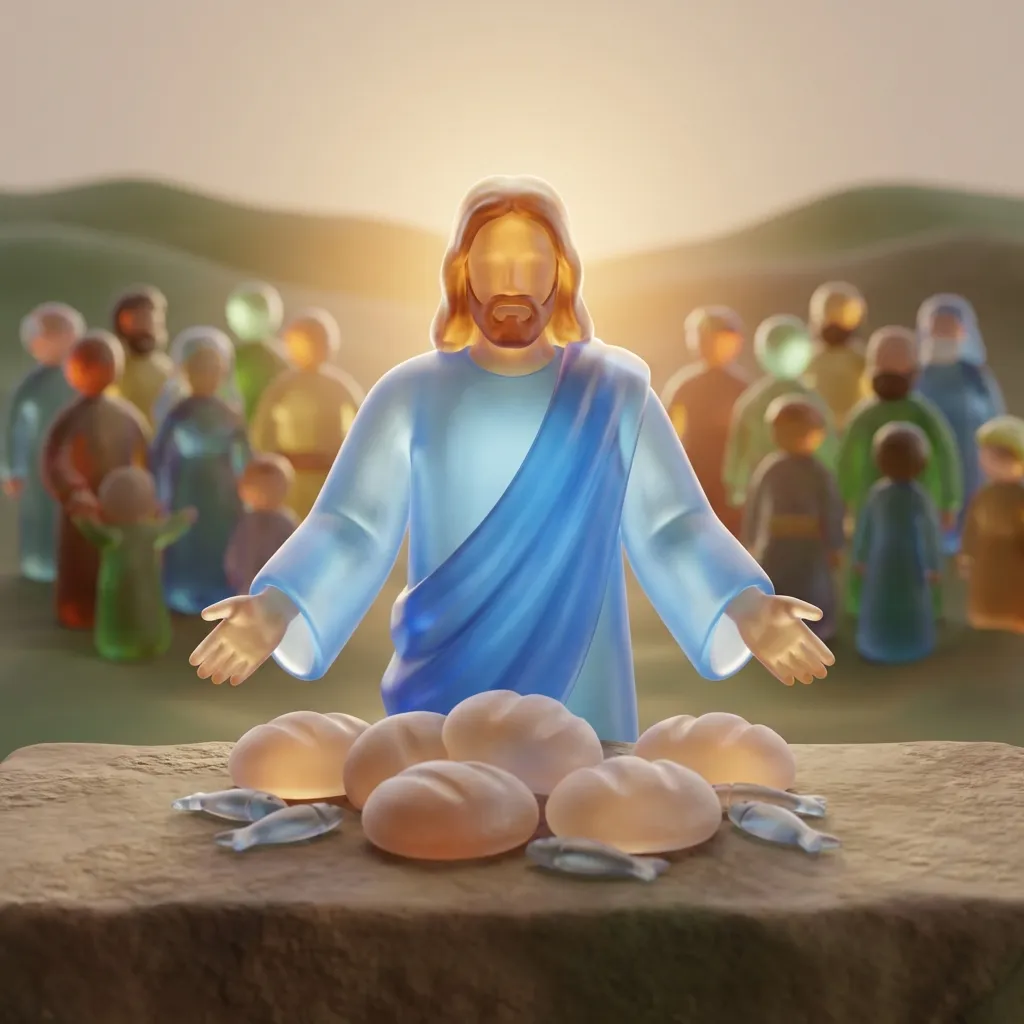
In the Gentile hills of the Decapolis southeast of the Sea of Galilee, a massive crowd of four thousand men, besides women and children, gathered around Jesus. Recorded in Matthew 15:32-39 and Mark 8:1-9, this second great feeding miracle was not a redundant repetition of the five thousand, but a prophetic declaration that the Bread of Life belongs equally to the Gentile world.
1. Three Days of Spiritual Hunger
Unlike the crowd of five thousand who were fed on the first afternoon, this Gentile crowd had remained listening to Jesus' teaching for three full days in the wilderness. Their provisions had completely run out, yet they refused to leave. Jesus called His disciples and said: "I have compassion for these people; they have already been with me three days and have nothing to eat. If I send them home hungry, they will collapse on the way, because some of them have come a long distance" (Mark 8:2-3).
2. The Blind Spot of Religious Prejudice
The disciples' response is bewildering: "Where in this remote place can anyone get enough bread to feed them?" Had they forgotten the five thousand? Not at all. Their hesitation was theological: that previous miracle took place in Jewish territory. In their minds, Yahweh's manna was holy food reserved for the children of Abraham. The idea that Jesus would multiply sacred bread for uncircumcised Gentiles was unthinkable to their Jewish worldview.
3. Seven Loaves and a Few Small Fish
Jesus asked: "How many loaves do you have?" They replied: "Seven, and a few small fish." Just as before, Jesus commanded the crowd to sit down on the ground. Taking the seven loaves and the fish, He gave thanks, broke them, and gave them to His disciples to distribute. Once again, Christ took meager human resources, sanctified them through thanksgiving, and broke them to release limitless supernatural multiplication.
4. Seven Hampers of Abundance
All four thousand men, plus thousands of women and children, ate until they were completely satisfied (echortasthēsan). Afterwards, the disciples picked up seven large baskets (Greek: spyrideis) of broken pieces. These were not the small travel bags (kophinoi) used in the Jewish feeding, but large hampers big enough to conceal a grown man (the exact type of basket used to lower Paul down the Damascus wall in Acts 9:25).
5. Manna for the Nations
The number seven resonates deeply with biblical theology: seven days of creation, seven nations of Canaan driven out (Deuteronomy 7:1), and seventy nations of the Gentile world in Genesis 10. By leaving seven massive hampers of bread in the Decapolis, Jesus was declaring that His sacrificial atonement would fully satisfy the spiritual hunger of all nations, tribes, and tongues.
Biblical Keywords & Theological Roots
Large hamper basket, woven flexible basket large enough to hold a man (Paul was lowered in a sphyris in Acts 9:25).
Desolate place, remote wilderness, wasteland devoid of human habitation or food supplies.
They were thoroughly satisfied, fattened, filled to repletion; Christ's miraculous meal left everyone completely stuffed.
🔑 Key Spiritual Takeaways
- Spiritual Hunger Outweighed Physical Hunger: For three days, thousands forgot physical food because their souls were being fed by the Word of God.
- Christ's Lingering Compassion: Jesus said: 'I have compassion for these people; they have already been with me three days and have nothing to eat.'
- Short-term Memory of Faith: Despite seeing 5,000 fed earlier, the disciples asked again: 'Where could we get enough bread in this remote place?'
- The Gospel is for All Nations: By multiplying bread for a Gentile multitude, Jesus demonstrated that the Bread of Life is freely offered to all humanity.
Support Independent Biblical Research
Did this study bless you? Help support our independent bilingual research and interactive visual Bible tools.
⚡ Fast Facts
- Distinct from the 5,000: This took place in the Gentile Decapolis (Matthew 15:32-39; Mark 8:1-9), whereas the 5,000 took place in Jewish territory near Bethsaida.
- Three Days Without Food: The crowd had stayed with Jesus in the wilderness for three days, hanging on His every word until their supplies completely ran out.
- Seven Large Hampers: Exactly seven large hamper baskets (spyrideis) of leftover bread were gathered—seven representing completion and the Gentile nations.
- Feeding the Nations: The feeding of the 5,000 symbolized the Gospel to Israel (12 baskets); the feeding of the 4,000 symbolized the Gospel to the 7 Gentile nations of Canaan.
❓ Frequently Asked Questions (FAQs)
How do we know the feeding of the 4,000 is a separate miracle from the feeding of the 5,000?
In Matthew 16:9-10 and Mark 8:19-20, Jesus Himself explicitly reviewed both miracles, contrasting the 5,000 fed with 12 small baskets (kophinoi) against the 4,000 fed with 7 large hamper baskets (spyrideis). The locations, crowd demographics (Jewish vs Gentile), and leftovers are completely distinct.
Why did the disciples seem to forget the first miracle when this crowd became hungry?
Because this occurred in pagan Gentile territory (the Decapolis), the disciples could not fathom that Jesus would perform a sacred Messianic miracle of manna multiplication for uncircumcised Gentiles. Their religious prejudice eclipsed their theological memory.
What is the prophetic significance of the seven baskets of leftovers?
In Deuteronomy 7:1, God warned Israel of the seven Gentile nations in Canaan. While the twelve baskets in the Jewish miracle symbolized the twelve tribes of Israel, the seven large hampers symbolized that the Messiah came to welcome and nourish the entire Gentile world.