"My God, my God, why have you forsaken me? Why are you so far from saving me, so far from my cries of anguish?"
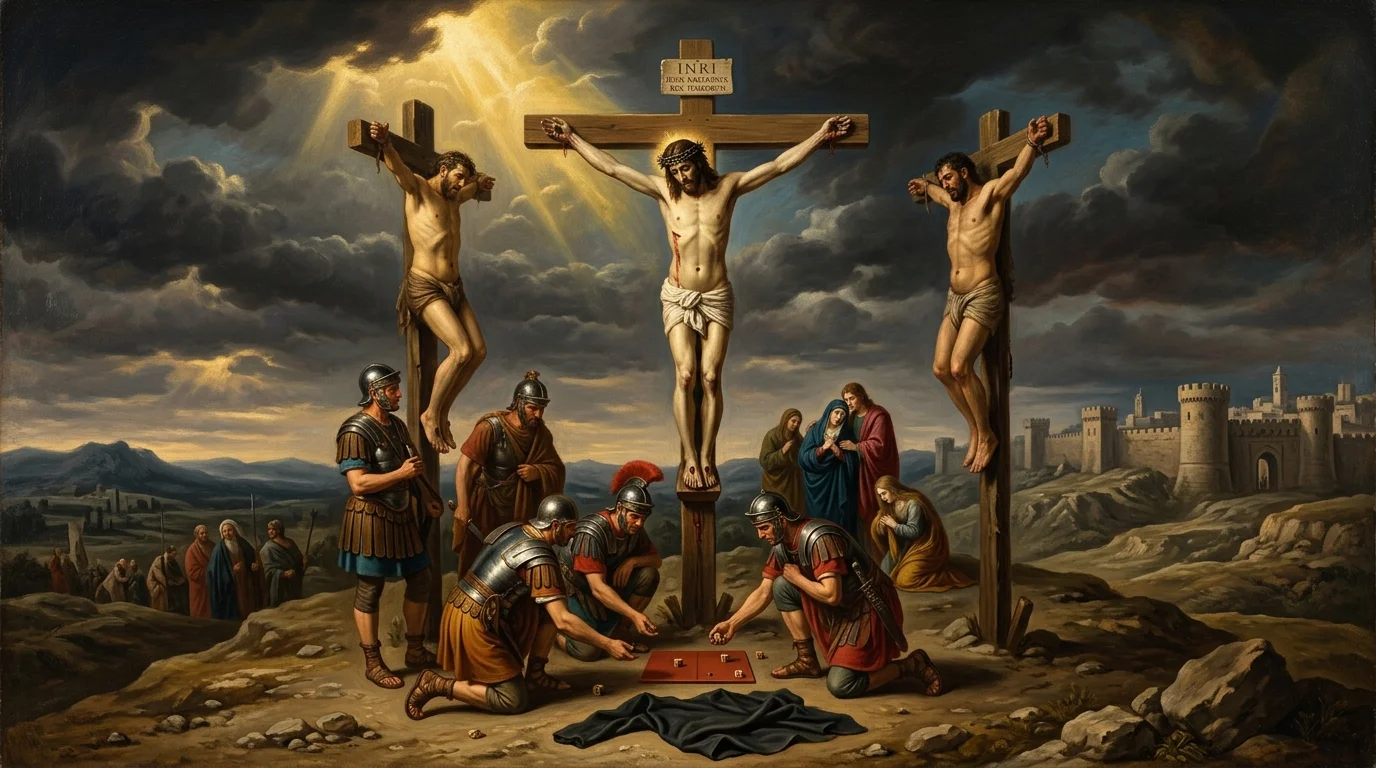
"From noon until three in the afternoon darkness came over all the land. About three in the afternoon Jesus cried out in a loud voice, 'Eli, Eli, lema sabachthani?' (which means 'My God, my God, why have you forsaken me?')."
Psalm 22:1 records the most agonizing question ever uttered in the cosmos: 'My God, my God, why have you forsaken me? Why are you so far from saving me, so far from my cries of anguish?' When Jesus shouted these exact Aramaic words from the cross at three o'clock on Good Friday, He penetrated the absolute depths of human redemption, experiencing the horrifying reality of divine abandonment so that we might be welcomed into God's eternal embrace.
1. The Cry from the Pitch Darkness
At noon on Good Friday, an inexplicable, terrifying darkness descended over the Promised Land for three hours. This was not a solar eclipse, which is astronomically impossible during a full moon Passover; it was the supernatural shroud of God’s holy wrath. In the Old Testament, darkness was the ninth plague of Egypt and the terrifying signature of the Day of the Lord (Amos 5:18). Inside that impenetrable blackness, the Father poured out upon His spotless Son the accumulated wrath due for the sins of the world.
2. The Cry of Dereliction: Matthew 27:46
At approximately three in the afternoon, the silence of Golgotha was shattered by a loud, guttural scream: 'Eli, Eli, lema sabachthani?'—which means, 'My God, my God, why have you forsaken me?' (Matthew 27:46). Notice Jesus’ address: in every recorded prayer in the Gospels, Jesus called God Abba, Father. But here alone, in the crushing weight of atoning substitution, He addresses Him as 'My God'. The relational intimacy was eclipsed by the judicial courtroom of heaven.
3. What Does It Mean that God Forsook Him?
How could holy God forsake His beloved Son? The Apostle Paul explains in 2 Corinthians 5:21: 'God made him who had no sin to be sin for us, so that in him we might become the righteousness of God.' Habakkuk 1:13 declares of Yahweh: 'Your eyes are too pure to look on evil; you cannot tolerate wrongdoing.' When the moral filth, blasphemy, murder, lust, and idolatry of all humanity were laid upon Jesus, the holy Father turned His face away. Jesus endured the ultimate essence of hell—total separation from the comforting presence of God—in our place.
4. The Signpost to Victory: Psalm 22
By quoting the first line of Psalm 22, Jesus was doing something far greater than merely venting agony. In ancient Jewish oral tradition, citing the opening line of a psalm (*incipit*) served as a headline pointing the audience to the entire composition. Psalm 22 begins in despair, but transforms in verse 22 into jubilant praise: 'I will declare your name to my people; in the assembly I will praise you.' The psalm concludes with global revival: 'All the ends of the earth will remember and turn to the Lord... they will proclaim his righteousness to a people yet unborn—he has done it!' (Psalm 22:27, 31). By quoting verse 1, Jesus declared that the cross would inaugurate global salvation!
5. Never Forsaken
Because Jesus was forsaken on the cross, the believer will never, ever be forsaken by God! At Calvary, Jesus drank dry the bitter cup of eternal condemnation. Therefore, the Apostle Paul can write with triumph in Romans 8:38-39 that neither death nor life, nor angels nor demons, nor things present nor things to come, will ever be able to separate us from the love of God that is in Christ Jesus our Lord. In our darkest midnight, we can rest secure, knowing our Savior walked the valley of utter abandonment so that we might abide in God's presence forever.
Biblical Keywords & Theological Roots
My God; intensely personal covenant address to God the Father amidst cosmic judgment.
To forsake, abandon, leave destitute; turning the divine countenance away from sin's imputed pollution.
Roaring, loud groan; guttural agony of a wounded soul pouring out its desperate lament.
Ancient Near Eastern & Archaeological Context
Under the Mosaic Law, the curse of God was symbolized by thick darkness (the ninth plague of Egypt, Exodus 10:21-23). The prophet Amos had foretold: 'In that day, declares the Sovereign Lord, I will make the sun go down at noon and darken the earth in broad daylight' (Amos 8:9). On Good Friday, from noon to 3:00 PM, an inexplicable cosmic darkness fell over Judea as God turned His face away from the Sin-Bearer.
🔑 Key Spiritual Takeaways
- Christ endured the terrifying horror of spiritual abandonment by the Father so that believers would never be forsaken by God.
- The separation was not a rupture of the Trinity's eternal love, but God's holy, judicial wrath turning away from our sin imputed to Christ.
- Jesus died not as an ordinary martyr surrounded by comforting light, but as our sin-bearer plunged into the outer darkness of judgment.
- Because Christ cried 'Why have you forsaken me?', we can stand on God's eternal promise: 'I will never leave you nor forsake you' (Hebrews 13:5).
Support Independent Biblical Research
Did this study bless you? Help support our independent bilingual research and interactive visual Bible tools.
⚡ Fast Facts
- Verbatim Aramaic Opening: In Matthew 27:46 and Mark 15:34, Jesus shouted in Aramaic: 'Eloi, Eloi, lema sabachthani?'—the precise opening line of Psalm 22:1.
- Three Hours of Supernatural Darkness: From the sixth hour to the ninth hour (noon to 3:00 PM), pitch black darkness engulfed the land, signifying cosmic judgment.
- Only Time Calling Him 'God': In all His prayers, Jesus addressed the Father as 'Father' (*Abba*); only in this supreme moment of bearing sin did He address Him as 'My God'.
- Signpost to Psalm 22's Triumph: In ancient Jewish tradition, quoting the first line of a psalm invoked the entire psalm, which concludes in verses 27-31 with the global conversion of all nations.
❓ Frequently Asked Questions (FAQs)
Did God the Father stop loving Jesus on the cross?
No! The Father loved the Son infinitely, especially in His willing obedience to die (John 10:17). The abandonment was judicial, not emotional or ontological. As our legal substitute, Jesus bore the full punitive weight of God's holy wrath against human sin (Habakkuk 1:13, 2 Corinthians 5:21).
Why did the bystanders think Jesus was calling Elijah?
In Aramaic, Jesus cried *Eli, Eli* ('My God, My God'). The Greek and Hellenistic bystanders heard *Eliya*, confusing His divine cry with the Hebrew name for the prophet Elijah (*Eliyahu*), whom Jewish folklore believed rescued pious sufferers.
How does Psalm 22 end?
While Psalm 22 begins with the Cry of Dereliction (v. 1), it ends in verses 27-31 with the resurrected King proclaiming God's righteousness to all nations: 'All the ends of the earth will remember and turn to the Lord... He has done it!' (*Asah*—the Old Testament equivalent of *Tetelestai*).