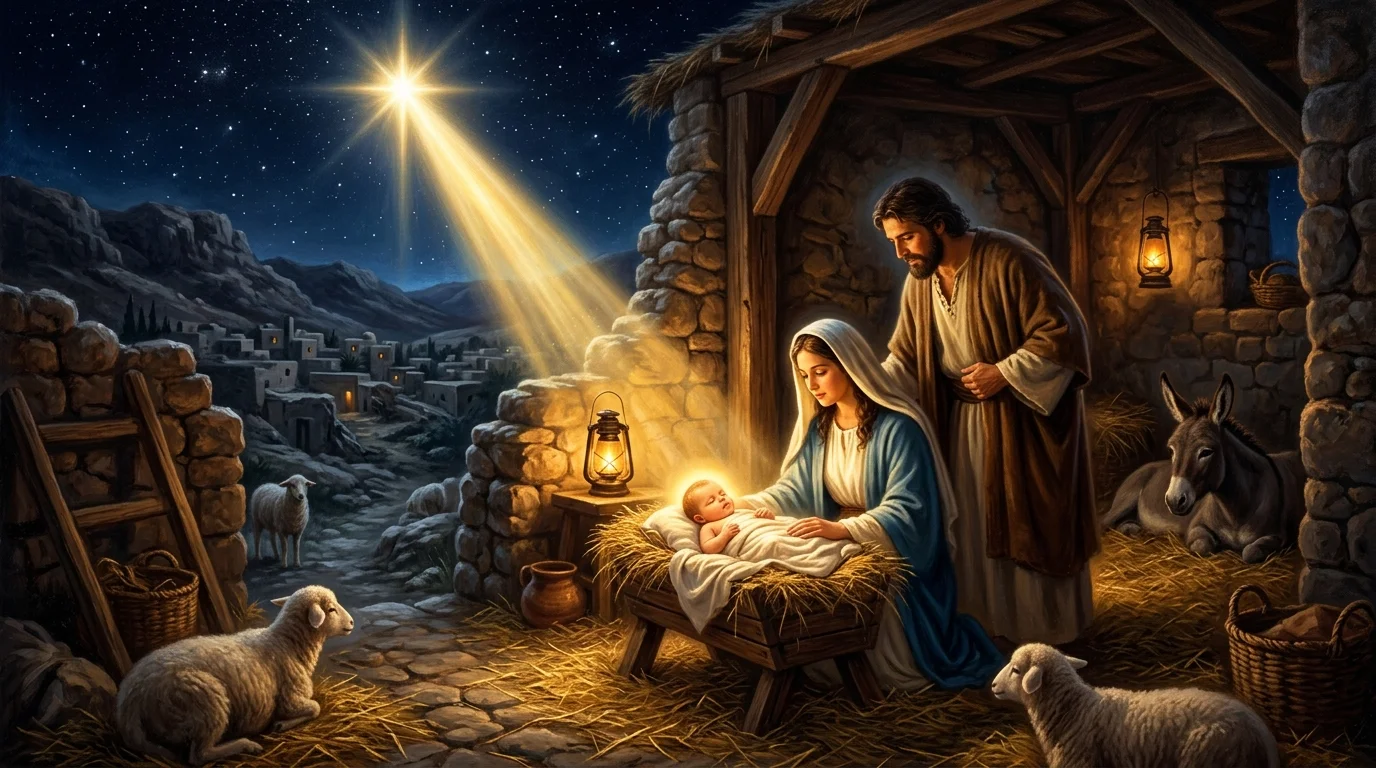
"But you, Bethlehem Ephrathah, though you are small among the clans of Judah, out of you will come for me one who will be ruler over Israel, whose origins are from of old, from ancient times."
"Jesus was born in Bethlehem in Judea, during the time of King Herod... 'In Bethlehem in Judea,' they replied, 'for this is what the prophet has written.'"
Micah 5:2 is one of the most geographically precise and theologically breathtaking prophecies in all of sacred Scripture. Uttered by an 8th-century peasant prophet from the foothills of Judah, this verse pinpointed the obscure village where the Savior of the world would be born while simultaneously declaring His eternal, uncreated deity.
1. The Obscurity of Micah's Prophecy: Little Among the Thousands
While the prophet Isaiah ministered within the royal courts of Jerusalem, his contemporary Micah walked among the rustic peasant villages of the Judean Shephelah. In Micah 5:2, the Holy Spirit guided his gaze beyond imperial capitals: "But you, Bethlehem Ephrathah, though you are small among the clans of Judah, out of you will come for me one who will be ruler over Israel, whose origins are from of old, from ancient times." In the military census of Israel, towns were grouped into clans or thousands (*alaphim*); Bethlehem was so economically and demographically negligible that it failed to warrant inclusion in Joshua's master registry (Joshua 15). Yet God bypassed imperial Babylon, philosophical Athens, and regal Jerusalem to place His Son in a humble sheep hamlet.
2. The Geographical Precision: Bethlehem Ephrathah
The Holy Spirit eliminated all room for ambiguity by attaching the surname 'Ephrathah' to Bethlehem. In ancient Israel, there existed a northern town of Bethlehem within the borders of Zebulun (Joshua 19:15), located barely seven miles from Nazareth. Had Jesus simply been born in a northern Galilean Bethlehem, skeptics would have claimed a vague coincidence. By specifying Bethlehem Ephrathah in the Judean hill country, God staked His prophetic veracity upon a specific plot of earth five miles south of Jerusalem.
3. From Days of Eternity: The Pre-existence of the Child
The second half of Micah 5:2 contains a staggering christological revelation: "whose origins (motsa'otav) are from of old, from ancient times (mi-yemei olam)." The child lying in the manger of Bethlehem was not a created being who originated at conception. His 'goings forth' stretch backward into the boundless shores of eternity. He is the eternal Logos (John 1:1), the Ancient of Days (Daniel 7:9), who dwelt in unbroken fellowship with the Father before the foundation of the world. Bethlehem was not His beginning; it was His incarnation.
4. Caesar's Edict: Rome as God's Unwitting Chariot
As the time of Mary's delivery approached, an immense geographical problem loomed: Mary and Joseph lived in Nazareth in Galilee, roughly ninety miles north across rugged mountain terrain. They had no personal, economic, or logistical reason to travel to Bethlehem. How would God move a heavily pregnant, impoverished peasant maiden across Judea? God simply moved the heart of Caesar Augustus in Rome! Augustus issued an empire-wide decree that all citizens must register in their ancestral towns (Luke 2:1-4). Believing he was merely maximizing imperial tax revenues, Augustus was in reality God's unwitting instrument to convey Mary to Bethlehem just in time for her water to break.
5. The House of Bread and the Living Manna
The name Beit Lechem literally translates to 'House of Bread.' How exquisitely providential that the True Bread of Life (John 6:35), who came down from heaven to satisfy the spiritual starvation of fallen humanity, was born in the 'House of Bread' and laid in a feeding trough (*phatnē*)! Furthermore, in the pastures of Bethlehem, priestly shepherds raised the Passover lambs destined for the temple sacrifices. There, amidst the bleating of sacrificial sheep, the Lamb of God who takes away the sin of the world was born to die for our redemption.
Biblical Keywords & Theological Roots
House of Bread; the modest Judean town chosen by God for the birth of the True Bread of Life coming down from heaven.
Fruitfulness, fertile; the ancient regional name distinguishing Bethlehem in Judah from the northern Bethlehem in Zebulun.
Origin, goings forth, source; declaring that the Messiah's active existence originates 'from of old, from everlasting' (asserting eternal pre-existence).
Ancient Near Eastern & Archaeological Context
Bethlehem Ephrathah, located five miles south of Jerusalem, was a modest agricultural hamlet perched on limestone hills surrounded by terraced olive orchards and wheat fields. In the tribal allotments of Joshua, Bethlehem was so small and insignificant that it was completely omitted from the formal registry of towns in Joshua 15. Yet it held deep sacred history: it was the burial place of Rachel (Genesis 35:19), the setting for the love story of Ruth and Boaz, and the hometown of the shepherd boy David whom Samuel anointed as king (1 Samuel 16). Surrounding Bethlehem were the pasturelands of Migdal Eder ('Tower of the Flock'), where priestly shepherds guarded spotless lambs designated specifically for daily sacrifice in the Jerusalem Temple.
🔑 Key Spiritual Takeaways
- God Chooses the Small and Despised: Bethlehem was 'small among the clans of Judah,' demonstrating God's pattern of exalting the humble over imperial capitals.
- The Eternal Pre-existence of Christ: The child born in the manger did not begin His existence at Bethlehem; His 'goings forth are from of old, from everlasting.'
- Secular Empires Serve Divine Decrees: Caesar Augustus believed he was raising tax revenue, but he was merely an instrument in the hand of God fulfilling prophecy.
- The House of Bread: It was divinely fitting that Jesus, the Living Bread who feeds hungry souls (John 6:35), was born in Bethlehem ('House of Bread').
Support Independent Biblical Research
Did this study bless you? Help support our independent bilingual research and interactive visual Bible tools.
⚡ Fast Facts
- 700-Year Prophetic Gap: Micah prophesied in the 8th century BC (c. 700 BC) during the reigns of Jotham, Ahaz, and Hezekiah, seven centuries before Christ.
- Geographical Precision: Micah specifically specified 'Bethlehem Ephrathah' to distinguish it from another town named Bethlehem located in the northern tribal territory of Zebulun (Joshua 19:15).
- The Chief Priests' Instant Answer: When Herod demanded of the chief priests and scribes where the Messiah was to be born, they answered without hesitation: 'In Bethlehem in Judea, for this is what the prophet has written' (Matthew 2:5-6).
- The Sovereign Census: God orchestrated an empire-wide decree from Caesar Augustus to compel Mary (nine months pregnant) and Joseph to travel 90 arduous miles from Nazareth to Bethlehem to fulfill Micah's prophecy.
❓ Frequently Asked Questions (FAQs)
Why did Micah explicitly say 'Bethlehem Ephrathah'?
In ancient Israel, there were two distinct towns named Bethlehem: one in the northern territory of Zebulun near Nazareth (Joshua 19:15), and one in the southern territory of Judah. By specifying 'Bethlehem Ephrathah', Micah eliminated all ambiguity, identifying the specific ancestral village of David in Judah.
What does the phrase 'whose origins are from of old, from ancient times' signify in Micah 5:2?
The Hebrew phrase *motsa'otav mi-qedem, mi-yemei olam* literally means 'his goings forth are from antiquity, from the days of eternity.' This is an explicit Old Testament declaration of the eternal pre-existence and deity of Jesus Christ, affirming that the Ruler born in Bethlehem had no beginning.
How did a Roman pagan emperor unknowingly fulfill a Jewish prophecy?
Mary and Joseph resided in Nazareth in Galilee, ninety miles north of Bethlehem. God used Caesar Augustus' bureaucratic decree for an empire-wide census (Luke 2:1-4) to compel Joseph and Mary to travel to Bethlehem to register, ensuring the Messiah was born in the exact village prophesied 700 years earlier.
