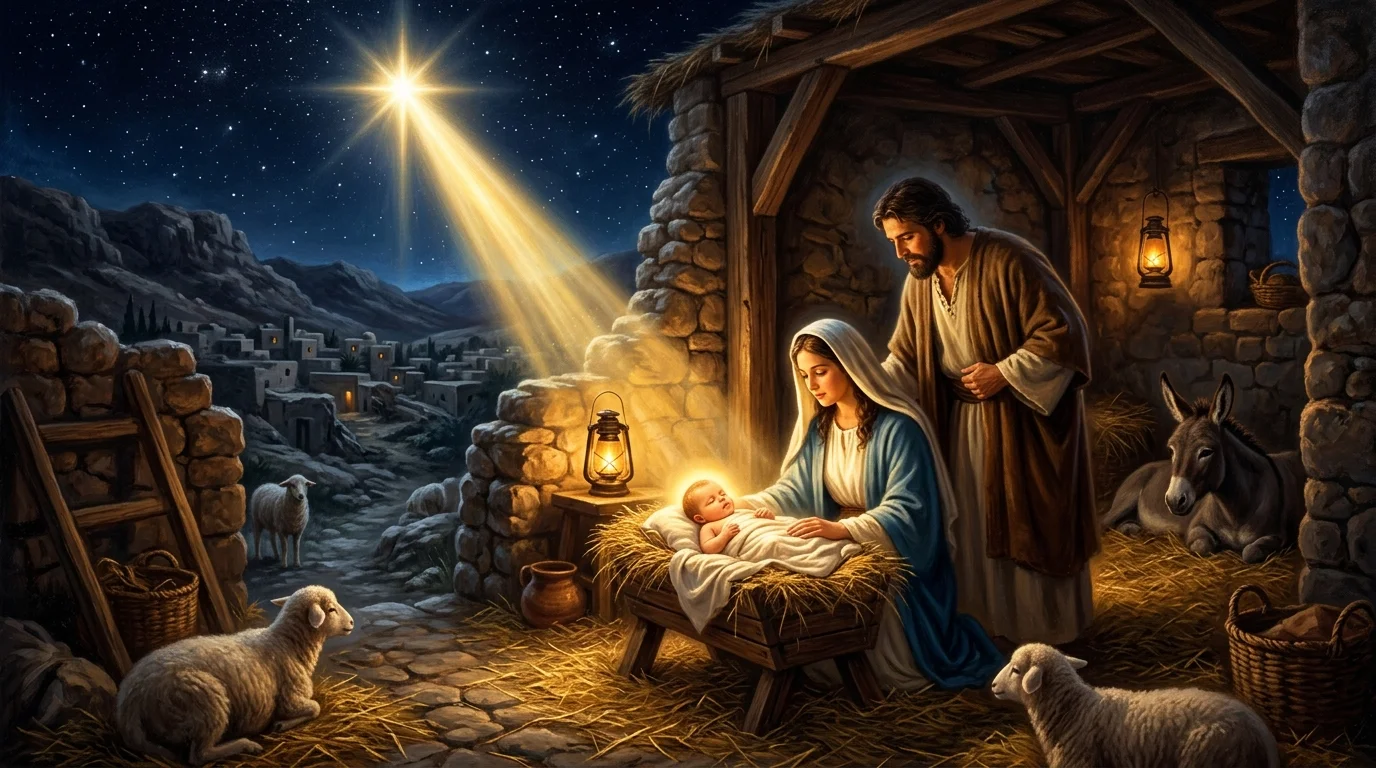
"Therefore the Lord himself will give you a sign: The virgin will conceive and give birth to a son, and will call him Immanuel."
"All this took place to fulfill what the Lord had said through the prophet: 'The virgin will conceive and give birth to a son, and they will call him Immanuel' (which means 'God with us')."
Isaiah 7:14 is one of the most famous and fiercely debated prophecies in Scripture. Given to wicked King Ahaz during a time of national invasion, God promised a sign that transcended the immediate crisis and echoed into eternity.
1. The Cosmic Sign to the House of David
God invited King Ahaz to ask for a sign as deep as Sheol or as high as heaven. When Ahaz hypocritically refused, the Lord declared: 'The Lord Himself will give you a sign: The virgin will conceive...' A natural conception is no miraculous sign; only a supernatural virgin conception could be a sign from the Almighty.
2. Immanuel: God With Us
The name Immanuel is the heart of the Christian faith. In Jesus, God did not merely send a message, a law, or an angel; God Himself stepped into human history, clothed in human flesh, to save His people from their sins.
⚡ Fast Facts
- Septuagint Translation: 250 years before Christ, Jewish scholars translated 'Almah' in Isaiah 7:14 into Greek as 'Parthenos' (specifically Virgin).
- The Divine Name: 'Immanuel' reveals the Incarnation—God Himself taking on human flesh to dwell among us.
- Mary's Virginity: Luke 1:34 records Mary's honest reaction: 'How will this be, since I am a virgin?'
- Sinless Nature: Being born of the Holy Spirit, Jesus was free from the inherited fallen nature of Adam.
❓ Frequently Asked Questions (FAQs)
In ancient Hebrew, 'Almah' refers to a young, unmarried woman of marriageable age who is presumed chaste (a virgin). When Jewish translators translated the Old Testament into Greek (the Septuagint) around 250 BC, they deliberately chose 'parthenos', the unequivocal Greek word for virgin.