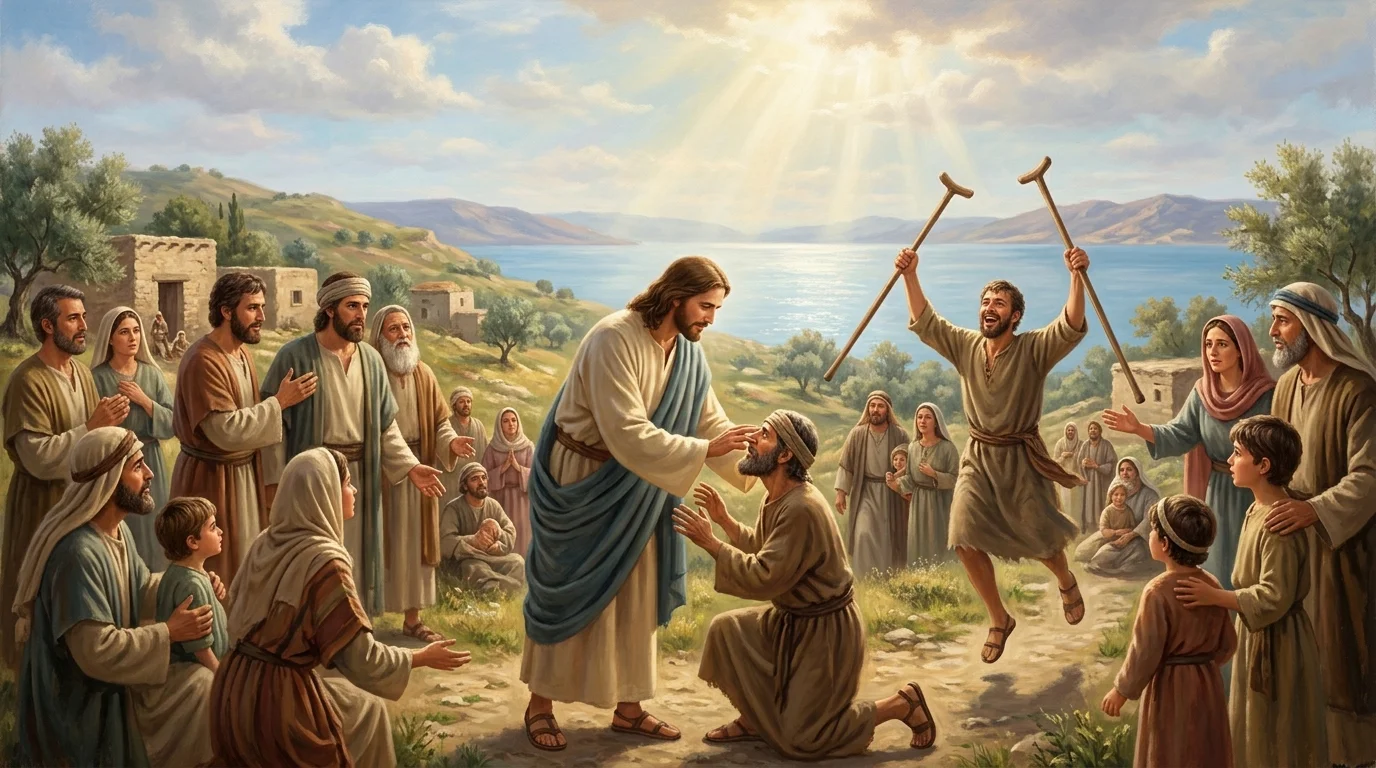
"The Lord your God will raise up for you a prophet like me from among you, from your fellow Israelites. You must listen to him... I will put my words in his mouth. He will tell them everything I command him."
"For Moses said, 'The Lord your God will raise up for you a prophet like me from among your own people; you must listen to everything he tells you.' ... After the people saw the sign Jesus performed, they began to say, 'Surely this is the Prophet who is to come into the world.'"
In Deuteronomy 18:15-19, on the very threshold of the Promised Land, Moses delivered one of the most consequential prophetic promises in Old Testament history. Recognizing that his earthly leadership was ending, Moses assured Israel that God would raise up from among their brothers an ultimate Prophet whose mouth would contain the very words of Yahweh, requiring the absolute obedience of every living soul.
1. The Sinai Crisis: The Cry for a Mediator
To understand the prophecy of Deuteronomy 18, one must revisit the fiery slopes of Mount Horeb (Sinai). When Yahweh descended in tempest, consuming fire, and shaking ground to proclaim the Ten Commandments, the terrified Israelites withdrew in agony: 'Do not have God speak to us or we will die' (Exodus 20:19). God affirmed their dread: holy divinity and sinful humanity cannot commune directly without destruction. God told Moses: 'What they say is good. I will raise up for them a prophet like you from among their fellow Israelites, and I will put my words in his mouth' (Deuteronomy 18:17-18). The promise was born from humanity's desperate need for an accessible, merciful mediator.
2. The Century-Long Prophetic Vacuum
For more than a millennium, Israel produced towering spiritual figures—Samuel, Elijah, Elisha, Isaiah, Jeremiah, and Daniel. Yet none matched Moses. Deuteronomy 34:10, written as an editorial epilogue to the Torah, recorded: 'Since then, no prophet has risen in Israel like Moses, whom the Lord knew face to face.' While other prophets received revelation in visions and cryptic dreams, Moses spoke with God with unshielded intimacy. Other prophets were messengers of the Mosaic Covenant; none could introduce a new covenant. Thus, Jewish expectation during the Second Temple period continually looked for 'The Prophet' (John 1:21, 7:40).
3. Astonishing Typological Parallels
The life of Jesus exhibits breathtaking parallels to Moses that cannot be coincidental. Both were born under murderous decrees aimed at exterminating male Hebrew babies (Pharaoh's edict in Exodus 1 vs. Herod's slaughter in Matthew 2). Both were supernaturally preserved in Egypt. Both renounced the comforts of royal prestige to suffer with the afflicted people of God. Both spent 40 days fasting in the wilderness before embarking on their public ministry. Moses provided manna in the desert; Jesus multiplied five loaves to feed thousands and declared, 'I am the bread of life' (John 6:35). Moses lifted up the bronze serpent on a pole to heal dying Israelites; Jesus was lifted up on the cross so that everyone who believes in Him should not perish (John 3:14-15).
4. Peter and Stephen's Apostolic Defense
Following the Day of Pentecost, the early apostles placed Deuteronomy 18 at the absolute center of their evangelistic proclamation to Israel. In Acts 3:22-23, Peter proclaimed to the thousands gathered at the Temple: 'For Moses said, The Lord your God will raise up for you a prophet like me from among your own people; you must listen to everything he tells you. Anyone who does not listen to him will be completely cut off from their people.' Shortly afterward, the deacon Stephen cited this identical passage before the Sanhedrin (Acts 7:37), demonstrating that the Jewish authorities who rejected Jesus were committing the exact same rebellion their ancestors committed against Moses.
5. Greater than Moses: The Son Over the House
While Jesus was truly 'like Moses' in His prophetic office, He infinitely surpassed him in His divine person. As Hebrews 3:3-6 states: 'Jesus has been found worthy of greater honor than Moses, just as the builder of a house has greater honor than the house itself... Moses was faithful as a servant in all God’s house... But Christ is faithful as the Son over God’s house.' Moses brought the Law on stone tablets which condemned the guilty; Jesus brought grace and truth in His own blood, imparting the Holy Spirit to write God's laws upon human hearts (Jeremiah 31:33, John 1:17). He is the ultimate Prophet to whom all creation must listen.
Biblical Keywords & Theological Roots
Prophet, divine spokesman, authorized mouthpiece who speaks directly the unmediated words of Yahweh.
Like me, resembling me; indicating a profound typology of covenantal mediator, lawgiver, deliverer, and intercessor.
To hear with obedient submission; not mere passive listening, but total alignment with the Prophet's divine revelation under penalty of judgment.
Ancient Near Eastern & Archaeological Context
At Mount Sinai (Horeb), Israel was terrified by the thunder, lightning, earthquake, and trumpet blast accompanying Yahweh's descent. Overwhelmed with dread, the people pleaded with Moses: 'Speak to us yourself and we will listen. But do not have God speak to us or we will die' (Exodus 20:19). God commended their reverence and promised that in the future, He would raise up a prophet from among their own brothers who would speak all divine words without consuming the people in consuming fire. For over 1,400 years, Israel waited for this singular 'Prophet' (John 1:21, 6:14), whom no subsequent prophet like Samuel, Elijah, or Isaiah matched.
🔑 Key Spiritual Takeaways
- Moses mediated the Old Covenant at fiery Sinai, but Jesus established the superior, eternal New Covenant sealed with His own blood.
- Where Moses could only behold God's back and reflect fading glory, Jesus came from the bosom of the Father as the exact radiant imprint of His nature.
- Rejecting Jesus' teaching is not merely dismissing a moral philosopher; it is defying God's ultimate celestial Spokesman under eternal penalty.
- Christ delivers believers not from geographical bondage in Egypt, but from cosmic spiritual slavery to sin, Satan, and death.
Support Independent Biblical Research
Did this study bless you? Help support our independent bilingual research and interactive visual Bible tools.
⚡ Fast Facts
- Moses' Parting Prophecy: Spoken in Deuteronomy 18 on the plains of Moab just before Moses died, promising an ultimate Mediator between holy God and sinful man.
- Unrivaled in the Old Testament: Deuteronomy 34:10 records that throughout Old Testament history, 'no prophet has risen in Israel like Moses, whom the Lord knew face to face.'
- Apostolic Proclamation: In Acts 3:22-23, the Apostle Peter cites Deuteronomy 18:15-19 on Solomon's Colonnade, boldly identifying the crucified Jesus as this very Prophet.
- Transfiguration Confirmation: On the Mount of Transfiguration (Matthew 17:5), God the Father audibly confirmed Moses' command: 'This is my Son, whom I love... Listen to him!'
❓ Frequently Asked Questions (FAQs)
Why did Deuteronomy 34:10 say no prophet like Moses had arisen?
Deuteronomy was compiled at the end of the Mosaic era, noting that throughout the subsequent period of Joshua, Judges, and the Monarchy, none of Israel's prophets possessed Moses' unique role as lawgiver, face-to-face mediator, and inaugurator of a covenant. This explicit historical gap kept Israel's expectation focused on the future Messianic Prophet.
In what specific ways is Jesus similar to Moses?
Both were preserved from infant slaughter by murderous rulers (Pharaoh and Herod), fasted 40 days in the wilderness, performed supernatural signs over nature and water, fed crowds miraculously with bread from heaven, interceded for sinners, and mediated a divine covenant sealed with blood.
How is Jesus far greater than Moses according to Hebrews 3?
Hebrews 3:1-6 explains that Moses was faithful as a servant inside God's house, but Jesus is faithful as the Son over God's house and the very Builder of the house. Moses pointed forward to future realities; Jesus is the reality Himself.