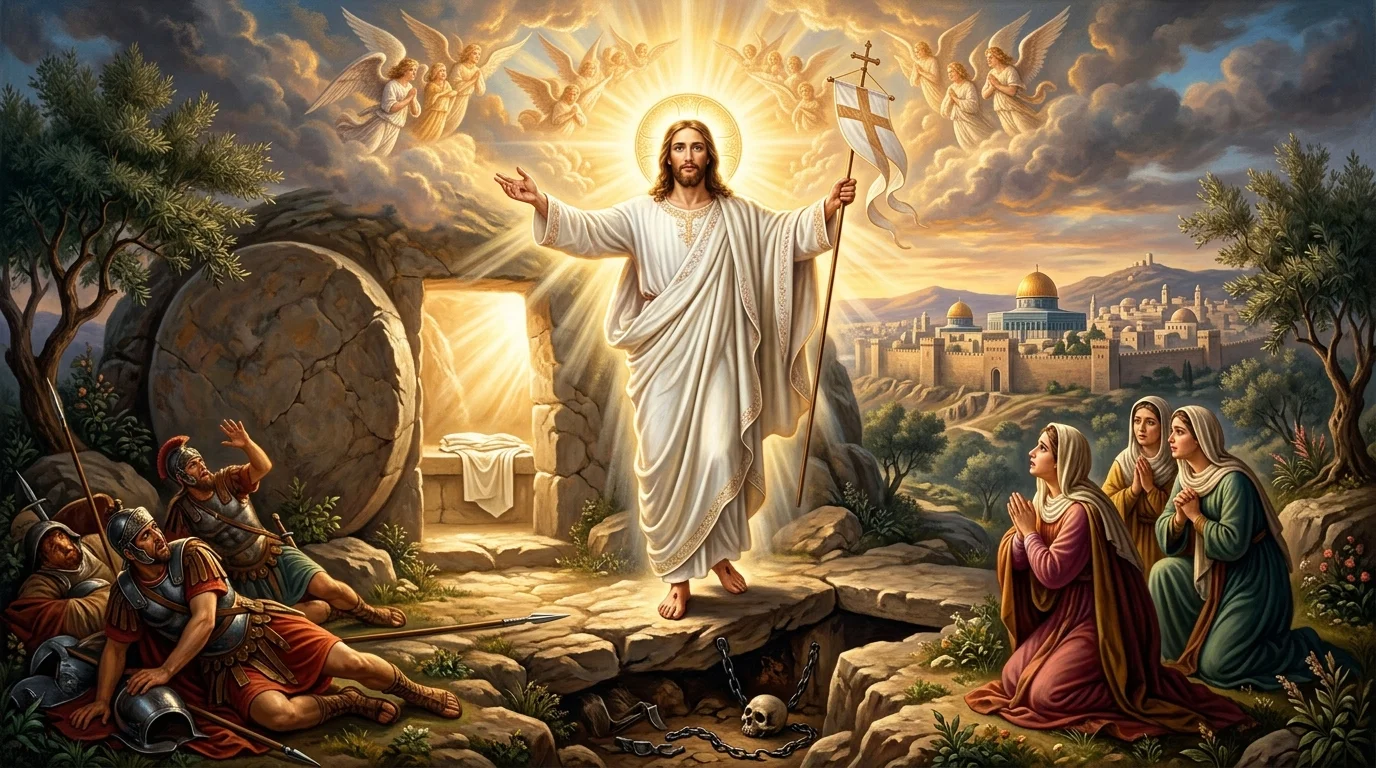
"Because you will not abandon me to the realm of the dead, nor will you let your faithful one see decay... After two days he will revive us; on the third day he will restore us, that we may live in his presence... though the Lord makes his life an offering for sin, he will see his offspring and prolong his days."
"Seeing what was to come, David spoke of the resurrection of the Messiah, that he was not abandoned to the realm of the dead, nor did his body see decay. God has raised this Jesus to life, and we are all witnesses of it."
Psalm 16:9-11 contains one of the most radiant, triumphant songs of hope in sacred Scripture: 'Therefore my heart is glad and my tongue rejoices; my body also will rest secure, because you will not abandon me to the realm of the dead, nor will you let your faithful one see decay. You make known to me the path of life; you will fill me with joy in your presence, with eternal pleasures at your right hand.' This ancient psalm became the apostolic cornerstone proving the physical resurrection of Jesus Christ on the third day.
1. The Golden Miktam of David
Psalm 16 is designated in its title as a Miktam—a golden jewel of Davidic literature. In it, the king contemplates mortality with profound confidence. While earthly graves conquer all mortal flesh, David prophetically looks through the corridors of time to a singular Figure: Yahweh's Chasid—His Holy One, His covenantal Beloved. God makes an inviolable promise: this Holy One will enter Sheol (the realm of the dead), but will not be abandoned there; He will enter the tomb, but His biological tissues will never undergo putrefaction or decay (*shachath*).
2. Peter’s Apostolic Masterpiece: Acts 2
On the Day of Pentecost, the Holy Spirit fell upon the disciples, and Peter stood before tens of thousands of Passover pilgrims in Jerusalem. Peter placed Psalm 16 at the very heart of his proclamation: 'Fellow Israelites, I can tell you confidently that the patriarch David died and was buried, and his tomb is here to this day' (Acts 2:29). Peter’s logic was airtight: everyone in Jerusalem knew David’s bones were crumbling to dust on Mount Zion just a few hundred yards away! Therefore, David was not speaking of himself: 'Seeing what was to come, he spoke of the resurrection of the Messiah, that he was not abandoned to the realm of the dead, nor did his body see decay. God has raised this Jesus to life, and we are all witnesses of it' (Acts 2:31-32).
3. Paul in Pisidian Antioch: Acts 13
Years later, on his first missionary journey, the Apostle Paul walked into the synagogue of Pisidian Antioch. Presenting the Gospel to Jewish scholars, Paul deployed the exact same theological argument: 'David served God’s purpose in his own generation, then he fell asleep; he was buried with his ancestors and his body decayed. But the one whom God raised from the dead did not see decay' (Acts 13:36-37). Both Peter and Paul independently recognized that Psalm 16:10 was the definitive Old Testament proof of Christ’s third-day resurrection.
4. The Biological Exactness of the Third Day
In Jewish medical and cultural understanding, bodily decomposition begins by the fourth day. When Jesus stood before the tomb of Lazarus, Martha objected to opening it: 'Lord, by this time there is a bad odor, for he has been there four days' (John 11:39). Jesus was placed in the tomb on Friday afternoon before sunset; He rested in the grave on the Sabbath; and before dawn on Sunday—the third day—He burst through the tomb in immortal glory! Cellular decay never touched a single cell of His holy body.
5. The Firstfruits of Our Resurrection
Christ’s resurrection is not an isolated historical anomaly; it is the guarantee of our future. In 1 Corinthians 15:20, Paul proclaims: 'Christ has indeed been raised from the dead, the firstfruits of those who have fallen asleep.' Because His flesh did not see decay, our mortal, perishable bodies will one day be clothed with imperishable immortality (1 Corinthians 15:53). Death has been swallowed up in victory! Jesus Christ has shown us the path of life, and in His presence there is fullness of joy forevermore.
Biblical Keywords & Theological Roots
Corruption, pit of decay, bodily putrefaction; decomposition of human flesh in the grave.
Holy One, saint, faithful loyal covenant partner beloved of Yahweh.
Sheol, underworld, realm of departed spirits; holding mortal souls until final resurrection.
Ancient Near Eastern & Archaeological Context
In ancient Jewish thought (Talmud, *Yevamot* 120a), it was believed that the soul hovered near the corpse for three days, but on the fourth day, as facial putrefaction and bodily decomposition set in, the spirit departed forever. Martha reflected this belief in John 11:39 regarding Lazarus: 'by this time there is a bad odor, for he has been there four days.' By rising on the third day, Jesus fulfilled Psalm 16:10 with absolute biological and theological exactness: His flesh never tasted decomposition.
🔑 Key Spiritual Takeaways
- The physical resurrection of Jesus Christ is the non-negotiable cornerstone of the Christian faith (1 Corinthians 15:14-17).
- Jesus did not merely rise spiritually as a ghost; His real physical flesh and bones were resurrected in immortal, incorruptible glory.
- Christ conquered the grave from the inside, shattering the chains of Sheol and transforming death into the gateway of eternal life.
- Because Christ’s flesh did not see decay, believers have the unshakeable guarantee that their mortal bodies will also be raised incorruptible at His return.
Support Independent Biblical Research
Did this study bless you? Help support our independent bilingual research and interactive visual Bible tools.
⚡ Fast Facts
- David's Golden Miktam: Psalm 16:10 declares: 'Because you will not abandon me to the realm of the dead, nor will you let your faithful one see decay.'
- Pentecost Apostolic Keynote: In Acts 2:25-32, the Apostle Peter built his entire Pentecost sermon on Psalm 16:10, arguing that since David's tomb was still preserved and his body decayed, David was prophesying the resurrection of the Messiah.
- Paul's Antioch Synagogue Sermon: In Acts 13:35-37, Paul repeated Peter's identical exegesis in Pisidian Antioch, proving that Christ was raised on the third day before cellular decomposition set in.
- Medical Window of Decomposition: In Jewish belief and medical science, physical decomposition of the corpse begins by the fourth day (John 11:39); Jesus rose on the third day, entirely preserving His flesh from decay.
❓ Frequently Asked Questions (FAQs)
How did Peter use Psalm 16:10 to prove Jesus' resurrection at Pentecost?
In Acts 2:29-31, Peter pointed out that King David died, was buried, and his tomb was still present in Jerusalem with his decaying bones inside. Therefore, David, being a prophet, was speaking not of himself, but looking forward to the resurrection of the Messiah, that He would not be abandoned to Sheol, nor would His flesh see decay.
What is the difference between resuscitation and resurrection?
Resuscitation (like Lazarus or the widow of Nain's son) is returning to mortal life, only to die again later. Resurrection (like Jesus) is entering into an immortal, glorified, indestructible physical body that can never die again (Romans 6:9).
Why is the empty tomb essential to Christian salvation?
If Jesus' body decayed in Palestine, then sin, death, and Satan won. As Paul writes in 1 Corinthians 15:17: 'If Christ has not been raised, your faith is futile; you are still in your sins.' The physical resurrection proves that the Father fully accepted Christ's atoning sacrifice.