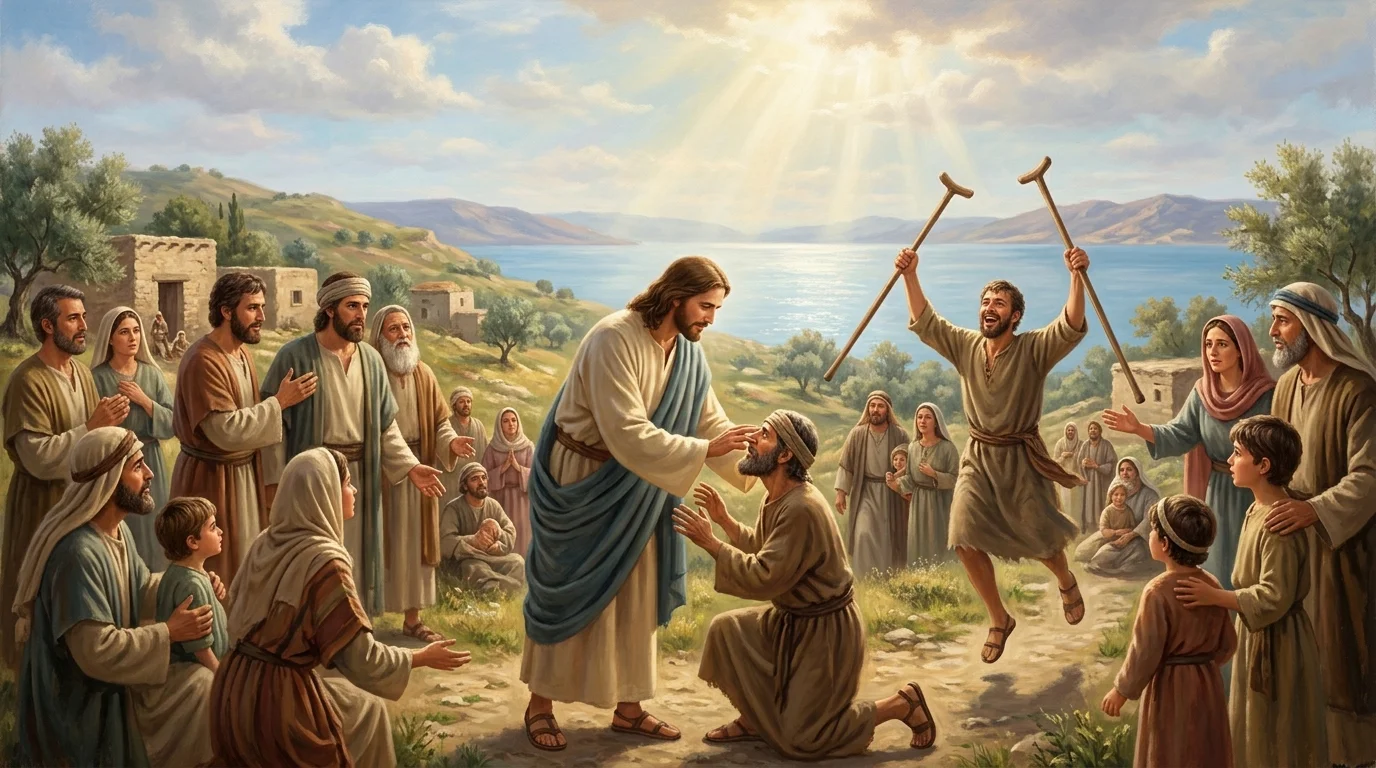
"The Spirit of the Sovereign Lord is on me, because the Lord has anointed me to proclaim good news to the poor. He has sent me to bind up the brokenhearted, to proclaim freedom for the captives and release from darkness for the prisoners, to proclaim the year of the Lord’s favor..."
"He went to Nazareth, where he had been brought up, and on the Sabbath day he went into the synagogue... The scroll of the prophet Isaiah was handed to him. Unrolling it, he found the place where it is written: 'The Spirit of the Lord is on me, because he has anointed me...' Then he rolled up the scroll... and said, 'Today this scripture is fulfilled in your hearing.'"
Isaiah 61:1-2 stands as the definitive Job Description of the Promised Messiah. Written 700 years before Christ walked the hills of Galilee, it foresaw a Servant uniquely anointed with the Spirit of Yahweh to announce glad tidings to the destitute, bind up shattered hearts, proclaim liberty to captive souls, and inaugurate the acceptable year of the Lord.
1. The Synagogue at Nazareth: Luke 4
On a Sabbath morning in Nazareth, Jesus entered the synagogue where He had grown up. As was the custom, He was handed the sacred scroll of Isaiah. Unrolling it to what we now designate as chapter 61, He read with quiet majesty: 'The Spirit of the Lord is on me, because he has anointed me to proclaim good news to the poor. He has sent me to proclaim freedom for the prisoners and recovery of sight for the blind, to set the oppressed free, to proclaim the year of the Lord’s favor' (Luke 4:18-19). He rolled up the scroll, gave it back to the attendant, and sat down. Every eye in the packed room was fastened on Him. Then He broke the silence: 'Today this scripture is fulfilled in your hearing.'
2. The Holy Anointing: From Jordan to Calvary
In Israel's history, three offices were consecrated with holy olive oil: prophets (1 Kings 19:16), priests (Exodus 30:30), and kings (1 Samuel 16:13). Jesus was anointed not with earthly oil, but with the unmeasured third Person of the Trinity! At His baptism in the Jordan River, heaven opened and the Holy Spirit descended visibly in the bodily form of a dove, while the Father's voice affirmed His pleasure. Acts 10:38 records: 'God anointed Jesus of Nazareth with the Holy Spirit and power, and he went around doing good and healing all who were under the power of the devil, because God was with him.'
3. The Cosmic Spiritual Jubilee
Isaiah’s language deliberately invokes the ancient Feast of Jubilee (Leviticus 25). Every fifty years, the ram's horn (*shofar*) blew across Judea, declaring release (*dror*) for all indentured slaves and the restoration of lost inheritances. Yet human greed routinely subverted this law. Jesus declared Himself the living embodiment of the ultimate Jubilee. He came not merely to cancel monetary debts, but to cancel the infinite, unpayable debt of human sin against a holy God. Through His blood shed on Calvary, the legal certificate of our indebtedness was nailed to the cross and completely erased (Colossians 2:14).
4. Binding Up the Crushed Heart
Human religion often addresses the intellect or imposes moral rules, but leaves the broken heart bleeding. Christ's ministry targets the innermost fractures of human existence. The Hebrew phrase 'to bind up the brokenhearted' (*lachavosh lenishberey-lev*) evokes a physician carefully splinting shattered limbs. Whether ministering to the weeping woman who washed His feet with tears, the paralyzed outcast by the pool of Bethesda, or Peter drowning in the agony of denial, Jesus brought holistic, supernatural restoration to the human soul.
5. Living in the Year of Divine Favor
When Jesus stopped reading Isaiah 61 in the synagogue, He deliberately halted before the phrase: 'and the day of vengeance of our God.' That pause is a 2,000-year expanse of sovereign grace! We are currently living in the dispensation of the 'acceptable year of the Lord.' Today the door of mercy remains wide open to every sinner, addict, and outcast. But this window of favor will not remain open indefinitely. When Christ returns, He will execute righteous judgment. Therefore, the call of the Gospel is urgent: receive the Anointed Preacher today and step into eternal freedom!
Biblical Keywords & Theological Roots
To anoint, consecrate with sacred oil; the foundational root of Mashiach (Messiah), designating divine empowerment.
To proclaim glad tidings, bear good news; the Hebrew equivalent of Euangelion (Gospel), heralding royal victory and restoration.
Liberty, release, spontaneous flow of jubilee emancipation where all debts are canceled and slaves are set free.
Ancient Near Eastern & Archaeological Context
In Leviticus 25, God instituted the Year of Jubilee (*Yovel*) every fiftieth year. When the ram's horn sounded on the Day of Atonement, all agricultural land returned to its ancestral owners, all hereditary debts were expunged, and all Hebrew slaves walked out in total freedom. In practice, greedy elites rarely kept the Jubilee, leading to systemic social oppression. Isaiah 61 projected this temporal economic reset into a cosmic spiritual emancipation enacted by the Spirit-anointed Servant of Yahweh.
🔑 Key Spiritual Takeaways
- Jesus was anointed not with perishable olive oil, but with the boundless, unmeasured fullness of the Holy Spirit at His baptism.
- The Gospel is essentially good news for the broken, spiritually bankrupt, and captive; human self-sufficiency cannot receive it.
- Jesus inaugurates an unending spiritual Jubilee, canceling the insurmountable debt of human sin through His redemptive blood.
- We live currently in the 'year of the Lord's favor'; today is the day of salvation before the door of grace closes at the Second Advent.
Support Independent Biblical Research
Did this study bless you? Help support our independent bilingual research and interactive visual Bible tools.
⚡ Fast Facts
- Nazareth Manifesto: In Luke 4:16-21, Jesus unrolled the scroll of Isaiah in His hometown synagogue and read Isaiah 61:1-2 as His inaugural ministerial manifesto.
- Deliberate Grammatical Stop: Jesus stopped mid-sentence at 'the year of the Lord’s favor', deliberately omitting 'and the day of vengeance of our God' to distinguish His first advent of grace from His second advent of judgment.
- Apostolic Declaration: After reading, Jesus closed the scroll and shook the synagogue: 'Today this scripture is fulfilled in your hearing.'
- Trinitarian Panorama: Isaiah 61:1 reveals all three persons of the Godhead: 'The Spirit [Ruach] of the Sovereign Lord [Yahweh] is on me [the Messiah].'
❓ Frequently Asked Questions (FAQs)
Why did Jesus stop reading Isaiah 61 before 'the day of vengeance'?
In Isaiah 61:2, the acceptable year of the Lord and the day of vengeance appear in the same poetic couplet. Jesus stopped reading mid-sentence because His First Advent was inaugurated exclusively to proclaim grace, forgiveness, and salvation (John 3:17). The day of vengeance pertains to His Second Advent when He returns to judge the world in righteousness.
What does 'binding up the brokenhearted' mean practically?
The Hebrew word for brokenhearted (*nishberey-lev*) refers to hearts that have been crushed into fragments by sin, grief, betrayal, and despair. Jesus does not merely soothe emotions; He surgically mends and resurrects the inner spirit through His abiding presence and justification.
How does the Holy Spirit's anointing upon Jesus empower the Church?
Acts 10:38 summarizes Jesus' ministry: 'God anointed Jesus of Nazareth with the Holy Spirit and power, and he went around doing good and healing.' On Pentecost, the resurrected Christ poured out this exact same anointing upon the Church (Acts 2:33), commissioning believers to continue His healing, liberating ministry to the ends of the earth.