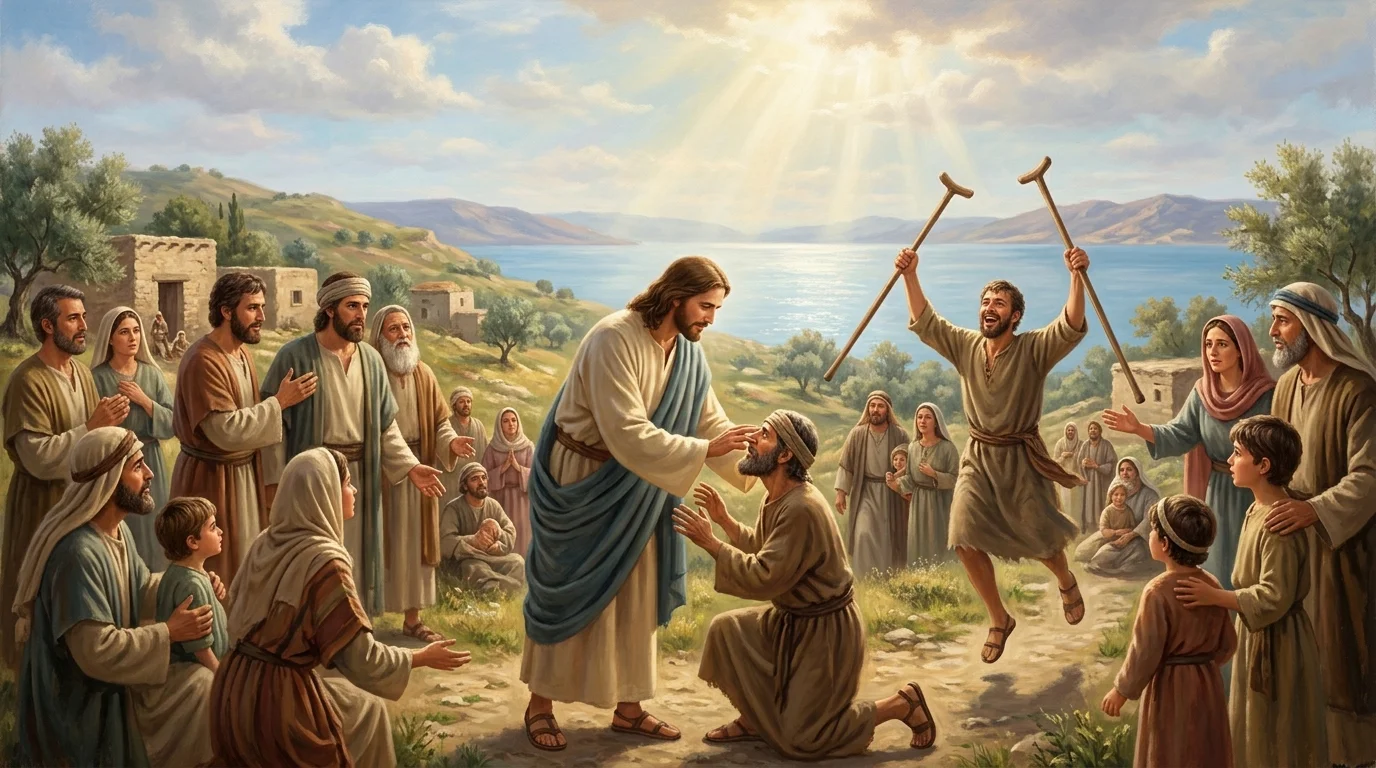
"Here is my servant, whom I uphold, my chosen one in whom I delight; I will put my Spirit on him, and he will bring justice to the nations. He will not shout or cry out, or raise his voice in the streets. A bruised reed he will not break, and a smoldering wick he will not snuff out. In faithfulness he will bring forth justice..."
"Aware of this, Jesus withdrew from that place. A large crowd followed him, and he healed all who were ill. He warned them not to tell others about him. This was to fulfill what was spoken through the prophet Isaiah: 'Here is my servant whom I have chosen... A bruised reed he will not break...'"
Isaiah 42:1-4 is the opening movement of the celebrated 'Servant Songs' of Isaiah. In words of sublime tenderness, the prophet reveals the inner character of Yahweh's chosen Messiah: 'A bruised reed he will not break, and a smoldering wick he will not snuff out. In faithfulness he will bring forth justice; he will not falter or be discouraged till he establishes justice on earth.' In Matthew 12:15-21, this text is identified as the living portrait of Jesus' earthly ministry.
1. The Four Servant Songs of Isaiah
In the second half of Isaiah, four remarkable poems stand out as the 'Servant Songs' (Isaiah 42, 49, 50, and 52-53). While Israel as a whole was called to be God's servant, the nation repeatedly failed through spiritual idolatry and rebellion. Therefore, Isaiah introduces a mysterious Individual—the ideal Servant—who embodies the perfect obedience Israel could never achieve. In chapter 42, the Father presents Him with affectionate delight: 'Here is my servant, whom I uphold, my chosen one in whom I delight; I will put my Spirit on him.'
2. Matthew's Longest Prophetic Quotation
The fulfillment of this prophecy in Matthew 12 occurs during a moment of intense crisis. The Pharisees had just conspired to assassinate Jesus because He healed a man with a withered hand on the Sabbath (Matthew 12:14). Aware of their murderous plot, Jesus withdrew quietly from the area. Crowds followed Him, and He healed all their sick, strictly warning them not to make Him known (Matthew 12:15-16). Matthew pauses the narrative to cite Isaiah 42:1-4 in full—the longest continuous Old Testament quotation in his entire Gospel—demonstrating that Christ's gentle withdrawal was not cowardice, but the exact fulfillment of messianic meekness.
3. The Bruised Reed: Infinite Compassion
Consider the metaphor of the bruised reed (*kaneh ratsuts*). Reeds grew abundantly along the banks of the Jordan River. Shepherds would cut them to fashion pastoral flutes. If a reed was stepped on or cracked by a river current, it lost its clear musical tone. An ordinary shepherd would immediately snap it in half, discard it, and pick a fresh stem. But Jesus does not break the bruised reed! When a human life is fractured by addiction, emotional trauma, or moral failure, the world discards it as worthless. Jesus draws near with infinite gentleness to bind, heal, and restore that life to sing His praises once again.
4. The Smoldering Wick: Rekindling the Flame
The second metaphor is the smoldering wick (*pishtah kehah*). Ancient clay lamps utilized a floating flax wick dipped in olive oil. When the oil ran dry, the wick began to smolder, emitting foul black smoke and stinging the eyes. The natural human reaction was to snuff it out instantly with two fingers. But Jesus does not snuff out the smoldering wick! When a believer's faith is flickering, choked by doubt, depression, or spiritual exhaustion, Christ does not extinguish them in anger. Instead, He gently shields the ember with His hands, pours in the fresh oil of the Holy Spirit, and breathes upon it until it blazes with holy fire.
5. Quiet Victory and Hope for the Gentiles
Worldly conquerors shout in the streets, stage pompous rallies, and impose their decrees with iron boots. Jesus operated with quiet dignity: 'He will not quarrel or cry out; no one will hear his voice in the streets' (Matthew 12:19). Yet this meekness must never be mistaken for weakness. The text guarantees: 'He will not falter or be discouraged till he establishes justice on earth. In his law the islands will put their hope' (Isaiah 42:4). Across two millennia, that quiet Galilean Servant has outlasted every Roman emperor, crumbled every pagan empire, and captured the hearts of billions from every tribe and tongue.
Biblical Keywords & Theological Roots
Servant, humble bondsman; the supreme title of the Messiah in Isaiah's Servant Songs, living in total subjection to the Father's will.
Bruised, fractured, splintered reed; depicting fragile, vulnerable souls bent over by the storms of sin and grief.
Dim, smoldering, flickering wick; faint spiritual spark about to be extinguished by darkness.
Ancient Near Eastern & Archaeological Context
In the ancient Roman and Hellenistic world, power was measured by aggressive oratorical posturing, military conquerors, triumphal parades, and the ruthless crushing of weaker rivals. A fractured shepherd's flute made of reed (*kaneh*) was instantly snapped and thrown away as useless trash; a smoking flax lamp wick (*pishtah*) that produced smoke and offensive smell was ruthlessly pinched out. Against this callous Greco-Roman background, Isaiah’s portrait of Yahweh's Servant was radically counter-cultural: a Monarch who cherishes the broken and revives the flickering.
🔑 Key Spiritual Takeaways
- Jesus does not conquer through bombastic military aggression or political intimidation, but through gentle, sacrificial meekness.
- If you feel like a bruised reed, fractured by failure, or a smoldering wick with fading faith, Christ will never discard or extinguish you.
- True spiritual strength is demonstrated not in crushing the weak, but in tenderly nursing them back to robust spiritual vitality.
- Christ's gentle justice will ultimately overcome all global injustice, bringing everlasting righteousness to every nation.
Support Independent Biblical Research
Did this study bless you? Help support our independent bilingual research and interactive visual Bible tools.
⚡ Fast Facts
- First Servant Song: Isaiah 42:1-4 is the first of four magnificent 'Servant Songs' in Isaiah (along with chapters 49, 50, and 52-53).
- Matthew's Longest OT Citation: Matthew 12:15-21 cites Isaiah 42:1-4 almost verbatim, marking Matthew's longest continuous Old Testament quotation.
- Quiet Ministry: When Jesus healed multitudes, He strictly warned them not to make Him known, deliberately fulfilling 'He will not shout or cry out, or raise his voice in the streets.'
- Gentile Destiny: The Servant's ultimate mission is international: 'In his name the Gentiles will put their hope' (Matthew 12:21, Isaiah 42:4).
❓ Frequently Asked Questions (FAQs)
Why did Jesus command people not to publicize His healing miracles?
Matthew 12:15-16 explains that Jesus withdrew and commanded secrecy to prevent the crowds from misunderstanding Him as a sensationalist political agitator or military rebel. He fulfilled Isaiah 42 by carrying out His mission without street brawls, self-promotion, or inflammatory demagoguery.
What is the spiritual meaning of a 'bruised reed' and 'smoldering wick'?
A bruised reed represents a believer wounded, battered, and fragile under life's pressures or personal sin. A smoldering wick is a soul whose spiritual flame is barely warm, clouded by doubt and exhaustion. Jesus treats such struggling believers with infinite tenderness rather than condemnation.
How will Jesus 'lead justice to victory'?
Through His Cross, Resurrection, and the global spread of the Gospel, Jesus establishes righteous justice in the hearts of men. At His Second Coming, He will consummate this by establishing universal, tangible justice across the whole earth, fulfilling Isaiah 42:4.