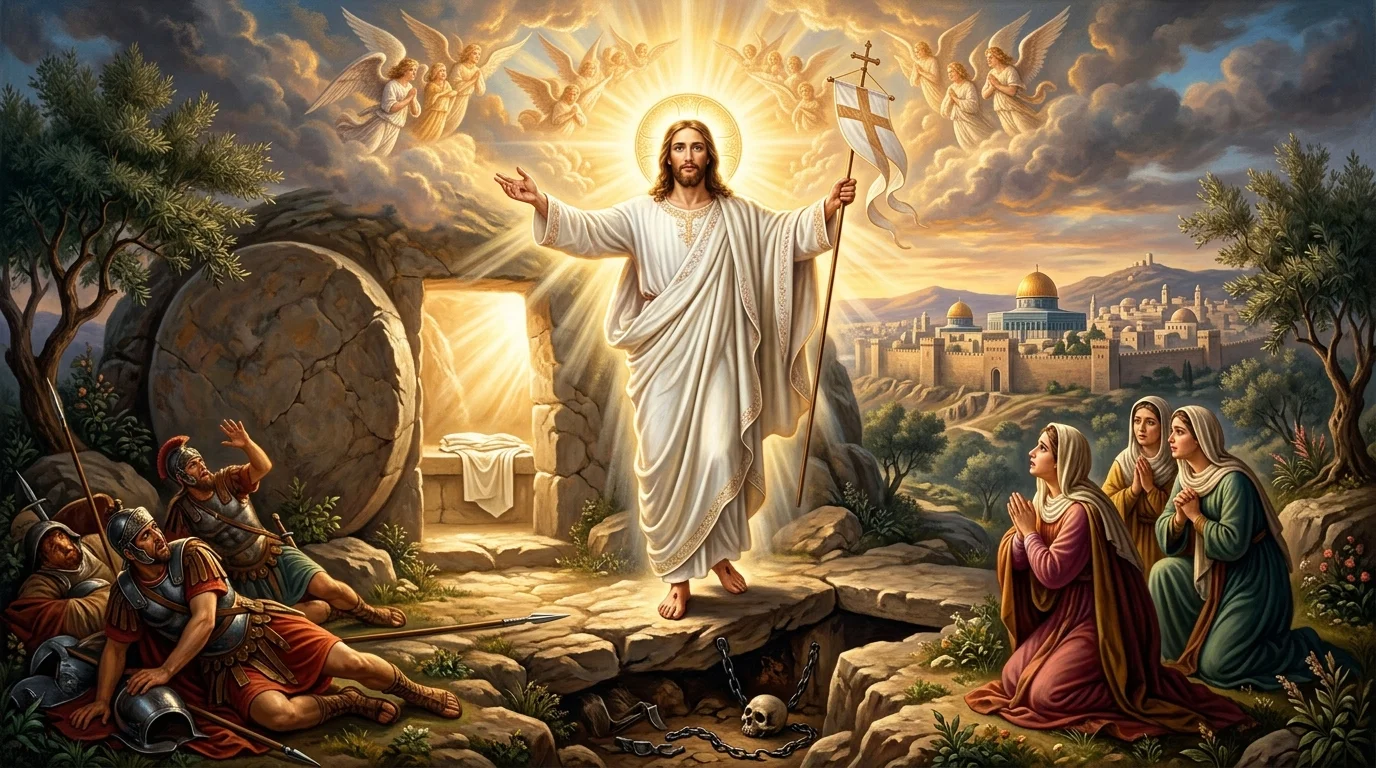
"In my vision at night I looked, and there before me was one like a son of man, coming with the clouds of heaven. He approached the Ancient of Days and was led into his presence. He was given authority, glory and sovereign power; all nations and peoples of every language worshiped him. His dominion is an everlasting dominion that will not pass away, and his kingdom is one that will never be destroyed."
"Jesus came to them and said, 'All authority in heaven and on earth has been given to me.' ... 'The kingdom of the world has become the kingdom of our Lord and of his Messiah, and he will reign for ever and ever.' ... that at the name of Jesus every knee should bow, in heaven and on earth and under the earth, and every tongue acknowledge that Jesus Christ is Lord."
Daniel 7:13-14 represents the glorious grand finale of Old Testament messianic eschatology: 'In my vision at night I looked, and there before me was one like a son of man, coming with the clouds of heaven. He approached the Ancient of Days and was led into his presence. He was given authority, glory and sovereign power; all nations and peoples of every language worshiped him. His dominion is an everlasting dominion that will not pass away, and his kingdom is one that will never be destroyed.' This text reveals the eternal destiny of the universe under the absolute kingship of Jesus Christ.
1. The Four Brutal Beasts vs. The Son of Man
In Daniel 7, the prophet watches as four ferocious, carnivorous monsters emerge from the tempestuous sea. They represent the totalitarian superpowers of human history: Babylon (the predatory winged lion), Medo-Persia (the devouring bear), Greece (the swift four-headed leopard), and Rome (the crushing iron-toothed monster). Human empire-building is inherently predatory, oppressing the weak and deifying human pride. But then the scene abruptly shifts to the celestial courtroom: thrones are placed, the Ancient of Days takes His seat in blazing fiery purity, and the beasts are slain.
2. The Celestial Cloud-Rider
Into this heavenly court steps a Figure who shatters all earthly paradigms: 'one like a son of man, coming with the clouds of heaven' (Daniel 7:13). In the Hebrew Scriptures, riding the clouds is the exclusive prerogative of Yahweh alone (Psalm 104:3, Isaiah 19:1). Yet this Person bears human likeness (*bar enash*). Here is the mystery of the God-Man: fully human, yet fully divine, stepping into the throne room of the Almighty to receive universal dominion.
3. Universal Worship: The Aramaic Pelach
Verse 14 declares that 'all nations and peoples of every language worshiped him.' The Aramaic verb used is pelach. In the Book of Daniel, *pelach* is used exclusively for the religious adoration and sacred worship rendered to deity (for example, in Daniel 3:12 when Shadrach, Meshach, and Abednego refuse to *pelach* the golden image). God shares His glory with no created being (Isaiah 42:8); the fact that heaven commands all nations to render *pelach* to the Son of Man proves His co-equal, eternal divinity!
4. Jesus' Claim: Matthew 28:18
Following His resurrection, Jesus gathered His disciples on a mountaintop in Galilee and boldly claimed the fulfillment of Daniel 7: 'All authority in heaven and on earth has been given to me' (Matthew 28:18). He then commanded them to make disciples of all nations (*ta ethne*). The expansion of Christianity across every continent, language, and culture over the last two millennia is the ongoing historical unfolding of Daniel’s prophecy. Millions from every tongue bow each Lord's Day to adore King Jesus.
5. The Everlasting Kingdom: Revelation 11:15
All human empires crumble. Babylon fell in a night; Persia was conquered by Alexander; Rome fractured into dust; the British Empire dissolved; modern superpowers will pass away. But Daniel promised: 'His dominion is an everlasting dominion that will not pass away, and his kingdom is one that will never be destroyed' (Daniel 7:14). In Revelation 11:15, the seventh angel sounds his trumpet, and loud voices in heaven proclaim the grand climax of cosmic history: 'The kingdom of the world has become the kingdom of our Lord and of his Messiah, and he will reign for ever and ever!' Hallelujah, the King of Kings reigns eternally!
Biblical Keywords & Theological Roots
Son of Man; enigmatic heavenly figure bearing human likeness yet possessing divine glory, riding the clouds of heaven.
Dominion, sovereign rule, absolute imperial authority conferred directly by the Ancient of Days.
Everlasting, eternal, indestructible; an age-abiding kingdom that will never be conquered, superseded, or dissolved.
Ancient Near Eastern & Archaeological Context
Daniel received this vision during the first year of Belshazzar, king of Babylon (c. 553 BC). Daniel beheld four grotesque, predatory beasts emerging from a storm-tossed sea: a lion with eagle's wings (Babylon), a lopsided bear (Medo-Persia), a four-headed winged leopard (Greece), and a terrifying ten-horned beast with iron teeth (Rome). While human empires are brutal, animalistic beasts devouring humanity, God's ultimate Kingdom is ushered in by One who possesses the gentle, noble likeness of a Human Being (Son of Man), receiving an indestructible eternal kingdom.
🔑 Key Spiritual Takeaways
- Earthly empires (Babylon, Persia, Greece, Rome, and modern superpowers) are like ferocious, temporary beasts that rise and fall; Christ’s Kingdom is eternal.
- Jesus Christ possesses absolute authority over every sphere of reality: in heaven, on earth, and under the earth (Matthew 28:18).
- The Kingdom of God will encompass every tribe, language, nation, and ethnic group in holy, unified worship of the King.
- Believers can face global chaos, persecution, and political turmoil with unshakeable peace, knowing that King Jesus holds the ultimate dominion.
Support Independent Biblical Research
Did this study bless you? Help support our independent bilingual research and interactive visual Bible tools.
⚡ Fast Facts
- Daniel's Night Vision: Daniel 7:13-14 records: 'There before me was one like a son of man, coming with the clouds of heaven... He was given authority, glory and sovereign power; all nations and peoples of every language worshiped him.'
- Jesus' Favorite Self-Title: In the four Gospels, Jesus refers to Himself as the 'Son of Man' approximately 80 times, intentionally invoking the celestial divine ruler of Daniel 7.
- Riding the Clouds: In Old Testament theology, 'riding on the clouds' is an exclusive attribute of deity (Psalm 104:3, Isaiah 19:1); by applying this to Himself, Jesus claimed full equality with God.
- The Universal Worship of Pelech: The Aramaic verb used for the nations serving Him is *pelach* (Daniel 7:14), which in Daniel refers exclusively to religious, sacred worship rendered to deity alone.
❓ Frequently Asked Questions (FAQs)
Why did Jesus use the title 'Son of Man' more than 'Son of David' or 'Messiah'?
In first-century Judea, 'Messiah' and 'Son of David' were heavily loaded with militaristic, anti-Roman political expectations. By adopting Daniel 7's 'Son of Man', Jesus avoided political sedition charges while claiming a far higher identity: the celestial, pre-existent, divine Judge who rides the clouds and rules eternity.
What does 'coming with the clouds of heaven' signify in Daniel 7:13?
In Jewish Scriptures, Yahweh alone rides the clouds of heaven (Deuteronomy 33:26, Psalm 68:4, Isaiah 19:1). In Daniel 7, the Son of Man approaches the Ancient of Days on the clouds to receive sovereign worship. This clearly depicts co-equality and divine glory within the Godhead.
When will Daniel 7:14 be fully realized?
The authority was legally granted at Christ's Resurrection and Ascension (Matthew 28:18). It is progressively exercised today through the proclamation of the Gospel among all nations. It will be visibly consummated at the Second Coming when Revelation 11:15 is fulfilled: 'The kingdom of the world has become the kingdom of our Lord and of his Messiah, and he will reign for ever and ever.'