Executive Theological Summary (BLUF)
Psalm 23 is David's masterpiece testifying to the comprehensive, lifelong covenant care of Yahweh Rohi (The LORD My Shepherd). In six compact verses, it moves from the pastoral green meadows of spiritual rest to the perilous "valley of the shadow of death" (where anxiety is dismantled by God's personal presence), ascending finally to a royal, eternal banquet where enemies are neutralized, the believer's head is anointed with oil, and God's goodness and covenant mercy (Chesed) relentlessly pursue the soul forever.
1. The Covenant Confession: Total Sufficiency in Yahweh Rohi (Verse 1)
Few phrases in human literature carry the emotional and spiritual resonance of the opening declaration of Psalm 23:
"The LORD is my shepherd: I shall not want." (Psalm 23:1)
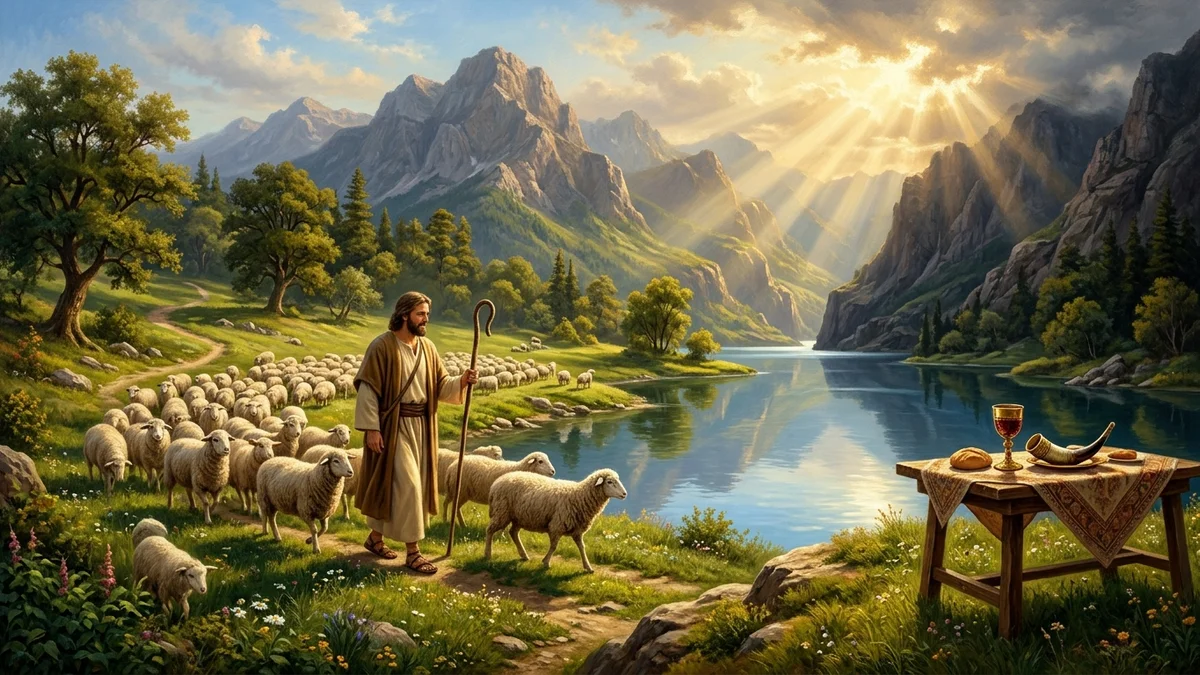
David does not say "The LORD is a shepherd," nor even "The LORD is the shepherd of Israel." He stakes his life on an intensely personal confession: Yahweh Rohi—The LORD is my shepherd. The ancient shepherd lived with his flock night and day, knew each sheep by name, bore the biting frost of winter and scorching desert heat, and placed his own body across the sheepfold opening as a living door of protection.
The immediate consequence of having Yahweh as shepherd is: "I shall not want" (Hebrew: Lo Echsar). This is not the hedonistic claim that every fleshly whim will be granted, but the triumphant realization that with God as our guardian, nothing essential for eternal life, righteous living, and daily peace will ever be lacking. As Charles Spurgeon wrote: "The sweet fruit of the tree of faith is contentment. He who has the Lord has all things."
2. Rest in Green Pastures and Soul Restoration (Verses 2–3)
David outlines the four-step rhythm of pastoral care in verses 2 and 3:
"He makes me lie down in green pastures. He leads me beside still waters. He restores my soul. He guides me in paths of righteousness for His name's sake." (Psalm 23:2-3)
Phillip Keller, in his classic work A Shepherd Looks at Psalm 23, notes that sheep will never lie down unless four conditions are satisfied: they must be completely free from fear, free from friction with other sheep in the flock, free from aggravating parasites, and fully satisfied with food. The presence of the Shepherd alone removes all four tensions.
The "still waters" (Hebrew: Me Menuchot, literally "waters of quiet rests") are calm pools, for sheep are terrified by turbulent, rushing mountain torrents and will not drink from them. When the soul is dehydrated by anxiety, the Shepherd leads to quiet springs of grace. Here occurs Naphshi Yeshovev: "He restores my soul." The Hebrew verb Shuv means to bring back from the brink, to breathe back life, or to revive the fainting spirit. Having restored the sheep, He guides them in Ma'aglei Tzedek—the well-worn tracks of righteousness, motivated not by human merit, but "for His name's sake." God's own glory is invested in the safe arrival of His flock.
3. Walking Through the Valley of Deep Darkness (Verse 4)
At verse 4, the tone of the psalm shifts dramatically from pastoral calm to perilous combat:
"Even though I walk through the valley of the shadow of death, I will fear no evil, for You are with me. Your rod and Your staff, they comfort me." (Psalm 23:4)
Notice the vital grammatical transformation: In verses 1–3, David speaks about God ("He makes me... He leads me... He restores"). But when darkness falls in the valley, David switches to the intimate second person: "for You are with me." Suffering strips away third-person theological discourse and forces face-to-face communion with the living God.
The phrase Ge Tzalmavet (the valley of the shadow of death) describes deep, lightless ravines in the Judean wilderness where predators lurked in limestone caves and sudden rockfalls threatened travelers. Yet David notes three critical realities:
- It is a valley to walk "through": The valley is a corridor, not a permanent residence. Believers do not pitch tents in the valley of darkness; they walk through it toward the summit.
- It is only a "shadow": Where there is a shadow, there must be a bright light shining somewhere nearby. The shadow of a dog cannot bite, and the shadow of death cannot sever the soul from Christ.
- The Rod and Staff comfort: The heavy oak club (Shevet) hangs at the shepherd's belt to smash attacking wolves and lions, while the curved staff (Mish'enet) hooks around the sheep's chest to pull it back from precipices. Power and tenderness walk hand in hand.
4. The Royal Banquet in the Presence of Adversaries (Verse 5)
In verse 5, the metaphor transforms from an outdoor pasture to an opulent royal banquet hall:
"You prepare a table before me in the presence of my enemies. You have anointed my head with oil. My cup runs over." (Psalm 23:5)
In the ancient Semitic world, hospitality was sacred law. When a fugitive fled from blood avengers and reached the tent of a great desert chieftain, the chieftain would spread a feast for the guest, anoint his dust-covered head with cooling, fragrant olive oil, and fill his chalice to the brim. The pursuers would stand at the tent door, grinding their teeth in fury, but powerless to touch the protected guest. God does not wait until all warfare ceases before blessing us; He hosts us at a royal banqueting table right under the glaring eyes of our spiritual enemies.
The phrase "my cup runs over" (Kosi Revayah) signifies divine generosity. God does not measure out His grace with a cautious dropper; He pours until the cup spills over into the saucer, overflowing with joy, salvation, and Holy Spirit revival.
5. Pursued by Goodness and Mercy into Eternity (Verse 6)
The psalm concludes with a magnificent double guarantee of covenant security:
"Surely goodness and loving kindness shall follow me all the days of my life, and I will dwell in the LORD's house forever." (Psalm 23:6)
The English word "follow" is far too passive. The Hebrew verb is יִרְדְּפוּנִי (Yirdefuni), derived from Radaph, which literally means "to pursue, chase down, or hunt relentlessly." David had spent years being hunted through the wilderness by King Saul's murderous armies. Now, David looks behind him and sees two heavenly guardians pursuing him with equal tenacity: Tov (God's pure goodness) and Chesed (God's unfailing, loyal covenant mercy).
And where does this pursuit lead? Not to an earthly sheepfold, but to the eternal household of God: "and I will dwell in the house of the LORD forever."
6. The New Testament Culmination: Christ the Good Shepherd
Psalm 23 finds its ultimate, climactic realization in the person and work of Jesus Christ. In John 10:11, Jesus boldly applied this divine psalm to Himself: "I am the good shepherd. The good shepherd lays down His life for the sheep." In the Old Testament, the sheep died for the shepherd's sustenance; but at Calvary, the Shepherd died to redeem the sheep from eternal slaughter. He is celebrated across the New Testament in three glorious pastoral dimensions:
- The Good Shepherd in Death (John 10:11): Giving His life at the Cross for the redemption and cleansing of the flock.
- The Great Shepherd in Resurrection (Hebrews 13:20): Brought up from the dead through the blood of the eternal covenant to equip us in every good work.
- The Chief Shepherd in Glory (1 Peter 5:4): Returning in majesty to reward His under-shepherds with an unfading crown of glory.
Because Jesus conquered the grave, the green pastures are eternal, the still waters never run dry, and the table He prepares is the Marriage Supper of the Lamb. Rest in His sovereign hands today!
Biblical Keywords & Theological Roots
The "LORD My Shepherd"; an intimate covenant title indicating continuous pasturing, vigilant guardianship, personal companionship, and total provision.
Lush pastures of tender young sprouts; rich oasis meadows where fearful, easily startled sheep can safely lie down in total rest and contentment.
The "Valley of Deep Darkness" or "Valley of the Shadow of Death"; narrow, sunless ravines plagued by flash floods, falling rocks, and predatory beasts.
My cup overflows to abundance; a lavish eastern banquet idiom denoting that the divine Host gives far beyond necessity, filling the cup until joy spills over.
Ancient Near Eastern & Archaeological Context
David understood sheep intimately. Domestic sheep are notoriously defenseless animals lacking fangs, claws, shells, speed, or acute directional instincts; without a vigilant shepherd, a flock quickly succumbs to predators, poisonous vegetation, or dehydration in the arid Judean wilderness. Written likely during David's maturity—perhaps during his flight from Absalom across the barren wilderness of Mahanaim (2 Samuel 17)—Psalm 23 captures a profound lifelong testimony: through every wilderness and treacherous gorge, God's sovereign goodness has remained unfailing.
Practical Discipleship & Spiritual Application
- Relinquish Self-Direction to the True Shepherd: A sheep cannot lead itself to water in a rocky desert. Stop agonizing over your five-year plan and pray daily: "Lord, lead me in Your paths of righteousness today."
- Find Rest Beside Still Waters: If your soul is burned out by modern anxiety, allow God to restore (Hebrew: shuv - revitalize, breathe back life into) your spiritual inner being through unhurried meditation.
- Face Darkness Knowing You Are Not Alone: In times of bereavement, medical diagnoses, or loneliness, remember that the valley is only a "shadow" (tzalmavet). A shadow of a dog cannot bite, and a shadow of a sword cannot kill; the valley is a passage, not a destination.
- Expect Divine Provision Amidst Warfare: God does not wait until all your enemies and trials disappear before blessing you; He sets a royal banquet table in the very midst of the conflict.
- Pursue God Because Goodness and Mercy Are Pursuing You: The Hebrew word for follow in verse 6 is "radaph" (to hunt, chase down relentlessly). God's steadfast love (Chesed) is actively pursuing your footsteps every day of your life.
A Prayer of Total Trust in the Good Shepherd
O Lord Jesus, my Great and Good Shepherd (Yahweh Rohi), I declare today that because You are mine, I lack no good thing. Forgive me for wandering, for fretting, and for attempting to guide my own steps through treacherous terrain. Lead me today to Your green pastures of quiet rest and beside Your still waters of living peace. Restore my weary soul, and steer my feet into the paths of righteousness for Your glorious name's sake. Even when my journey takes me through the sunless valley of the shadow of death, sickness, or grief, I will refuse to fear any evil, for You are with me. Your rod defends me against the roaring adversary, and Your staff gently guides me when I stumble. Thank You for preparing a lavish banquet table before me in the very presence of my foes, anointing my head with the fresh oil of the Holy Spirit until my cup runs over with joy. Surely Your unfailing goodness and covenant mercy shall pursue me every day of my earthly pilgrimage, and I shall dwell in the house of the LORD forever. Amen.
Support Independent Biblical Research
Did this study bless you? Help support our independent bilingual research and interactive visual Bible tools.
⚡ Fast Facts
- David composed Psalm 23 drawing from his real-world experiences as a shepherd boy defending his father's flock in Bethlehem from lions and bears (1 Samuel 17:34-36).
- The grammatical focus shifts profoundly at verse 4: in verses 1-3 David speaks about God in the third person ("He leads me"), but in the dark valley of verse 4, he speaks directly to God in the second person ("for You are with me").
- Sheep cannot lie down if they are hungry, fearful of predators, troubled by parasites, or in friction with other sheep; the Shepherd's presence resolves all four anxieties.
- The Psalm transitions from the outdoor pastoral imagery of a Shepherd in verses 1-4 to an indoor royal banquet hosted by the King of Kings in verses 5-6.
❓ Frequently Asked Questions (FAQs)
The phrase "I shall not want" (Hebrew: Lo Echsar) does not mean a life free of hardship, but rather absolute sufficiency in God. Because the Almighty Lord is the Shepherd, the believer lacks no good thing necessary for eternal well-being, spiritual growth, and daily provision (Psalm 34:10; Philippians 4:19).
The "rod" (shevet) was a short, heavy oak club used as a defensive weapon to strike attacking predators and an authoritative instrument to count and inspect the sheep. The "staff" (mish'enet) was a long, slender crook used to gently guide straying sheep, lift fallen lambs from thorny ravines, and draw the flock close to the shepherd. Together, they represent protective power and gentle guidance.
In ancient Semitic culture, when a sovereign host received a pursued refugee into his tent, laid out a royal feast, and anointed his head with fragrant olive oil, the guest came under the sovereign's covenant protection. Enemies pursuing the refugee could only stand outside the tent boundary, powerless to touch the honored guest.
Jesus explicitly identified Himself as the fulfillment of Psalm 23 in John 10:11, declaring: "I am the Good Shepherd. The Good Shepherd lays down His life for the sheep." He is also the "Great Shepherd" resurrected by the blood of the eternal covenant (Hebrews 13:20) and the "Chief Shepherd" returning in glory (1 Peter 5:4).